Research

Positive Psychology and Positive Thinking

In developing my exhibition, “Irrational Exuberance (Asst. Colors),” last spring, I studied positive psychology. During the closing dialogue, “As Is: Pop and Complicity” (read the transcript), I realized that the term positive psychology is easily confused with popular psychology—understandably, since the distinction is not entirely clear, when my readings of positive psychology take form in trade paperbacks—and positive thinking. Certainly, positive psychology is optimistic; through research-based cognitive behavior modification, it aims to increase happiness, and to engage in that kind of self-awareness and change is to embrace to possibility that one can positively change one’s attitudes. However, to mistake positive psychology for mere positive thinking is a mistake.

In “Power Lines: What’s behind Rhonda Byrne’s spiritual empire?” (New Yorker, September 13, 2010), Kelefa Sanneh reviews two recent books on positive thinking. He takes a critical look at Rhonda Byrne, the positive thinking guru and author of “The Secret” (2007) and “The Power” (2010), starting off with Byrne’s appearance on Oprah. Maybe I’m an elitist, sheltered in a ‘Bay Area Bubble’ unconcerned with such mass culture, but the phenomenon of “The Secret” remained a secret to me until now. Is this what people think I mean when I say positive psychology?

Sanneh contrasts Byrne’s quasi-but-un-religious, ultra-simplistic mysticism with Barbara Ehrenreich’s “Bright-Sided: How Positive Thinking is Undermining America” (2009; also released with the more specific, less ‘sticky’ subtitle, “How the Relentless Promotion of Positive Thinking is Undermining America”). When the leftist activist fired this shot, it alarmed me, but as Sanneh points out,

For Ehrenreich, the alternative to the pursuit of happiness is the pursuit of justice—except you don’t have to choose…. She promises that we can find a deeper, richer form of happiness by ‘shaking off self-absorption and taking action in the world.’

This, of course, brings to mind the three components, according to Paul Martin, author of “Sex, Drugs and Chocolate” (2008) of happiness: pleasure, the absence of displeasure, and satisfaction—becoming an agent, enacting one’s will in the world. Striving and accomplishing goals through acting in the world—not mere positive thinking—leads to deeper happiness? Yes, I’d agree with that. I am now more inclined to believe that Ehrenreich—whose undercover reports on working class struggle instantiated institutional privilege in America in “Nickel and Dimed” (2001) I enjoyed—is explicit in her aim at unthinking positive thinking, rather than all psychology concerned with happiness.

So while the terminology may overlap, along with the general optimistic outlook and “woo woo” self-improvement vibe, positive psychology and positive thinking are very different. For the latter, read Byrne and watch Oprah. For the former, read psychologists and researchers like Martin Seligman and Mihaly Csikszentmihalvi.

Standard
Research

Houseplants & Contemporary Art

There’s something fun and funny about live houseplants in contemporary artworks.

Live plants takes the edge off of self-serious contemporary art. By growing or dying, plants challenge the static condition of art-hood and the illusion of timelessness. Their standardized pots clue the viewer in to their status as ready-mades. By referencing consumer culture, decoration and domestic life, there is an appealing familiarity. Houseplants strike me as unpretentious and welcoming.


Won Ju Lim. Ruined Traces, 2007. Installation with projections, vitrines and artificial houseplants. Patrick Painter Gallery, Santa Monica, CA. Image Source: Art Rabbit, feature on LA art by Courtney Shermer, Oct. 16, 2007. (Granted, these aren’t live houseplants, but I included them because they function the same. Plus, live plants wouldn’t survive an exhibition run such a dark space.)

Simon & Tom Bloor: As Long As It Lasts

Simon & Tom Bloor: As Long As It Lasts. Installation view, Eastside Projects, Birmingham, UK.


Mostly trees, but there is a houseplant in the background. Image Source: Eastside Projects.

Martin Creed, work from Down Over Up, 2010

Martin Creed, work from Down Over Up, 2010


Down Over Up is on view at the Fruitmarket Gallery in Edinburgh through October 31, 2010.
Image Source (and many more delightful photos at): This Is Tomorrow, thanks to NM. (I’m also loving the black, diagonal, paint roller stripes in the gallery.)

Alejandro Almanza Pereda, A doctor can bury his mistakes, but an architect can only advise his clients to plant vines.

Alejandro Almanza Pereda, A doctor can bury his mistakes, but an architect can only advise his clients to plant vines


Image Source: Artist’s site.
Alejandro Almanza Pereda exhibits a larger iteration of this sculpture in The Heaviest Luggage for the Traveler is the Empty One
at Magnan Metz Gallery in Chelsea, NY, through October 23, 2010.

Rodney McMillian, Succulent, 2010, Installation view, Susanne Vielmetter Los Angeles

Rodney McMillian, Succulent, 2010, Installation view, Susanne Vielmetter Los Angeles


Tiny image, sorry. Image source: Paper Monument.

Also — Jeremy Deller said

I have a fantasy of lighting a concert with some tropical plants on turntables and a few lights.

Brilliant! Read more from the joint interview between Deller and David Byrne (awesome just got awesomer) at ArtInfo.com.

Standard
Community

Southern Exposure: ART PUBLISHING NOW

San Francisco’s where it’s at! Wish I could be at this art publishing summit at Southern Exposure. It’s a convergence of three of my passions: DIY publishing, contemporary art, and criticism.

Southern Exposure: ART PUBLISHING NOW.

Saturday, October 9, 2010, 11 am – 10 pm
Sunday, October 10, 2010, 11 am – 6 pm

Southern Exposure
3030 20th Street
San Francisco, CA 94110
http://soex.org
http://artpublishingnow.org

Art Publishing Now is a two-day event dedicated to the investigation and showcasing of art publishing practices in the Bay Area. It includes a day of presentations and critical discussions, an after-party, an art publishers fair, library and archive.

Not to be outdone, NYC’s artist-thinkers have scheduled a meeting of the minds that same weekend…

The Creative Time Summit: Revolutions in Public Practice 2

Cooper Union’s Great Hall
October 9-10

The Creative Time Summit is a two-day conference that brings more than forty cultural producers together to discuss how their work engages pressing issues affecting our world. Their international projects bring to the table a vast array of practices and methodologies that engage with the canvas of everyday life. The participants range from art world luminaries to those purposefully obscure, providing a glimpse into an evolving community concerned with the political implications of socially engaged art. The Creative Time Summit is meant to be an opportunity to not only uncover the tensions that such a global form of working presents, but also to provide opportunities for new coalitions and sympathetic affinities.

Standard
Art & Development

Gallery Jaunt: New Museum, Brooklyn Museum, ICP, John Jay

I’m trying to take advantage of the access to art afforded by living in New York. But there are so many art spaces here, even now when many institutions are closed in preparation for Fall shows, it’s still overwhelming. I’ve been here 2 weeks and visited a few spaces, with not nearly enough time at most of them.

Rivane Neuenschwander: A Day Like Any Other
New Museum
Thru Sept. 19

I really like the contemporary Brazilian artist’s videos; this is a chance to see new and prior works in installation, participatory/social practices, works on paper, paintings and actions. I think the most coherent is the fourth floor, where the central focus is an installation of buckets hung at head-height which slowly drip water into buckets on the floor. On the walls are dilapidated maps of New York counties painted and mounted in design-y hues. A video of an egg clattering in a spoon, shot as if the spoon were tucked into the viewer’s mouth, and the viewer were rambling through a wooded forest, runs in a corner. Flip clocks whose numbers have been replaced with zeros (recalling a flip-clock project by San Francisco artist Chris Bell) are placed throughout the museum, but the chance that you’d be looking at the clock when its zeroes flip is infinitesimal, so the clocks appear static and unchanging; in effect, it’s a largely conceptual piece. Perhaps it was the discreteness and completeness of the projects that appealed to me; the third floor, dominated by a space in which narrow swathes of carpet were ripped up, and sectors of a gridded wallpaper were stripped from the walls—not so much. The demolition was the result of a site-specific project involving the artist finding microphones hidden by the museum staff at the artist’s request. Is it viable to complain that the chance operation seemed a bit preconceived? Other projects in the space captivated: a 10-minute video of a single bubble traveling around a house (at the same time that it frustrated any sense of resolution); a calendar made of punched circles of text scattered across a black ground, creating constellations on a night sky; portraits of first loves described by public participants and drawn by courtroom artists.

On the first floor, in the odd, narrow glass-enclosed space, Neuenschwander’s I Wish Your Wish project continues.

Strangely, I left the show rather disappointed that I experienced no major revelation. But in retrospect, perhaps my expectation to be surprised or enchanted was misinformed. To displace the work—to find it in social exchanges and participatory actions, as her Tropicália predecessors did—seems to embrace an experimental approach to the practice of art. The results need not be revelatory. I experienced this same unapologetic unevenness in Damián Ortega’s work at the Boston ICA, where the works were pervaded with a sense of generosity and experimentation, and between stunning perceptual experiences were lackluster results that didn’t add up to more than their component parts.

Kiki Smith: Sojourn
Brooklyn Museum
Thru Sept. 12

There’s an unimpeded quality to this new work by the irrepressibly prolific symbolist printmaker and sculptor. Dozens of large drawings and prints of female figures on very light, wispy paper appear in the show, as do large silver figurative sculptures, installations with light bulbs and birds, and a simple coffin with a breathtaking surprise inside. Because many of the images were prints, more or less with the same figure, and set of materials, there was a sense of iterative generation. Clearly she’s interested in, and quite faithful to, the authenticity of the expressive line.

A suite of dozens of Photoshopped advertisements by Hank Willis Thomas is a joy to see if you’ve seen some, but not all as a collection.

For All the World to See: Visual Culture and the Struggle for Civil Rights
International Center of Photography
Thru Sept. 12

A historical show concerning the photographic and filmic image and its impact on the Civil Rights movement. Don’t expect a photography exhibition; it is rich with reproductions—including some shockingly retrograde attitudes exposed in the captions in Life magazine—and artifacts.

Also at ICP:
Perspectives 2010: Carol Bove, Lena Herzog, Matthew Porter, Ed Templeton, Hong-An Truong
Thru Sept. 12

The lighting in Lena Herzog’s room was brilliant. Black walls, black-and-white photographs, the illumination of each photo extending only to the four edges of the frame. Very fitting for the spine-chilling, Wunderkammer-inspired content.

Nyeema Morgan: Like It is
John Jay College, third floor art gallery
Thru Sept. 17

My friend and CCA cohort Nyeema modestly described her show as “four drawings and a video.” The drawings, however, were impressive 38×50″ photo-realist graphite renderings of photocopies of title pages. They brought to mind Washington DC-based Molly Springfield‘s drawings of theory readers, replete with the black bars that are photocopiers’ perceptions of depth. While Ny’s practice often involves text, it isn’t solely concerned the drawn reproduction of it. Nyeema was attracted towards books with the word “extraordinary” in them, and her obsession also manifested in a video comprised of clippings of people saying that word. I thought the show was accomplished and tight, and I left feeling quite proud of my friend.

Standard
Art & Development

unravelled

I’m merely batting around an idea like a cat with a ball of yarn when it comes to whether an art object is a “Work” (objet d’art), “work” (residue of practice), or “text” (which is constantly re-written). SW, on the other hand, hits a grand slam with this brief, potent first-person narrative on how difficult it is to pin down what makes art significant these days in his blog post, “Embedded.”

Standard
Art & Development, Community, Travelogue

Late Summer, Cross-Country Points of Reference

I’ve just crossed the country from San Francisco to New York by car. That’s three thousand, eight hundred miles in 14 days: camping, sightseeing, a few gallery visits and more than a few BBQ meals. The experience increased my appreciation for friendliness, waving at strangers, America, the grandeur of the West, the rich musical history of Tennessee, the quaint main streets of the lush Eastern seaboard—and most of all, the astounding diversity. I love that so many people can epitomize being American, while freely espousing indigenous, foreign, and home-spun cultures without a sense of paradox. From West to East, a few of my strongest visual impressions:

Dockside with Friends
Lake Merritt, Oakland, CA

A gathering of friends on a beautiful July evening at sunset. Celebrating friendships and the blessed life I’ve enjoyed since moving to Oakland in 1994.

landscape with road, arizona
The West
I’m California-born and raised, but I haven’t really seen the “West until now. It’s stunning. My fears that the world is crisscrossed with interstates and civilized with Walmarts are not completely warranted. The drive from Las Vegas, N.V. to Santa Fe, N.M. showed me that much of the West is still wild; the dramatic red bluffs are nothing short of breathtaking. I snapped some pics, but they fall terribly short; you have to be there to experience sense of scale and grandeur.

Santa Fe paper mache
Santa Fe, New Mexico, America
M and I played tourist in Santa Fe, seeing sites in the historic downtown (and crashing a church festival for some G.O.A.T. carne asada tacos). Santa Fe is gorgeous, scenic, historic, and bursting with culture. Tons of visual art, Native American art (so many images from art history classes come to life: black-on-black pots by Maria Martinez, squash blossom turquoise-and-silver-necklaces), Spanish colonial architecture, and fun stuff like Native American papercuts, paper machê crafts, and—yes, ya’ll—Southwestern regional woodcut artists (and why not?). Our brief visit was far too short; I was struck with the feeling that I could easily spend more time there. So I’m putting it out there, Universe: Have Me Back To Santa Fe.

The Dissolve: SITE Santa Fe’s 2010 biennial
Santa Fe, NM

A strong show of videos made and manipulated by 30 contemporary international artists, including biennial-circuit usual suspects (Kara Walker, Paul Chan, William Kentridge) and more. Thomas Demand’s video of raindrops hitting a glossy concrete floor is another impressive feat of stop-motion paper animation, very sweet in its mundanity. Robin Rhode’s short video in black and white, largely about inversions, race and light, is another favorite of mine. I just didn’t have time to see the whole show (which would have taken days), but many of my impressions were influenced by the forceful exhibition design, for better and worse. The first room successfully featured scrims dividing roughly equal-sized screening rooms.* But the exhibition design of later rooms overpowered the ther works. The light and audio seepage in the cyclorama-like oval were missteps, as was the integration of solo viewing booths into a bench in theater with one dominant screen. The experience was unpleasantly akin to screen-in-screen browsing; I could focus on neither screen in front of me. I think this kind of overwhelming media experience is fine for solo shows, but in a group show, it shafts the artists who’ve drawn short straws. It’s a strong curatorial statement to feature 30 videos, and it would be a challenge to any institution, but you have to wonder what the architects were thinking. SITE Santa Fe had some flaws but it was energetic, now, and smart.

Who Shot Rock & Roll?: A Photographic History, 1955 to the Present
Brooks Museum, Memphis, TN
Organized by the Brooklyn Museum with guest curator Gail Buckland

Who Shot Rock & Roll is a large, highly enjoyable exhibition of photographs of rock and pop musicians from the last half-century. The celebrity, glamor, pop culture, and sensationalism appeals. Those who dig deeper will find insightful captions about the technique, ingenuity and chance that went into the making of the famous photographs. Having spent my fair share of adolescence studying trippy album covers, I also appreciated the didactic texts and displays about the surreal, pre-Photoshop images by artist-designer Storm Thorgersen and Jean-Paul Goude (of superhuman Grace Jones, natch).

Hatch Show Print

Photo: Michael Yap

Hatch Show Print
Broadway, Nashville, TN

In our improvised gander at Nashville, we stumbled into a beautiful, huge, working letterpress shop and storefront. Downtown Nashville is anchored by a shiny new country music museum, the usual Hard Rock Cafe and BB King blues club, so I wasn’t expecting to see such historic, indie culture. But there it was on touristy Broadway, with its fittingly nostalgic relief prints, cheeky and upbeat typography, and endearingly worn sign type. While we were browsing the wares, I overheard the proprietor mentioning CCA and the SF Center for the Book!

Roanoke, VA
That the two most interesting contemporary art exhibits on my eastern migration (the SITE Santa Fe biennial and Rock & Roll) were curated by New York curators/institutions was not a good sign for the idea of a de-centralized contemporary art world. So it was a pleasant surprise to come across SF Bay Area artists Binh Danh and Primitivo Suarez in, of all places, Roanoke, VA. Danh (whose solo show opens at Mills College Art Museum August 21) mentioned that he was doing a residency, but I forgot until I saw his artist’s talk advertised in the local paper. Suarez has a large installation on view at the Taubman Museum of Art, a swooping steel-and-glass trifle that contrasts sharply with the colonial railroad town.
roadside America
roadside America
Roadside America
Shartlesville, PA

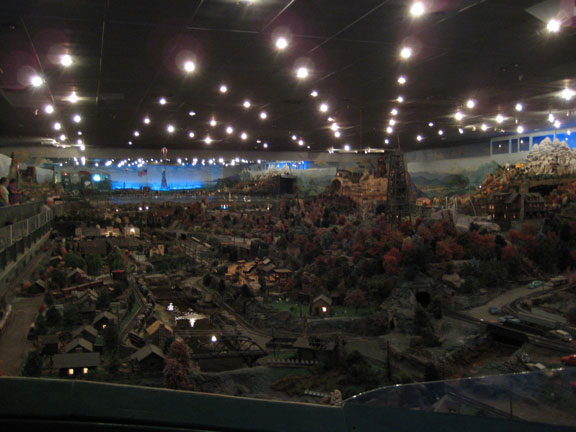
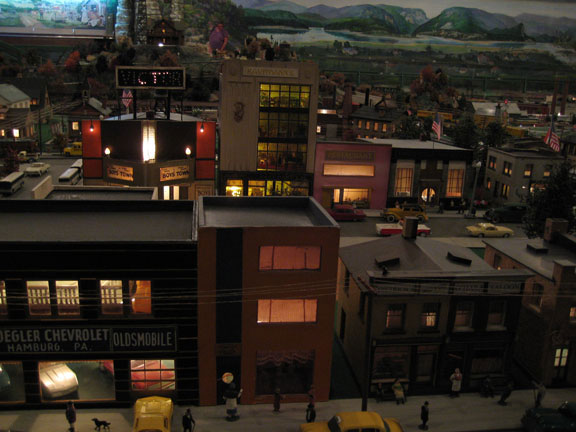
Perhaps M was right—this is a tourist trap. Or maybe I’m right—a miniature village hand-crafted by two brothers at mid-century, which sprawls over several thousand square feet, loaded with electric trains, lights, fountains and a waterfall is art. Or at least it is artistic production worth a visit, because it says something about tinkerers, hobbyists, miniature culture, maker culture, and the urge to create and reflect the world you see. In either case it is odd and wonderfully preserved, though you get the sense that it is anachronistic enough that its future is in jeopardy, and you feel lucky to have seen it.

Brushy Lake State Park, Oklahoma

National Forests and State Parks
Despite serious weather (lots of thunderstorms, and threats of flash floods, hail, tornadoes and severe heat), our car-camping trip was safe, fun, and scenic. Here’s a brief round-up of our stays made possible by the U. S. of A.’s government-run, social programs:
·Coconino National Forest, A.Z.: Friendly park hosts, beautiful pine grove at elevation that brought the oven-like southwestern heat to nice cool temps. Absolutely pristine and sparsely populated in a way that you’d never see in California.
·Ute Lake State Park, N.M.: Your basic horseshoe campground in a great plain. Curious and friendly park hosts and RV campers. Apparently we visited during monsoon season; hot, humid, windy.
·Foss Lake State Park, western O.K., and Brushy Lake State Park, eastern O.K. Oklahoman reservoirs tricked out for RV camping and water sports, a study in contrasts. The former filled with empties-throwing, nappies-leaving, jet-skiing yahoos and not a ranger in sight; the latter, alcohol prohibited, but quiet, scenic, clean and staffed by a generous host.
·Edgar Evins State Park, T.N.: A unique campground situated on a steep hillside. Sites were wood-plank and I-beam pads jutting out from the road. The reservoir was clean and calm, great for swimming. Fireflies abounded.
·Hungry Mother State Park, V.A.: Hands down the best park: natural lake with diving boards, lots of swimming, lots to explore, cute discovery center. The only downside was that the sites were too close together, but the neighbors in our RV subdivision were nice enough.
·Fort Frederick, M.D. Self-pay, no water, no bathrooms, lots of rules, and a train passing nearby. The fort itself had a neat history (at one time owned by a formed slave) but the campsites weren’t nothing special.

A pleasant greeting
Queens, NY

My new neighbors shouting from the patios of their tidy brick townhouses:
“Welcome to Astoria!”

[*In a previous version I got my German filmmakers with the initials L.R. mixed up, committing a cardinal sin of be-smirching an innocent leftist with Nazi support. It was a mistake. Apologies.]

Standard