Yesterday with ABC, I re-visited Glenn Ligon: America, the beautiful mid-career survey at the Whitney. It’s a stellar show, and I experienced anew this installation:

Glenn Ligon, Rückenfigur, 2009, neon, paint. Source: Whitney.org.
The word rückenfigur refers to portraits with figures looking at a landscape with one’s back to the viewer, as in the famous Caspar David Friedrich painting below. Rückenfigur is one of Ligon’s masterful America neons, and it’s an elegant use of text, in title and in form. Ligon’s neon features individually-reversed letters; the word is clearly “America” at first glance, but it is not backwards, yet individual letters, like the “R” and “C,” clearly are. This causes an experience of uncertainty, of not comprehending what is plain before you, similar to trying to grasp the vast culture of the US.
Additionally, the sign is painted black on the back side; viewers see no soft glow on the wall, just hard linear neon, an effect that is extremely rare among this nearly ubiquitous type of sign. Listen to the audio guide that accompanies this work.

Caspar David Friedrich, The wanderer above the sea of fog, 1818, oil on canvas. Source: Wikipedia.org.
The rückenfigur also appears in Ligon’s self-portraits, installed as a series of five photographs rendered in screenprint on canvas. Of the five images, four are of the back of the artist’s head.

Glenn Ligon, Self-Portrait, 1996, screenprint ink and gesso on canvas. Collection of the artist ©Glenn Ligon. Source: Whitney.org.
ABC—always an inquisitive and passionate interlocutor—and I discussed these images. She guessed that they were gestures of turning towards a landscape of sorts. I surmised that the artist was giving us his back, refusing to be identified, pinned down, or boxed in, or perhaps, embracing or representing the anonymity or blankness of social perceptions. They seemed to be about ambivalence, or making the viewer project his or her own assumptions onto the image to me.
Ligon is an artist of remarkable subtlety; the exhibition tells a compelling story about an artist who expresses pointed political stances through others’ language. The show is gorgeously paced and installed; I even became fond of the Marcel Breuer-designed galleries, to which I was indifferent to (though I’ve always loved the lobby, with its grid of chandeliers with half-silvered bulbs). America continues through June 5 at the Whitney, then travels to LACMA in the fall of 2011 and to the Modern Art Museum of Fort Worth in early 2012. Mark your calendars.
—

Claude Glass, Manufactured in England, 18th century. Source: V&A Museum website.
In thinking about the rückenfigur, and the negation of turning one’s back, I recalled the Claude glass, or black mirror, which I’ve blogged about before. The Claude glass is a pocket mirror of black glass that Romantic painters would use to restrict the tonal range of the landscape. To use the mirror, painters would turn their backs to the landscape and reflect the landscape in the glass. They’d paint the reflection, not the actual landscape.
—
Thanks to Google Images, I came across a series of beautiful photographs of a Claude glass in action by Carter Seddon. The site is under construction, but if these photos are any indication, I’d advise: Get it together; the pictures are good.
—
Arcade Fire’s “Black Mirror” single comes to mind. View the arcane and lovely filmic video on YouTube.
—
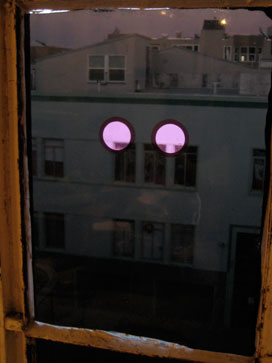
Detail, untitled, 2008, site-specific window intervention: window film, gels, acetate
Late one night in 2008, I was installing Activist Imagination at Kearny Street Workshop. One of my projects required tinting a window with black film. After nightfall it was much easier to see my reflection than it was to see what I was doing. The Arcade Fire single came on, and my mood surged; I was overjoyed by the coincidence.
—
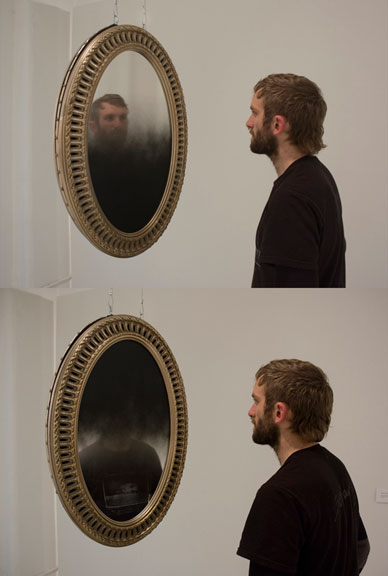
mirrorsblackportrait, 2011, mirrors, paint, frames, wire, motor, hardware; 112 x 21 x 21 in / 2.8 m x 0.5 x 0.5 m (site variable).
Memory and time…. Earlier today, I participated in the artist’s talk for The Black Portrait at Rush Arts Gallery in NYC. It’s an exhibition to which I contributed mirrorsblackportrait, a kinetic sculpture of two mirrors, one painted black on top, one painted black on bottom. During the talk, I mentioned the Claude glass, and the idea that suppressing perceptions might have the paradoxical effect of opening up a space for viewer’s experiences. Then, I had the good fortune of receiving kind and thoughtful feedback from other artists in the show. KO told me that as the sculpture turned, his mind stitched the memory of the lower reflection with the memory of the upper reflection. SS added that in revisiting a memory, it becomes strengthened. In this sense the work is also about time and recognition.
KO also mentioned a fascinating project of his involving flea markets, and how the lives of objects often outlast the lives of their owners. This reminded my of my favorite Daniel Spöerri quote, which is just as fresh and relevant to my practice now, as it was when I first read it five years ago:
We are all fetishists snared by the object…. The object is the vehicle of the affections… until they reach the flea markets of the world, where these objects continually pile up stripped of their magic and cut off from the memory of their history… All that remains of these preserves is the container the artists made for the time, the “can” the preserves came in…. The container will never interest me as much as the contained, but where would I pour my wine without a glass?—and it is in between these two poles of the inseparability of the two that my anxiety of finding a definite solution will oscillate, which could be interpreted positively as the desire for instability and change.
—Daniel Spoerri, The Mythological Travels, 1970.
To this, SS added her memories of going to the racetrack as a child. She recalls it as a site populated by outsiders, rife with belief in luck, superstitions and talismans. The idea of imbuing an object with magic or meaning carries over in to so much of what artists aspire to do.
—
Another attempt to refine a sensibility: CV recently pointed out that my work is not about optimism and pessimism per se, but that it’s about the moment of discovery. I think she meant that my work offers experiences that elicit responses, which highlight optimistic or pessimistic tendencies.
As my work has shifted towards happiness and sentiment, I’ve encountered skepticism—disbelief of my earnestness. And as a viewer, I am not always sympathetic to earnest works of art. Social practice gardening, for example, can seem a bit cutesy, and not very thought-provoking to me. So how could I expect or encourage viewers to take my earnestness at face value, and to not assume that sincerity is antipathetic towards criticality?
I recently posed two questions, and received two very good responses from friends. As I interpret it, AV answered in terms of what an artist or his/her work of art should exhibit to a viewer.
What makes earnestness beget curiosity and kindness?
AV: Genuine commitment.
What makes earnestness beget cynicism and ridicule?
AV: Naive idealism.
AR answered with what a viewer should bring to the work of art.
What makes earnestness beget curiosity and kindness?
AR: Courage.
What makes earnestness beget cynicism and ridicule?
AR: Fear.
Demonstrating genuine commitment in my inquiry seems like a more tangible goal than cultivating courage in viewers.
—
Whimsy, earnestness, sentiment and insignificance… On a somewhat related note, I recently came across Charlotte Taylor’s 2005 article in Frieze about whimsy. The article counterposes The Believer‘s intellectual whimsy against n+1. In the process, Taylor identified these observations:
…whimsy triumphs when the import of the apparently insignificant and the relevance of the random are discovered.
Like camp, intellectual whimsy is not best understood as ironic: it places a premium on unabashed sincerity while at the same time treading a fine line of self-parody. It often signals this self-parody by appropriating typographical and design conventions from the past… The provocative or unexpected becomes the precious….
For the editors of n+1 whimsy signals a dismaying lack of conviction and encourages the conspicuous squandering of energy on trivialities rather than issues of substance….
Wes Anderson’s films are whimsical because their unexpected juxtapositions are imbued with sentimental significance.
…whimsy values the ability to appreciate the aesthetic harmony possible among myriad incongruent objects. It draws attention to the act of perception and the sensibility of the perceiver. This is why intellectual whimsy can readily become grating—it invites you to be pleased by the innovations of another person’s taste.
—
Ironically, the style of these Points of Reference posts is to draw connections between seemingly incongruous ideas. Though I’m still sorting them out, I believe these points relate and that finding their similarities can be a productive exercise to advance my studio practice. I’ll leave you with a paraphrased quote, from today’s NYT video of friends pitching in to save one Alabama man’s house from flooding. As they built levees against a rising river, a friend expressed, without contradiction, his simultaneous feelings of futility and determination:
It may seem like a wasted effort. But it would not be for lack of effort.


 R+D
R+D