Art Competition Odds

art competition odds: Lower East Side Printshop’s Special Editions Residency

The Lower East Side Printshop’s 2012 Special Editions Residency Program received over 500 applications for 3 residency openings.

///////////////////////////////////////////////////////////////////////////
///////////////////////////////////////////////////////////////////////////
///////////////////////////////////////////////////////////////////////////
///////////////////////////////////////////////////////////////////////////
///////////////////////////////////////////////////////////////////////////
///////////////////////////////////////////////////////////////////////////
//////////////////////////////////////////////////+ 

or about 1:166, or 0.6%.

[Year-to-year comparison: 2011’s odds are about the same—less applications, yet one less residency awarded. With the number of applications rounded down, the actual increase or decrease in competitiveness cannot be determined.]

See all Art Competition Odds.

Standard
News

Opening Wed., Feb. 1: In Other Words @ Intersection for the Arts

I’m very excited to be part of this exhibition at Intersection for the Arts. I’ll have over 40 Positive Signs drawings—including several new ones not yet posted on SFMOMA’s Open Space—on view. I am familiar with the work of some of the other artists, and I think it’s a very promising line-up.

Positive Sign #59, 2011, glitter pen, gridded vellum, 8.5 × 11 in / 21.5 × 28 cm

Positive Sign #59, 2011, glitter pen, gridded vellum, 8.5 × 11 in / 21.5 × 28 cm

February 1–March 24, 2012
In Other Words
Intersection for the Arts
925 Mission Street, San Francisco CA 94103

Members VIP Reception: Wed, February 1, 6-7pm
Opening Reception: Wed, February 1, 7-9pm
Gallery hours: Tue–Sat, 12–6pm
Free admission

In Other Words is a group exhibition that looks at language and its capacity to clarify and confuse, convene and separate, inspire and discourage. Language can excite our spirit, comfort our feelings, and inform our intellect; it can also extinguish desire, destroy confidence, and cloud perception. By exploring a range of areas concerning the influence and evolution of language in our lives — the impact of technology, the obscurity of industry-specific terminology, the psychological internalization of language, and the recontexutalization of language — the artists in this exhibition demonstrate through a diversity of media the many ways in which we strive to communicate to each other.

In Other Words features work by Katie Gilmartin, Julia Goodman, Emanuela Harris-Sintamarian, Susan O’Malley, Meryl Pataky, Alex Potts, Cassie Thornton, Annie Vought and Christine Wong Yap.

Related programs:

IN OTHER WORDS: SF LIBRARY READING LIST
February 1 | Free
In celebration of our new exhibit, the San Francisco Public Library will share a suggested reading list that reflects the power and diversity of language.

(By coincidence, James Geary’s I is an Other—a book on metaphors that inspired Positive Signs—is on the reading list!)

IN OTHER WORDS: BLOG CONTEST
February 1-March 24 | Free
Every couple weeks, we’ll have a new call out for fun images and stories! Participants email us their content. Top submissions will appear on our website and a handful of lucky contributors are chosen to receive special prizes!

IN OTHER WORDS: BALDERDASH
March 21 | 7PM | $10-$15
Do you like word games and team activities? Familiar and foreign terms from the arts, business, finance, and social service worlds set the stage for a game where YOU are the expert. Join us for an uncensored friendly competition where fictitious and honest definitions abound. Sign up as a team for a round of Balderdash hosted by author Michelle Tea to show off your smarts and win prizes!

IN OTHER WORDS: ARTISTS TALK
March 24 | 2PM | Free
The “In Other Words” exhibit comes to a close. Please join us in this candid talk to hear directly from the creative minds that graced our gallery with such fun and thought-provoking art.

theintersection.org

Standard
Art Competition Odds

art competition odds: Catskill Film and Video Festival

The Greene County Council on the Arts’ Catskill Film and Video Festival program received over 100 applications for 32 selections.

///////////////////////////////////////////////////////////////////////////
/////////////////////////+

or about 1:3, or 32%.

Sources: Tattfoo Tan‘s iheartrejectionletters.com and greenarts.org.

See all Art Competition Odds.

Standard
Research, Sights

Feelgood art and Jeremy Deller retrospective

Wow! Isn’t this grand? Vanessa Thorpe’s article, “Feelgood art: the pick-me-up to get us through an age of anxiety,” appeared on Guardian.co.uk yesterday.

She cites artists encouraging positive emotions: Michael Landy’s kindness-on-the-Underground project, Tracey Emin’s “trust me” neon, the title of Jeremy Deller’s upcoming retrospective at the Hayward.*

But wait, I think all of these artists aren’t so one-dimensional that their work could be considered “feelgood.”

I’m thrilled to bits to hear about artists considering psychology from non-negative attitudes, as well as the influence of positive psychology expanding into the arts and humanities, but Thorpe’s article is not that. I think Thorpe set up an annoying happy face in the headline and lede only to slap it down in the article. It’s simple-minded to call artwork concerning positive affect “feelgood” and “pick-me-up.” It’s a misinterpretation of Deller, whose work has been consistently class-aware and courageous. Thorpe acknowledges as much, after rankling readers into mild outrage in their aversion to unabashed sentiment. Desparate, newsworthi-fying journalese.

*Actually, this is grand:

February 22 – May 13, 2012
Jeremy Deller: Joy in People
Hayward Gallery, London

Deller’s a brilliant artist, I love his work and thoughtful approach to developing projects and working with people. Plus, the Hayward is an amazing space. I really wish I could pop over to the Southbank Centre this spring for this!

Standard
Meta-Practice, Research

words on social practice and creativity

Christoph Büchel’s Piccadilly Community Centre: an exciting example of social practice.

J.J. Charlesworth’s “Hidden Intentions,” (Art Review, December 2011) introduced me to this brilliant intervention transforming the tony Central London Hauser & Wirth location (formerly a bank) into a working social centre, and not just for in-the-know art students, but for the public—senior citizens, yoga practitioners and so on. Piccadilly Circus is a popular tourist’s nexus like Times Square, where simply winding through crowds, dodging street salesmen, and finding a restroom can be exhausting. So Büchel’s gesture of turning an exclusive, expensive, private space into a rambunctious, free, public one is quite satisfying. I was also intrigued to read that

much was made of whether Büchel’s project was a comment on David Cameron’s ‘Big Society’

I find Büchel’s responsiveness commendable.

On irony, and bridging the divide between art and life

“Hidden Intentions” is not an exhibition review, but a speculative essay. Charlesworth also examines Matthew Darbyshire’s faux loft ads at Herald Street, writing that it

is interesting because, like Büchel’s community centre, it points backwards to interrogate the capacity of the viewer to recognise the gesture as ironic. Because irony always implies a ‘double’ audience—those who accept the gesture at face value and those who realise the gesture is simulated intentionally—it also implies a form of superiority, which is often couched in terms of criticism of another….

This is art that writes itself into the fabric of everyday life with only the fading trace of the artist as proof of its reality as a sort of ironic gesture, and in which the work’s audience is made complicity with the artist’s manipulation of the world of others…. Of course, it still needs the institutional frame of the artworld to allow it to happen, but in doing so, it takes to an extreme the postmedium scope of current artistic possibility, where in the end, the only thing that is distinguishable is the discursive setup of the artworld itself.

Conflict aids creativity?

So argues Jonah Lehrer in “Group Think: The Brainstorming Myth” (The New Yorker, January 20, 2o12). He presents evidence contrary to the widely-accepted prohibition against criticism in brainstorming:

According to [psychology professor Charlan] Nemeth, … “…debate… will always be more productive. True creativity requires some trade-offs.”

To Lehrer and Nemeth, I’d respond with a constructively critical, “Yes, but…”

Positive Sign #1, 2011, glitter and fluorescent pen with holographic foil print on gridded vellum, 8.5 × 11 in / 21.5 × 28 cm

Consider Mihaly Csikszentmihalyi‘s five stages of the creative process: preparation, incubation, insight, evaluation, and elaboration. I would think that debate is productive in some stages (such as evaluation and elaboration) and not others (such as preparation, incubation, and insight).

Perhaps more even-handed: sociologist Brian Uzzi analyzed musicals to find correspondences between social intimacy among creators and box office and critical success.

“The best Broadway teams, by far, were those with a mix of relationships,” Uzzi says. “These teams had some old friends, but they also had newbies. This mixture meant that artists could interact efficiently—they had a familiar structure to fall back on—but they also managed to incorporate some new ideas. They were comfortable, but not too comfortable.”

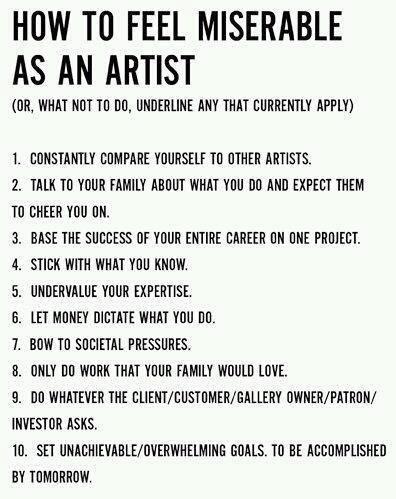
For artists considering creative and professional collaborators, choose carefully.

Lehrer also makes an exemplar of the MIT “rad lab”—where a disused building became home to divergent departments, creating spillover, and presumably, lending interdisciplinary gusto to the work of Chompsky, Bose, and other paradigm shifters. Lehrer concludes

The lesson of Building 20 is that when the composition is right—enough people with different perspectives running into on another in unpredictable ways—the group dynamic will take care of itself…. The most creative spaces are those which hurl us together.

I cringed when I read that last sentence, after my experiences in open-plan studios in graduate school. Unwanted intrusions can make focusing attention seem like a Herculean task. Being hurled together say, when you’re reading or trying to resolve an artwork, with someone taking a phone call or playing music, is not creative, but torturous. Psychologist Jonathan Haidt points out that humans can adapt to many things, but we never adapt to intermittent noise:

Research shows that people who must adapt to new and chronic sources of noise … never fully adapt, and even studies find some adaptation still find evidence of impairment on cognitive tasks. Noise, especially noise that is variable or intermittent, interferes with concentration and increases stress. It’s worth striving to remove sources of noise in your life.

Jonathan Haidt, The Happiness Hypothesis, New York: Basic Books (2006) 92.
Standard
Research

trinkets from the bitstream

O, Internet! Some glimmers of humor and poetry:

No cover

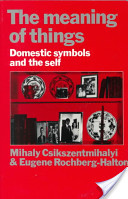
In search of a book, I found this little gif. It’s a cover design that’s meant to stand in for a missing file, but it’s handsome, balanced, mysterious and beautiful on its own. Book-face with a swash-nose. I’d read it.

Mihaly Csikszentmihalyi & Eugene Halton, The Meaning of Things, 1981

Mihaly Csikszentmihalyi & Eugene Halton, The Meaning of Things, 1981

I’m slowly working my way through psychologist Mihaly Csikszentmihalyi’s books. This one, co-authored with Eugene Halton, is on how objects become associated with sentiment. It sounds very enriching for me as an artist. I love this graphic cover too: plates and photos on display, with the title in sentence casing in a gothic typeface.

Aziz Ansari’s Treat yo’ self! clip from Parks and Rec. Ridiculous, self-indulgent, yet quite possibly a brilliant idea. What if everyone had one big Treat Yo’ Self Day every year? Rewards following accomplishments are nice, but too much performance-orientation can be unsustainable. I imagine that participants might demonstrate more restraint in the weeks prior and after the big day. You don’t need “fine leather goods” to indulge; you can share time, company, grace, learning experiences, etc.

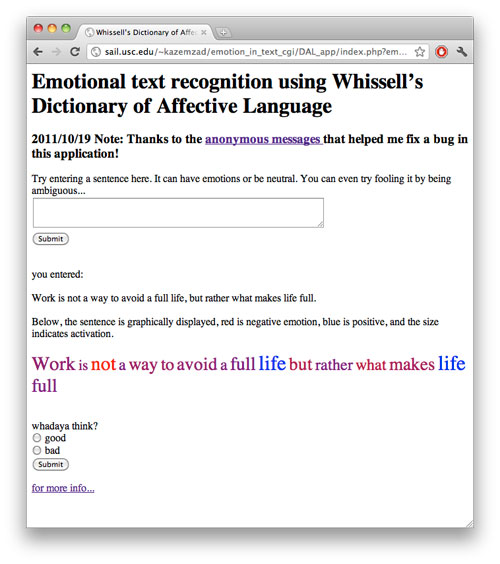
Ebrahim "Abe" Kazemzadeh, Emotional text recognition using Whissell’s Dictionary of Affective Language

Ebrahim "Abe" Kazemzadeh, Emotional text recognition using Whissell’s Dictionary of Affective Language. Source: http://sail.usc.edu/~kazemzad/emotion_in_text_cgi/DAL_app/

Ebrahim “Abe” Kazemzadeh’s program, Emotional text recognition using Whissell’s Dictionary of Affective Language. Kazemzadeh is a PhD student at the University of Southern California (USC) studying computer science, with a graduate degree in computational linguistics. The program assigns colors and sizes to emotional words. Red indicates negative emotions; blue, positive. Representing subjective states with programming is such a wonderfully strange idea. The inherent failure is what makes it compelling.

Pollyanna, I re-learned, lives by the principle of The Glad Game, the objective of which is to find something to be glad about in every situation. It turns out that Littleton, NH, hometown of the Pollyanna author, has an annual Official Pollyanna Glad Day, with a parade. Why not be glad? Why not tie balloons and daisies to and parade in a yellow pick-up?

Official Pollyanna Glad Day 2005, Litteton, NH (hometown of Pollyanna author Eleanor H. Porter)

Official Pollyanna Glad Day 2005, Litteton, NH (hometown of Pollyanna author Eleanor H. Porter). Source: GoLittleton.com

Standard
Sights

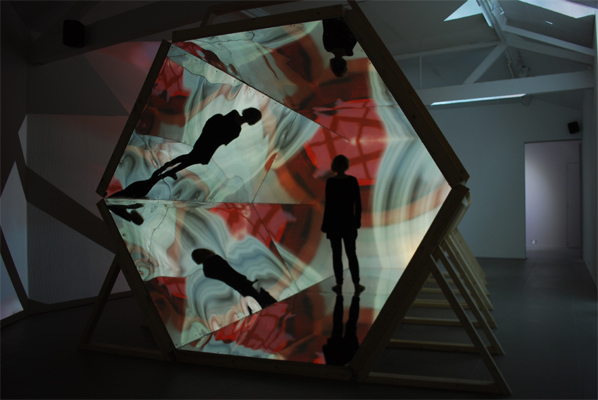
see: Laura Buckley’s Fata Morgana at Cell Project Space, London.

Via Re-title

Laura Buckley, Fata Morgana, 2012, mixed media, (l.480 x h.290 x w.242 cm)

Laura Buckley, Fata Morgana, 2012, mixed media, (l.480 x h.290 x w.242 cm)

Laura Buckley
Fata Morgana
20th January – 26th February, 2012
CELL PROJECT SPACE
258 Cambridge Heath Road, London E2 9DA

For Fata Morgana, Buckley has initiated an ambitious single screen installation commissioned specifically for the CYcLORAMA series and produced with the assistance of Cell, The Arts Council and The Irish Arts Council.

The title Fata Morgana refers to a highly complex superior mirage where inverted and erect images are stacked one on top of another causing an object on the horizon to be distorted beyond recognition. The name also refers to Morgan le Fay, mythical figure from the Arthurian legends at once a villain, seductress, witch, healer or goddess, her unquestionable power is dictated by her ability to shape-shift throughout the myths and legends in which she appears.

Where previously mechanical movement of objects has made up an important part of her installations, in Fata Morgana both the film and the sculpture are static. This allows the fast paced edit of the film and surface of the sculpture to interact with the body and perception of the entering viewer, including and absorbing them into the kaleidoscopic installation.

Read more at Re-title.

Visit the outdated, but interesting, artist’s site.

Standard