Research

“All my work is based on the potentiality of trust. Though we rarely speak of trust in relation to art, a work of art may well be the ultimate expression of trust. It is as if we trust, for instance, that some inked piece of paper or painted canvas will receive us and speak truly about our world and its own. It is this space of trust that enables dialogue to unfold. Dialogue is a group of people freely reaching a place and verbally exchanging thoughts in a present and immediate way whilst listening, not only to others but also to themselves with others, then coming together and exchanging again, and after having left, coming together yet again. Such gathering is never spontaneous; still, it must be proposed.”

Esther Shalev-Gerz, The Contemporary Art of Trusting Uncertainties and Unfolding Dialogues, Art & Theory Publishing.

–Esther Shalev-Gerz, The Trust Gap (2013)

Quote
Sights
Mathilde Ter Heijne,  Woman to Go

Mathilde Ter Heijne, Woman to Go

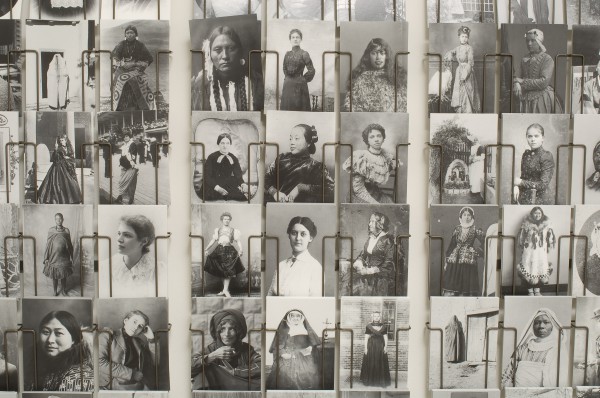
This is an interesting premise for a show: postcard reproductions of early Daguerreotypes of unidentified women, with texts about recognized women, given away for free. Increasing the visibility of women through this act of generosity/ distribution. More info at the artist’s site.

It’s on view at Jack Hanley Gallery in NYC. Nice to see non-commercial projects at a commercial gallery.

Mathilde Ter Heijne: Woman to Go @ Jack Hanley Gallery

Aside
News

And We’re Off… New Mobile-Responsive Website Launched

New Year, New Website

Screen shot 2014-01-19 at 7.31.05 PM

The new home page features filtering and sort functions.

My new website is live!

christinewongyap.com

The redesign is mobile responsive—the content scales accordingly to phone or tablet. (No more tiny text!)

This allows for bigger pictures and texts on desktop monitors and laptops. I like the new, big-text aesthetic of web design. As screen time increases, might as well make screen content really easy to read.

The new home page features filtering and sorting options. Find projects by theme or media, and/or then sort your  results by name or year. This project index also appears at the bottom of project pages, so you can easily pick another project to view.

Project pages have been reconfigured so you control the display of gallery images. Mobile users load only a preview image, while laptop and desktop users see thumbnails. Click a button to view the full gallery.

The redesign is the result of many weeks of learning, coding, revising, and testing (with lots of support from M and feedback from friends).

I’m pleased with it and I hope you like it too. If you come across any broken links or other mistakes, please let me know!

Standard
Meta-Practice

Bushwhacking My Way to a New Artist’s Website

Notes from a website-in-progress.

In November, I decided that I was going to code a new responsive artist’s website, instead of using a CMS like SquareSpace. This fateful decision has meant many weeks consumed with good old standbys (HTML, CSS), lost acquaintances (PHP) and new grappling partners (Bootstrap, JS, JQuery, Less). I’m really excited with how my website-in-progress is looking, but behind the scenes, my code, my computer, and my mind have become a crazy quilt, a patchwork worthy of Funkadelic.

My last post on this theme, Artists’ Website Advice (11/28/2013), was cheery and optimistic. Now, from the weeds, come these follow-up thoughts:

  • Easier said than done!
  • Everything takes time. And many things take much more time.
  • The metaphor of a learning curve as a steep ascent is apt!
  • Sometimes learning things the hard way means making multiple attempts, and ultimately only learning what doesn’t work…. if that qualifies as learning a thing at all: Finding its contours in the negative. A plaster mold sculpted from stabs in the dark.
  • You can bang your head on a proverbial, nonphysical wall, and turn your actual meatspace brain into mush.
  • Unless you know code or you need to make weeks of your life disappear, don’t attempt to code your own site.
  • When I’m building things for others, I wish they could visualize what they want first. And though I thought I knew what I wanted in my site, there were many details I had to build, experience, and then revise. UX is complicated. Knowing what I like or dislike about other sites was enough to give me a general direction, but it didn’t replace actual expertise.
  • You can’t please everyone. Technically, there are too many variables—devices, browsers, accessibility issues—to ensure a perfect UX for everyone.
  • You won’t please everyone. My target audience within the art world is fairly niche, yet everyone’s tastes differs. I asked friends to give feedback to some sample pages. It was informative. It was not decisive. It helped me make decisions, and it’s also prepared me for the fact that no one will love my site as completely as I—it will be too big, too small, too much, and too little simultaneously for different people.

Now for some good thoughts:

  • Indispensable tools: Automator, Photoshop’s batch processing, MAMPCybercrab Screencheck, Bootstrap, JQuery, Github.
  • Benefitting from coder’s generous spirit of sharing of knowledge on the web. Even if I understand only 2% of it, it’s still more than what I started out with.
  • More understanding and appreciation for what M did during his IXD degree; M’s patience.
  • The light at the end of the tunnel.
Standard
Meta-Practice, Values

Recommended Reads on Public Sculpture and Self-Criticism

On Public Sculpture

“Best of All Possible Worlds” by Mark Lane
The Believer (Nov/Dec 2013)

Public sculpture, a well-intentioned art competition, Richard Florida-inspired development, class, gentrification, a NYC artist and an Evansville, IL neighborhood collide in this report of a true and impolitic debacle. I highly recommend it.

Implicitly, it suggests how not to redevelop a neighborhood, run an art competition, and instrumentalize public sculpture. At the same time, it offers one way an artist could ethically interact with locals.

On Self-Criticism

“Four Ways to Constructive Criticze Yourself,” by Juliana Breines
Greater Good Science Center, January 9, 2014

These suggestions are fantastic. Artists can benefit from them, especially when thinking about what we can and can’t control in the art world, our own practices, and networks. It’s easy to get down in the dumps when we’re hungry for more, or get poisonously resentful that we’re not the recognition that you deserve. For people who are really hard on yourself, take this as a reminder to practice self-compassion.

Standard
Art & Development

2013 Year-end Roundup


phtos from residency at the Tides Institute and Museum of Art, Montalvo Art Center, Happiness Is... Chinese Arts Centre, more

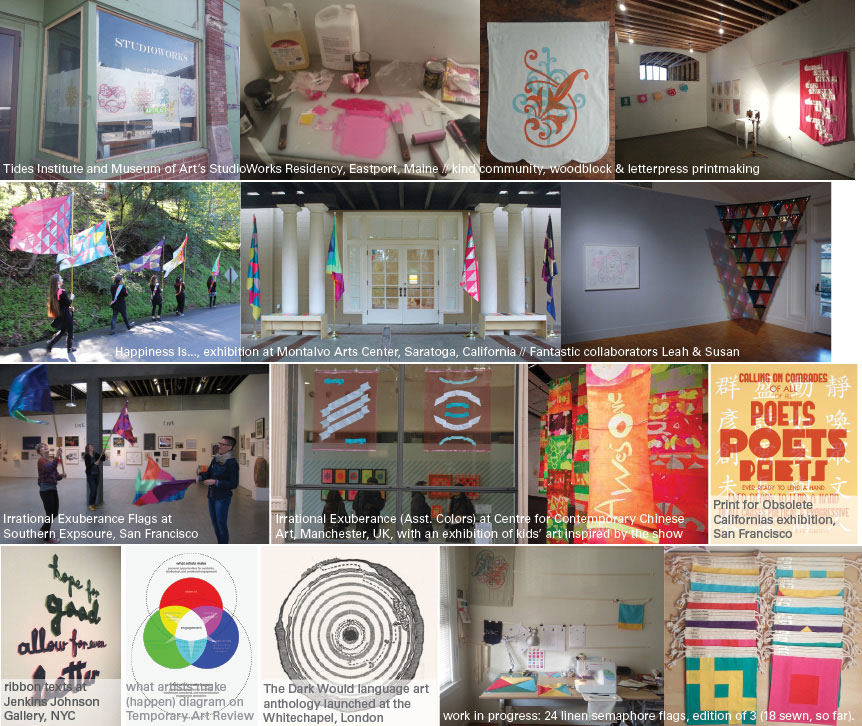
2013 year-in-review. Highlights include the residency at the Tides Institute and Museum of Art in Eastport, Maine; Happiness Is…, at Montalvo Arts Center in Saratoga, California; Irrational Exuberance Flags at Southern Exposure; Irrational Exuberance (Asst. Colors) at Centre for Chinese Contemporary Art in Manchester, UK; Obsolete Californias in San Francisco; Jenkins Johnson Gallery in NYC; publications such as Temporary Art Review and The Dark Would.

Looking back at 2013, I’m grateful for the generosity and passion of many people…

• the dedicated staff at arts organizations providing residencies and exhibition opportunities to artists like myself…

• whipsmart collaborators Leah Rosenberg and Susan O’Malley… and

• inspiring, fearless women artists like Torreya Cummings, Sarrita Hunn and Lauren Adams who shape the art worlds they would like to participate in.

In 2014, I’m looking forward to…

Bronx AIM informal studio visits. Visiting photographer Martyna Szczesna's studio.

Bronx AIM informal studio visits. Visiting photographer Martyna Szczesna‘s studio.

• participating in the Bronx Museum of Art’s AIM program, and helping to organize mutual studio visits in the interim…

• contributing to artist’s publications: the next Ortega y Gasset Gazette, and Land and Sea, slated to debut at the LA Book Fair…

• launching a new version of my website…

• continuing to read and participate in book clubs about class, community, and engagement.
Standard