Art & Development

Katharina Grosse on Impermanance

Valuing vs. being indifferent to permanence.

Katharina Grosse’s Public Art Fund artist’s talk at New School last night was inspiring. Her large scale, site-specific spray paintings were a revelation to me. I enjoyed how she constructed her talk from a studio perspective, revealing how the questions she asked herself led her to new questions and techniques in subsequent works. Her practice seemed experimental, and her thinking fearless.

Frustrated with the NYC’s market orientation, and its emphasis on permanence as a way to protect artworks’ commodity values, I asked Grosse about how impermanence shapes her work. She said she doesn’t think about it. She is most excited about making the work, rather than looking at the work. Before she moved on to a new question, she added that thinking about permanence may hinder one’s studio development.

Maybe I have been privileging permanence. When I look at recent projects, I have been making art objects that are easily shipped and exhibited. It’s been a matter of logistics and productivity—my capacity is such that I feel the need to take opportunities even when I have limited time and budget, and having works ready to ship makes that more feasible. At the same time, maybe to some extent I am limiting myself with values and conventions of the art world that are not my own.

I admire how Grosse is simultaneously unpretentious and confident about her practice: there seems to be no gap between this is what I’m interested in, and this is what I’m going to do. It’s an unrestrained way of working. I wondered how my art would grow or change if I had 5% more of this fearless quality. Or, what might my work look like if I spent a year making only temporary, ephemeral projects?


Standard
Make Things (Happen)

See the work of double zero in L O V E, a group exhibition at Montalvo Arts Center’s Project Space Gallery in Saratoga, CA through June 8.

While double zero were in residence at Montalvo earlier this year, they also developed Call This Number, an interactive experience  especially made for make things (happen). Dial in.


Making Things Happen: double zero in L O V E at Montalvo Arts Center

Aside
Art & Development, Community

A Week in Review: Seven Days in My Art World

Art and art experiences from the past seven days.

So I haven’t been to the Whitney or MoMA lately. Does that mean I’m taking living in NYC for granted? Possibly. But over the past eight days, I’ve experienced art and art dialogues in lots of ways….

  • Self-organized studio visits among Bronx AIM participants (Margaret Inga Wiatrowski, Didier William, Tatiana Isotomina, and Anna Ablogina). The cohort’s practices are quite developed; members ask very thoughtful questions; and we stay fueled up on candy and snacks. There’s a lot of mutual goodwill and I’m so thankful to be part of it.
  • A few Chelsea galleries off the beaten path. Making a highly-edited list on artcards.cc forced me off my usual four-block slither…. Killer charcoal drawings by Robert Longo at Petzel—an art school fundamental, executed to perfection. Peter Dreher painted the same glass of water, over and over (Koenig & Clinton); hardheaded persistence seemed winsome to me. Insignia intermixed with Thai embellishments by Jakkai Siributr at Tyler Rollins Fine Art…. My list exceeded my time; yet to see the shows by Justin Matherly, Lisi Raskin, David Maisel, Kristen Morgin, Josephine Mekseper, and Adam Pendleton. [Funny, all but one of these artists I have worked with, or handled their artworks, or heard them speak. This makes me think that Chelsea is less predictable than I usually give it credit for, or galleries are putting their best foot forward for this month’s fairs. Or maybe I’m just getting around more.]
  • Artist’s talk at a Parson’s undergrad class.* Under-slept and over-caffeinated, I delivered a zippy talk about my work, opinions on the art world, and professional strategies.  Seeing the students sprawled out on the model plinths, half-broken stools and paint-splattered floor made me a little nostalgic for art school.
  • My studio. Finishing up a new ribbon text—actually a translation of an existing text—for a forthcoming billboard overseas. (Details will be announced soon.) Starting a new project—the hardest part. I remembered the art school assignment to do 100 drawings—it’s still a great way to declare a no-judgment zone, overcome self-critical inertia, and get to work. Patti Smith’s descriptions of her and Mapplethorpe’s passion for getting lost in creative activity in Just Kids helped too.**
  • LMCC’s Open Studios. Visited one of the strangest settings for art—an entire semi-reconstructed floor of a corporate high-rise in the financial district. Lots of great artists in this highly competitive studio program. I was also very moved by an interactive play-in-progress by Aya Ogawa.

*Thanks, SAS, for inviting me!

** Thanks for the book trade, CLF.

Standard
Make Things (Happen)

Elizabeth Hamby’s Alphabet City—a show of prints, sculptures, and works on paper based on footprints of buildings around NYC—is on view through July 9 at Casita Maria in the Bronx.

Hamby is one half of Meta Local Collaborative. To get with the bike-love this weekend in NYC, check out Meta Local Collaborative’s activity sheet for make things (happen)(how to) make friends, make a scene, make things happen, and fall in love with your neighborhood.

Making Things (Happen): Elizabeth Hamby @ Casita Maria, Bronx

Aside
Values

Book Idea: Seven Days in the Art Underworld

Reading Sarah Thornton’s Seven Days in the Art World* makes me want to read about who’s stories aren’t being told.

I’m enjoying Thornton’s stylized writing and insight into major institutions, but a few quotes hit a nerve with me:

Gallerist Jeff Poe:

“Takashi [Murakami] worked so hard on this painting that several staff quit.”

(What’s wrong with this sentence? What are the implications of making “Takashi” a metonym for a vertically-integrated art production empire?)

Artist Phil Collins, while a Turner Prize nominee:

“…the commercial art world … is there anywhere you could possibly feel smaller?”

(If Collins, who has significant recognition, can made to feel small in the art world, what are the psychological effects for everyone else with less power?)

In response, I envision a restorative book to tell the stories of marginalized figures in the art world, make their invisible labor visible, and reveal the fullness of their humanity denied in their roles propping up the art world, its power dynamics, ethics, and etiquette. Here goes:

Profiles would shadow subjects at their day jobs, as well as in their commutes, homes, their own art studios, and communities.

In general, I’d like to know: What is it that they do? How do you explain what you do to non-art people? What attracts about this job? What are the disadvantages of this job? How does it rank against other jobs? What are the physical tolls? The psychological or emotional ones? How much security does it offer? Where do you see yourself in 20 years? How does this job lend you power/insight/connection/meaning, or not? What is the value of interfacing with the art world in this way? Do you see yourself as part of the art world? What are your contributions? Are they adequately recognized? Does your family and community/communities participate in the art world; how, why, or why not? Ideally how would you like to participate in an art world? In the world at large?

The seven chapters would profile:

  1. Gallery Interns/Sitters: Young art students, their debt and their privilege, what they are learning in exchange for their unpaid labor—explicitly, and implicitly.
  2. Museum Guards & Custodians: Profile two or three at different museums, unionized and non-unionized. Who are they are as a group? How do they interpret the art or interact with artists? What they would recommend about museum policies and practices, such as admission, curation, engagement?
  3. Museum Preparators: Expose what they do. What the risks are, and how the hierarchies in museums work, and what is the gender distribution. How many are artists/musicians?
  4. Artist’s Assistants: Including former assistants who’ve walked off the job, and a survey of Murakami/Koons alum for example.
  5. Fabricators: What type of skills are required, how they feel about producing artists’ work, how they became fabricators, assuming that many went to art school for their own practices.
  6. Art Handlers: On a truck, in a private home collection, service entries, bars. Profile a young upstart and an old timer. Investigate the nature of male cynicism.
  7. Museum construction crews: Who are they, where are they from, what are their working conditions, and what they will do at the end of their contract?

Also, a section of data visualizations, including CEO vs average worker type comparison charts, and maps of art-related labor migration overlaid with globalized art fair/biennial circulation.

This would clearly take a year or more in the making. It could be a standalone book, or a series of long form essays in a periodical. I don’t have this kind of capacity, but I’d love to see this in the world‚ so I encourage others to take this idea and run with it!


*Thanks for the book trade, CLF!

Standard
Community

But Crafter-Hours is also a way to give credit where credit is long overdue. Every art show relies on the labor of many people, including interns, staff, and fabricators. The work depends on far more than just the (usually singular) artist credited with its authorship. Crafter-Hours is one opportunity to trouble the convention of rendering that labor invisible.

—Lisi Raskin, with Roxanne D. Crocker, Kate Fox, Lydia Enriquez, Sean Gerstley, Misha Kahn, Kim Charles Kay, Brittany Mroczek, Lisi Raskin, Jon Rider, Katie Stout, Recuperative Tactics at Art in General through May 31.

Lisi Raskin addresses Invisible Labor through Crafter-Hours

Quote
Art & Development, Community, Works

My Imaginary Group Show

A few weeks back, I posted about an assignment for artists to describe their own dream group show.

I came up with one version of my own dream group show—it’s local, site-specific and combines numerous interests. I was so excited by all the projects and artists, the only way I could keep my presentation under the six-minute limit was to read out a script of only keywords, and that’s what I’ll include here. Enjoy! And consider coming up with one of your own—it’s a fantastic, liberating exercise.

1,000 Single Steps

For Jeremy Deller,

art isn’t about what you make
but what you make happen.

Inspiration.
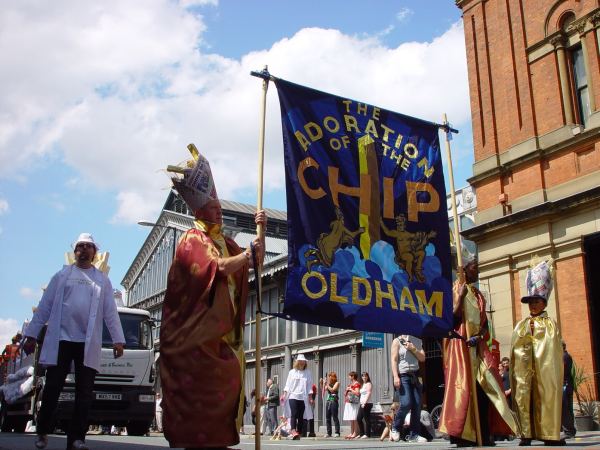
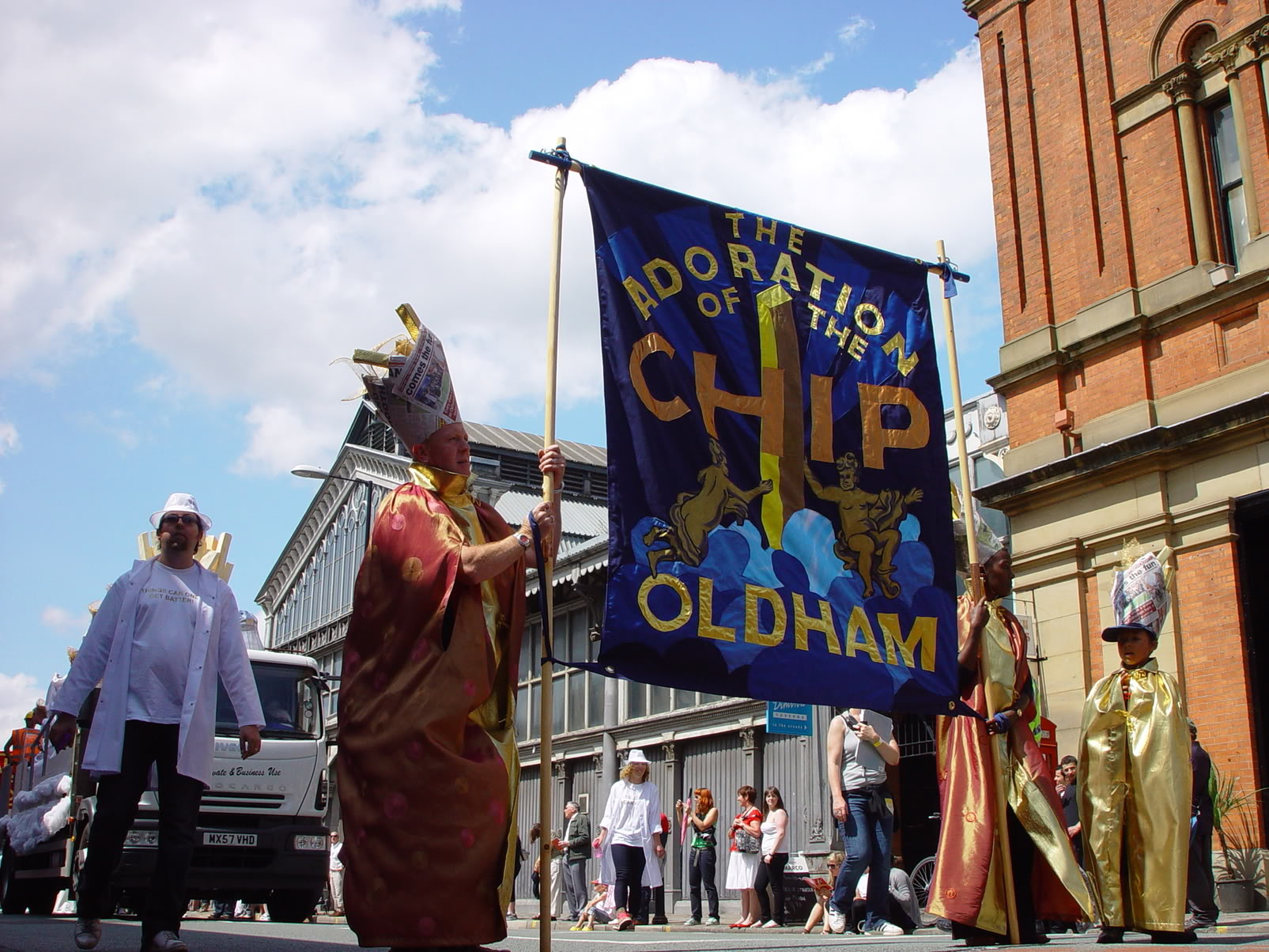
Jeremy Deller, Ed Hall, (Banner Maker), Procession, 2009

Jeremy Deller, Ed Hall, (Banner Maker), Procession, 2009

Manchester Int’l Festival.
Manchester History.
Industrial Revolution.
Workshop of the World.
Birthplace of Socialism.
Textile Mills.
People’s History.
Tradition of Banner-making.
Participation.
Contemporary groups working with a banner maker.
Parade.
Absurdist.
Crown of french fries.

Even the emo teens.

Participants. Jeremy Deller, Ed Hall (Banner Maker), Procession, 2009

Participants. Jeremy Deller, Ed Hall (Banner Maker), Procession, 2009

Proposed Site: The Queens Way

Summer of public programming as grand opening.
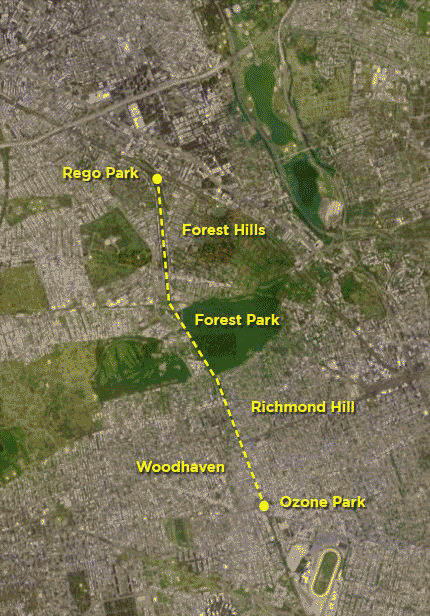
Map of the Proposed Queens Way. // Source: TheQueensWay.org.

Map of the Proposed Queens Way. // Source: TheQueensWay.org.

• 3.5-mile portion of the abandoned Rockaway Rail Line
• community-led effort
• current status: feasibility studies

Present conditions of the Queens Way. // Source: TheQueensWay.org.

Present conditions of the Queens Way. // Source: TheQueensWay.org.

I am not a natural optimist.
Anxiety and rumination, humans’ natural states.
Exercise, surefire mood-elevation.
Importance of access to clean, green open space.
For Physical health.
For Psychological health.
A society where women can go for a run in their own neighborhoods without fear.
Improve quality of life for generations.


Artists and Projects
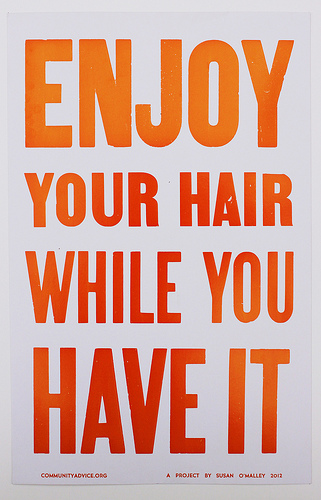
Susan O’Malley, Community Advice, 2012.

Susan O’Malley, Community Advice, 2012. // Source: susanomalley.org
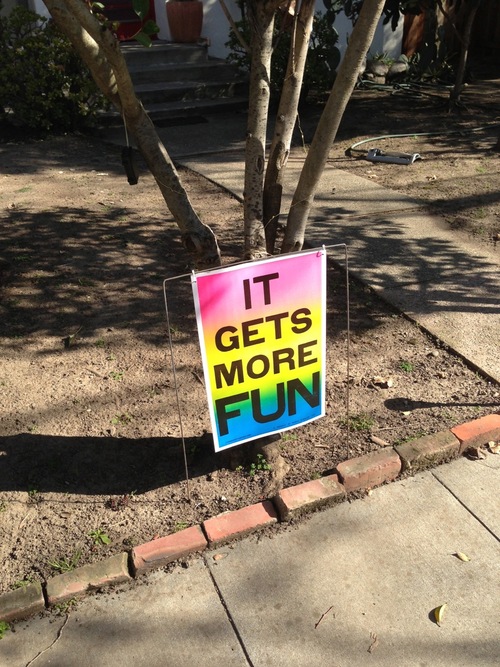
Susan O’Malley, Community Advice, 2012. // Source: susanomalley.org

Susan O'Malley, Community Advice, 2012. // Source: susanomalley.org

Susan O’Malley, Community Advice, 2012. // Source: susanomalley.org

Classmate, friend.
Based in California.
Site-specific variation on project.
100 participants.
2 questions.
What advice would you give your 80-y-o self? 8?
Collaboration with printmaker.
Wood type posters
Posted in the community.

Carlos Cruz-Diez, Transchromie Mécanique 1965, 1965
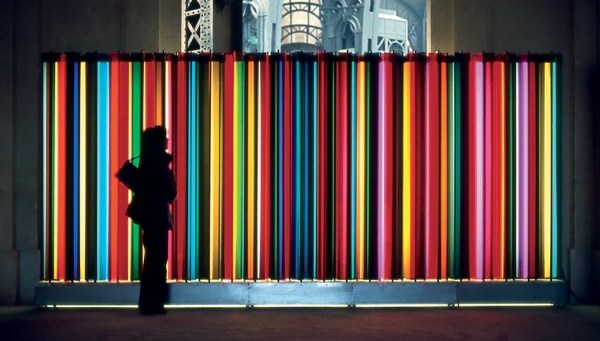
Carlos Cruz-Diez, Transchromie Mécanique 1965, 1965 // Source: cruz-diez.com

Carlos Cruz-Diez, Transchromie Mécanique 1965, 1965 // Source: cruz-diez.com

Immersive phenomenological optical installations.
Like Eliasson, but earlier.
Like Turrell, but happier.
Commission:
Shadows underneath elevated tracks.
Transformed to spaces of light and color.

Michelangelo Pistoletto, Lunch Painting, 1965

Michelangelo Pistoletto, Lunch Painting, 1965 // Source: afasiaarq.blogspot.com

Michelangelo Pistoletto, Lunch Painting, 1965 // Source: afasiaarq.blogspot.com

Arte Povera.
Transition from gallery oriented art object to direct social engagement.
Seminal work.
Blue-chip artist.
Museum collections.
Do not touch.
Proposed exhibition copies as public sculptures.
Please touch.

Bob and Roberta Smith, The Art Party, 2011–ongoing

Bob and Roberta Smith, The ArtParty Conference, 2013 // Source: suegough.blogspot.com

Bob and Roberta Smith, The ArtParty Conference, 2013 // Source: suegough.blogspot.com

Artist mostly known for twee sign paintings on junk.
Recent years’ increasing activism.
Reaction to Tea Party.
Opposition to cuts in Art Education in UK.
Paintings, installations, videos, events.
Defense of accessibility of art education and therefore art.
Earnest.
Populist.
Art is not elitist.
Everything is made.
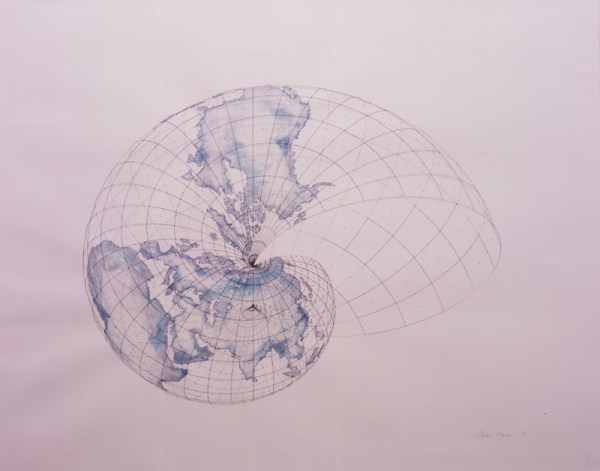
Agnes Denes, Isometric Systems in Isotropic Space—Map Projections, 1979

Agnes Denes, Isometric Systems in Isotropic Space—Map Projections, 1979 // Source:  students.concordiashanghai.org

Agnes Denes, Isometric Systems in Isotropic Space—Map Projections, 1979 // Source: students.concordiashanghai.org

Proposed billboards.
Artist mostly famous for wheat field in Lower Manhattan.
Beautiful drawings of world maps.
Cube, pyramid, donut.
Love diagrams.
Queens demographics.
Always changing.
Always diverse.
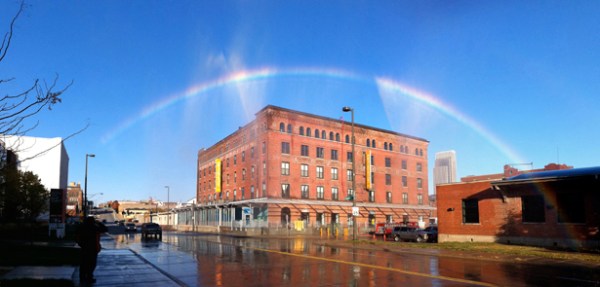
Michael Jones McKean, The Rainbow: Certain Principles of Light and Shapes Between Forms, 2012

Michael Jones McKean, The Rainbow: Certain Principles of Light and Shapes Between Forms, 2012 // Source: therainbow.org.

Michael Jones McKean, The Rainbow: Certain Principles of Light and Shapes Between Forms, 2012 // Source: therainbow.org.

Bemis.
Artificial rainbow.
Water hoses.
Experiment.
Unpredictable results.
Depends on weather.
Ironic.
Makes it even better.

Fourth of July 2012: San Diego Pyrotechnic Accident

san diego 2012 fireworks display

San Diego 2012 fireworks display

Not art.
Curatorial influence of Jenns Hoffmann.
Contemporary art alongside historic art and artifacts.
Contextualizes art practice in wider cultural production.
7,000 fireworks in less than 60 seconds.
Holiday ruined?
Or expectations exceeded.
Grand Finale.

Addendum:

I also recently learned about this other spectacular fun-but-relatively-safe disaster, which I love for the same reasons as the fireworks display:
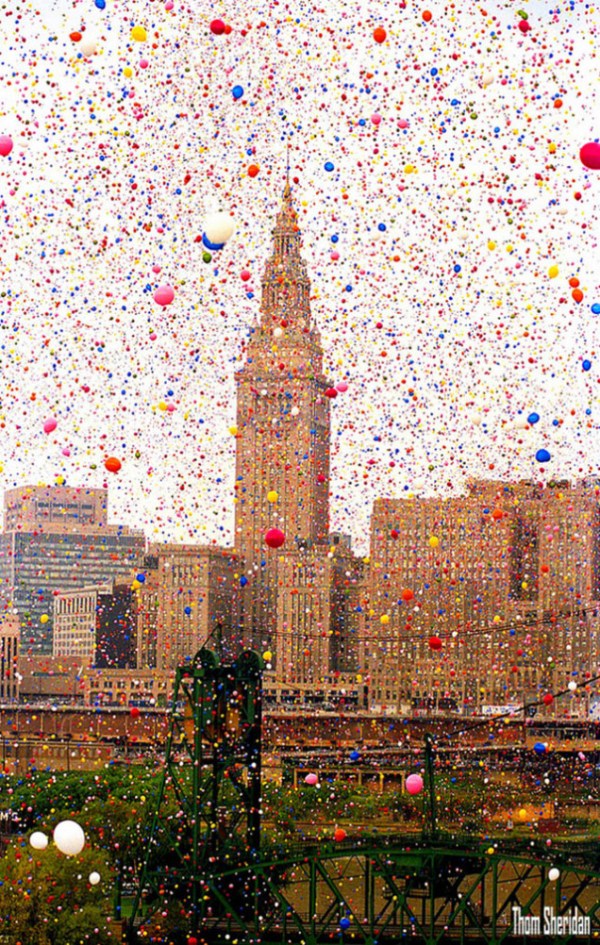
1986 Cleveland accidental 1.5 m balloon release. // Photo: Thom Sheridan // Source: Gizmodo
1986 Cleveland accidental 1.5 m balloon release. // Photo: Thom Sheridan // Source: Gizmodo


Standard