Travelogue, Values

greening manchester

Tibb Street car park "bring" site

Manchester is planning to start a kerbside recycling program for the Northern Quarter in the fall of this year. Even Santa Rosa, CA started a recycling program in the eighties — and Santa Rosa was still a hick town back then; the air hung thick with the stench of manure in planting season.

The irony is that Manchester has historically been known as a city where coal smoke blackened the sky. Public and private partnerships have spiffed up the city, even spawning a “Green Quarter” housing district.

But in terms of public services, the Manchester City Council seems behind the times, barely keeping pace with industry and the national government.

Please make the facilities exist so the public may recycle.

Please make the facilities exist so the public may recycle.

Currently, Manchester only runs “bring” sites for recycling, where residents can voluntarily drop off household glass, paper and cans. Neither plastics nor cardboard are accepted. Waste receptacles found on city streets are for rubbish only.

Furthermore, there’s no household hazardous waste program in Manchester either. What do you do with a bag full of compact fluorescent lights, each containing small amounts of mercury? I hope the city council doesn’t wait several more years to make their waste management safer for public health, as the national government plans to phase out the production of incandescent bulbs this year.

What do I care, anyway? Well, to make art, artists have to bring, consume, reshape, and dispose of things. Materials matter.

Standard
Art & Development, Travelogue, Values

3 visits + a P.O.V.: Manchester Museum, Whitworth, Urbis, US-UK

Manchester Museum
The natural history museum is a metonym for Manchester: a bricolage of old and new. There are bright, airy, open galleries brushing up against dim halls lined with cabinets that look like they’re from Darwin’s time. It’s all fitted neatly into a neo-gothic building at the University of Manchester.

During today’s visit, I found the mineralogy department the most fascinating. It’s small — a single room, almost, though a tiny gift shop shares the space. But the specimens are small, so there’s actually lots to see. I must have spent at least an hour looking at rocks today.

The north of Britian is geologically diverse, and the museum featured many spectacular specimens from nearby mines. The range of colors and shapes where dazzling, to the point, where I wondered, as an artist, how could I ever possibly complete with the beauty in Nature?
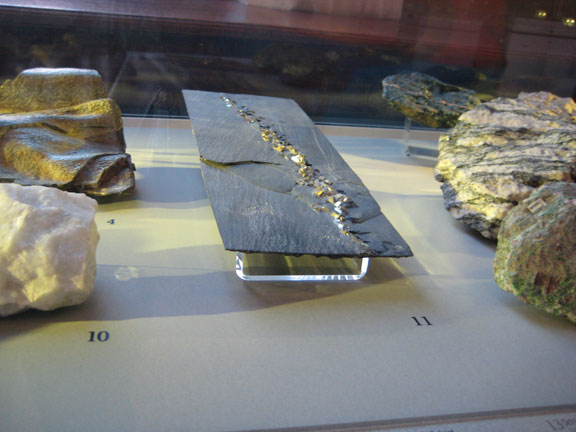
Slaty cleavage of pyrite cubes

Slaty cleavage of pyrite cubes

I almost missed one dark cabinet, thinking it was out of order. Then I found a button and pushed. UV lights blinked on, and rocks of all shapes glowed in purples and phantasmagoric grains of green. Awesome. I love the idea of minerals formed by heat, pressure and seismic shifts gaining the property of phosphorescence, even when they are deep in the earth, shielded from light. I find it poetic that in the mining of coal or ore for industry, enigmas were also uncovered.

Whitworth Gallery

Subversive Spaces is a large-scale exhibition pairing early 20th century Surrealism with contemporary sculptures, installations and videos by international artists. I’ve had two brief encounters with the show and find that it’s just not my cup of tea. Maybe I’m just not that into Surrealism. Part of this has to do with the fact that Surrealism is often used to introduce viewers to Modern Art, so, for me, it’s taken on a whiff of the palatable, familiar, introductory. Besides, after HBO and David Lynch, the Freudian ideas in early Surrealist paintings and sculptures aren’t very shocking anymore.

That said, I was impressed with Markus Schinwald’s video (watch it on YouTube) featuring two actors — including an immensely capable dancer/movement artist. I think this work epitomizes the show: it’s subversive, surreal and innovative.

The show includes works by major contemporary artists. Among these are two sculptures by Mona Hatoum (a prison-like baby crib in galvanized steel, and an oversized egg slicer), two sculptures by Robert Gober (the foot coming out of a wall, and a perspectival playpen), an installation by Sarah Lucas (a figurative display composed of lights and furniture), and a video by Francis Alÿs (creating music by walking and hitting a fence with a stick).

Gregor Schneider‘s Weisee Folter, a new, site-specific commission that takes up a major gallery, is highly hyped but viewable one visitor at a time. Advance bookings are not taken, and wait times were 90 minutes on an early Tuesday afternoon. So I skipped it, though I suspect that it would register as particularly German—intellectual and dark—like the work of Anselm Kiefer and Martin Kippenberger.

Urbis
Urbis is an ingenious building that’s completely out of character with old Manchester, but it can be forgiven because it adds large, high-quality exhibitions of art and design to the city centre.

Aidan O’Rourke’s Manchester Mega-Photo—basically a giant photographic cityscape—is cool. Even though the commercial district smacks of boosterism, the Mega-Photo is still enjoyable. And anyway, the higher your familiarity with Manchester, the more meaningful the photo becomes.

Reality Hack: Hidden Manchester by Andrew Brooks is a series of fantastic, large light boxes and prints of Manchester’s hidden spaces. These digitally-composed photos are densely-detailed, well-composed, dramatically lit, and completely vertiginous. Nice use of light boxes and prints on silvered paper, which make the photos appear illuminated from within like light boxes, but with the added advantage of non-reflective surfaces.

The photos are visually stunning, though I’ll register two minor qualms, both stemming from questions of taste and commercialism. First, the wall labels: while the didatic texts are well-written and useful, I found the graphic design drew too much attention to itself. They were hard to read (small type, white ink on black ground, rather low on the wall) and cheesy (the exhibition’s identity scheme, a bar code—why?—appeared on all wall labels). Most offensive were the punning titles, like “Abel Tower” (a photo of a bell tower) and “Culvert Report” (a photo of a culvert). Cringe-inducing. So much skill and sophistication in the work, undermined by these useless add-ons. Urbis’ curatorial vision seems like it could use more contemporary art rigor.

While two of the exhibits seem explicitly about Manchester, others are very American.

Black Panther: Emory Douglas and the Art of Revolution
I live in Oakland, and I’ve met Emory Douglas (nice guy). The traveling exhibition is largely educational, employing lots of original source materials, oversized vinyl and wallpaper. Much of the original art is lost, but it was meant for reproduction anyway. It’s curious to be in a multicultural center of England learning about the Black Panther’s radicalism in the U.S. Something about it seems totemic, historicizing, in a way that disconnects the BPP from today’s struggles.

Coming up, Urbis will have a show called State of the Art: New York. Urbis showcases different creative cities in an annual program, but New York!? What is this, 1980? What’s with this obsession with America?

Printed canvas art in Oldham, Greater Manchester, UK

Printed canvas art in Oldham, Greater Manchester, UK

It turns out that some Brits would love for the UK to join the European Union, while others hope that the UK would be more like America. This easy to see in Manchester’s commercial city centre, where nearly all young men are dressed in deliriously colorful post-Kanye gear, while the most popular look for young women includes tights, Uggs, blonde highlights and orange tans. It’s SoCal simulacra under slate Mancunian skies.

Clearly, Manchester is has reinvented itself since the post-Industrial decline and nineties’ IRA bombing into a vibrant city. But its model need not be so sanitized and American, with high-rise condos and Urban Outfitters. Rather than aspire to be Santa Monica today, I’d rather see a new, distinctly English or European vision for tomorrow. Distinctly contemporary English things like The Cooperative: a co-op that actually provides services like quality groceries and banking. Preserving the pubs alongside the hip lounges. And walking the green walk: have a recycling program, for starters. Green the city and its canals. Create other safe, viable public spaces besides the mall.

Standard
Community, Values

DIY, DDIY

I was pleasantly surprised by how much I liked the installation-in-progress by resident artist Daniel Nevers at Southern Exposure. His project involves accumulating and configuring ready-made materials purchased from Home Depot.

Before I saw the work, I suspected that I’d miss a sense of intervention or critique, as Nevers’ Home Depot transactions do not disrupt manufacturing or retail business-as-usual. But then again, artists still get their paper and plaster from somewhere — Home Depot may be a more notorious multi-national big box, but it doesn’t mean that Dick Blick or other chains are any better.

Nevers is interested in “DIY as the new self-help.” I didn’t see the introspective, psychological layers to the work in my quick walk-through; perhaps I was too dazzled by so much new and shiny merchandise, which is reminiscent of the work of Jessica Stockholder.

Nevers’ installation inhabits nearly every cubic foot of the storefront gallery. Liminal spaces are framed by 2x4s and sealed behind plastic sheeting. Mounds of orange extension cords on the floor are visually attractive — sensuous, even. A screen seamed with blue-green cable ties makes a 3-D fringe, and plunger heads outfitted with tiny light bulbs form beacons on the windows. Expanding foam overflows its container, lending an oozing, vegetative quality. Visitors have to find their own narrow paths through this crammed-to-the-gills installation, and every corner reveals more unexpected colors and patterns. The effect is like walking inside an overgrown window display. Through Nevers’ comically exaggerated accumulations and arrangements, the recognizable household items — push-brooms, sawhorses — outshine their mundane identities.

Recent Headlands Center for the Arts resident David Moises also uses consumer-grade appliances and tools as foundational materials in his work. Moises, though, intervenes in the objects’ functions to create viewer-interactive kinetic works, such as gasoline-powered hobby horses. He spoke about his interest in examining a tool’s potential, like liberating a bumper car from its electric floor.

Lisa Anne Auerbach‘s manifesto, “DDIY: Don’t Do It Yourself” (Journal of Aesthetics and Protest, #6), directly critiques DIY as co-opted by corporations and lifestyle magazines. In keeping with the manifesto style, the premise is indicting, the tone hyperbolic. Auerbach proposes “Don’t Do It Yourself,” which sounds a lot like the original spirit of DIY, with the revisions of hiring professionals when appropriate and trading services whenever possible. DDIY “is un-commiditized, barter-based, community-crazed and liberating.”

I have shared Auerbach’s disgust at the ridiculous extent of DIY ubiquity (e.g., God’s Eyes, the pre-school age appropriate art activity, on the cover of Readymade Magazine), and the marketing of rudimentary creative trends like scrapbooking.

As an artist and freelance graphic designer, I also agree that expertise should be valued accordingly. But though bartering can be fruitful, I think it’s an alternative to monetary compensation that should be carefully negotiated and never presumed. (Until the day landlords and HMOs accept payments in home-baked bread or knit hats, independent contractors should be spared the indignity of defending the value of their services.)

At the same time, I see nothing wrong with DIY. My parents rototilled their own land, sewed their childrens’ clothes and repaired their own home. But they didn’t call it DIY; it wasn’t a fashion or political statement, or a way of demonstrating indie community values. Their way of life has been largely abandoned because of marketing and consumer culture, true, but also due to affluence and de-skilling. Auerbach hopes to reclaim creativity and skill-building, but she disdains DIY-marketed products. But rejecting consumer culture — including DIY-marketed products — is as easy as it’s always been: shop less and do it yourself more often.

Standard
Research, Values

Odds and Ends

r+d‘s got a new look, as do my Web sites for my art and design practices.

The past few weeks have flown by. Election euphoria gave way to economic meltdown despair, which vies for attention alongside holiday shopping and business as usual. Keeping one’s head above water as an artist seems not so bad when everyone else has been thrown into instability.

What I’ve been up to:

An art review. Forthcoming.

Reading about photography, and feeling out of sorts. From Roland Barthes’ Camera Lucida:

What I want, in short, is that my (mobile) image, buffeted among a thousand shifting photographs, altering with situation and age, should always coincide with my (profound) “self”; but it is the contrary that must be said; “myself” never coincides with my image; for it is the image which is heavy, motionless, stubborn (which is why society sustains it), and “myself” which is light, divided, disperse; like a bottle-imp, “myself” doesn’t hold still, giggling in my jar: if only Photography could give me a neutral , anatomical body, a body which signifies nothing!

Sketch comparing the gap between material and ineffable as described by Daniel Spoerri and Roland Barthes

Sketch comparing the gap between material and ineffable as described by Daniel Spoerri and Roland Barthes

I was surprised to learn that the phrase “Camera lucida” is Latin for “lit room.” In a camera obscura, a room with a pinhole displays an image, functioning like the cameras we know today. But in a camera lucida — a drawing tool comprised of a mirror and a semi-silvered (or two-way) mirror — the lit room is the scene for not just an image, but for the artist, drawing substrate and subject. This emphasis on context — on the whole picture — resonates with my work, which has become less about discrete objects and more about the viewers’ engagement with the object in the gallery (another lit room, a space for viewing — a lucid camera of the mind?).

Claude glasses, thanks to Elizabeth Mooney‘s recent show at McCaig Welles Rosenthal

Consume; think again. This financial crisis/recession/whatever sucks. But I think a period of consolidation is not bad if it takes American hubris down a notch, and forces consumers to shift towards simpler, less toxic, more meaningful lifestyles. It seems to me that American consumers were in denial about the difference between what we want, need, and are entitled to (as are the auto industry giants — and see where that got them).

Like the Rolling Stones song goes: You can’t always get what you want, but you get what you need.

Consume with care. Ironically, Christmas muzak pervades but social institutions are likely to suffer this year due to the economic slowdown. As David Brooks pointed out on the NewsHour with Jim Lehrer today, during recessions, memberships to social institutions fall. The tenor of the news suggests that consumers owe it to retailers to keep shopping as usual and to help major corporations stay afloat. I disagree. I’m trying to do my part by doing my holiday shopping at non-profits, alternative art spaces and local art sales.

There’s a gazillion ‘What to give’ lists out there, showing off precocious lamps and gratuitous gadgetry, but here’s a list of for arts-minded locals:

LOCAL SALES:
Lots of alternative art spaces are having holiday fairs and sales — here’s a sample:
Blankspace Gallery
Compound Gallery
Rowan Morrison Gallery
Richmond Art Center
The Lab
Root Division

ONLINE:

Memberships to cutting-edge art organizations.
Basic memberships start at $35-65; get a full year of free or discounted admission to gallery exhibitions and/or performances, film screenings, talks… e.g.,
Southern Exposure
YBCA
Kearny Street Workshop
Intersection for the Arts
Headlands Center for the Arts
Recipient uninterested in art, you argue? Luckily, there are museums and organizations specializing in craft, design, photography, cartoons, cars, you name it!

Tickets to the opera or ballet.
(SF city arts budgets would be halved under Supe. Peskin’s budget proposal, warns SFGate. Boo Peskin! Yeah for Obama (read the Obama-Biden arts platform [PDF]) and Michael Chabon (read his postamble to the platform)!)

Not sure what seats to purchase? The SF Ballet offers gift certificates in increments of $25.

Single tickets for the SF Opera, which will feature Gershwin’s Porgy and Bess next summer, start at $16-18.

Standard
Art & Development, Values

Economic stimulus packages

I’m sure the credit card companies are releasing a collective grunt right about now, as the Fed’s stimulus checks are hitting accounts and taking a bite out of the balances artists like me are carrying. Not what the Feds had in mind — so sue me!

But for the past several weeks, artists far and wide have been not just talking together, but really working together! What’s happening? YBCA’s Bay Area Now 5, the triennial showcase of local visual arts, opens July 19th.

I’m involved times three! First, a few weeks ago, Jessica Tully invited me to contribute to Syndicate, which is part of Ground Scores, a component curated by Valerie Imus relating to San Francisco’s forgotten histories. Then, David Buuck, a psycho-geographer (look it up) working with B.A.R.G.E. (another featured group in Bay Area Now), asked me to contribute my web design services.

Last but not least, the illustrious Jenifer K. Wofford invited me to be part of Galleon Trade: Bay Area Now 5 edition, where five Bay Area artists will be presenting work in dialog with art by five Manila based artists.

For my project, I’ve sought out the help of Nyeema Morgan, an artist with loads of fabrication skills and experience. It turns out that she’s helping out two other artists for Bay Area Now as well!

It takes money to make art. So if you really wanted to stimulate the economy by turning a segment of notorious tightwads — artists — into spendthrifts, help them make and show art!

Standard
Citizenship, Research, Sights, Values

Answers: we all need them.

“In general relativity, an event horizon is a boundary in spacetime, an area surrounding a black hole, beyond which events cannot affect an outside observer. Light emitted from inside the horizon can never reach the observer, and anything that passes through the horizon from the observer’s side is never seen again.”

http://en.wikipedia.org/wiki/Event_horizon

The phrase “the art world” suggests that art is like a foreign entity with rules of its own making.

I blog to increase transparency about art and artists and bust the myths about artists and art making that are so pervasive and persistent: That a person “can” or “can’t draw.” That you don’t get famous until you’re dead. That modern art is a sham. That meaningless rhetoric turns a tampon in a teacup into art. That artists are stereotypes: the starving artist, the egocentric artist, the flamboyant, condescending artist. The anti-social artist. They’re like a list of Smurfs, where everyone’s boiled down to one outstanding characteristic designed for easy, non-threatening identification.

When you’re in a community of artists, it’s easy to feel human — whole, sane, remarkable for the breadth of our modest experiences. But it’s different in the World at Large, where one is reminded that the general public thinks of art as synonymous with paintings, that the point of art is beauty or expression (but the point of being an artist is to be famous), and that hostility towards contemporary art is a completely acceptable means of anti-elitist individuation.

Brushing up against that world can leave me feeling like my work is both less productive or valuable to society, and paradoxically, my work makes me special: I’m more tireless, more gifted (rather than skilled or disciplined), more remarkable for my Other-ness for having a creative pursuit at the center of my life.

So can you blame an artist for feeling like she navigates two worlds? For wishing to see more observers outside of the event horizon to get sucked into the World of Art?

I mean, people participate in multiple worlds all the time. For example, I skirt the edges of the macho World of fight sports. Going to a boxing match for the first time was new and scary, but I got over it. On the other hand, some people find the prospect of attending a gallery opening too intimidating or too unrewarding to try.

Fundamentally, if people think they either “can” or “can’t” draw as children, as adults they might think that they either “get” modern or contemporary art, or they don’t. That if a Matisse portrait with a green nose doesn’t stir something in you, that you’re somehow not smart enough to intuit the significance, so you shouldn’t even bother figuring out why the Donald Judd shelves are art. But how to look at a Judd, or understand the historical conditions that led to Modernism, is something that can be learned, very easily (An art history class: You sit in a dark room and keep your eyes open while someone talks and shows slides).

As an artist, it’s in my best interests for more people to engage with art, to take art history classes, to feel like art is a desirable, rewarding part of one’s life. In other words, it’s not in my best interest to be egocentric or condescending, or to be secretive about art and art making. I believe most secure artists like to encourage other artists and help the public engage art.

Earlier, I visited Yahoo Answer‘s Visual Arts forum. Most questions were about appraising antiques, materials recommendations, or requests for critiques by amateur manga artists, nature photographers and still-life painters, with a few how-to questions. I posted a few answers about techniques and materials, and more urgently, safety suggestions (melting plastic in one’s oven = not a good idea). I also responded to the heartbreaking post from a 14-year-old girl whose dad said her drawings wouldn’t be good enough for her to study art in college.

At the risk of sound like an intellectual snob, or maybe someone just someone with a sense of cynical irony, here’s a list of questions that made me want to laugh, cry, or both:

What is the significance of clowns in Chicano Art? What do they mean? Can anyone tell me?

If you sick a metal rod, (lightning rod) in sand and its struck in a storm will this make glass figures?

I want to forge my own sword. I’m in chicago, does anybody knows where do I go?

Can someone give me a list of COOL graffiti names?

Where can I register as an Artist (Oil Painter)?

What do you think of the name federico?

I need a pict of a toryilla chip next to apair of red headphones on the shoulder of a man in a bannana suit?

I have over the past few years started painting abstracts. How do I get my work into gallerys?

Is blue a real color?

How do I find an artist willing to submit to my every whim?

Can anyone tell me of a symbol that represents “being true to yourself”?

A good Logo design idea for a design and Print broker?

Why do my photos from my Sears Portrait CD come out all odd?

What kind of pictures would be funny/interesting if they were unfinished or half-drawn?

How much does it cost to order/purchase a bronze statue of a man, actual size?

IS there such website?
That allows you to see what you will look like at a certian age such at if you are 16 and you want to see what you might look like at 32 or something like that

Ideas??????
I cant think of anything to shoot!!!

To any graffiti lovers in the ny/nj area?

If the world discovered a new color, what would it look like and what would it look like?

Im not creative do you have any ideas?

Standard
Values

Safe water = good

In keeping with my creed that the notion that a modern country like the U.S. can’t provide safe drinking water is absurd,* I applaud the effort to pressure Clorox, owner of the North American branch of Brita, to recycle those costly, carbon-filled filters. I gave up my Brita filter years ago, but at least the filtered water drinkers reduce the amount of bottles wasted.

Take Back the Filter: An Oaklander starts a campaign to urge Clorox to recycle used Brita water filters.
By Beth Terry, June 18, 2008, East Bay Express

I didn’t know whether to laugh or cry when I read this:

Clorox is making a bid for the green consumer at this time with its purchase of Burt’s Bees and its development of Green Works cleaning products.

Something about a wolf in sheep’s clothing. Or a wolf in a green jumpsuit.

*Karl Pilkington is right: We’re going backwards.

Standard
Art & Development, Values

The Business of Art

The Center for Cultural Innovation just published The Business of Art: An Artist’s Guide to Profitable Self-Employment, a 256-page book with the following sections:

Chapter 1: Work Like An Artist, Think Like an Entrepreneur
(Assess your skills and weaknesses, set goals, and write a business plan. Why do artists need business plans? Often artists use the models which are most familiar to them, like the non-profit or community-based organization model, but a self-employed / sole proprietorship is probably more useful. An overview of business structures is included.)

Chapter 2: Getting the Most Out of Public Relations and Self-Promotion
(Marketing. Publicity. Pricing. Press Releases.)

Chapter 3: Managing Money and Financial Planning
(Bookkeeping, budgeting, invoicing. Health, legal, tax overview.)

Chapter 4: LAW is not a 4-Letter Word
(Lawyers, Contract, Negotiation/Mediation/Arbitration)

Chapter 5: I’ve Written My Business Plan. Now Where’s the Money?
(Grants, loans/banker relationships, bootstrapping {replaces the need for investment capital}, microlending, more)

And a huge Resource list.

I’m a huge advocate for artist’s professional development, and after mulling over the Kerry James Marshall lecture for a few days, I’m even more motivated to get organized and be an agent — to not let my presence be conditional upon outside forces. The Creative Capital Professional Development workshop gave me a lot of skills, and I want to share resources like CCI’s book. It covers similar themes — goal setting, making a business plan, marketing, financial planning — so I would really encourage artists who are feeling like their fate is controlled by jurors, gallery owners and critics to get this book and start being strategic about your participation in the art world now. And it’ll also be a great reference book; better to have advice about legal issues when you don’t need it, than not have it when you do.

Standard