Citizenship, Meta-Practice, Values

Just say no

Stop asking artists to work for free.

And artists, just say no to working for free.

That’s what Tim Kreider called for in “Slaves of the Internet, Unite!,” a funny, bitterly-laughing-because-it’s-true, op-ed on NYT (Oct. 26, 2013). (Recent grads and emerging artists are the most guilty.) Krieder included a form letter:

Here, for public use, is my very own template for a response to people who offer to let me write something for them for nothing:

Thanks very much for your compliments on my [writing/illustration/whatever thing you do]. I’m flattered by your invitation to [do whatever it is they want you to do for nothing]. But [thing you do] is work, it takes time, it’s how I make my living, and in this economy I can’t afford to do it for free. I’m sorry to decline, but thanks again, sincerely, for your kind words about my work.

“In this economy” implies the recession, and that working for free might be OK in abundant times. But in this capitalist economy, where artists have no protections, I don’t think we can’t really afford it, recession or none.

The Graphic Arts Guild has been preaching to freelance illustrators and graphic designers to ask for decent compensation for the good of their fields, and it’s about time for fine artists and freelance writers to take up the mantle.

W.A.G.E. has been agitating for artists to get paid for our labor—such as exhibiting our work. I’ve added my name to the list of supporters, and you can too.

Their latest project is W.A.G.E. Certification, in which non-profits in NYC can sign up to be certified as organizations that equitably pay artists’ fees. I love the idea; nationwide requirements like CARCC would be ideal, but short of that, this model, sort of like a Better Business Bureau of art nonprofits, is a huge step forward.

I hope it spreads like wildfire around the country.

I hope foundations take it up as a grant requirement to nonprofits.

Basically, W.A.G.E. Certification requirements stop organizations from asking artists to work for free:

1. Artist Fees must be paid.

2. The Artist Fee is separate from, and must not be used to cover travel, lodging, installation, shipping or any other expenses associated with production.

Though W.A.G.E. Certification is currently in progress, it’s already helped me think through certain artist’s opportunities.

For example, a Brooklyn art nonprofit has a current call for a fellowship program. Successful applicants will receive a solo exhibition along with the requirement to stage a public program. No funds are promised.

In fact, not only will artists not receive an artist’s fee, nor any production expense reimbursements, applicants are required to submit a budget and a plan for external funding for the public program. So in addition to unpaid exhibition labor, Fellows will undertake fundraising and project management labor, too.

The organization’s only monetary outlay, according to the application, is the printing of postcards. That’s like, what, $75 to $300, a pittance compared to artist’s expenses incurred in a solo show. I could easily spend $1-3k on materials alone, whereas the greatest financial burden is incurred by the time it takes to conceptualize, prototype, procure, produce, pack/crate, transport, install, and de-install a show.

(Think about this: I work as an art installer at a nonprofit gallery. They pay me to handle artworks. This other nonprofit gallery would have me take time off from a paid job to do the same exact labor, but will not pay because the artwork is by a different artist: me.)

This nonprofit receives support from state, city, and borough funding agencies, as well as corporations and foundations. Yet not one of those dollars will go directly to individual artist Fellows who will take on the lion’s share of creating a gallery exhibition and public event. In exchange for a venue and access to the organization’s audience, Fellows arguably take responsibility for a fraction of the gallery’s annual programming, not for a fraction of its annual budget, but zero compensation.

Sometimes interactions that should be little to no work still amount to working for free.

I recently contributed images to a nonprofit organization’s printed curriculum, which, despite their good intentions and my attempts at self-protection, still ended up backfiring.

They didn’t have money for reproduction rights (always suspect to me, as publication budgets usually account for design and printing). 

I did it as a favor to friend, though I asked for a contract. (Again, artists, get the GAG handbook if you haven’t already!) The organization’s lawyer drafted one that specified artworks, and I submitted images with full caption information.

The publication included images that I didn’t permit them to use, as well as incomplete and incorrect captions (which would have duly credited the art organizations that did support me with actual money). I sent the organization a list of ways they overstepped their own agreement. They were sincerely apologetic and pulled the curriculum to revise it, which I appreciate.

Zero compensation is bad enough; further time and frustration expended is worse.

Kreider should be paid well for his skill. I admire his ability to write about this topic humorously. To me, arguing such an obvious point makes me smack my forehead in exasperation.

Organizations can be very ironic in how they characterize their own labor. An artist’s residency program posted this recently on re-title.com:

We are tired of artists not getting the support and time they need to move forward with their artistic careers. So, we want to offer artists a space to rest, experiment, and create – and to do so with ease.

The note of frustration is pretty hilarious, because what this organization does—charge about $850 USD after tax for a one month rental of a bedroom and semi-private studio—doesn’t qualify as artists “getting the support and time they need” to me.

For that amount, you could rent a small studio in Brooklyn, the second most expensive urban area to live in the US, after Manhattan.

What I am really after is the normalcy of transactions. Artists provide a service and undertake labor. Nonprofits who purport to support artists should then funnel their funds to artists. It’s pretty simple.

I was once hired by a nonprofit to design an appeal letter for their direct mail campaign soliciting cash donations. I finished the job and sent an invoice for my services, extending a nonprofit discount to them.

A week later, I receive an envelope in the mail. Expecting a check, I opened it, only to find the very appeal letter I designed.

“Oh!” I thought. “You’ve got it turned around. I don’t pay you. YOU pay ME.”

I need to bring that clarity and certainty as a designer to my approach towards opportunities as an artist.

Despite this rant, I am glad that nonprofits exist. They’re part of a legacy of social change and transformation in this country that I’m very proud of. Lots of amazing and ethical arts nonprofits exist and support countless artists. Nonprofits are spaces in which alternative futures can be played out in the present… until the time when better alternatives will become more viable.
Standard
Citizenship, Meta-Practice, Values

Points of reference: Income inequality, empathy, artists, and capital

There’s something in the air…. Articles have been popping up about the intersection of the tech sector and extreme wealth, and status and the empathy gap, just as my artist friends in the Bay Area are reeling about news of galleries closing and venerable artists being evicted. To consider income inequality, class, and how artists got into the position we’re in in relation to the high-powered wealth-corrupted “art world,” I’ve been thinking specifically about capitalism.

Here are some points of reference, of which I’m still trying to make sense:

INCOME INEQUALITY:

In New York, Bill de Blasio‘s NYC mayoral campaign.

This past weekend’s Creative Time Summit. I didn’t go, but will watch some of the videos, esp Rebecca Solnit’s keynote on gentrification in SF, and My Brooklyn’s mapping- and data-driven anti-gentrification efforts.

“Will Work for Inspiration,” David Byrne’s op-ed for Creative Time Reports, includes this bit on preserving NYC for all:

I don’t believe that crime, danger and poverty make for good art. That’s bullshit. But I also don’t believe that the drop in crime means the city has to be more exclusively for those who have money. Increases in the quality of life should be for all, not just a few.

THE EMPATHY GAP:

The title says it all: “Rich People Just Care Less” is an op-ed by psychologist Daniel Goleman posted in NY Times (October 6, 2013):

A growing body of recent research shows that people with the most social power pay scant attention to those with little such power. …

Income inequality is at its highest level in a century. This widening gulf between the haves and have-less troubles me, but not for the obvious reasons. Apart from the financial inequities, I fear the expansion of an entirely different gap, caused by the inability to see oneself in a less advantaged person’s shoes. Reducing the economic gap may be impossible without also addressing the gap in empathy.

Over at the Greater Good Science Center, Jason Marsh posted “Why Inequality Is Bad for the One Percent” last year (September 25, 2012), and though it opens with then-presidential candidate Mitt Romney, it’s furnishes more background to Goleman’s op-ed…

…in a 2010 study published in Psychological Science, researchers found that people of higher socioeconomic status (SES) were worse at reading other people’s emotions—a skill known as “empathic accuracy,” a basic part of empathy.

… inequality may be self-perpetuating: The lack of compassion the rich feel might make them less likely to out look for the less fortunate, thereby increasing the gap between rich and poor—and the worse this gap gets, the research suggests, the less inclined the rich may be to do anything about it.

… insularity is an enemy of empathy.

CREATIVITY:

In trying to get a foothold in NYC as an artist, it’s nice to hear David Byrne acknowledge the difficulty:

As one gets a little older, those hardships [of surviving in NY in the 1970s] aren’t so romantic – they’re just hard. The trade-off begins to look like a real pain in the ass if one has been here for years and years and is barely eking out a living. The idea of making an ongoing creative life – whether as a writer, an artist, a filmmaker or a musician – is difficult unless one gets a foothold on the ladder, as I was lucky enough to do. I say “lucky” because I have no illusions that talent is enough; there are plenty of talented folks out there who never get the break they deserve.

ART META-PRACTICE:

Maria Popova recently posted “Happy Birthday, Brain Pickings: 7 Things I Learned in 7 Years of Reading, Writing, and Living” on Brain Pickings:

Do nothing for prestige or status or money or approval alone. As Paul Graham observed, “prestige is like a powerful magnet that warps even your beliefs about what you enjoy. It causes you to work not on what you like, but what you’d like to like.” Those extrinsic motivators are fine and can feel life-affirming in the moment, but they ultimately don’t make it thrilling to get up in the morning and gratifying to go to sleep at night — and, in fact, they can often distract and detract from the things that do offer those deeper rewards.

Jerry Saltz, who seems perpetually in a pickle about being an art world insider while trying to critique the art world’s narrow halls of power, did have this worthwhile critique to share, in “Saltz on the Trouble With Mega-Galleries” in NY Mag:

The artist is a brand, and the brand supersedes the art. The scale and pace of these places often turn artists into happy little factories with herds of busy assistants turning out reams of weak work. It’s the new Capitalist Realism.

Andrea Fraser’s “1% Art” came out last year in Adbusters, but only recently crossed my path. It’s really good, so I’ve quoted it at length:

A broad-based shift in art discourse may help precipitate a long overdue splitting off of the market-dominated subfield of galleries, auction houses, and art fairs. If a turn away from the art market means that public museums contract and ultra-wealthy collectors create their own privately controlled institutions, so be it. … It is time we began evaluating whether artworks fulfill, or fail to fulfill, political or critical claims at the level of their social and economic conditions. We must insist that what art works are economically determines what they mean socially and also artistically.

If we, as curators, critics, art historians and artists, withdraw our cultural capital from these markets, we have the potential to create a new art field where radical forms of autonomy can develop: not as secessionist “alternatives’ that exist only in the grandiose enactments and magical thinking of artists and theorists, but as fully institutionalized structures, which, with the “properly social magic of institutions,’ will be able to produce, reproduce and reward noncommercial values.”

Fraser’s post made me ask myself, “What am I doing?” If I resent how much Saltz bags on others for writing too much about the 1% art world and mega-galleries, when they and he should write about the 99%, shouldn’t I focus my efforts in the 99% as well? What does that mean for me as an artist, in relation to other artists and institutions? What does that mean for me as an art worker—an installer and assistant?

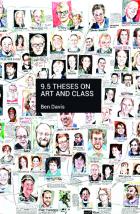
Ben Davis, 9.5 Theses on Art and Class (Haymarket Books).

Ben Davis, 9.5 Theses on Art and Class (Haymarket Books).

Finally, I read Ben Davis’ 9.5 Theses on Art and Class (Haymarket Books) in an informal book club. The book was provocative, but I’ve really enjoyed exchanging ideas with bright artists, curators and art historians in our little self-organized book club. (You can participate in a virtual book club hosted on Temporary Art Review, thus far here and here.)

Our final meeting yesterday, ended with a fascinating discussion about how our future selves might look back on this contemporary moment in art history from a post-capitalist perspective. How will we historicize this Capitalist art? What will it be like to be distanced from such narrow conditions of production?

What if artists are at the center, not the power players that Davis spends so many chapters discussing? What if I went on a 1% Art World diet, ignoring the art stars, yacht parties, the market, celebrity gossip, and auction records, how much time would I have for thinking about materials and processes?

What might a post-capitalist art world look like? What kinds of structures and institutions will artists work within? How do I turn my attention towards those alternative futures now?

Standard
Values

What not to do at a phenomenological art installation

[CURMUDGEON WARNING: This is going to be an angry, misanthropic post. I try to be optimistic and share the positive, but all my efforts yesterday could not save my experience at James Turrell’s exhibition at the Guggenheim from being marred by other viewers.

Turrell is one of my favorite artists. He creates spaces for one-of-a-kind perceptual experiences and transcendence. I went to his exhibition to restore my faith in why I make art, to be freed from mundane constraints; so I cleared my schedule on a weekday morning to avoid crowds, and I cleared my head to be receptive. When I got there, I tried to block out other viewers’ inane conversations (first mentally and then physically by plugging my ears) and ignore their persistent, distracting photo-taking and mobile device addictions. I even conducted positive self-talk about personal boundaries and controlling my psychic energy(1). But it was all for nought. Having enough physical and psychic space to appreciate Turrell’s subtle installations was impossible.

As an artist, I need viewers. But as a viewer, especially for phenomenological installations like Turrell’s, I could do without 90% of them. I know most viewers have good intentions and, by dint of being at the museum, want to appreciate art, however, I could not help but feel how selfish and self-sabotaging many viewers were at the Guggenheim yesterday. What follows is ranting and conservative—for the positive, come back another time.]


What not to do at a phenomenological art installation:

  • Take pictures when photography is explicitly forbidden. It’s disrespectful to the artist and the institution. If those entities seem too abstract to you, at least use your self-control to not disregard and thereby disrespect the guards as fellow human beings. They didn’t make the rules but they bear the brunt of enforcing them, thousands of times a day, week after week, when the rules are clearly stated.(2) While many institutions allow picture taking, it’s a privilege, not a right. Furthermore, picture-taking forces guards to verbally enforce the rules, which further distracts other viewers from the art.
  • Take pictures when photography is explicitly forbidden and the host institution has posted plentiful pictures on their website. It’s especially selfish and pointless.
  • Take pictures or use a mobile device when viewing a finely-calibrated light installation that utilizes the entire space. You are inside the artwork. Just as you wouldn’t add paint to a painting, do not add your screen’s light to a light installation.
  • Take pictures of a phenomenological, durational exhibition, whose very intention is for viewers to be present, slow down, quiet the mind, and free oneself from contemporary distractions.(3)
  • Make shadow puppets, or let your children make shadow puppets, in the light installations. There are endless places to play with shadows in the world, but only a handful in which to view a Turrell installation. Behave yourself for the same reasons that you wouldn’t climb on a marble statue at the Met.
  • Take one of the highly coveted seats inside the installation to read a newspaper or use your mobile device. If it’s an emergency and you must use your device, excuse yourself to a lobby or hallway. If it’s not, stop sabotaging your own experiences and be present! Further, to pass your time not engaging the artwork is especially inconsiderate when there are over a hundred people waiting in line outside due to the installation’s limited capacity.
  • Start up a conversation about how too many people are talking to fully experience the installation, and carry it on, contributing to the problem.

1. From Mihaly Csikszentmihalyi’s Flow:

A memo on my desk with Mihaly Csikszentmihalyi's advice for creating flow experiences: The quality of consciousness determines the quality of life. Purposeful action leads to enjoyment. Erect barriers against distractions. Dig channels so energy can flow. Do not let chance or external routine dictate what we do. Source: Mihaly Csikszentmihalyi, Flow (2008).

A memo on my desk with Mihaly Csikszentmihalyi’s advice for creating flow experiences: The quality of consciousness determines the quality of life. Purposeful action leads to enjoyment. Erect barriers against distractions. Dig channels so energy can flow. Do not let chance or external routine dictate what we do. Source: Mihaly Csikszentmihalyi, Flow (2008).

2. I probably saw over a hundred people taking pictures in the hour or so I was in Aten Reign, Turrell’s once-in-a-lifetime, site-specific installation in the Guggenheim’s iconic rotunda. Visitors blatantly felt that they did not have to follow the no-pictures rule—that their need to take a photo surpassed any of the artist or institution’s logic or any basic respect of the guard as a human being just doing his job.

This is how bias works: People understand that bias exists—but we believe that only other people are biased, whereas we think that we see things as they really are. The flaw, of course, is that if everyone else is biased, no one, including ourselves, is unbiased. In fact, we are all biased. (See Jonathan Haidt, The Happiness Hypothesis (2006).)

No photography means no photography. It doesn’t mean that other people can’t take photos.

3. Louis CK takes down mobile phone addictions beautifully on Conan: put down the device, be present, experience art, and let yourself experience real emotions.

Addictions erode self-control and the incredibly important characteristic of being able to delay gratification. The very definition of addiction is when people continue an automatic behavior out of desire, even as pleasure diminishes (see Paul Martin, Sex, Drugs and Chocolate: The Science of Pleasure). If feeding the addiction leads to selfish and self-sabotaging behaviors, self-regulation is in order. There’s a profound difference, anyway, between fleeting pleasures and lasting enjoyment.

Christine Wong Yap, Positive Sign #49 (Pleasure and enjoyment), 2011; glitter and neon pen on gridded vellum; 8.5 × 11 in./21.5 × 28 cm.

Christine Wong Yap, Positive Sign #49 (Pleasure and enjoyment), 2011; glitter and neon pen on gridded vellum; 8.5 × 11 in./21.5 × 28 cm.

Standard
Meta-Practice, Values

How to be everywhere at once, or not

Inspired by a walk around Chelsea and CAA, here are a few thoughts about how artists of a certain level are able to sustain multiple galleries and fairs…

Variations and editions

At Doug Aitken’s show at 303 Gallery, the list of works stated that all artworks, except for the site-specific installation, were multiples. Text works that could have been fabricated by sign shops were editions of four, plus two artist’s proofs. Other text works that might involve more chance, such as a piece with broken mirrors and another foam piece that was partly carved by hand, were variations, plus artist’s proofs.

The way Aiken and many contemporary other artists edition sculptures seems  pragmatic—there is so much research and development that goes into each work, and so many venues for international artists, that being able to exhibit and sell the same work is advantageous. Yet, these editioned sculptures would never be displayed next to each other, or heavens forbid, in the same fair at different booths—like the earliest fine art print editions, the whole concept of an edition is to create scarcity and value. I’m curious if collectors feel like they’re buying originals, are concerned with the fidelity to exhibition copies, or are simply less concerned with purchasing copies, especially of industrially-fabricated works.

(The show itself was dazzling in the video as well as in person, but not especially affective. I believe a critic for the New Yorker found the show to be resemble window displays, and I got the same feeling. There were intimations of destruction, but no danger. In the large hole drilled out of the concrete gallery floor, the milky water was lit from beneath, as if a hot tub. One text work was set behind a faux wall with a cartoonish circular hole cut away; the drywall was filled with pebbly rubble painted white as if on a theatrical set made of Plasticine.)

A few rules make disparate drawings a series

Of particular interest at Mark Dion at Tanya Bonokdar:

1. The vitrines with marine encrustations that were on view in International Orange in San Francisco are now highly salable objects in a Chelsea gallery. (Also, I believe  those were clearly indicated as collaborations in San Francisco, a fact not obvious in NYC.) The settings are so different I found it humorously ironic. Fort Point was bitterly cold, practically in the Pacific Ocean than abutting it. The vitrines were lit in a theatrically dim light, which minimized Fort Point’s peeling walls. At Bonokdar, the pristine gallery housed a number of vitrines and installations, all of which were perfectly installed and maintained. The change of context from the edge of the continent to the center of a commercial art world demonstrates a fluidity that contrasts greatly with so many artists I know who exhibit in odd places in the Bay Area.

2. Dion makes preliminary sketches for his various public projects and commissions—from the UK to San Francisco’s Balboa Park—in red and blue colored pencil. Who knows why, but the effect is that a room with dozens of such drawings hung salon-style looks fantastic. A simple set of rules increases the volume of exhibition-ready work.

Conflicts of Interest Vs. Conflicts of Self-Interest

At the College Art Association conference a few weeks ago, I attended a session called “The Future of Art Magazines” (see GalleristNY.com’s write-up). A comment that has stuck with me is that people play so many roles in the art strata, that it can pose dilemmas to critics. For example, critics who are also curators may worry that they can’t negatively review certain institutions that they might work with, or risk offending artists that they might curate or be asked to curate. I wondered if this was an actual conflict of interest, when the potential of a partnership is merely a potential. Perhaps it would better be phrased as a conflict of self-interest?

Of course people do this all the time. Yet the frequency of self-interested behavior doesn’t make it right—call it Darwinian, hustlin’, or playing the game, it’s also selfish, opportunistic, and small.

To be big, one must imagine that other people are big, too. That artists or administrators won’t be offended if you write a negative review with honesty and integrity. Whether others are in a position of power or not relative to yourself, people should be able to handle direct, open communication with judiciousness and discretion. In my recent correspondence with commenters on Temporary Art Review, I have been trying to encourage artists to give feedback directly to residency administrators. It seems a reasonable thing to do, except for a fear of retaliation that is not a part of the art world that I would like to participate in.

Standard
Research, Values

Off-Cuts, Part 1

In no particular order, I submit some exhibitions, passages, and ideas worth savoring. Get the stockpot ready;  offcuts are best after a low and slow simmer.

Richard Wilson’s 20:50 (1987/2012)

I’d only read about this installation involving tons of used sump oil in installation art books and on Matt’s Gallery’s website. It was a delight to stumble upon it in the Saatchi Gallery. It doesn’t look like much; but you have to be there to understand its depths (literally and figuratively).

Richard Wilson, 2050, 1987/2012. Saatchi Gallery, London.

Richard Wilson, 20:50, 1987/2012. Saatchi Gallery, London.

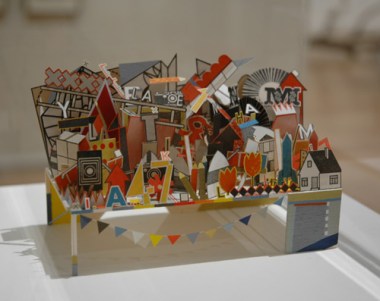
Sarah Bridgland’s papercut assemblages.

Sarah Bridgland, The Pier, 2012, paper, card, balsa wood, glue, thread, pencil, paint. On view in The First Cut, Manchester Art Gallery, Manchester, UK.

I loved this for the typographic exuberance, plus who can resist the miniature pennant flags? But have a look at Brigland’s site—the less figurative work is quieter yet lovely as well.

Seen at Manchester Art Gallery’s The First Cuts exhibition. A neat survey of works on paper by international artists. A lot of nature/tree/leaf and bird artworks—maybe too many.

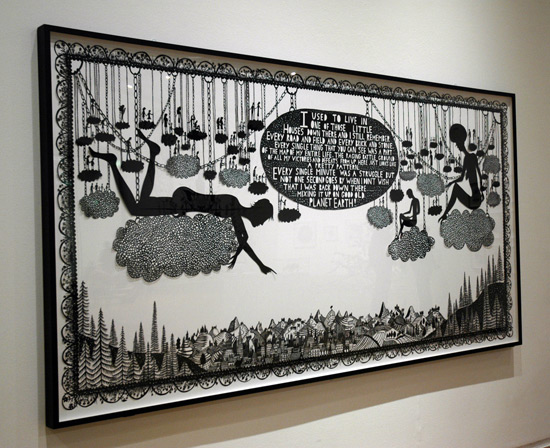
Rob Ryan‘s paper cuts.

He works in a sweet, illustrative vein, making children’s books and gift cards. Not unlike Nikki McClure.

Rob Ryan, papercut, The First Cut, Manchester Art Gallery.

Rob Ryan, The Map of My Entire Life, framed papercut, 2012. The First Cut, Manchester Art Gallery, Manchester, UK.

VIEWER FAIL.

I had the sad experience of watching museum goers fail to engage meaningful artworks. I was able to find a silver lining—which could mean I’m an optimist, finding the positive, or maybe I’m a cynic, so low are my standards.

When a group of museum goers encountered  silhouettes by a well-regarded artist, they didn’t register the horrifying narratives of slavery, rape, mutilation and vengeance. Instead, they took photos of themselves mimicking the pose of one pair—a gentleman taking the hand of a Victorian lady. Ugh!

Though I was morally outraged, I was able to find a comforting logic: If even this artist’s work can be regarded so flippantly by “viewers” (the label seems to be an overstatement in this case), then it can happen to any artist’s work. So, if it happens to my artwork, I don’t have to take it personally. It’s not my problem.

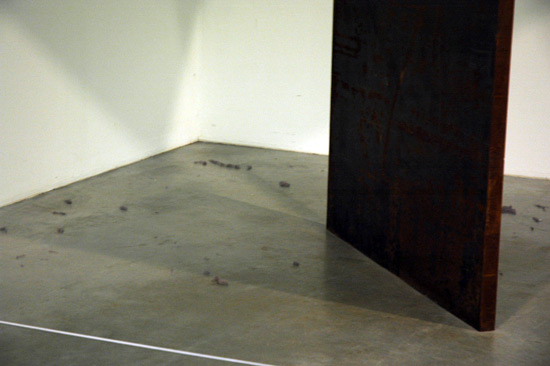
Dust bunnies under a Richard Serra sculpture at the Tate Modern. Good decision to leave it as is. Would you want to sweep under a massive sheet of steel that is not fastened to anything?

Dust bunnies under a Richard Serra sculpture at the Tate Modern. I’m glad I don’t have to sweep under gigantic, unfastened sheets of steel, and it looks like no one at TM does either.

Alfredo Jaar‘s kinetic lightbox sculpture

Brilliant. Two identical lightboxes; one hangs upside down from a motor on the ceiling. As it lowers, the room is washed with greater intensities of light, until the tables meet and seal the light inside, and the room goes dark, like a supernova, except for a fine horizon line encircling the room. A perfect Minimalist gesture, loaded with content if you consider Jaar’s interests in history, who tells it, etc.

Alfredo Jaar, Lament of the Images, 2002, motorized lightboxes. Tate Modern.

Alfredo Jaar, Lament of the Images, 2002, motorized lightboxes. Tate Modern.

Alfredo Jaar, Lament of the Images, 2002, motorized lightboxes. Tate Modern.

Alfredo Jaar, Lament of the Images, 2002, motorized lightboxes. Tate Modern.

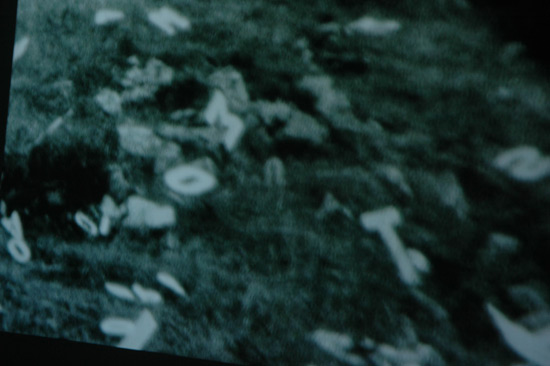
Ewa Partum

When I think of early language and conceptual art, I think of b/w photos and videos, often of white, Western men. So learning about Partum, a female Polish artist pioneering conceptual art and feminist performance in the 1960s, is exciting. More info at tate.org.uk.

Still from Poem video documentation by Ewa Partum. Tate Modern.

Still from Poem video documentation by Ewa Partum. Tate Modern.

University of the Arts London's MA Textile Arts students' massive textile baobob.

University of the Arts London’s MA Textile Arts students’ massive textile baobob.

Yinka Shonabare had some amazing public installations (love the Fourth Plinth project!) in London, and when I saw this baobob tree covered in world textiles at the Southbank Centre, I assumed it was a work of his as well. But it’s not! It’s but MA Textile Arts students. I love it, I think it’s brilliant especially in connection with this summer’s Olympics, signaling a place for the whole world to gather.

Art Update

Really became a fan of Art Update’s booklet-format gallery guide. Each neighborhood in London had its own spread: maps right next to listings.

A spread from my well-travleed copy of Art Update: London.

A spread from my well-traveled copy of Art Update: London.

I hope I never have to open any more large maps standing in the middle of the sidewalk again. I also hope I never have to sort through gallery listings not separated by neighborhood. And I hope more gallery guides indicate locations with gallery names instead of numbers.

The Liverpool Biennial had a lovely identity, but way finding was not its best asset. Why separate the map from the listings in the brochure? Why put an arrow when a location was off the map, but omit the address? There were sandwich boards announcing that you’ve found a location, but not many signs helping you get there, or find the entrance (as much needed on the Cunard Building). I walked around Flag Exchange looking for flags or an exchange, only to see that the design-conference-y tents were the artworks… <disappointment> …I think?  <Uncertainty.> It was too cold (upper 30s, and I had only a light jacket on) for me to care <indifference>.

Cheryl Strayed

From “Tiny Beautiful Things: Advice on Life and Love from Dear Sugar” (2012):

Let whatever mysterious starlight that guided you this far guide you onward into whatever crazy beauty awaits….

Something to aspire to:

What do you do when you don’t know what to do about something?

…I attempt to analyze the situation from the perspective of my “best self”—the one that’s generous, reasonable, forgiving, loving, bighearted, and grateful. I think really hard about what I’ll wish I did a year from now…. I move towards the light, even if it’s a hard direction in which to move.

And, for artists (myself included) who think of themselves upon hearing of other artists’ successes:

You know what I do when I feel jealous? I tell myself not to feel jealous. I shut down the why not me? voice and replace it with one that says don’t be silly instead. It really is that easy. You actually do stop being an awful jealous person by stopping being an awful jealous person. When you feel terrible because someone has gotten something you want, you force yourself to remember how much you have been given. You remember that there is plenty for all of us. You remember that someone else’s success has absolutely no bearing on your own. You remember that a wonderful thing has happened to one of your … peers and maybe, if you keep working and if you get lucky, something wonderful may also someday happen to you.

And if you can’t muster that, you just stop. … There isn’t a thing to eat down in that rabbit hole of bitterness except your own desperate heart. If you let it, your jealously will devour you….

I know it’s not easy being an artist. I know the gulf between creation and commerce is so tremendously wide that it’s sometimes impossible not to feel annihilated by it. … the people who don’t give up are the people who find a way to believe in abundance rather than scarcity. They’ve taken into their hearts the idea that there is enough for all of us, that success will manifest itself in different ways for different sorts of artists, that keeping the faith is more important than cashing the check, that being genuinely happy for someone else who got something you hope to get makes you genuinely happier too.

Standard
Citizenship, Travelogue, Values

Points of Reference: Utah

View from a summit outside of Park City, UT.

I just visited Utah for the first time on a collectively-organized art retreat. N invited us to share work, get feedback, talk shop, explore new landscapes and art experiences, re-connect with distant colleagues, and generally re-set. I feel blessed to have come along for the journey with such worthy shipmates and epic landscapes.

Utah’s natural landscape is an unending source of wonder and discovery. Dolomite-like mountains, luminous calcite caverns, pristine waters, dense starry skies, fat moons, salt flats—it was all stunningly beautiful, with nice people and fascinating historical sites. Here are a few highlights.

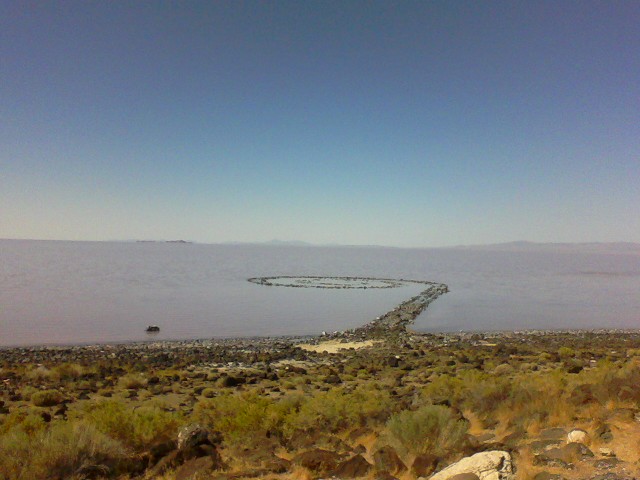
Robert Smithon's Spiral Jetty.

Robert Smithon’s Spiral Jetty.

Robert Smithson’s Spiral Jetty
Completed 1970, 1,500′ long coil 

We made an art pilgrimage. After a period of submersion, Smithson’s famous work of Land Art has partially resurfaced, and we waded out on it. It sits on a surreally pinkish part of the Great Salt Lake, with a few cartoon blots of raw oil. It’s huge, very impressive, and literally immersive. In imagining Smithson tackling this monumental work, he cuts an even larger than life historical figure.

Golden Spike National Historic Site
Transcontinental rails joined in 1869, creating rail lines 742 to 1,032 miles long

Spiral Jetty is just past the Golden Spike National Historic Site, where the Transcontinental Railroad was finished. Since Salt Lake City is synonymous with Mormons, it was eye-opening to situate the histories of other Americans, such as the Chinese and Irish immigrants who built the railroads, here too. (We also learned that we were a few hours away from the Topaz War Relocation Center, the huge internment camp that processed 11,000 Japanese Americans in WWII.)

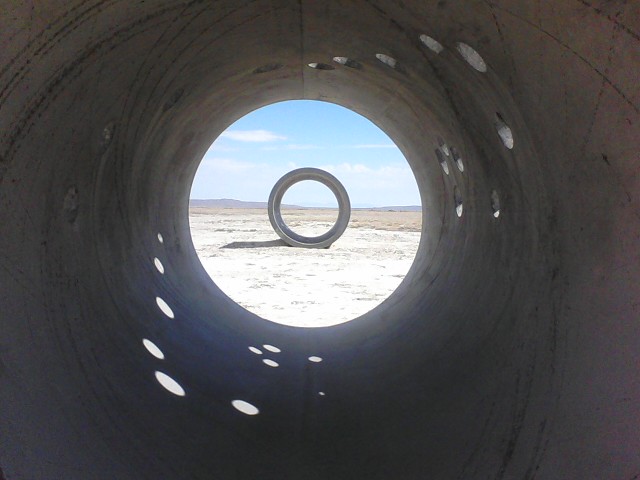
Nancy Holt's Sun Tunnels.

Nancy Holt’s Sun Tunnels.

Nancy Holt’s Sun Tunnels
Completed 1976, each tunnel 9′ diameter x 18′ length

Like a rare earth magnet, Nancy Holt’s Sun Tunnels drew us clear across the state to a remote swath of BLM land near the Nevada border. It is a really powerful, iconic work by one of the few women Land Artists. Four concrete tunnels are arranged as two intersecting lines that frame the sun on the summer and winter solstices. Each tunnel bears holes corresponding to constellations. It’s an elegant intervention in the landscape, with varied viewing and sensate experiences—even for a day visitor (imagine visiting the site at night, or on the solstices, or under snow). At the Jetty, I looked at the lake, but mostly at the jetty. At Sun Tunnels, I looked at the concrete tubes, but also considered how it framed the landscape, and how the landscape framed it. I noticed mountain ridges near and far. It made me see gaps between ridges, where salt flats lay beyond view, and horizons were too distant to see through the atmosphere. The clarity of the sky and sunlight seemed to come into focus with the tunnels. I think Sun Tunnels is worth the trek. The detour’s not small, and this recommendation not insubstantial, when you consider the four anxious hours we were stranded without cell phone service after the shale-specked roads shredded two of our tires.

Bonneville Salt Flats.

Bonneville Salt Flats.

Bonneville Salt Flats
The remains from 17,000 year old Lake Bonneville; ~12 miles long and 5 miles wide

Just over the ridge from the Sun Tunnels was this landscape marvel and heart-fluttering mecca for motor sports enthusiasts. The crunchy, crystalized earth stretched into the distance, making for a surreal aural space as well.

Anaglyph Map of the Bingham Canyon Mine and Vicinity, Utah, on display at the Center for Land Use Interpretation's Wendover Complex, Orientation Building.

Anaglyph Map of the Bingham Canyon Mine and Vicinity, Utah, on display at the Center for Land Use Interpretation’s Wendover Complex, Orientation Building.

Center of Land Use Interpretation
Founded in 1994, with field offices in six states

Nearby, the strange historical and industrial sites around Wendover, Utah, are nicely presented by the CLUI’s Orientation Building. To get there, you follow specious directions to an seemingly abandoned military base, and then punch a code into a door. There is a 3-D map of one of the largest mines in the world, an archive of notable military sites that are terrifying (the Enola Gay hangar, replica German houses for munitions tests) and odd (a cavern that servicemen outfitted with a jukebox), and notes on unimaginable environmental degradation (moving tons of earth for a few pounds of ore). You can access much of this archive online at CLUI’s Land Use Database, but I felt very grateful and honored to visit this site guarded only by a sense of commons.

Bison. Antelope Island State Park.

Bison. Antelope Island State Park.

Antelope Island State Park
Initial park creation in 1969; 15 miles long by 7 miles wide

This testament to the importance of preservation sits in the Great Salt Lake, and is home to 500 bison and numerous antelope, coyotes, jackrabbits, and birds. It was a peek into a past wildlife-filled America that will never exist again. I could not really comprehend the bison that ambled on to the road near us. It was so massive, and so unlike any other animal I’d ever laid eyes on.

Timpanagos Cave.

Hansen Cave, Timpanagos Cave National Monument.

Timpanagos Cave National Monument
65 million year old caves, ‘discovered’ 1887, National Park in 1933.

Like Antelope Island, this site in the Uinta National Forest filled me with gratitude for the visionaries who preserved such wonders for future generations. Three large caverns stoked my geology interest with their ethereal, translucent calcite formations. The area, shot through with craggy Dolomite-like peaks, evinces the drama of the Continental Drift, with oceanic matter in this high-altitude, land-locked state.

Go Parks! Leave No TraceTread Lightly.

Standard
Values

Resilience training

After a running-related injury earlier this year, I’ve been whining about losing the little speed and endurance I gained last season. Instead, I should be glad to remain injury-free. I should be grateful for so many things—what I have, and what I’ve been spared.

Running abounds with inspiring stories of resilience. You think you have pretty good excuses about why you can’t run today, or why you can’t faster, longer or more, but then you hear about people who overcome hurdles—in running and in life—much bigger than your own, and go on to achieve much more. By their feats, they give perspective and motivation.

The 2012 Olympics Track and Field events has featured some amazing stories. Here are the ones I’m most moved by:

The US took second place in a qualifying heat for a 4 x 400 relay race—after Manteo Mitchell ran half of his race on a fractured leg. Mitchell knew his leg was hurt, yet his performance gave no indication the the pain he was in: see a video of the race. (How fast did he run? 400 meters in 46.1 seconds. That’s over 19 MPH!) Interviewed on BBC World Service earlier today, Mitchell was a class act, speaking with high regard for his teammates, and optimistic that his team will do well in the finals even without him.

Of course, there’s Oscar Pistorius, the South African “Blade Runner.” Pistorius’ lower legs were amputated at the age of 13 months; I’d heard about him first via nasty accusations that his prosthetics gave him mechanical advantages. Having won in the ParaOlympics, Pistorius dreamed of running in the Olympics. Here’s a video of him in the 400 meter semifinals. He doesn’t qualify to move on to the finals, but he’s humbled by the chance to fulfill his dream. The race winner exchanges bibs with him in a gesture of fellowship.

Kellie Wells takes bronze in the 100m hurdles. Wells suffered a major injury (torn hamstring), but that’s just the beginning of it—she overcame significant abuse and childhood tragedies. She came public with her story for the sake of other victims of abuse. In a great race, she became an Olympic medalist, and also, despite the individual nature of the competition, and the highly nationalistic context, she shared congratulatory hugs with the other runners. Kellie Wells is huge. I’m a fan.

Everyone runs their own race, in life and in sport. I love this video of the women’s 100 meter, especially the runners’ level view at 2:45. Look at how fast they’re going! Then keep in mind all the obstacles women runners have faced. (Here’s a great slide show of female groundbreakers at the Boston Marathon.) Olympic running events were only opened to women in 1960, and the first women’s marathon wasn’t until 1984. (And of course, 2012 marks the first year of women’s Olympic boxing.) There’s so much more to come…

Standard
Research, Values

Cultivating Indifference to Toil

Jiro Dreams of Sushi* is a documentary film about Jiro Ono, a three-star Michelin chef who runs a small sushi restaurant in Tokyo. What emerges from the portrait is an unending search for perfection; Jiro is 85 years old and is not interested in retiring. Jiro’s philosophy of his success is pure rigor—get up and do the same thing every day, but try to make it better every day. It’s not OK to make it just as good as last time.

Westerners might call this level of commitment passion or obsession, yet Jiro seemed to transcend emotion. He didn’t seem crazy or myopic. He was just astoundingly hardworking and rigorous.

Jiro also talked about choosing a line of work and loving it, and never complaining about it. This really struck me. As an American, my conversational style is casual, emotional, and revealing. As a New Yorker, I’d love to be the New Yorker type that thinks that everything is fabulous; I’m not. And as an artist, I can feel challenged working with partners with differing time lines, communication styles, and priorities. But this is a good reminder to be grateful for all the opportunities to make art, work as an artist, and share my thoughts and projects. There is much more to think about beyond the constraints.

*Watch the trailer.

Standard