Sights

see: Nam June Paik and Ai Wei Wei retrospectives at the Smithsonian

Looks like the Smithsonian’s art programming is going to force my hand to act on my daydream of visiting DC. Both of these retrospectives sound too good to miss:

Nam June-Paik: Global Visionary
American Art Museum
Through August 11, 2013

Ai Wei Wei: According to What?
Hirschhorn Museum & Sculpture Garden
Through February 23, 2012

Standard
Sights

noted: yvette mattern’s global rainbow

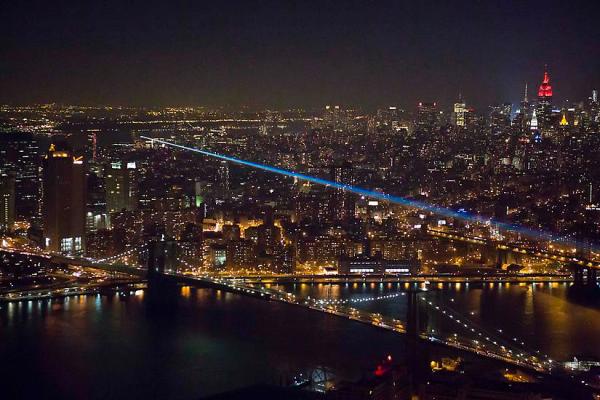
I missed the Art Production Fund’s presentation of Yvette Mattern’s Global Rainbow laser light public art project in New York. Projected from the top of the Standard hotel towards the Rockaways, the film and video artist dedicated the project to those recovering from Hurricane Sandy. I would have loved to see this in person.

Yvette Mattern, Global Rainbow, 2012, lasers across New York City. Photo by James Ewing. Art Production Fund // Source: http://artproductionfund.org/projects/yvette-mattern-global-rainbow

Yvette Mattern, Global Rainbow, 2012, lasers across New York City. Photo by James Ewing. Art Production Fund // Source: artproductionfund.org


Standard
Research, Sights

On the Fungibility of Language: Forensic Linguistics, plus Performance Art

As an artist who works with text, I’m always fascinated with the fungibility of language.

Jack Hitt parses the gap between spoken word and constructed meaning in his article about forensic linguistics (“Words on Trial,” New Yorker Magazine, July 23, 2012):

Most people assume that meaning is embedded in the words they speak. But, according to forensic linguists, meaning is far more vaporous, teased into existence through vocalized puffs of air, hand gestures, body tilts, dancing eyebrows, and nuanced nostril flares. The transmission of meaning still involves primate mechanics worked out during the Pliocene era. And context is crucial; when we try to record a conversation, we are capturing only part of the gestalt of that moment….

According to (retired F.B.I. forensic linguist James) Leonard, words serve as catalysts, setting off sparks of potential meaning that the listener organizes into more specific meaning by observing facial expressions, body language, and other redundant cues. We then employ another powerful tool: prior experience and the storehouse of narratives that each of us carries—what linguists call “schema.” To every exchange we bring unconscious scripts; as any given sentence unspools, we readjust the schema to make better sense of what we are hearing….

Meaning, Leonard noted, is constantly bend by expectation, and can be grossly distorted.


Likewise, I was excited to hear about this performance along the same theme…

August 9, 10 & 11 @ 8:30 pm.
Emily Mast: B!RDBRA!N
REDCAT, Los Angeles

Originally conceived of for Pacific Standard Time, B!RDBRA!N is a series of vignettes that form a live collage based on the juxtaposition of an accumulation of highly stylized details that all relate to channels of communication in which language is problematic, challenging and/or inappropriate. I have been working with a stuntman, a stutterer, a sign-language interpreter, an actor, an auctioneer, a comedian and a child to investigate and interrogate language as a prop onto which we project meaning, language that hides or deflects meaning and all-out rebellion against words.

Standard
Sights

how’s this for irrational exuberance

I am working on projects relating to the themes in Irrational Exuberance (Asst. Colors), a shop-like installation of modest ambitions and accessible pleasure. This video of last night’s fireworks show in San Diego, in which all of the pyrotechnics were accidentally activated all at once, instead of a leisurely, choreographed set, sort of captures the mood: perhaps a bit daft, yet irrepressibly cheerful.

Standard
Sights

The Third Paradise presented by Cittadellarte – Fondazione Pistoletto

I love Italian Arte Povera artist Michelangelo Pistoletto’s screenprints on mirror-polish steel.

I also really enjoyed theorist Claire Bishop’s book, Installation Art: A Critical Survey (Routledge, 2005).

While Pistoletto is well-known for his mirror pieces, he has also been creating Cittadelarte, a non-profit with numerous working groups re-imagining art, life, work and more. I’m not quite sure I understand what it is, as much as glean a sense of revolutionary possibility from it. I thought I’d visit if I ever make my way to Italy, but it turns out I don’t have to go there to participate. See below for a worldwide Cittadelarte participatory program coming this December.

Bishop, on the other hand, is no fan of participatory art, and is in fact launching her latest book, Artificial Hells, at CUNY’s Martin E. Segal Theater tomorrow night.

Hold these opposing thoughts in your mind, if you can:

June 26, 2012, 6:30–7:30pm
Artificial Hells Book Launch
Martin E. Segal Theatre, 365 Fifth Avenue, New York, NY 10016

A searing critique of participatory art by an iconoclastic historian

Join art historian Claire Bishop and Carrie Lambert-Beatty in conversation at the Martin E. Segal Theatre to celebrate the launch of Bishop’s new book, Artificial Hells: Participatory Art and the Politics of Spectatorship.

Since the 1990s, critics and curators have broadly accepted the notion that participatory art is the ultimate political art: that by encouraging an audience to take part an artist can promote new emancipatory social relations. Around the world, the champions of this form of expression are numerous, ranging from art historians such as Grant Kester, curators such as Nicolas Bourriaud and Nato Thompson, to performance theorists such as Shannon Jackson.

Artificial Hells is the first historical and theoretical overview of socially engaged participatory art, known in the US as “social practice.” Claire Bishop follows the trajectory of twentieth-century art and examines key moments in the development of a participatory aesthetic. This itinerary takes in Futurism and Dada; the Situationist International; Happenings in Eastern Europe, Argentina and Paris; the 1970s Community Arts Movement; and the Artists Placement Group. It concludes with a discussion of long-term educational projects by contemporary artists such as Thomas Hirschhorn, Tania Bruguera, Paweł Althamer and Paul Chan.

Since her controversial essay in Artforum in 2006, Claire Bishop has been one of the few to challenge the political and aesthetic ambitions of participatory art. In Artificial Hells, she not only scrutinizes the emancipatory claims made for these projects, but also provides an alternative to the ethical (rather than artistic) criteria invited by such artworks. Artificial Hells calls for a less prescriptive approach to art and politics, and for more compelling, troubling and bolder forms of participatory art and criticism.

Via Art Agenda:

21 December 2012
Michelangelo Pistoletto

The Third Paradise
cittadellarte.it
rebirth-day.org

Rebirth-Day: the first worldwide day of rebirth
A great celebration throughout the world—a vital, living, breathing symbol of a new beginning.

December 21st, the winter solstice in the northern hemisphere and the summer soltice in the Southern, is a day celebrated by mankind since time immemorial.

A fateful “end of the world” connotation, as widespread as it is unfounded, has been attributed to this day in 2012, proposing a theme that is recurrent in mythologies and religions as well as in the literature of fantasy and science fiction.

All imaginative factors aside, this date can take on a symbolic meaning, as it effectively corresponds to a climactic phase of human history. We are progressing steadily toward an inevitable collapse—the science is there to prove it.

The whole of human society is now in the reckoning and so must face a historic transition, a complete change.

Humanity has gone through two paradises. The first, in which it integrated fully with nature; the second, in which it expanded into an artificial world of its own, which grew until it came into conflict with the natural world. It is time to begin the third stage, in which humanity will reconcile and unite nature and artifice, creating a new balance at every level and in every area of society: “an evolutionary step in which the human intelligence finds ways to live in harmony with the intelligence of nature” (Michelangelo Pistoletto).

A new perspective opens up that involves everyone, without exception, in the daily effort to implement the process of rebirth—each according to his or her abilities and possibilities.

On 21 December 2012, let us meet in streets and squares all over the world, and on the Web, to take part in the great inaugural celebration of the Third Paradise.

Participation in the Rebirth-day represents a personal commitment to the process of change….
Standard
Sights

See: Common Ground @ City Hall Park, Lower Manhattan

I just spent the past few days assisting an artist producing a massive concrete sculpture for Public Art Fund’s upcoming exhibition. If the other projects in the show are as ambitious the one I worked on, it’s going to be very inspiring.

May 24–Nov. 30, 2012
Common Ground
Public Art Fund
Elmgreen & Dragset, Ian Hamilton Finlay, Roger Hiorns, Jenny Holzer, Matthew Day Jackson, Christian Jankowski, Justin Matherly, Paul McCarthy, Amalia Pica, Thomas Schutte
City Hall Park
, Bordered by Broadway, Chambers Street, Centre Street, and Park Row, NYC
Opening: Wednesday, May 23, 2012, 5:30 – 6:30pm
Performance at 5:45pm // Remarks at 6:00pm

Throughout history, art in the public realm has been a means to represent common beliefs, values, and ideals. However, in our own diverse and pluralistic society, we value art most highly as the expression of a unique personal vision. Common Ground brings together the work of an international group of contemporary artists, each with a strikingly original artistic language and a strong engagement with the civic role and context of public art.

Standard
Sights

see: Michael Jones McKean’s The Rainbow

Last year I started running a loop that spanned the East River, and I got the crazy notion of creating a massive rainbow connecting Queens and Manhattan, without the slightest notion of how to manifest such an art project. Luckily, I don’t have to; another artist has figured out how to, in Omaha.

Michael Jones McKean, The Rainbow, 2011 (test).

Michael Jones McKean, The Rainbow, 2011 (test). Source: Art-Agenda.com.

June 1–September 15, 2012
Michael Jones McKean
The Rainbow: Certain Principles
of Light and Shapes Between Forms

Bemis Center for Contemporary Arts
724 S 12th Street, Omaha, Nebraska 68102
Opening weekend: June 21–23

Michael Jones McKean’s The Rainbow: Certain Principles of Light and Shapes Between Forms creates a simple but phenomenal visual event—a rainbow in the sky. The public artwork will produce temporary rainbows above the Bemis Center using the most elemental materials: sunlight and rainwater. Twice per day with clear sun, for 20 minutes each, a rainbow will appear above Bemis Center’s downtown building.

A rainbow operates as an egalitarian visual experience. It is by nature temporary, undetermined, and wonderful. The Rainbow exists somewhere between real and representation, actual and artifice. McKean is deeply interested in the rainbow as a complex form—ephemeral and steeped in mythology—that possesses an out-of-time existence as pure optical phenomena. The image of a rainbow extends through time, surpassing our known and archived histories, and operates as a constant unchanged form. Although the symbol of a rainbow has been co-opted, politicized, branded, and commodified, an actual prismatic rainbow still has an ability to jolt us from the everyday. It feels hopeful, yearning, optimistic, ghost-like, and meaningful.


Standard