Art & Development, Research, Travelogue

Mancunian slang and temperments

Mancunian Slang Adjective Flash Drawings: Stroppy, Naff, Scally, Grotty, Mardy Ink on six ready-made fluorescent yellow die-cut papers 12 x 7.5 inches each; 37 x 50 inches assembled. Produced during the Breathe Residency at Chinese Arts Centre

Mancunian Slang Adjective Flash Drawings: Stroppy, Naff, Scally, Grotty, Mardy Ink on six ready-made fluorescent yellow die-cut papers 12 x 7.5 inches each; 37 x 50 inches assembled

One of the things I’ve been researching during the Breathe Residency is Mancunian slang and temperaments. (Mancunian means of Manchester, for you Yanks). Manchester is known as a rainy post-industrial city, but I’ve found its emphasis on cultural life and development to be very forward-looking. It’s sort of like an English Detriot or Oakland–perpetually stuck between an unrecoverable past and a difficult-to-realize future, but with glimpses of hope all around.

The first thing I noticed about Manchester is the accent–broad, flat vowels, and the way words like “early” (“arr-lah”) feel flipped around to me. The next thing I noticed is the colorful slang.

I did some drawings that attempted to quantify the Mancunian temperment by taxonomizing the slang words that I heard by chance. In other words, I noticed that there were more slang words to describe displeasure, than there were to describe pleasure.

Above, an initial early version of the project. For the benefit of my fellow Americans, here’s a run-down:

Stroppy and mardy are both unpleasant characteristics, sort of irritable, uncommunicative, whiny. Many Brits are surprised that Americans don’t use the word stroppy. Maybe in an Anne of Green Gables book, but not in Oakland.

Naff means not good. Janky might be a good American corollary.

Scally means chav, a young Briton who’s adopted American hip-hop style, generally regarded as tacky, trashy, low-life. They are usually described as wearing trackie bottoms (track suit pants), flat caps (baseball hats), trainers (sneakers) and Burberry hats, though I haven’t seen any Burberry hats in Manchester. There are connotations of class, Northerner-ness (city mouse v. country mouse?), and probably racial ones, too, but I don’t know enough about it.

Grotty means dingy. It’s also used like the American slang adjective, ghetto.

Another word I heard was wanky, which is just a short way of saying like a wanker.

I only heard a few slang words that were positive:

Chuffed means enthusiastic, e.g., “I’m not too chuffed about it myself.”

As in America, Wicked means cool, e.g., “Hey, I’ve got an open studio coming up.” [Hands over a postcard.] “Wicked.” I’ve only heard it once or twice, which I attribute to a reluctance to express unbridled enthusiasm.

Sorted means sorted out, e.g., “Have you got it sorted?” or “Did you eat?” “Yeah, we went to Pizza Hut. Sorted.”

One more phrase is necessary to round out this list.

All right is the typically lukewarm, understated Mancunian way of expressing approval or appreciation. It can mean anything from OK to great. E.g., a Mancunian could enjoy an event, and describe it as “all right.”

This is in contrast with the American usage, which expresses neutrality or can even be a euphemism for bring underwhelmed, e.g., “How was ‘Marley and Me’?” “It was all right.” “Hm, didn’t really do it for you, huh?”

—–

The Manc temperment is partly explained by the Northern identity. In England, a North-South divide signifies cultural differences as well as disparate levels of prosperity and health indicators.

For those interested in learning more about the north of England, I’d recommend these starting points:

Stuart Maconie’s Pies and Prejudice: In Search of the Great North, which I blogged about before.

Time Shift – Series 8 – The North-South Divide, an interesting hour-long BBC documentary.

HearManchester.com, which I also mentioned in a previous blog

Zeitgeist, a Salford University-produced arts and entertainment TV program. Watch past episodes online.

Standard
Art & Development, Research

artists talking about their own art

My appreciation for artists who talk about their practices with enthusiasm and curiosity, and are able to articulate their references and ideas, only intensifies. Last Tuesday, I heard the Scottish artist, Dave Sherry, present his work at the Tuesday Talks series at the Whitworth Gallery. Before his lecture, I poked around Sherry’s web site a little. The performances seemed so inconsequential, and drawings and documentation so haphazard, I was skeptical. Is this just another (white) jokey Conceptualist skating by on a boy-genius aura?, I thought. Fortunately, Sherry gave a great talk, interspersing images of his own work with historical reference points that lent his slight gestures the credibility of an established lineage, which includes Ceal Floyer, David Hammons, Bruce Nauman and Martin Creed. Sherry’s talk was well organized and extensive. He also went above the call of duty and conducted a live performance. It was short (maybe 5 minutes?) but with its Beckett-influenced repetition and absurdity, it demonstrated Sherry’s physical mastery and endurance. Learn more about Sherry at his site. I’m especially partial to “Looking through Tom Cruise’s Eyes” (2005) (rollover the thumbnails).

I’m also really impressed with Joseph Kosuth’s Meet the Artists lecture at the Hirshhorn Museum (mp4). Many artists present their work with only rote descriptions (“This slide is of a project I did in 1988”). Descriptions are often necessary, but without a narrative to stitch it together, the lecture can become soulless and awful. Kosuth, on the other hand, presented his work way of an astute art history and theory paper. It’s dense and I’d recommend it — if you can devote an hour of your full attention.

So I’m really excited to check out Verissage.TV art television.

Standard
Research, Travelogue

Fareed Zakaria’s The Post-American World

Global economic collapse.
The quagmire in Iraq.
Anti-American sentiment.
China, the sleeping dragon, asserting itself.

There are so many geopolitical reasons to be anxious, afraid and pessimistic. Like many Americans, I’ve been feeling a foreboding sense of decline. In The Post-American World, Fareed Zakaria* argues that America will not be the same kind of lone superpower it has been, but we have many reasons to be optimistic. Indeed, he posits that if the US faces the coming challenges with cooperation and adaptability, we can help shape a secure, prosperous post-American world.

The post-American world is “not about the decline of America but rather about the rise of everyone else,” Zakaria writes. Globalization and rising economic powers means that past paradigms (“integrate with the Western order, or reject it”) no longer apply. As he puts it, “The world is moving from anger to indifference, from Anti-Americanism to post-Americanism.” China and India are becoming major players. They will work to secure their interests and expand their influence. It’s not that the American share of the pie will get smaller, but the pie itself will get bigger.

After all of the boosterism, accusations, and cynical “othering” around the 2008 Beijing Olympics, I found Zakaria’s perspectives on China quite refreshing. China’s rapid growth has caused some Americans to fear China as an evil, inscrutable state. But Zakaria argues that the Chinese government is not intentionally malicious — its major priority has been non-confrontational economic growth, which has lifted millions out of poverty in the past 30 years. Furthermore, Chinese manufacturing flourishes, but it’s not a threat to America yet, as Americans are good at innovation and adding value. We benefit from the high profit areas of development and retail/marketing.

Innovation, of course, is key to growth, and growth is more critical for future success than wealth. For example, when Europe was reeling from the Black Plague, China could have led the world in discovery and innovation. Instead, it closed itself off, and disregarded new technologies.

Another country that paid a dear price for failing to innovate is Great Britain. It was known as the world’s workshop in the 19th century, but failed to compete against U.S. innovation in the 20th century.

But America is different; our economy demonstrates unique advantages. Even though “The Post-American World” was published before the mortgage crisis led to bank collapses, I suspect that the author would still maintain his optimistic views. Despite all our problems, the U.S. economy — however weakened — is still the largest in the world (comprising a quarter of the world’s G.D.P.).

There’s our “demographic vibrance.” As Zakaria points out, “Europe presents the most significant short-term challenge to the U.S. in the economic realm,” but Europe’s population is declining, and unlike the US, it is reluctant to allow and assimilate immigrants. Zakaria asserts, “America’s edge in innovation is overwhelmingly a product of immigration” and “this is what sets this country apart from the experience of Britain and all other historical examples of great powers.”

Then there’s our technology and innovation. Zakaria dispels the myth that our students are outperformed by foreign counterparts. The averaged statistics mislead (or rather, they reveal the inequality in our schools). Still, many of the top universities are located in the U.S., which attract top talents from around the world. We should retain them, too, instead of implement regressive immigration policies.

Unlike Great Britain, whose biggest challenge in maintaining its superpower was economic, Zakaria argues that America’s biggest challenge is political. He says that the post-American world will be multi-polar world. America can help this world be prosperous and stable by taking an active role, guided by principles of cooperation, consultation and compromise. The U.S. can’t make exceptions for itself when it comes to rules like nuclear weapons. The U.S. can’t solve all the world’s problems, but some larger problems, like climate change, require an organizer, and only if the U.S. maintains great relationships with all countries, can it be a successful facilitator. The U.S. must stop cowering in fear from terrorists (and overreacting to them), asserting its military might when diplomacy would do, re-gain its confidence, become open and inviting again, and re-gain legitimacy.

I think Zakaria is saying: It’s not only possible, but necessary, to approach the future with optimism.

Will America be optimistic, and take these steps towards mutual respect and collaboration? I hope so. Next on my optimism/pessimism reading list: Barack Obama’s Dreams of My Father.

*A note about ideology: I think Zakaria makes many valid points grounded in research, reason and pragmatism. This should be adequate grounds for discussing his ideas; I hope ideology doesn’t get in the way of discourse. Some progressives may not find Zakaria sufficiently leftist, but I think that’s a poor reason for discrediting his work. I value his rigor in making clear, persuasive arguments. For example, when John McCain threw a Hail Mary and nominated Sarah Palin (and successfully galvanized the right), it seemed like lefties couldn’t recover from the sheer audacity. They hysterically bashed Palin amongst themselves, instead of responding productively and bringing the conversation back to real issues. So when Fareed Zakaria published an editorial articulating why Palin is bad for America, I took note.]

Book Review by Josef Joffe, NYTimes

FareedZakaria.com

Excerpt, Newsweek

Standard
Art & Development, Research

Graphic design for art institutions

One of the things I am really enjoying is the top-notch graphic design employed by so many art organizations in the UK—it’s not an afterthought, even among governmental organizations!

Loving:

The Tate logo

The Bluecoat’s printed ephemera

A Bluecoat catalog (left) and calendar (right).

A Bluecoat catalog (left) and calendar (right).

This handsome poster exterior from the Castlefield Gallery (an artist’s run org; believe it!)

Poster/brochure face from Castlefield Gallery

Poster/brochure face from Castlefield Gallery

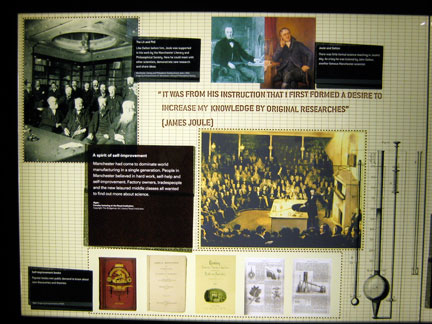
The amazing exhibition design at the Museum of Science and Industry.

Lightbox in science wing of MOSI.

Lightbox in science wing of MOSI.

More illumnated didactic texts.

More illuminated didactic texts.

This isn’t graphic design, but it’s still brilliant exhibit design.

Video holograms projected into dioramas tell historic scientists' stories from the first person. Brilliant!

Video holograms projected into dioramas tell historic scientists' stories from the first person. Brilliant!


A high-tech counterpoint to Manila's Ayala Museum.

Standard
Research

I enjoy taking photos, but I only find satisfaction from printed photographs on occasion. I find the idea of presenting my own photos fraught with pitfalls. So I’ve turned to books for help.

Roland BarthesCamera Lucida: Reflections on Photography (translated by Richard Howard {Hill and Wang, 1981}) is a primer in the study of photographs and semiotics. It’s also a good starting point because it’s Barthes’ personal investigation of the photograph, written in the first-person and in the present-tense. He begins with his understanding of the photograph and concludes with an examination of the role of photographs in his grieving process for his late mother.

James Elkins, though, has criticized Barthes for taking too sentimental an approach to photographic theory. Elkins’ books include:

Visual Studies: A Skeptical Introduction
Master Narratives and Their Discontents
What Happened to Art Criticism?
Why Art Cannot be Taught
On Pictures and the Words That Fail Them

These polemical titles may seem off-putting, but I admire Elkins’ rigor and multi-disciplinary scholarship. I’ve taken a crack at his latest book, “Six Stories from the End of Representation: Images in Painting, Photography, Astronomy, Microscopy, Particle Physics, and Quantum Mechanics, 1980-2000” (Stanford University Press, 2008) and it’s quite good. He reviews principles in modernism and postmodernism, such as a historical and Kantian definition of the sublime, in contrast to the “overused” Romantic notion. He also identifies artistic strategies in modernism and postmodernism, including “The Ladder,” with which an artist descends into darkness, leaving behind the clarity of illusionistic representation. Lower rungs of the ladder include the strategies of the blur and darkness.

Elkins’ writing is methodical and exact, so one can understand why he is so critical of vagaries in art. He writes about some art that uses darkness and blurring:

The problem is that as it stands, much of the work is mediocre. The critical literature follows this lead, providing impressionistic commentaries on belatedness, the loss of memory, the affection for clumsiness, faint melancholy, the embrace of meaninglessness, obsolescence, the departure of the aura, sophisticated evasions, missing objects, ineffective repressions, loss of space, loss of language, hopelessness.

He’s right. The “loss of memory” is overused to justify decrepitude as a visual style. And so much of the stylized, narrative drawing around the Bay Area (you know what I’m talkin’ ’bout–those screenprints of telephone poles!) is romanticism masked as cultivated urbanity, and touches on similar vagaries — melancholy, obsolescence, the affection for clumsiness.

Most compelling, though, is Elkins’ methodological approach of trying to bridge the humanities with the sciences. Far from the other vague art cliché, “nature versus technology,” Elkins has the chops to execute a rigorous study of astronomy, miscroscopy, particle physics and quantum mechanics. Having recently studied astronomy for the Binary Pair project, I’m looking forward to delving into this chapter.

Standard
Research, Values

Odds and Ends

r+d‘s got a new look, as do my Web sites for my art and design practices.

The past few weeks have flown by. Election euphoria gave way to economic meltdown despair, which vies for attention alongside holiday shopping and business as usual. Keeping one’s head above water as an artist seems not so bad when everyone else has been thrown into instability.

What I’ve been up to:

An art review. Forthcoming.

Reading about photography, and feeling out of sorts. From Roland Barthes’ Camera Lucida:

What I want, in short, is that my (mobile) image, buffeted among a thousand shifting photographs, altering with situation and age, should always coincide with my (profound) “self”; but it is the contrary that must be said; “myself” never coincides with my image; for it is the image which is heavy, motionless, stubborn (which is why society sustains it), and “myself” which is light, divided, disperse; like a bottle-imp, “myself” doesn’t hold still, giggling in my jar: if only Photography could give me a neutral , anatomical body, a body which signifies nothing!

Sketch comparing the gap between material and ineffable as described by Daniel Spoerri and Roland Barthes

Sketch comparing the gap between material and ineffable as described by Daniel Spoerri and Roland Barthes

I was surprised to learn that the phrase “Camera lucida” is Latin for “lit room.” In a camera obscura, a room with a pinhole displays an image, functioning like the cameras we know today. But in a camera lucida — a drawing tool comprised of a mirror and a semi-silvered (or two-way) mirror — the lit room is the scene for not just an image, but for the artist, drawing substrate and subject. This emphasis on context — on the whole picture — resonates with my work, which has become less about discrete objects and more about the viewers’ engagement with the object in the gallery (another lit room, a space for viewing — a lucid camera of the mind?).

Claude glasses, thanks to Elizabeth Mooney‘s recent show at McCaig Welles Rosenthal

Consume; think again. This financial crisis/recession/whatever sucks. But I think a period of consolidation is not bad if it takes American hubris down a notch, and forces consumers to shift towards simpler, less toxic, more meaningful lifestyles. It seems to me that American consumers were in denial about the difference between what we want, need, and are entitled to (as are the auto industry giants — and see where that got them).

Like the Rolling Stones song goes: You can’t always get what you want, but you get what you need.

Consume with care. Ironically, Christmas muzak pervades but social institutions are likely to suffer this year due to the economic slowdown. As David Brooks pointed out on the NewsHour with Jim Lehrer today, during recessions, memberships to social institutions fall. The tenor of the news suggests that consumers owe it to retailers to keep shopping as usual and to help major corporations stay afloat. I disagree. I’m trying to do my part by doing my holiday shopping at non-profits, alternative art spaces and local art sales.

There’s a gazillion ‘What to give’ lists out there, showing off precocious lamps and gratuitous gadgetry, but here’s a list of for arts-minded locals:

LOCAL SALES:
Lots of alternative art spaces are having holiday fairs and sales — here’s a sample:
Blankspace Gallery
Compound Gallery
Rowan Morrison Gallery
Richmond Art Center
The Lab
Root Division

ONLINE:

Memberships to cutting-edge art organizations.
Basic memberships start at $35-65; get a full year of free or discounted admission to gallery exhibitions and/or performances, film screenings, talks… e.g.,
Southern Exposure
YBCA
Kearny Street Workshop
Intersection for the Arts
Headlands Center for the Arts
Recipient uninterested in art, you argue? Luckily, there are museums and organizations specializing in craft, design, photography, cartoons, cars, you name it!

Tickets to the opera or ballet.
(SF city arts budgets would be halved under Supe. Peskin’s budget proposal, warns SFGate. Boo Peskin! Yeah for Obama (read the Obama-Biden arts platform [PDF]) and Michael Chabon (read his postamble to the platform)!)

Not sure what seats to purchase? The SF Ballet offers gift certificates in increments of $25.

Single tickets for the SF Opera, which will feature Gershwin’s Porgy and Bess next summer, start at $16-18.

Standard
Research

Rochelle Steiner Lecture at CCA

Rochelle Steiner, Director of the New York-based Public Art Fund, gave a lecture tonight at CCA. The Public Art Fund is a non-profit organization that commissions new, temporary works of public art by contemporary artists. You have heard of Olafur Eliasson’s Waterfalls project, perchance? That was them.

I came away really impressed with the Public Art Fund’s work. The organization thinks of itself as a museum without walls, so their public works rotate after six months. Developing a new work could take years, so their commitment to keeping the art temporary is admirable.

Steiner showed Public Art Fund projects by big-name artists—Alex Katz, Mark di Suvero, Juan Munoz, Jenny Holzer, Anish Kapoor (whose Sky Mirror in Rockafeller Center might be one of the most brilliant public interventions I’ve seen), Chris Burden—so I was familiar with all of the artists. I must have been looking for art that seemed incongruous with the artists’ oeuvres, because I was a little surprised that it all looked like contemporary art. I guess I was expecting some public art works to have more of a “community art” feel. More modest, pictorial, “easier.” But it didn’t. And I think that’s wonderful. The work is top-notch, the kind of thing that audiences would flock to at the Venice Biennale. Of course, it was public art for New York, free for anybody walking by to take a gander at, and made in collaboration with city agencies or corporations, yet I didn’t see any signs of compromise, of the urge to dumb down the art for general audiences, or to simplify elaborate installations.

Lest you think that the Public Art Fund is all highfalutin’, they also do educational outreach. In the Waterfalls project, they developed, printed and distributed a curriculum to NYC classrooms, and developed boat and bicycle tours. Steiner also listed the huge economic benefit to the city. Of the Waterfalls’ $15.5 million budget, the City gave a $2m grant; but the economic impact in tourism, boat trips, etc., centered around Lower Manhattan, is estimated to be around $60m. (Not that I think art’s aesthetic payoff isn’t enough.)

I left the lecture with one small regret—there are no equivalents in the Bay Area, no nimble public arts non-profits free from the problematizing consensus-building that dominates civic agencies.


Ann Pasternak, Director of Creative Time, is talking at UC Berkeley’s Kroeber Hall on Nov. 24. Don’t miss it.

Standard
Research

Recent writing on art

Clear. Consistent. Coherent. Concise.
—A note seen taped to a journalist’s computer

As a writer, I’m more journalistic than academic. I’m drawn to elegant brevity. I believe that criticism can be both intellectually engaging and beautifully written. See examples below.

Excellent writing on art, culled from recent mainstream publications:

Malcolm Gladwell, “Late Bloomers” (NewYorker.com) October 20, 2008.
Why do we equate genius with precocity? Gladwell asks. He examines two case studies — Picasso (young genius) and Cezanne (late bloomer), and the writers Jonathan Safran Foer (young genius) and Ben Fountain (late bloomer) — and suggests the conventional wisdom that artistic talent is innate is a disservice to late bloomers, who require more time to mature and create their greatest work.

This is the vexing lesson of Fountain’s long attempt to get noticed by the literary world. On the road to great achievement, the late bloomer will resemble a failure: while the late bloomer is revising and despairing and changing course and slashing canvases to ribbons after months or years, what he or she produces will look like the kind of thing produced by the artist who will never bloom at all. Prodigies are easy. They advertise their genius from the get-go. Late bloomers are hard. They require forbearance and blind faith. (Let’s just be thankful that Cézanne didn’t have a guidance counselor in high school who looked at his primitive sketches and told him to try accounting.) Whenever we find a late bloomer, we can’t but wonder how many others like him or her we have thwarted because we prematurely judged their talents. But we also have to accept that there’s nothing we can do about it. How can we ever know which of the failures will end up blooming?

Impressively, Gladwell arrived at a conclusion that no one likes to talk about, but is a difficult real-world lesson artists often learn along the way: Not only must late bloomers persevere for decades on end, so must their patrons — or, in the case of Ben Fountain, and many artists I know (ahem!) — their spouses and families.

Sharie was Ben’s wife. But she was also—to borrow a term from long ago—his patron. That word has a condescending edge to it today, because we think it far more appropriate for artists (and everyone else for that matter) to be supported by the marketplace. But the marketplace works only for people like Jonathan Safran Foer, whose art emerges, fully realized, at the beginning of their career, or Picasso, whose talent was so blindingly obvious that an art dealer offered him a hundred-and-fifty-franc-a-month stipend the minute he got to Paris, at age twenty. If you are the type of creative mind that starts without a plan, and has to experiment and learn by doing, you need someone to see you through the long and difficult time it takes for your art to reach its true level.

…This is the final lesson of the late bloomer: his or her success is highly contingent on the efforts of others. … We’d like to think that mundane matters like loyalty, steadfastness, and the willingness to keep writing checks to support what looks like failure have nothing to do with something as rarefied as genius. But sometimes genius is anything but rarefied; sometimes it’s just the thing that emerges after twenty years of working at your kitchen table.

Special Galleries issue, New York Times, November 14, 2008
Roberta Smith takes on Chelsea; Holland Cotter peruses the LowaEside; Karen Rosenberg pads around the Upper East Side; and Ken Johnson spanks Soho. OK, that last part isn’t true…. (or is it?)

I’d love to get this kind of expansive overview of New York galleries once a month, but I take what I can get. What I don’t understand is, why aren’t there more surveys of other cities’ art galleries, of comparable clarity, consistency, coherence and concision? Well, it’s New York, you argue. Exactly my point: There’s so many more galleries in New York, that reviewing a city like San Francisco should be a piece of cake.

Standard