Research

Vexman.net

I’ve been sewing flags. Mini desktop ones. Full-sized ones. Scouring the garment district for woven synthetics, heftier lamés. Strategically planning grommet-hammering sessions to for my neighbors’ sakes. Very excited about opportunities to show them in  New York (Art in Odd Places, October 5–15) and beyond (details forthcoming)….

One sleepless night, I stumbled upon Vexman.net, a vexillology resource by Dave Martucci. Vexillology is the study and science of flags. Martucchi’s site harkens back to the early days of the web, when home pages expressed the depth and variety of one’s enthusiasms via long, encoded HTML pages with small, quick-loading graphics. Pages include:

I enjoyed learning about flag terms, cultural associations, and histories. I’ve been experimenting with colors, shapes, and proportions on my own, because I wanted to make my flags free of referent. They should simply express Irrational Exuberance.

Standard
Research

what i have learned, and what i have learned again

What I have learned:

Things made with Liquid Nails are very difficult to take apart. Windshield cutting wire is not nearly as effective as one might hope. There is no substitute for elbow grease.

Sometimes you need four people to move a wall. When you personalize not being able to lift one half of a wall in a walking clean-and-jerk, it means that you’re too harsh.

What I have learned again:

Mise en place is gratifying. You will feel better after you put things away.

You will always over-pay for fruit from a deli salad bar. Just get a banana.

Walk fast. Jog slow.

Running too can be a natural, autotelic rhythm. Inertia: To feel propelled, you must first impel.

Standard
Research, Sights

On the Fungibility of Language: Forensic Linguistics, plus Performance Art

As an artist who works with text, I’m always fascinated with the fungibility of language.

Jack Hitt parses the gap between spoken word and constructed meaning in his article about forensic linguistics (“Words on Trial,” New Yorker Magazine, July 23, 2012):

Most people assume that meaning is embedded in the words they speak. But, according to forensic linguists, meaning is far more vaporous, teased into existence through vocalized puffs of air, hand gestures, body tilts, dancing eyebrows, and nuanced nostril flares. The transmission of meaning still involves primate mechanics worked out during the Pliocene era. And context is crucial; when we try to record a conversation, we are capturing only part of the gestalt of that moment….

According to (retired F.B.I. forensic linguist James) Leonard, words serve as catalysts, setting off sparks of potential meaning that the listener organizes into more specific meaning by observing facial expressions, body language, and other redundant cues. We then employ another powerful tool: prior experience and the storehouse of narratives that each of us carries—what linguists call “schema.” To every exchange we bring unconscious scripts; as any given sentence unspools, we readjust the schema to make better sense of what we are hearing….

Meaning, Leonard noted, is constantly bend by expectation, and can be grossly distorted.


Likewise, I was excited to hear about this performance along the same theme…

August 9, 10 & 11 @ 8:30 pm.
Emily Mast: B!RDBRA!N
REDCAT, Los Angeles

Originally conceived of for Pacific Standard Time, B!RDBRA!N is a series of vignettes that form a live collage based on the juxtaposition of an accumulation of highly stylized details that all relate to channels of communication in which language is problematic, challenging and/or inappropriate. I have been working with a stuntman, a stutterer, a sign-language interpreter, an actor, an auctioneer, a comedian and a child to investigate and interrogate language as a prop onto which we project meaning, language that hides or deflects meaning and all-out rebellion against words.

Standard
Research

This is your Brain on Art

In Jill Suttie’s review of Elaine Fox’s new book, “Rainy Brain, Sunny Brain,” on the Greater Good Science Center blog (July 30, 2012), she shares some fascinating insights for optimism and aesthetic experiences.

I often wonder, in the course of my Irrational Exuberance projects, whether objects attract or repel viewers, how, and why. How does presenting art about happiness and pleasure impact viewers? Suttie and Fox might lend a clue:

if optimists and pessimists are exposed to pleasurable stimuli, like a picture of a beautiful sunset or a box of chocolates, both will experience good feelings in the moment; but optimists can better sustain those feelings longer, because of asymmetric brain activity in which the left side is more active than the right.

Further, I’d suspected that optimism and pessimism might be related to the trust or skepticism that viewer enact when they focus their attention on challenging contemporary works that don’t look like art.

This difference in brain activity may help explain why optimists are more likely to take risks in approaching potentially rewarding experiences while pessimists, who have greater activity in the right side of the brain, tend to be more cautious.

Researchers have also found that people who are anxious or depressed—who also tend to be more pessimistic—have less connection between the prefrontal cortex of the brain (associated with cognitive activity) and the amygdala (associated with a feeling of fear). This means that pessimists are less able to control their fear response with thoughts, making them susceptible to emotional trauma from non-threatening situations and to difficulty recovering from setbacks in their lives.

What an insightful review and promising book. I’ve been feeling cautious and anxious—yes, pessimistic—lately, so this sounds like the perfect reading to add to the mix of references this summer.

Standard
Research, Values

Cultivating Indifference to Toil

Jiro Dreams of Sushi* is a documentary film about Jiro Ono, a three-star Michelin chef who runs a small sushi restaurant in Tokyo. What emerges from the portrait is an unending search for perfection; Jiro is 85 years old and is not interested in retiring. Jiro’s philosophy of his success is pure rigor—get up and do the same thing every day, but try to make it better every day. It’s not OK to make it just as good as last time.

Westerners might call this level of commitment passion or obsession, yet Jiro seemed to transcend emotion. He didn’t seem crazy or myopic. He was just astoundingly hardworking and rigorous.

Jiro also talked about choosing a line of work and loving it, and never complaining about it. This really struck me. As an American, my conversational style is casual, emotional, and revealing. As a New Yorker, I’d love to be the New Yorker type that thinks that everything is fabulous; I’m not. And as an artist, I can feel challenged working with partners with differing time lines, communication styles, and priorities. But this is a good reminder to be grateful for all the opportunities to make art, work as an artist, and share my thoughts and projects. There is much more to think about beyond the constraints.

*Watch the trailer.

Standard
Impressions

An inspirational art collector

Via Michael Arcega:

Howard Vogel: postal worker by night (shift), art collector by day.
1922-2012

Just read about the amazing life of Howard Vogel (Matt Schudel, “Herbert Vogel, unlikely art collector and benefactor of National Gallery, dies at 89,” Washington Post, July 22, 2012). He and his wife, Dorothy, lived modestly in a NYC apartment and collected amazing works by Chuck Close, Richard Tuttle, Sol Lewitt, and many more.

The obituary characterizes couple as letting their passion for art shape their lives, despite the draw of the riches and luxuries that would have been theirs with a few choice sales from their collection. Instead, they chose to share their collection to the National Gallery of Art, where the couple viewed art decades ago, and where admission fees are never charged.

Standard
Sights

how’s this for irrational exuberance

I am working on projects relating to the themes in Irrational Exuberance (Asst. Colors), a shop-like installation of modest ambitions and accessible pleasure. This video of last night’s fireworks show in San Diego, in which all of the pyrotechnics were accidentally activated all at once, instead of a leisurely, choreographed set, sort of captures the mood: perhaps a bit daft, yet irrepressibly cheerful.

Standard
Impressions

Coney Island Museum Postcards

I finally visited Coney Island. Interested in the site’s history, we went to the Coney Island Museum (which also houses the Side Show, where tattooed punks and burlesque fire-eaters find gainful employment). It’s a very small museum, but worth the $5 admission fee if you’re a fan of:

outsized theatrical productions (a wall of photos documents the over-the-top performances that Coney Island was once known for, each one with hundreds of actors in Biblical disaster scenes),

graphic design (each ride featured their own beautifully printed, die cut tickets),

hand painted signs, which lined the rises of the stairwell,

tchotchkes (historical souvenirs included flip books and a pennant flag, a shape I’ve been working with a lot!),

funhouse mirrors (some things never get old), and last but not least,

artist-created museums. Like the Museum of Jurassic Technology in Culver City, CA, parts of the Coney Island Museum seems largely the work and invention of one Aaron Beebe, an artist who lovingly created a cosmorama (like a cyclorama, but not all the way round) of the great Dreamland fire.

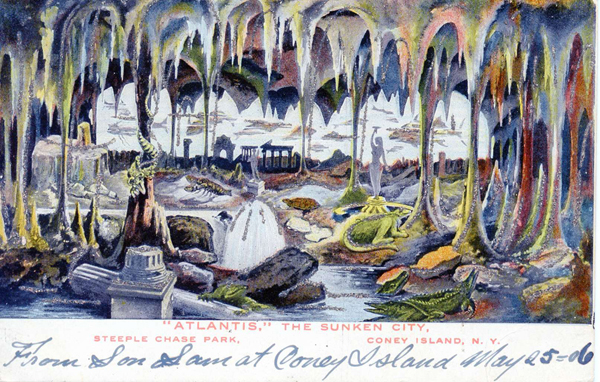
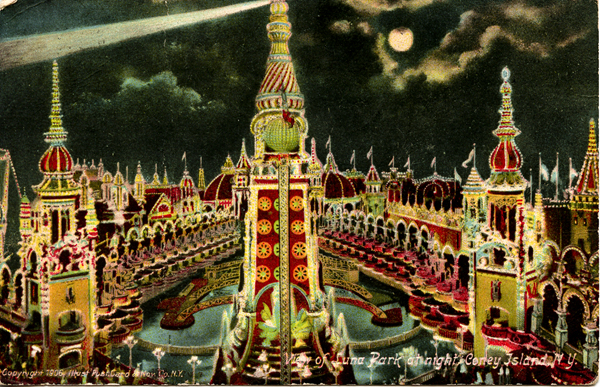
My favorite part was a series of vintage postcards in velvet-lined displays set into the wall. Flip a switch, and a light comes on, revealing the postcards’ delicate illustrations of historical Coney Island scenes. Flip the switch again, and the postcard becomes back-lit. This is the postcards’ ingenious second view: the same scene at night, illuminated by electric lamps and moonlight! Tiny die cuts form colored paper windows that glow when backlit. It’s brilliant, and preceded, unknowingly, my Lens Flare (Miniature Multiple) project.

I couldn’t find pictures of the backlit postcards, but enjoy these, via astropop.com:

View of Luna Park at Night, Coney Island. Credit: Postcard courtesy of The Coney Island Museum // Image source: astropop.com.

View of Luna Park at Night, Coney Island. Credit: Postcard courtesy of The Coney Island Museum // Image source: astropop.com.

"Atlantis," The Sunken City, Steeplechase Park, Coney Island. Credit: Postcard courtesy of The Coney Island Museum // Image source: astropop.com

“Atlantis,” The Sunken City, Steeplechase Park, Coney Island. Credit: Postcard courtesy of The Coney Island Museum // Image source: astropop.com

For more postcard images, visit astropop.com/coney/.

Standard