Research

at times wild, at times modest

Two kinds of optimism this week:

Wild optimism: the audacious, leap-of-faith kind, the decisions that chart a course for a lifetime or more.

I helped someone in their quest to become an adoptive parent. My projects are usually meaningful, but few are so directly involved in such dramatic life changes—the determination of  one child’s family, one hopeful mom’s child.

Modest optimism: tiny points of light, small things to be grateful for.

M and I rode bikes on the Palisades today. It was a short ride, nothing to brag about—except that over the past few months, my knee has been finicky, aggravated by exercise as well as routine movements like putting on shoes. Today’s ride gives me hope that I’m recovering. It is such a small success, hardly an achievement at all—still, I’m delighted.

Standard
Research

Let it be

Looking at [“Dancing Around the Bride” at the Philadelphia Museum], I regretted how much time we all spent trying to explain [Duchamp’s, Cage’s, Cunningham’s, Rauchenberg’s, and John’s] theoretical innovations: the dethronement of art, the declassicizing, decentering. We thought we had to, in order to get people to take an interest in this new kind of art. But we shouldn’t do it anymore. Duchamp’s nude descended the staircase a hundred years ago. Cage sat down and didn’t play “4′ 33″ ” sixty years ago. Cunningham stuck his foot into Johns’s “Numbers” fifty years ago. Most of the public is never going to like such things. Most of the public doesn’t like modernism. Let it be.

Joan Acocella, “Bride Wars,” New Yorker, Dec. 24, 2012
Standard
Research

Our Times

From Joel Lovell, “George Saunders Has Written the Best Book You’ll Read This Year,” (NY Times, January 3, 2013):

Characterizing the absurdism and affect of our times:

You could call this desire — to really have that awareness, to be as open as possible, all the time, to beauty and cruelty and stupid human fallibility and unexpected grace — the George Saunders Experiment. It’s the trope of all tropes to say that a writer is “the writer for our time.” Still, if we were to define “our time” as a historical moment in which the country we live in is dropping bombs on people about whose lives we have the most abstracted and unnuanced ideas, and who have the most distorted notions of ours; or a time in which some of us are desperate simply for a job that would lead to the ability to purchase a few things that would make our kids happy and result in an uptick in self- and family esteem; or even just a time when a portion of the population occasionally feels scared out of its wits for reasons that are hard to name, or overcome with emotion when we see our children asleep, or happy when we risk revealing ourselves to someone and they respond with kindness — if we define “our time” in these ways, then George Saunders is the writer for our time.

Saunders, on capitalism and work:

“I saw the peculiar way America creeps up on you if you don’t have anything,” he told me. “It’s never rude. It’s just, Yes, you do have to work 14 hours. And yes, you do have to ride the bus home. You’re now the father of two and you will work in that cubicle or you will be dishonored. Suddenly the universe was laden with moral import, and I could intensely feel the limits of my own power. We didn’t have the money, and I could see that in order for me to get this much money, I would have to work for this many more years. It was all laid out in front of me, and suddenly absurdism wasn’t an intellectual abstraction, it was actually realism. You could see the way that wealth was begetting wealth, wealth was begetting comfort — and that the cumulative effect of an absence of wealth was the erosion of grace.”

On art and fiction:

The lesson he learned was the thing he sensed all those years ago in Sumatra, reading but not fully grasping Vonnegut. “I began to understand art as a kind of black box the reader enters,” Saunders wrote in an essay on Vonnegut. “He enters in one state of mind and exits in another. The writer gets no points just because what’s inside the box bears some linear resemblance to ‘real life’ — he can put whatever he wants in there. What’s important is that something undeniable and nontrivial happens to the reader between entry and exit. . . . In fact, ‘Slaughterhouse-Five’ seemed to be saying that our most profound experiences may require this artistic uncoupling from the actual. The black box is meant to change us. If the change will be greater via the use of invented, absurd material, so be it.”

Art and interpersonal relationships:

We were talking about the idea of abiding, of the way that you can help people flourish just by withholding judgment, if you open yourself up to their possibilities, as Saunders put it, just as you would open yourself up to a story’s possibilities. … The universal human laws — need, love for the beloved, fear, hunger, periodic exaltation, the kindness that rises up naturally in the absence of fear/hunger/pain — are constant, predictable. . . . What a powerful thing to know: that one’s own desires are mappable onto strangers.”

At the risk of hyperbole at the end of a story that began in a state of fairly high exaltation, I would say that this is precisely the effect that Saunders’s fiction has on you. It “softens the borders,” as he put it in one of our conversations. “Between you and me, between me and me, between the reader and the writer.” It makes you wiser, better, more disciplined in your openness to the experience of other people. …

It’s hard to maintain, the softness. It’s an effort. That Dubai story ends with these lines, wisdom imparted from Saunders to himself: “Don’t be afraid to be confused. Try to remain permanently confused. Anything is possible. Stay open, forever, so open it hurts, and then open up some more, until the day you die, world without end, amen.”

Standard
Research

happiness is… research note #17

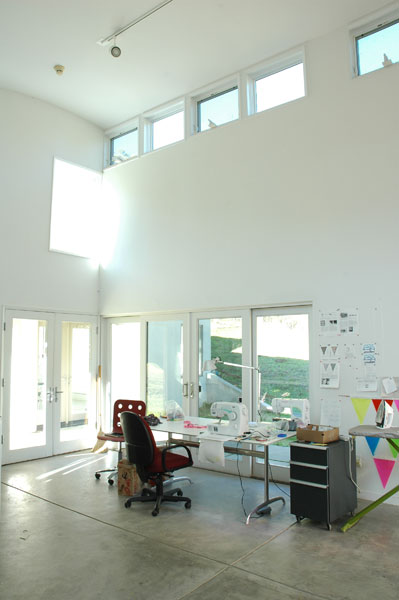
Studio view

Studio view.

A few fragments at the end of a 5.5-week residency at Montalvo…

My art expresses optimism and positivity. I do, at times. And not, at others. Just like most everybody else.

In the past two weeks, I made five Irrational Exuberance Flags. Each ~4×6′ flag and accompanying sash takes at least two long days to design, pattern, cut, sew, and finish. Working late and waking early, with noisy storms puncturing my sleep, I fell into exhaustion and crankiness. It’s ironic—the project is intended to inspire delight and pleasure.

I do strive to apply positive psychology to my process. Most often, I find flow in production, zoning out with podcasts on—just enough noise to prevent negative rumination. But I’m goal-oriented, and with production deadlines looming, I dug deep. Put my game face on. Chunked it out.

And I’m so glad I did. A few days ago, on a sunny, windy day, I did a test run and hoisted the flags on Montalvo’s 30-foot flagpole. After a year or more of only seeing these flags as sketches and prototypes, my flags were finally flying!

If you have never hoisted a flag, I highly recommend it. It’s joyous.* Hoisting a flag is somewhat like flying a kite—you watch it go up, up up, and it takes on new shapes and an endless variety of motions. Like kites, flags catch the wind as well as the light, with just enough translucency to appear to glow against blue skies.

(*Here’s your chance to hoist a flag: the public will be invited to sign up to select an Irrational Exuberance Flag and raise it on Montalvo’s flagpole as during the course of the Happiness Is… exhibition.)


After looking at the flags on the flagpole, I realized that one flag design was too much of an outlier. I knew it in my heart when I woke up this morning, on my last full day of this stint of the residency. Jumping right back into do-work mode, I made a sixth flag and sash to take its place today.

Most viewers won’t know about this extra step, but I know…. I know that bringing the project that much closer to the best it can be is deeply satisfying. I traded off the positive affect of a more leisurely pace for the chance to reflect on this project and have no doubts or regrets. And I’m glad I did.

Montalvo has been a lovely experience of time, space, focus, and support. Kind people and diverse artists. Lovely redwood creek, brushy orchards, lovingly prepared food. A nicer, larger studio than I’ve ever been able to afford, and will ever for quite some time. The opportunity to realize large projects that have just been sketches carried around in notebook after notebook.

Homesickness, too. Nostalgia for affection. For small, mundane rituals. The holidays in a wood-stove-warmed house, snow outside, laughter of children, awaiting.

Artworks packed up, ready for my return in January to install the exhibition. Studio is clean again. Without  clutter, the endless bits of thread stuck on my clothes and shoes, it all looks newer, and ready for more projects. Ambivalence means being pulling strongly—equally—in two directions. I am ready to go home. But I look forward to coming back.

Happiness Is… opens Friday, January 25th at Montalvo Arts Center’s Project Space Gallery. Opening Friday night, artist’s talk Saturday. Full list of events and gallery hours here.


Standard
Research

happiness is… research note #16

A recent sunrise at Montalvo.

A recent sunrise at Montalvo.

Happiness is savoring a good experience, and then being able to share the chance for others to experience it firsthand…

I’m very excited to share the news:

Montalvo Arts Center’s Sally and Don Lucas Artists’ Residency program has just announced an open call today! For the past seven years, the residency program operated on a nomination-only basis. For me, from the outside, this process made the program seemed exclusive, and by extension, all of Montalvo seemed less accessible. It’s great news that California artists are now invited to apply directly to the program.

Currently a funder mandate restricts applications to California residents, but a little bird told me that an international call is anticipated in the future.

The deadline to apply is January 25, 2013. See the details at:

http://montalvoarts.org/programs/residency_application/


Deer at Montalvo.

Deer at Montalvo.

Standard
Research

Happiness Is… Research Note #15

This is what I think of as “the H-word problem”:

Happiness is commonly associated with simply being in a cheerful mood. Thus, making work about happiness can seem (at worst) simplistic, childish, thoughtless, naïve, privileged, trivial, and myopic.

Dig a little deeper, and happiness is complex, multifaceted, and subjective. So much so, that I think the works I’m making about happiness are quite modest. These projects hint only at elements of happiness, so elusive is happiness itself.

So it’s nice to read about the commitment to crafting tiny things. Jerry Seinfeld’s commitment to the quotidian, and his highly-disciplined pursuit of perfection are inspiring (see Jonah Weiner, “Jerry Seinfeld Intends to Die Standing Up,” New York Times, December 20, 2012).

After staying up late to finish a 96-square checkerboard flag (it doesn’t really evidence “the hand” that makes artists’ authorship obvious, and I imagine, will be read as a store-bought item by some viewers), I especially appreciated Seinfeld’s reflection that his work is to spend inordinate amounts of time on matters that most of us don’t think twice about. Even if the content does not strike viewers as especially consequential, the larger project is one of rigorous craftsmanship and dedication, which informs each gesture.

Standard
Research

happiness is… research note #14

Complete overkill, but one can dream, right? Alvin 4x8' self-healing cutting mat.

Complete overkill, but one can dream, right? Alvin 4×8′ self-healing cutting mat.

Happiness is having the right tools for the job. 

I brought two small 12×18″ cutting mats to this residency. What I saved in shipping costs is lost in time and accuracy. I’m constantly re-positioning the mats and fabric, snipping threads in the gap between the mats, and can’t trust the mats’ printed grids to line up.

The uses and limitations of my sewing ruler is also clearer. It’s great for cutting seam allowances (always 5/8″ or 1/4″) and holds up very well to use and even dropping it! The density and hierarchy of information is just right (a principle that  anyone whose used a tape measure with too much info can attest).  But, while cutting ninety-six 6-7/8-inch squares for a checkerboard flag, I wished I had a square quilter’s ruler.

Source: google.com via Christine on Pinterest


As I learned from my Portland Sewing lesson, you don’t adjust the shape as you’re sewing; when you sew, trust your cuts. Accurate cuts and tools means I get closer to actualizing things as I envisioned them.

Standard
Research

happiness is… research note #13

Two more thoughts about working with materials:

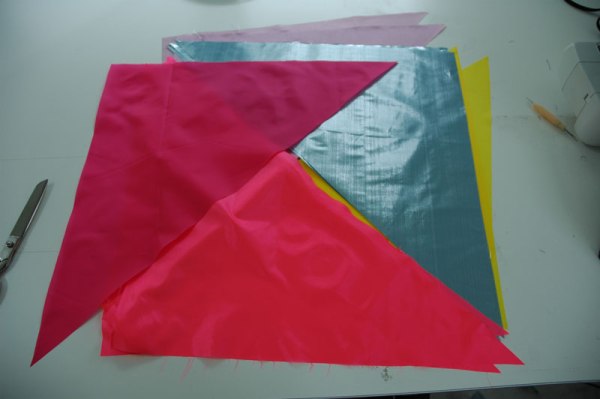
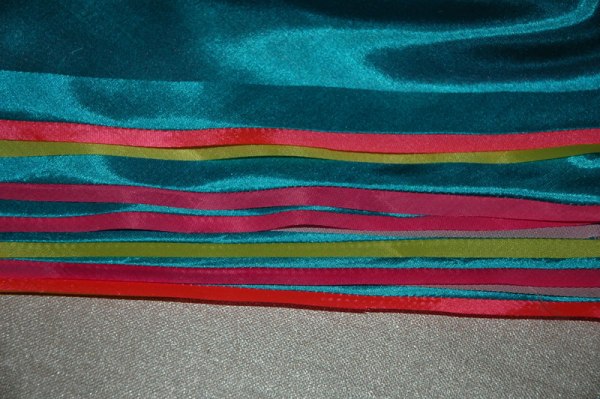
Sometimes they are dazzling and fun to look at, even in the early stages of production.

Parts of a flag-to-be; cut.

Parts of a flag-to-be; cut.

Parts of a flag-to-be; wrapped seams readied for pressing.

Parts of a flag-to-be; wrapped seams readied for pressing.

It gets better.

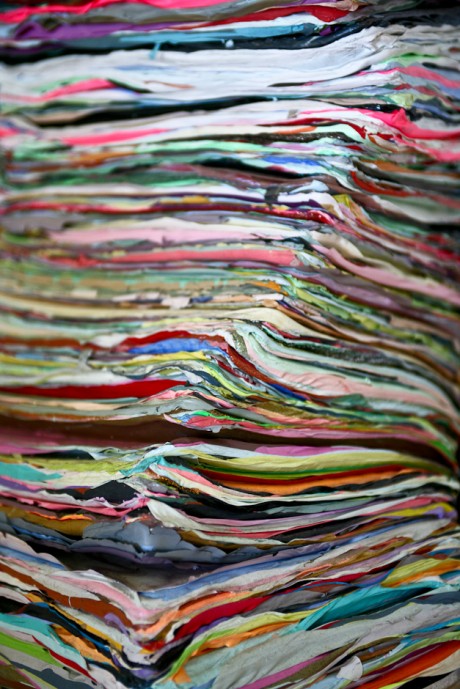
Sometimes the patterns remind you of artworks by friends, what begins as a material revelation becomes an opportunity for relatedness—connecting or re-connecting with like-minded others.

Detail, painting by Chris Duncan. Photo: Klea McKenna. // Source: InTheMake.com

Detail, painting by Chris Duncan // Source: InTheMake.com

Detail, paint stack by Leah Rosenberg. Photo: Klea McKenna. // Source: InTheMake.com.

Detail, paint stack by Leah Rosenberg. Photo: Klea McKenna. // Source: InTheMake.com.

Standard