Art & Development, Citizenship

Kempinas, Happiness, Democracy

Zilvinas Kempinas’ Double O (2008) at the MoMA
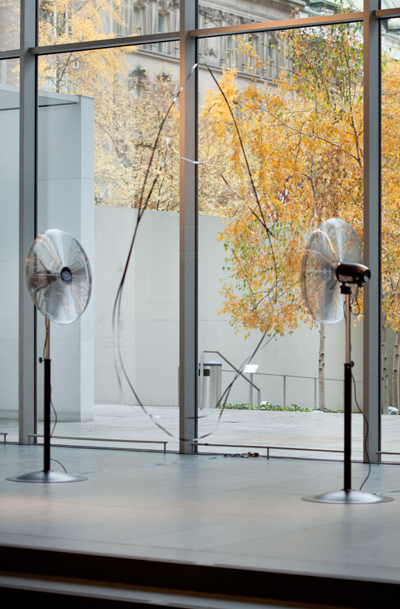
Zilvinas Kempinas. Double O. 2008. Installation view at MoMA as part of On Line: Drawing Through the Twentieth Century. Photo by Jason Mandella

Zilvinas Kempinas. Double O. 2008. Installation view at MoMA as part of On Line: Drawing Through the Twentieth Century. Photo by Jason Mandella. Source: MoMA.org

Zilvinas Kempinas’ Double O (2008) at the MoMA is a mesmerizing, extraordinarily simple installation in which fans suspend two loops of VHS tape in their intersecting currents. Have a look at the video on the MoMA site. The examples of Kempinas’ work that I first encountered seem like larger-than-life explorations of form and optics. Double O is a miraculous combination of simple materials, which prove to be just as effective as labor-intensive, perfect installations.

And the Pursuit of Happiness
A panel in the Live from NYPL! series and the Walls and Bridges Festival

This Franco-American panel of theorists and artists was a mishmash of languages, somewhat esoteric areas of academic research (via French Revolution specialist Sophie Wahnich and Ancient Greece expert Barbara Cassin), American common sense (no-nonsense artist/illustrator Maira Kalman), and likable, self-effacing irreverence (the author Daniel Handler, AKA Lemony Snicket). The Americans seemed like they couldn’t hang with the intellectual rigor of the French academics, while the French seemed oblivious to the idiomatic phrases and physical cues that made the Americans seem warm and entertaining to the audience of New Yorkers.

Unintended absurdity, evident investment in the topic, and the chance to see and hear examples of Kalman’s and Handler’s work and process kept me in my seat. However, at the end, I could hardly contain myself. The concluding question was “What makes you happy?” and nearly all of the respondents talked about losing oneself in skilled activity–yet no one mentioned Mihaly Csikszentmihalyi’s concept of flow.

Further, Handler divulged that happy conditions don’t inspire him to write. Italo Calvino’s short story, “The Adventure of a Poet”—which I wrote a post about a few days ago—is exactly about how much easier it is to represent the mundane, while the transcendent often begets cliché.

I was also interested to hear Wahnich discuss the centrality of the political self in the search for happiness. If I understand her—or her interpreter—correctly, she explained that the freedom to act politically—not necessarily in the civic sense as an activist or voter, rather the basic liberty of movement, speech, thought, and action—is fundamental to the pursuit of happiness. Handler said that the Declaration of Independence is a statement about how democracy must be homegrown; it cannot be installed by foreign powers, and it must be fought for by the people. Still, no one on the panel connected this talk about self-determination and the struggle for democracy with the grassroots democracy movement in Egypt today.

While the Declaration of Independence sought liberty for some men, and the struggle for civil rights in this country is far from over—gay marriage being the most obvious liberty, to me, that the state ought not deny its citizens—its passage on happiness and building democracy seems worth remembering at this time.

We hold these truths to be self-evident, that all men are created equal, that they are endowed by their Creator with certain unalienable Rights, that among these are Life, Liberty and the pursuit of Happiness.–That to secure these rights, Governments are instituted among Men, deriving their just powers from the consent of the governed, –That whenever any Form of Government becomes destructive of these ends, it is the Right of the People to alter or to abolish it, and to institute new Government, laying its foundation on such principles and organizing its powers in such form, as to them shall seem most likely to effect their Safety and Happiness.
Standard
Citizenship

Why bowing to censorship is a bad idea

The Andy Warhol Foundation for the Visual Arts–a briliant funder of the arts–has demanded that the Smithsonian restore David Wojnarovicz’s censored artwork to its exhibition. If the Smithsonian does not comply, the Warhol Foundation will cease funding future exhibitions at the Smithsonian. In the past three years the Warhol Foundation has given more than $375,000 to the Smithsonian.

Cheers to the Warhol Foundation. Sometimes it seems like people in the arts are so consumed with etiquette, so afraid of offending someone or burning a bridge, they haven’t got any guts. Cheers to the Warhol Foundation for putting your money where your mouth is!

This follows a national grassroots movement to exhibit the censored works at alternative art spaces and galleries. Participating spaces include the San Francisco Bay Area’s Southern Exposure and SF Camerawork.

If you are able, please support the work of these amazing nonprofits by becoming members. They are only able to support the work of artists via risk-taking funders like the Warhol Foundation, and individual members like you and me. For further backstory on the homophobic, politically-motivated censorship of this work by a seminal American artist, please see Blake Gopnik’s articles in the Washington Post.

Standard
Citizenship

The coming Culture Wars

Think anti-gay bullying is just for kids? Ask the Smithsonian.

That’s from LA Times critic Christopher Knight weighing in on the recent controversy in which the Smithsonian pulled David Wojnarowicz’s video from an exhibition after someone from the Catholic League complained. Subsequently, Republican representatives (who, like the Catholic League instigator, didn’t actually see the exhibit) attacked the Smithsonian and the NEA.

The merits of art–especially contemporary art that does not conform to traditional/conservative tastes or ideals of beauty–ought to be discussed and debated, not censored. By bowing to religious right pressure, the Smithsonian thought it might be playing it safe, but it showed how easily it capitulates. Homophobia is so not cool. And capitalizing on religious backlash to slash the NEA is so tired. Get over yourselves.

Cheers to Blake Gopnik and the Washington Post for their fearless coverage (afflicting the comfortable!) and alternative art space Transformer Gallery in DC and LA gallery CB1 for exhibiting the Wojnarowicz video in question.

Standard
Citizenship

Irwin, Acconci, Poundland tat, Anno

Robert Irwin‘s works at MOCA‘s Collection exhibition: Gorgeous. Incredibly well-installed and lit. His flat dot paintings appeared soft and voluminous; the rounded discs read super flat. Really stunning to see them the way they are meant to be perceived.

My interest in art has never been about abstraction; it has always been about experience… My pieces were never meant to be deal with intellectually as ideas, but to be considered experientially.

—Robert Irwin, wall text, Collection at MOCA Grand

Following Irwin’s stellar lecture at Mills College, Vito Acconci will lecture there Wednesday, March 31st, 7:30pm. If the Irwin lecture was any indication, you’d best arrive 30 minutes early.

These odd, home-made product review videos sardonically critiquing cheap goods from Poundland stops (discount stores in the UK). Clearly, you get what you pay for with pathetic, mass-manufactured tat (crap); to review them is an exercise in absurdism. A jaunty Brit attitude keeps it cheeky.

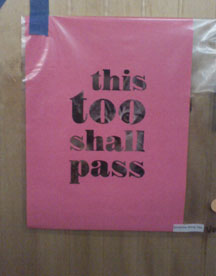
Christine Wong Yap, This Too Shall Pass, 2010, papercut/collage: found cat calendar on fluorescent colored paper


Southern Exposure’s Monster Drawing Rally. I made two collages and had a great time. The Rally is a grand tradition in which artists draw for one hot hour, and collectors and non-collectors fight over who gets to purchase the works for a mere $60, all benefiting the alternative art org. When I see multiple buyers crowd around a work, the capitalist in me thinks about how much money the non-profit organization is losing by not auctioning the works. But selling the works at the fixed price to whoever draws the lucky card is really a fair system that keeps art affordable for everyone. Yay!

I also really like this video, “Spoiling Yosemite,” by artist Kim Anno.

Standard
Citizenship

Flooded Manila: How to help

Three days ago, Manila was besieged by Typhoon Ketsana. Sixteen inches of rain fell in 12 hours. 80% of Manila was flooded, with some areas under 20 feet of water. The flood extends to 25 nearby provinces. 140 people have been killed, and over 100,000 have taken refuge in shelters. (Source: BBC)

When I visited Manila in 2007, I saw many, many people of very modest means living there. But I saw just a fraction of an unbelievably dense, sprawling metropolitan area. It’s almost incomprehensible to imagine the 450,000 people who have been displaced by the storm.

It’s hard for most Americans to understand how far a U.S. dollar can go in the Philippines normally, much less during a state of emergency. If you can, please support the relief effort, so that the displaced can access clean water, food and aid.

If you can do bank transfers or fax your credit card info to an international line, you can donate to Philippines Red Cross.

To support the relief effort for children via credit card, visit UNICEF.

Standard
Citizenship, Community, Research

Things are grim, but I can’t stop thinking about happiness.

Where my mind’s been at:

Positive psychology — a relatively new field of evidence-based self-help for being happier. Think of it like the shift in medicine from treating illness to increasing wellness. As Tal Ben-Shahar, PhD, writes in Happier, pretty much everything we want in life ultimately leads back to happiness.

The idea is to increase happiness in daily life, rather than dealing with unhappiness only during moments of crisis.

[See also Dr. Martin Seligman, Prof. Philip Zimbardo and Dr. Walter Mischel (whose research was the subject of a great article by Jonah Lehrer recently in the New Yorker Magazine).]

Practicing gratitude is one of the oft-cited methods of increasing happiness.

I’m tremendously grateful for friends helping friends. I know, I know, everyone’s hurting now financially. But a lot of artists are freelancers, and while freelancing is typically like riding a roller coaster, it seems like a lot of my peers are feeling lost in a free fall. These are bright, hardworking people doing everything from graphic design, to interactive art direction, to preparator/installation to cooking.

The financial safety nets are being strained, but it seems like social bonds are staying strong… Artists helping artists. Freelancers helping freelancers. I’m so grateful to be in an art community, in which, even in lean times, can exhibit generosity instead of competition.

If you can support the arts in these times, for goodness’ sake, here’s how (and where and when!):

travis meinholf art
Formerly San Francisco-based, now Berlin-based artist Travis Meinolf is in the unenviable position of raising funds for a matching grant (good luck!) for his kind of hilarious but also strangely innovative practice of action-weaving. Like his healthy ‘stache, Travis’ participatory weaving seems impossibly sincere (his last project resulted in 12 volunteer-made blankets being donated to a women’s shelter). He’s a good guy and a hard worker and I wish him the best of luck in sowing his weaving projects ’round the world… Contact Jennifer McCabe, director of the Museum of Craft and Folk Art at jmccabe@mocfa.org to make a contribution towards Meinolf’s exhibition. (Image source: actionweaver.com)

(In case you missed it, I mentioned Scott Oliver’s totally fund-able project about my beloved Lake Merritt in a previous post.)

This Saturday night is Pop Noir, an auction to benefit Southern Exposure, an alternative art space that’s consistently invested in local artists, community engagement, and excellence in contemporary art. This female-led organization has always pushed the envelope, and I’m very proud to donate a pair of text-based drawings to support their work. Over a hundred and fifty other local artists have donated work too. Countless volunteers are contributing time. But it’s all for naught without buyers. So come on down—with auction prices starting at a fraction of the retail price, the price is right. Look for some really nice pieces by Weston Teruya, The Thing Quarterly by Allora and Callzadia, Michael Hall, Laurie Reid, Jeff Canham, Jamie Vasta, Edgar Arcenaux, Dustin Fosnot, and yours truly (pictured as follows).
weston teruya artThe Thing Quarterlymichael hall artlaurie reid artjeff canham artjamie vasta artedgar arcenaux artdustin fosnot artchristine wong yap art
(Image sources: Southern Exposure’s Pop Noir Auction Artists

Pop Noir will be held at the gorgeous galleries at Electric Works at 8th and Mission Streets in San Francisco. Tix, more info, pics of the auction lots, and absentee bidding details here. Hope to see you there.

Stephani Martinez, Daily Cakes - Extra Fancy, 2009, Variable, Doilies, Plaster, Gold Leaf
(Image: Stephani Martinez, Daily Cakes – Extra Fancy, 2009, Variable, Doilies, Plaster, Gold Leaf. Image source: Intersection for the Arts’ 2009 Benefit Art Auction.)
Of course the other amazing alternative art space in San Francisco is Intersection for the Arts, who is well-respected for the rigor of their programming, and renown for making miracles on a shoestring. Like many non-profits, the downturn is hitting their typically lean infrastructure hard. Intersection’s auction comes up next weekend, on the following Saturday, June 13.

Daniel Tierny, Double Jump, 2009, Tape on lambda print, 23 x 33 in., Courtesy of the Artist and Steven Wolf Fine Arts, San Francisco.
(Image: Daniel Tierny, Double Jump, 2009, Tape on lambda print, 23 x 33 in., Courtesy of the Artist and Steven Wolf Fine Arts, San Francisco. Image source: Headlands 2009 Benefit Auction, Artists, Daniel Tierney.)
Wednesday, June 10, the Headlands Center for the Arts holds their auction at the Herbst International Exhibition Hall in the Presidio. I’ve been an Affiliate Artist at the Headlands for a year and a half. The Headlands is an amazing locus for an international and local art community. When I think about relocating, few places compare with the quality of the Bay Area arts scene, partly because of the Headlands’ role in drawing international artists in residence to the area.

So there you go. Support an artist directly, or support the organizations who support the artists. And take home some artwork!

Standard
Art & Development, Citizenship

Shepard Fairy v. the Associated Press v. Mannie Garcia

The lawsuits over the Obama “Hope” poster questions fair use, what constitutes art, and ethics in commercial art (NYTimes.com article). Embroiled are arguably the world’s most famous semi-legal street artist, a previously under-the-radar freelance photographer, and one of America’s most trusted wire services.

WHYY’s Fresh Air attempted to present all sides of the story. Host Terry Gross interviewed Shepard Fairey, the poster artist; Mannie Garcia, the freelance photographer; and a lawyer on fair use. She also read a statement from the Associated Press.

As an artist, I am all for Fair Use and artistic appropriation. I think Fairey’s pre-emptive lawsuit against the A.P. is motivated primarily by self-interest, but he might also harbor a sense of duty and morality — he seems to recognize that few artists enjoy his enviable capacity to fight the A.P.

On the other hand, as a freelancer, I sympathize with the photographer’s right to be credited and compensated accordingly.

I don’t, however, feel for the A.P. Bullying Fairey, disputing their own freelancer*, and sending Fresh Air a statement instead of a representative (what kind of media company avoids other media outlets?) scream, “Evil corporation” to me.

[*Garcia and the A.P. are in a dispute over ownership of the photograph — Garcia claims he was a freelancer and so he owns the copyright; the A.P. maintains that Garcia was in their employ (a good reminder for freelancers to always insist on contracts).]

I’m indifferent to Fairey’s art, but I’m siding with his right to fair use in this case. I see the poster as a new work of graphic art in Fairey’s trademark stylized iconography. Garcia may deserve credit for the source photo, but the case for remuneration seems weak. It would have been polite for Fairey to ask, but I think it would be ridiculous for him to have to license the photo, because he isn’t reprinting or modifying the photo, but using it as a reference to create a transformed visual. If anything, Garcia’s photo has probably appreciated (it’s included in an exhibition at the National Portrait Gallery, and prints are available at Danziger Gallery, NYC) because of Fairey’s appropriation.

Illustrators have always used photographic reference materials. In the olden days, they kept file cabinets called “morgues” full of reference photos, clipped from every imaginable (and probably copyrighted) source. Google Images acts as a giant, searchable “morgue.” It’s a bane and a boon to illustration: it’s the largest, most accessible “morgue” illustrators have ever accessed, and it’s one more nail in the coffin of the industry.

One thing hasn’t changed: Fair Use allows for artists to appropriate existing images if the image is adequately transformed.

I reject the idea that digital processes are inherently less skilled or valid forms of transformation than manual drawing. Those old-tyme illustrators may not have had computers, but that doesn’t mean they didn’t have copying tools, like camera lucidas, tracing paper and light boxes. Drawing plot points over an photo onscreen is not much different than outlining a photo on tracing paper — both require technical skill, artistic decision-making, and manual dexterity (as anyone who’s tried a Bezier tool or Wacom tablet for the first time would agree).

For better or worse, Warhol and Winston Smith lend Fairey more artistic legitimacy. I think appropriation will never seem as subversive as it was during the emergence of Pop Art, but this imbroglio shows that fair use needs to be better understood by all content makers and borrowers. Democracy isn’t the eradication of difference, but the ongoing negotiations between parties to resolve their conflicts.

Standard
Citizenship

all quiet on the home front. ’til now.

Today, while I was dealing with the tedious details of daily life like deadlines and health insurance, something big was going down in the streets.

This afternoon, a large crowd peacefully protested the shooting of Oscar Grant, the unarmed 22-year-old, by a BART police officer. I think that’s beautiful that people are getting organized — the shooting of an unarmed man is a completely legitimate cause for outrage. In fact, I think it is a cause for concern for any citizen, regardless of your politics: those charged with protecting the citizenry have to be competent, aware of basic rights, and they have to be accountable to us, the citizens. That is not asking too much.

No one should be shot in his back while lying on the ground. Period.
Regardless of race, past criminal activity, the time of night, your attitude, the part of Oakland you’re in.

Given that, it’s outrageous that BART Police has been so slow to take action. They did not release the officer’s name for several days, and today, the officer, Johannes Mehserle, resigned, effectively dodging the responsibility of answering questions from BART internal affairs investigators. Wait — a week has passed and you haven’t questioned the guy that pulled the trigger!?!?

I can’t comprehend how one person could fatally shoot another human being — and still be walking around free, without having to answer investigators’ questions. What is the hold up? When will they formally charge him? Why aren’t they worried about him hopping the borders, like that corrupt Oakland Rider who has yet to see his day in court (though those that did were acquitted)?

The right to bear arms is founded on the ideas that (1) abuse of power should come as no surprise, and (2) that Americans have a right to resist injustice. In the same vein, our laws against murder or manslaughter can’t only apply to civilians only. I know it’s complicated, but cops have to be brought to justice too. Could BART Police do a worse job of this already? It’s possible that this investigation will lead to a formal charge and prosecution, but honestly, there’s few indications so far. Is it any wonder that people are outraged and frustrated?

The peaceful march in the afternoon turned into a sensational news-worthy riot tonight, with significant BART closures, property damage, and footage of chaos and fiery cop cars. I was worried that the investigation would drag out until the public lost interest, but now I’m afraid the public will lose sight of the issue at hand.

I can’t condone the violent faction of protestors’ poor choice of targets — it sucks that they smashed mom and pop shops and damaged property belonging to average citizens. On the other hand, protest is fundamental to a democratic life; it’s a like a heartbeat showing that people do give a shit, and that not all of us are standing in a fog in Home Depot.

A lot of people can’t sympathize with protestors when they interrupt their commute or take illogical actions. But I can’t help but wonder, what if a popular white kid from Walnut Creek was shot in the back by a cop, and a week went by with no signs of justice? Would the grieving family’s action of recourse be seen as an outlandish money-making scheme? Would mayors be urging calm then? Would local message boards commenters suggest that the investigation, however slow, is good enough? To get the New York Times’ attention, would the shooting be enough of an outrage, or would it take a messy, violent uprising?

Enough. The District Attorney needs to charge Mehserle already. And Mayor Dellums needs to do something besides shake hands with people at Safeway and warn about budget shortfalls. FIX IT. The accused has been dodging his responsibility with the president of the police union at his side. BART won’t handle it, and if this goes on, and maybe a boycott is in order.

Standard