Citizenship

Ai Weiwei and the search for justice

From Christopher Bodeen, “Artist Ai Weiwei released by China, says he’s fine,” Associated Press (6/22/2011):

Renowned artist Ai Weiwei, the most high-profile target of a sweeping crackdown on activists in China, returned home late Wednesday after nearly three months in detention. Looking tired and thinner, he said the conditions of his release meant he could not talk more.

The official Xinhua News Agency said Ai confessed to tax evasion, accusations his family had long denied and which activists had denounced as a false premise for detaining him….

“I’m sorry I can’t (talk), I am on probation, please understand,” Ai said, speaking in English….

…Jerome Cohen, a top expert on Chinese law at New York University… said Ai was most likely released on a form of bail that restricts suspects’ movements to their home city for one year. However, authorities can reopen the case at any time, meaning Ai faces the ever-present threat of being detained again on the same accusations….

“It’s quite a step back for the regime. It demonstrates the utility of large amounts of international attention, plus international connections that had been sufficient to keep him out of jail before,” he said.

Ai’s release might also have been a face-saving move, coming just days before Chinese Premier Wen Jiabao was due to travel to Hungary, Britain and Germany, countries where supporters of the artist have been vocal in their condemnation of his detention.

A relief. But not justice.

Standard
Citizenship

63 days

Ai Weiwei was arrested/disappeared 63 days ago today. Except for a 30-minute visit from his wife, he’s been cut off from family, friends, and legal counsel. While spring unfolds with tornados, unseasonable rain storms and heat waves, and the art world’s focus turns to the Venice Biennale, the unjust detainment of critical voices, like Ai’s, his associates, and dozens of thinkers, continues in China.

It’s difficult to fathom the amount of time that’s passed since April 3rd, when Ai and his associates were taken away by police. A brief thought experiment might help: recall where you were in early April, and everything you’ve done since then—the accomplishments, the work, the setbacks, the people and places… For Ai it’s missing the closing of his show at Tate Modern, the opening of his Zodiac Heads in London’s Somerset House and New York’s Central Park, the release of his book by MIT Press, not to mention other professional, personal, and and political activities, or the basic human freedoms of movement, speech, association, etc…

Standard
Citizenship

41 Days since the PRC disappeared Ai Weiwei

Per FreeAiWeiWei.org, the authorities should have charged or released the detained artist five days ago. Continuing to detain Ai without filing charges is a violation of China’s criminal procedures.


Still, Ai Weiwei: A Conversation, Tate Channel
Still, Ai Weiwei: A Conversation, Tate Channel

Still, Ai Weiwei: A conversation, Tate Channel

Still, Ai Weiwei: A conversation, Tate Channel

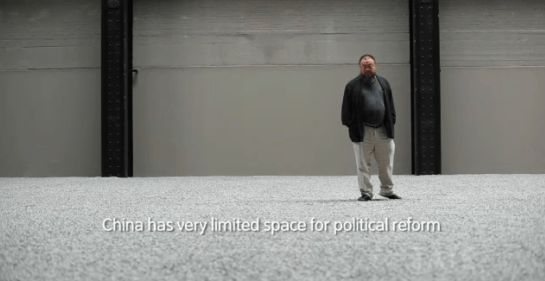
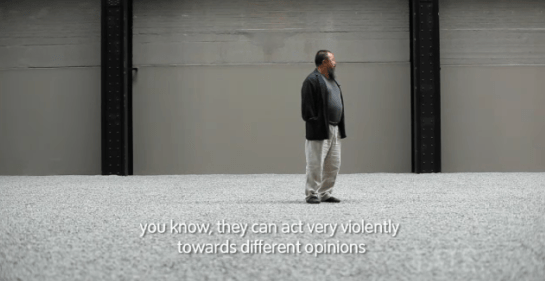
The Tate Modern posted a short, moving video with clips from Ai Weiwei’s October 20, 2010 interview at TM, as well as shots of his Sunflower Seeds installation in Turbine Hall. Presciently, an audience member asks Ai, “Why aren’t you in jail?”

Ai’s response:

“I don’t want to stop myself; maybe I will be stopped by some other kind of force. You know, life is like that. I think you have to take chances.”

Ai’s Zodiac Heads public sculptures opened last week in New York, and this week in London. Tom Scocca posted a pointed article in the Washington Post on May 4:

All that’s missing this time around is the artist — a humiliation inflicted by China on itself….

He provoked the system, in a seemingly open-ended piece of performance art, by pretending it was reasonable and accountable that an ordinary citizen had the right to dissent.

Disappointed with the poor coverage of the recent US-China human rights talks, I was glad to read that Secretary of State Hillary Clinton ratcheted up the rhetoric on China’s human rights violations in her recent interview with Jeffrey Goldberg in the Atlantic Monthly (May 10, 2011). The discussion focused on the Arab spring and Middle East peace process, but in passing Secretary Clinton said,

we have encouraged consistently, both publicly and privately, reform and recognition and protection of human rights. But we don’t walk away from dealing with China because we think they have a deplorable human rights record….

Goldberg: And (the Chinese) are acting very scared right now, in fact.

Clinton: Well, they are. They’re worried, and they are trying to stop history, which is a fool’s errand. They cannot do it. But they’re going to hold it off as long as possible.

Spoken at the Zodiac Heads ceremony:

Without freedom of speech there is no modern world, just a barbaric one.

(Alexandra Munroe, senior curator of Asian art, Guggenheim Museum, via Roberta Smith on NYT)

Ai’s disappearance is likely part of a crackdown following the Arab spring, which the artist warned Dan Rather about just 10 days before his disappearance. Dozens of thinkers, bloggers, radicals and reformists have been detained. As the PRC refuses to charge or release Ai, it seems more likely that the intention is suppression — to repress a Jasmine Revolution in China. In fact, the Chinese authorities are even taking steps to ban jasmine (see Andrew Jacobs and Jonathan Ansfield’s “Catching Scent of Revolution, China Moves to Snip Jasmine,” New York Times, May 10, 2011), the word and the flower, as if they could suppress inevitable change and progess:

the Chinese characters for jasmine have been intermittently blocked in text messages while videos of President Hu Jintao singing “Mo Li Hua,” a Qing dynasty paean to the flower, have been plucked from the Web…. the police issued an open-ended jasmine ban at a number of retail and wholesale flower markets around Beijing.

For continued coverage, see Eyeteeth, a Minneapolis-based art blog that posts excellent round-ups of news related to Ai Weiwei.

Standard
Citizenship

27 days since Ai Weiwei has been disappeared

An NYU law professor weighs in on Ai’s case:

… whatever the evidence being assembled about tax evasion or other charges, that this was not the motivation for Ai’s detention. This case started out on a “detain first and look for justification later” basis. If evidence sufficient to sustain a conviction is found, the case will become a preeminent example of what criminal justice experts call “selective prosecution.” Ai has been singled out from a large number of potentially suspected offenders not because of the magnitude of any alleged economic crimes but because of his creative and eye-catching political challenges to the regime and his defense of human rights.

…however the investigation phase of this case ends, it has already demonstrated once again how far China’s police are not only from adhering to the standards of fair criminal justice enshrined in the International Covenant on Civil and Political Rights, which the government signed in 1998 but has yet to ratify, but also from adhering to their own country’s criminal procedure law. If a famous figure like Ai Weiwei can be so blatantly abused in the glare of publicity, what protections do ordinary Chinese citizens receive from their police?

—Jerome Cohen, “The Ai Weiwei Case: So Far, So Bad.” NYU School of Law’s US Asia Law Institute Blog, April 26, 2011.

In a spineless act of omission, NYC’s Parks and Rec department fails to mention Ai’s nearly month-long disappearance in its press release promoting Full Circle: Ai Weiwei and the Emperor’s Fountain, the forthcoming exhibition of photographs of Ai and his sculptures in Central Park.

The text even touts the nuanced political history informing the sculptures. But by neglecting to mention the enormous price the artist is currently paying for his activism, the Arsenal Gallery appears to be abandoning the artist to fate, even as his physical whereabouts are unknown and his safety is likely endangered. The fear of taking a political position and stirring up controversy is far too common. I would like to think that American civic values translate to being courageous—not cowardly—in the face of injustice.

Standard
Citizenship

Love the Future

Love the Future/Chinese Cosulate, New York City; Studies in Perspective after Ai Weiwei('s disappearance)

Love the Future/Chinese Cosulate, New York City; Studies in Perspective after Ai Weiwei('s disappearance)

In China, the state tightly controls the internet. Chinese citizens can’t access Google, Facebook, or Twitter. Any searches with Ai Weiwei’s name are terminated, as the artist explained in a prescient interview with Dan Rather shot just 10 days before his unlawful detention and disappearance on April 3.

To skirt censors, Chinese citizens have adopted the code-phrase, Love the Future (愛未來), which is similar to Ai’s name (艾未未) in Chinese.

“Love the Future” has many interpretations. It’s an affirmation, a progressive rallying cry, an admonishment to the repressive Chinese government to fear not its own courageous activists, a call to change.

The above photo is inspired by this declaration, Ai’s courage, and his Studies in Perspective photographs.

Love the Future! Release Ai Weiwei and all unlawfully detained activists immediately.

Standard
Citizenship

1001 Chairs for Ai Weiwei

Sunday, April 17, 2011, 1:00pm


Curator Steven Holmes to reenact Ai Weiwei’s project Fairytale: 1,001 Qing Dynasty Wooden Chairs—an installation which was comprised of 1,001 late Ming and Qing Dynasty wooden chairs at Documenta 12 in 2007 in Kassel, Germany—in front of Chinese embassies and consulates around the world.


This Sunday, April 17, at 1 PM local time, supporters are invited to participate in 1001 Chairs for Ai Weiwei, by bringing a chair and gathering outside Chinese embassies and consulates to sit peacefully in support of the artist’s immediate release.

Facebook: 1001 Chairs for Ai Weiwei.

Standard