Art & Development, Community

love it/ hate it

Love it:

“The Big Three,” the current exhibition at Rosenthal Gallery, features the work of 18 artists, though the title could be written for me, since three of my classmates from CCA (MFA 07) are in it: David Gurman, Renee Gertler and Erik Scollon.

Scollon continues his series of life-sized fist-shaped cast ceramic sculptures. The new sculptures are all pushing the boundaries of domestic kitsch, featuring the sort of rose patterns you’d find on linens at Ross. While some of his past blue-and-white fist sculptures were ironic and cool, these would especially great atop crocheted doilies.

The always-meticulous Gurman shows a dyad of photographs sourced from government agencies. I wasn’t able to get through his verbose statement at the packed opening, but I appreciate his conceptual rigor as an artist working with found photos, a process that can lend itself towards emotional, intuitive interpretations.

Gertler contributes goodie-bag assortment of odd forms in aluminum foil, painted paper mâche, “DO NOT EAT” silicate pebbles, balsa wood and other unidentifiable scraps. It’s a kind of joyous formalism — humorous, humble and a bit nerdy. As an artist struggling with how my work fits in the world and the market, I really appreciate Gertler’s commitment to making impertinently impermanent art.

Love it, too:

Good coincidences. I realized yesterday that I should look into getting a bank of LEDs for an upcoming project. Guess what came in the mail today? The new Jameco catalog! Sweet!

Hate it:

What I’d add to The Onion‘s “Things We’re Barely Tolerating This Week”:

Michael’s, the craft store. Despite its new logo and cutesy interior design, its biggest problems persist: crap customer service (No wonder the cashiers give customers attitude! I heard two surly teenage slackers give the manager lip today.) and heavy-handed mark-ups (A 10 oz jar of Armour Etch, a wonderful and frighteningly caustic cream used for etching glass: $27.99. At Long’s in Oakland, you can get a jar with 2 more oz for $4 less! As Woff says, “Long Live Longs.”)

Standard
Art & Development

mid-january: art season in the mission

With the slow economy, I suspected that gallery owners would hibernate a little longer than usual, but it turns out Mission District galleries are ready to go. A string of openings this afternoon and tonight should be a good way to while away a Saturday in the City. (Sadly, my Canon Powershot is out of commission, so no pics tonight.)

Drawn Together
Community Celebration at Laguna Honda Hospital
Featuring a collaborative art project lead by Helena Keeffe
Saturday, January 24, 2009, 2-4pm
Laguna Honda Hospital, Moran Hall, 3rd floor, main building
375 Laguna Honda Blvd
San Francisco, CA

Mads Lynnerup: You are the Artist, You Figure it Out
Baer Ridgway Exhibitions
172 Minna Street
Opening Reception :Saturday, January 10, 2009, 4-6 pm
Exhibition: Jan. 10- Feb. 14

Retractions: An exhibition exploring notions of vacated information
Curated by Whitney Lynn
Opening Reception: Saturday, January 10, 7-10 pm
Exhibition Dates: January 7-24, 2009
Sliding Scale Suggested Donation: $2-$20
Root Division Gallery
3175 17th Street (at S. Van Ness)
San Francisco, CA 94110
ARTISTS INCLUDE:
Peter Baldes
Taha Belal
Jan Blythe
Ross Campbell
Deric Carner*
Jon Clary* & Bruce Wilhelm
Julie Cloutier & Claire Nereim
James Davis
Adam Whitney Day
JRF
Jennifer Maria Harris
Ryan Hendon
Robin Johnston
Ryan Jones*
Forrest Lewinger
Ann Mansolino
Ramekon O’Arwisters
Piero Passacantando
Moshe Quinn
Michael J. Ryan
Jeff Schmuki
Travis LeRoy Southworth
James Tantum
Will Tucker
Hooper Turner
J. Parker Valentine
Allison Watkins
Julie Weitz
Jameson Zaerr
* Root Division Resident Artist

Mat O’Brien
I Ain’t no Freud, I’m from SF.

Opening: Saturday, January 10, 2009, 7-10pm
Exhibition: Jan. 10- Feb. 14
Eleanor Harwood Gallery
1295 Alabama Street
San Francisco, CA

The Big Three
Opening: Saturday, January 10, 2009, 6-9pm
Rosenthal Gallery
365 Valencia Street
San Francisco, CA
Featuring 18 young artists: Scott Barry, Sara Blaylock, Nicholas Bohac, Amy Casey, Nathan Ross Davis, Robyn Engel, Renee Gertler, David Gurman, Katty Hoover, Sangyon Joo, Lauren Lavitt, Christine Monahan, Suzy Poling, Anthony Record, Brion Nuda Rosch, Erik Scollon, Michael Swaine, and Annie Wong.

Standard
Art & Development, Community

LA Art Trip 2008

Four days.
Five museums.
Thirty-five galleries.
I saw innovative, fresh exhibitions in museums, and only a few ambitious shows in galleries. Many galleries were closed for the holidays, though a few have folded since my last visit a year ago (too bad, I really liked Anna Helwing’s gallery).

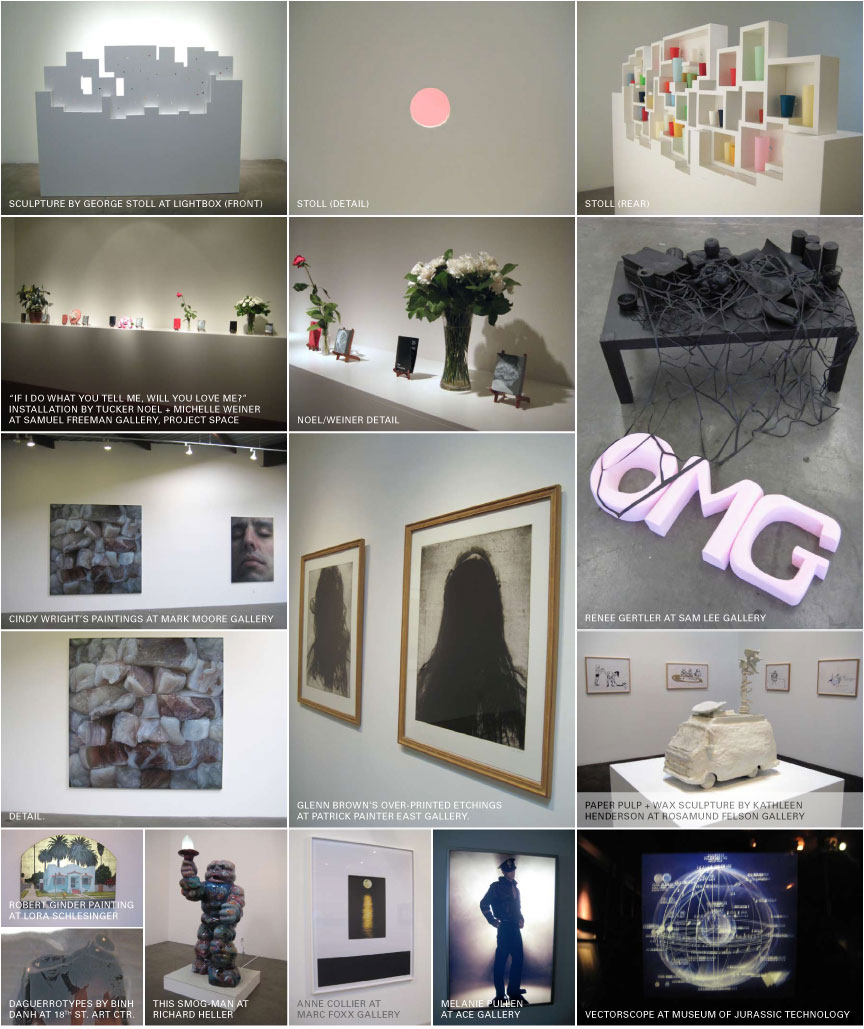
Click on the image below for a larger view. It’s a big file, give it a sec.
la_art_trip_photos

High points:

1.
California Biennial
Orange County Museum of Art

A fantastic show that counterbalances a surprisingly pointed emphasis on war and borders with utopic, phenomenological experiments. Curator Lauri Firstenberg pulled off a multi-site show featuring many excellent artists of color and women. I saw the museum show, the site of work by only about 30 of 50+ artists. I really enjoyed the work of Erica Vogt, whose small-scale projector-based installations were intimate reflections on media as framing devices. Mike Arcega‘s installation of two-by-fours looked great, and worked well sited near the port of Long Beach, as did Jebediah Ceasar’s 4x4x8’ polyurethane block. Anna Sew Hoy‘s site-specific sculptures for a dance performance were Isamu Noguchi-esque and a little cuddly. Justin Beal presented an intriguing installation of objects, furniture and wall-based works at the intersection of industrial production and war profiteering. Daniel Joseph Martinez‘ installation with an animatronic human figure was cold and discomfiting, effectively conjuring (for me) our complicity in acts of torture. Jordan Kantor and Mark Hagan both present satisfyingly odd, brainy paintings. (If commercial galleries only exhibited drawings and paintings as thought-provoking as Hagan’s and Kantor’s, gallery goers would be spared so much mediocre art!) Edgar Arceneaux‘s installation of shiny things, broken mirrors and haphazard projectors looked like a set for a Pink Floyd video, while his video reminded me of Politics of Rehearsal, Francis Alÿs’ show at the Hammer Museum. Arceneaux’s search for meaning seems highly provisional, reflecting the times’ uncertainty. In the same vein, I found Amanda Ross-Ho‘s excised studio walls — assemblages of found objects upon found marks — a little too totemic for my tastes, but I could appreciate the inward-looking search for authenticity, especially as institutions are crashing down all around us.

2.
Other People: Portraits from Grunwald and Hammer Collections
Oranges and Sardines
Gouge: The Modern Woodcut 1870 to Now
Armand Hammer Museum

I like the Hammer a lot. My current investigations don’t overlap with any of these shows’ themes — woodcuts, new abstract painting, and portraits — so it’s a testament to the institution that I found all of these shows elucidating, richly textured and curatorially interesting.
Other People mixed contemporary and historical portraits. It was a treat to see 400-year-old engravings by Dürer next to narrative photographs by Wolfgang Tillmans and Catherine Opie. I also really liked Mike Mandell‘s baseball trading cards featuring photographers. The photos are dorky and fun, and a little bit cringe-worthy like Mike Smith’s photos.
In Oranges and Sardines, six contemporary abstract painters selected art to hang alongside one of their own works. I’m not crazy about Wade Guyton’s inkjet prints on canvas, but his selections — which included a light by Dan Flavin, a stage for a go-go dancer by Felix Gonzalez-Torres, and a photograph of a hammer, sickle and slice of pizza by Andy Warhol — were sensational and funny, and they inspired a new look at his work. Oranges and Sardines is a great chance to see painters’ points of references firsthand.
I’m familiar with woodcuts, but I still enjoyed many surprises in Gouge. Indian prints from the late 1800s were endearingly stylized; they seemed to be evidence of early modernism’s appropriation of non-Western visual languages. I was amazed by a detail of Thomas Kilpper’s ambitious project, “The Ring,” a woodcut made from a 4,000 square foot parquet floor. I also found Christine Baumgartner’s engraving-style woodcuts based on video surveillance satisfying in its visual and conceptual integration. And Edvard Munch’ timeless variations on the Kiss (see image) were moving as always.

3.
Anne Collier
Marc Foxx Gallery

Really nice photos about photography / framing framed things like albums, prints, works of art. It’s a tight grouping of images that compels the viewer to construct a narrative from these disparate, but beautifully made and installed, images.

4.
Violent Times
Melanie Pullen
Ace Gallery

Ninety-five massive prints and lightboxes feature models dressed as soldiers in action. The show is a sexy indictment of the valorization of youth, masculinity and war.

5.
Ambitious programming, like Rain Field by Jake Lee-High at Fringe Exhibitions, and Nail to Nail by Darren Almond at David Patton Projects
Honestly, I’m most impressed by the scale and ambition of these works. Lee-High presents a 117-channel audio and weather installation in nearly complete darkness. Almond presents a beautifully-shot, comment-free documentary-style video of a worker mining sulphur in Indonesia. The work is interesting and good, but considering that most galleries of this size are content with simply putting pictures on the walls, I especially admire the galleries for committing to this risk-taking art.

Low points:

The Grapevine was closed due to a severe storm, forcing us to take a lengthy detour to Highway 101. The drive takes twice as long as it should have.

A disgustingly artificial tea. I asked for an unsweetened chai and receive a drink loaded with “No Sugar Added®” sweetener. The English language is being supplanted by branded corporate-speak.

Standard
Art & Development

oh, the irony!

About ten or fifteen years ago, I was a twenty-something-year-old woodcut printmaker primarily concerned with expression. I felt that big expensive art was tacky and elitist, while prints were affordable and proletariat.

One day, in a tony downtown gallery, I was completely bored by an outlandishly expensive work of art. It a cube of glass about 4x4x4′, raised to eye-level by a simple chrome structure. The glass transitioned from clear to two-way mirror, creating a few optical tricks. My knowledge of art after modernism was pretty weak. I felt that it looked like corporate art scaled down for a rich person’s home. The artist, Dan Graham, didn’t ring a bell; the price, $100,000, made me laugh out loud. Who would pay that much money for this thing! It had no content, no beauty.

Which, I’ve since learned, is exactly the point of Minimalism. It’s not about expression or representation, but about the viewer’s relationship to the art-object.

Lately, I’ve been working with mirrors and have come around to studying Dan Graham’s work. He is interested in power and public versus private space (there is content, after all), so the corporate feel is probably intentional.

Conceptual art is often hard to “get”—the clues to content and context are hidden, so viewers often need to be armed with information to appreciate the art. When I first saw Graham’s work, I saw a content-less structure in the context designed for private sales. But I can appreciate this work now because I have more information about Minimalism, Conceptualism, Graham’s interests, and the ideal context, which is a public park, like his project with Dia:Beacon.

[I also don’t find the cost of the work so outrageous anymore. Here’s why:
• Galleries sometimes offer discounts to long-term collectors.
• The gallery (and there can be more than one) gets half.
• Graham gets the other half, to allot to his costs: labor (including architects, fabricators, engineers, designers), studio costs, health care, materials, assistants, etc. Shoppers are used to paying for corporation’s overhead costs, but sometimes approach products and services by individuals differently. For example, it might only cost $5 to manufacture a shirt, but that doesn’t deter shoppers from paying $50 for it.]

Standard
Art & Development

The Original, with cross-references

It’s impossible to be truly original or free of influences. (See postmodernism.)
Besides, originality is overrated. (See Appropriation Art.)

I saw my past and future in other artists’ works today.

THE PAST

“Seven Future Gifts” (2008) is an installation by Mircea Cantor (see a photo on VVork.com) of ribbons and bows around empty spaces, suggesting absent gifts. The shape is very similar to my “Absent Presents” (2007) series of sculptures.

Christine Wong Yap, Green Present, 2007

Christine Wong Yap, Green Present, 2007

But the similarity doesn’t bother me.

As I mentioned in the previous post, what matters is not who comes up with an idea first, but who does it best (a cousin to the cynical saying, If you can’t do it better, make it bigger).

Cantor’s Future Gifts are significantly bigger; they appear to range in scale from about one foot tall to 10 feet tall. In terms of engineering and craftsmanship, the concrete Future Gifts are easily more impressive than my Absent Presents, of modest scale and materials (balsa wood, paper and glue).

Yet for all their similarities, Cantor’s Future Gifts function completely differently than my Absent Presents. What mattered to me most were the concept of a vessel for the viewer’s projections, my skepticism of the role of the artist, the play on words, the colors, the ho-hum store-bought materials juxtaposed with Minimalist forms. Cantor, I’m sure, meant to reference Minimalism as well, but to a contrasting result: the Future Gifts‘ monumental scale, unfinished concrete and simple, unvarying bow are funereal, high-art serious. I’m guessing the extreme shifts in scale are a result of an interest in the phenomenological experience. And perhaps by repeating the same exact shape throughout seven gifts, Cantor may be making a point about industrial modes of production and consumption. I’m also interested in consumption, but in a dorky, Christmas store display sort of way. Whereas the Future Gifts are serious, the Absent Presents’ human scale, festive colors, and exuberant bows are playful. The Absent Presents wink at viewers.

THE FUTURE

During my research for the Anti-Campfire project, I came across the engrossing factoid that diamonds and graphite are both allotropes of carbon. This is a rich metaphor — diamonds are rare, valued for clarity and refractivity, while graphite is common, dark, cheap.

Naturally, I wanted to make drawings of diamonds in graphite or charcoal (another common carbon allotrope). Conceptually, such a drawing would raise the question of value, by conflating the artist’s labor with great beauty, and the work of art with a pricey commodity. I was also greatly interested in the implications of the interconnectedness of light and dark / optimism and pessimism. I printed photos of famous diamonds and brought them to my studio a few months ago.

I hadn’t actually made any drawings, but tonight I saw what the drawings would look like, more or less, courtesy of Sylwia Gorak.

Gorak is an Artist in Residence at the Headlands Center for the Arts, where she presented her work, including a past series of charcoal drawings of famous diamonds. She mentioned her interest in the conceptual logic of depicting a diamond with a material of the same base element — same as me. The results were nice charcoal drawings — accomplished, probably better photo-realist images than I could have done.

So I found myself in the funny position of looking at images that I had considered making, but finding the conceptual rationale sort of one-dimensional (“Thunk!”). It sort of offered me a peek beyond my own subjectivity. I’m interested in conceptual art when it gives viewers more to tease out beyond visuality; but if the concept engages the mind for only a second or two, that’s not good enough. There has to be a better payoff.

THE PRESENT

A lot of artists fear being unoriginal, so they usually wince when they encounter similar work by other artists. Whatever. Here’s a new saying: Similarities happen. It’s not the worst thing in the world. In fact, it can work out for everyone.

—–

[I’m not always so peppy. There are other times, like when I feel like Eric Clapton crying after a Jimi Hendrix concert: I’ll never be that good! Grab a tissue box and click over to Abelardo Morrell’s photos of interiors made into pinhole cameras at Bonni Benrubi Gallery.]

Standard
Art & Development

some art highlights

First Thursday openings in San Francisco. Some highlights:

Lynn Hershman Leeson
Ant Farm
Gallery Paule Anglim

Cheers to Anglim for consistency: local notables, nice work, a smartly paired exhibition.

Leeson, of course, is a significant figure from early Feminist Art, has been in and around San Francisco for decades, and has continued to make new work in new media. I really loved her museum show at the Whitworth Gallery in Manchester, which showed off her facilities in multiple media. At Anglim, she’s showing mostly large, impressive photographs of a female mannequin with a look of surprise; the mannequin has also been placed behind a digital projection of Manet’s Olympia, and there’s also a wholly digital, multivalent media presenting another female avatar. The odd, cold distance between viewer and subject (mannequin, avatar) is an important part of the work, so there’s lots of “meta-” to mull over.
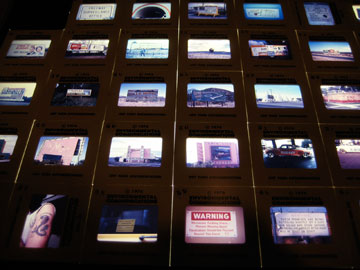
Detail of slides at Ant Farm show (Gallery Paule Anglim)
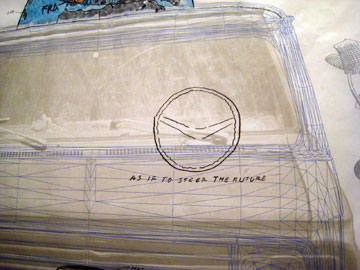
Detail of slides at Ant Farm show (Gallery Paule Anglim)

Detail from drawing/print on vellum by Ant Farm (Gallery Paule Anglim)

Detail from drawing/print on vellum by Ant Farm (Gallery Paule Anglim). Text: As if to steer the future.

In the small room, Ant Farm presents fantastic dreams of a media van via architectural prints/drawings on vellum, with some supplementary media (such as digital photo collages and a completely conceptually honest lightbox displaying slides from 1977-78, when Ant Farm initiated their first van project). Of course, the van itself will be on view at SFMOMA (whose site has finally undergone a cleaner, crisper re-design) in The Art of Participation exhibition, which opens Nov. 8. It’s great to see how these art elements take form in the public sphere after seeing the van in production for months at the building next door to my studio.

David Huffman at Patricia Sweetow Gallery

David Huffman at Patricia Sweetow Gallery

David Huffman
Jefferson Pinder
Patricia Sweetow Gallery

Another nice pairing of good art!

I never met David Huffman, though our stints at CCA overlapped quite a bit: me undergrad, Huffman grad; me grad, Huffman professor. So I’ve seen his work a bunch. His ‘bots continue to evolve, and his paintings are staying a few astral steps ahead of those of many Bay Area painters. In this exhibition, washes of paint and glitter verge on sublime, still, they’re paired with tightly rendered, pointedly racial people, places and things, such as the pyramid of watermelons in the picture above. In lieu of a firsthand account of the artist himself, I offer in congratulatory spirit this favorable account of the painting professor’s words: “You’re a painter! You have to be a vampire of paint!” For sure! The teacher shows an insatiable drive to forge ahead…

Jefferson Pinder covers his photogenic face in shaving cream — a whitening-out reversal of Zhang Huan’s self-drenching in ink — in a series of self-portraits with butoh-like results. In fact, an Asian stringed instrument accompanies the riveting video of still images of the whitened-out artist behind a projection of a rocket launch. The juxtapositions are quite tense, and result in some brilliant images captured in additional photographs. It’s an interesting bridge between video, photography and performance, with much in kinship with experimental theater that incorporates video, like the work of Sarah Kraft and David Szlasa.

Vik Muniz
Rena Bransten Gallery

Gilson inspects a photograph of a paper cut by Vik Muniz (Rena Bransten Gallery)

Gilson inspects a photograph of a paper cut by Vik Muniz (Rena Bransten Gallery)

Awe-inspiring. Muniz makes pictures out of food, garbage, and now, puzzles and cut paper. The sheer feats of craftsmanship are engaging, and the photos perfectly executed. The prints have an uncanny depth. As Gilson pointed out, it’s a common art school assignment to make a collage from gray paper or found objects. But Muniz proves that you don’t have to be the first one to do an idea, you just have to do it best. I’m starting to wonder what can’t he do?
Stripes!

Stripes!

There were also some nice pictures by Richard Avedon at Frankel Gallery, rare perfections from Life Before Photoshop. The Dustin Fosnot show at Steven Wolf Fine Arts was poetic, edited, and personal — in contrast with his last, which was quirky-quirky-quirky. I find pathetic art appealing. Ironic, distanced pathos is common and easy, but the new Fosnot pathos is restrained, uncomfortably intimate.

I missed two shows that are probably good — Diem Chau at Mark Wolfe Contemporary and Tiffany Bostwick at Gregory Lind — but I was already crossing Market and going back in time to 111 Minna, which manages to be forever young. At their group show of figurative painters and draw-ers concerned with fauna, I saw old friends with new beards. So goes 2008.
Standard
Art & Development, Citizenship

ambivalence

I embrace my ambi•valence [being pulled two ways] between optimism and pessimism, but an overall ambiguousness has been disorienting lately.

I’ll reel this blog back towards art momentarily
… but in the meantime, the coverage of electoral politics has become both “pornographic” (you can’t look away, as one NPR programmer said today), and yet, any other topic seems trifling.

[Given:] It’s so important to turn out the vote,
but…
[Questionable:] as far as the presidential election, is it really? I live in California and feel like my presidential vote is insignificant. A new infographic on NYTimes.com on state influence by electoral college members explains why.

Of course, in California, the ballot measures are a big fight — don’t believe the hype (“Red Sex, Blue Sex” in this week’s New Yorker Magazine shows how misdirected the evangelical impulse to “preserve” marriage is; rather than targeting gay marriage, red states could address their high divorce rates {linked to high teen pregnancy rates stemming from anti-abortion and abstience-only stances}) and vote no on 8.

—–

Finally a few notes about art•life….

Photography and the Invisible, 1840-1900
SFMOMA
Pretty great. Large educational and enjoyable survey of early photographic works, including goodies like Muybridges, experimental prints made with electro-magnetism, daguerrotypes of the moon, 3-D botanical pictures, and lots of impressively clear photos of faraway planets. Lots to see and think about. Wear sensible shoes and clear the afternoon — the didactic texts are very informative.

Depleted Selves by Cheryl Meeker
Mission 17
I arrived late and didn’t get to digest the whole show, but Meeker is showing some really beautiful portraits wherein the subjects resist identification. Thoughtful and unsettling. I’m undergoing a late-onset respect for fine picture-making, and Meeker’s facility with making cool, exacting images is inspiring.

Elizabeth Mooney
McCaig Welles Rosenthal
An solo show by a MFA friend inaugurates a new gallery. Lots of small paintings on panels layered with landscape contours, as well as a few curious objects, like real branches covered in mirror tiles and a kinetic kalidescopic installation for viewing paintings.

Shifted Focus
Kearny Street Workshop
OK, I’m in this show, but I’m honored to be in it with some well-respected longtime locals. The curators, Ellen Oh and Sally Szwed, have put together an interesting show of new contemporary works, many of which might surprise you. From the press release,

In reflecting back over a decade of APAture festivals, we have chosen to also look forward by selecting new works by each artist, many of which have never previously been shown. … The artists featured in SHIFTED FOCUS have all produced work that functions as interpreters of our common surroundings. While in the past many have looked inward at issues of identity, now they are looking outward at the world and investigating it through various vantage points—by zooming in, dissecting, inverting, or filtering through a critical or historical lens.

See photos of Shifted Focus on Jenifer Wofford’s blog.

Standard