Art & Development, Research

Graphic design for art institutions

One of the things I am really enjoying is the top-notch graphic design employed by so many art organizations in the UK—it’s not an afterthought, even among governmental organizations!

Loving:

The Tate logo

The Bluecoat’s printed ephemera

A Bluecoat catalog (left) and calendar (right).

A Bluecoat catalog (left) and calendar (right).

This handsome poster exterior from the Castlefield Gallery (an artist’s run org; believe it!)

Poster/brochure face from Castlefield Gallery

Poster/brochure face from Castlefield Gallery

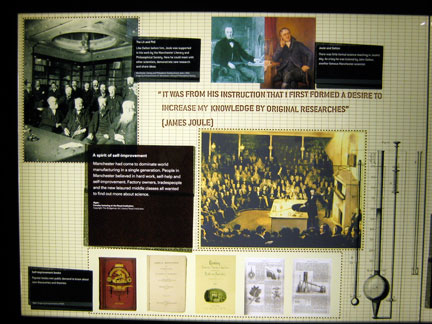
The amazing exhibition design at the Museum of Science and Industry.

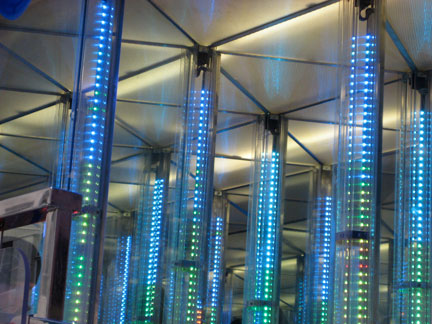
Lightbox in science wing of MOSI.

Lightbox in science wing of MOSI.

More illumnated didactic texts.

More illuminated didactic texts.

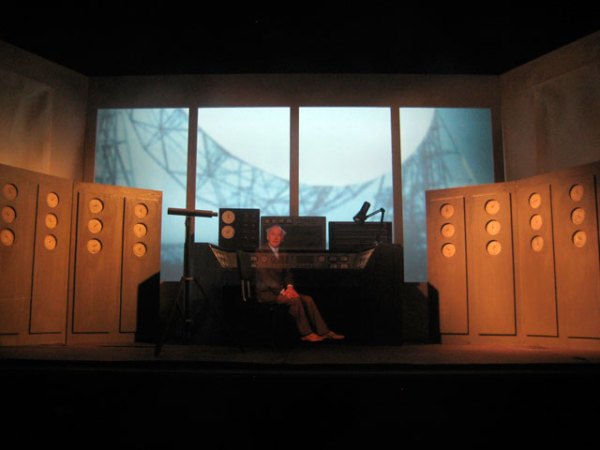
This isn’t graphic design, but it’s still brilliant exhibit design.

Video holograms projected into dioramas tell historic scientists' stories from the first person. Brilliant!

Video holograms projected into dioramas tell historic scientists' stories from the first person. Brilliant!


A high-tech counterpoint to Manila's Ayala Museum.

Standard
Art & Development, Travelogue

Liverpool

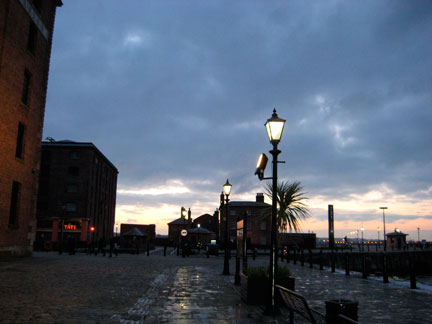
Albert Docks, Liverpool

Albert Docks, Liverpool

An all-day art trip to Liverpool today, guided by the indefatigable Breathe Residency co-ordinator, David Hancock. I’ve got a ridiculously high tolerance for gallery-going, but even I was starting to wane compared to David’s vim. Yesterday’s snow had melted and frozen again, leaving patches of slippy ice on the footpath (slippery ice on the sidewalk), but the rain stayed away, so we covered a lot of ground.

In America, it’s easy to be unaware that Liverpool was the 2008 European Capital of Culture, and now I can see how the city deserved the recognition. It’s a compact city compared to Manchester, and I found it quite scenic. Both cities are historic, but Manchester’s not especially picturesque, and while its recent development has lent a sense of energy, it’s sort of a tony, American, consumerist vibe. In contrast, my sense was that Liverpool culture was a little underground, more woven in with historic architecture, and that there’s quality arts and culture site here.

FACT (Foundation for Art and Creative Technology)
An institute for contemporary art dedicated to new/digital media.
I was intrigued by the website, and the actual place lived up to my expectations. It’s a cool building on a quiet little street lined with a few pubs and architecture/design studios. The galleries are nice, and the installations are meticulous. There were three shows on — one primarily found-sound installation, one essentially an art music video featuring beautiful video of industrial sites, and one kinetic/live data feed type of thing. All were high quality, impressive installations. I’m looking forward to going back to see more great shows, and maybe knocking back a cocktail before visiting their cinema.

Random observation: These UK ICAs sure know how to incorporate both cafes and cool lounge/bars into their buildings nicely. Maybe because the national museums are free, but it seems more common to find galleries to be cool, well-utilized hang-out spaces over here.

Open Eye Gallery
A non-profit gallery focusing on photography. A nice gallery of modest scale, featuring a great show by David Goldblatt. The exhibition pairs photographs shot in South Africa, contrasting framed, grainy, apartheid-era B/Ws with large, unframed, contemporary color prints. The premise could easily be problematic, but the quality of the work, and the way the show is organized, made a delicate, artful statement.
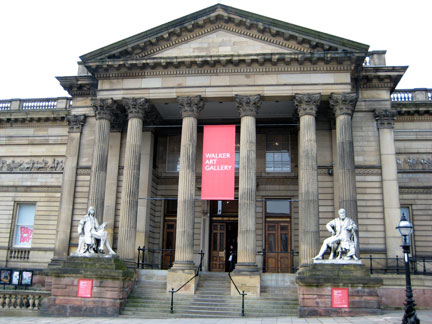
Walker Art Gallery, Liverpool

Walker Art Gallery, Liverpool. My American sensibilities find these century-and-a-half-old neo-classical buildings fantastically impressive; I wonder if they become run-of-the-mill for Britons?

Walker Art Gallery
Yet another free, civic-run general art gallery. The collection is fine, inclusive of decorative arts and old paintings.
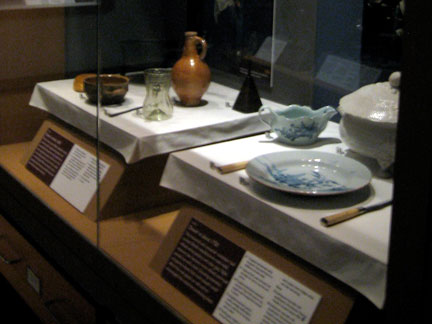
A typical table setting before (left) and after (right) the start of the Industrial Revolution. Walker Art Gallery.

A typical table setting before (left) and after (right) the start of the Industrial Revolution. Walker Art Gallery.

I’m finding the Industrial Revolution-era glass and ceramics to be really interesting, since it speaks to Chinoserie and the rise of the middle class. You really get a sense of how quickly the Industrial Revolution changed things. Plus, so many famous factories were here — Wedgewood, producers of delftware, pressed glass, etc. I’m better appreciating the over-the-top sensibilities of commemorative bowls, teapots, mugs and trays.
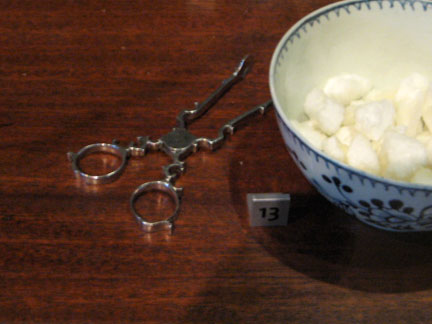
A beautiful pair of tongs for sugar lumps.

A beautiful pair of tongs for sugar lumps.

One contemporary project took my breath away: Jyll Bradley‘s The Botanic Garden, a series of photographic lightboxes shot around the cities’ botanical sites, including labs, libraries, and greenhouses. I love the stunningly dissonant photograph of two night guards. In the background, foliage and the domed conservatory walls loom grandly, but the guards’ station, littered with oversized containers of Nescafe and milk, couldn’t be more mundane. The photos were amazing: densely detailed, rich colors, and printed or mounted on some sort of matte substrate whose tooth reminded me of quality paper.

The Bluecoat
This fantastic ICA wasn’t on my radar before, but it sure is now. It’s a really beautiful, contemporary venue set in an old brick school with a recently-expanded galleries, along with in-house studios for artists and creatives. Brilliant.

Next Up: Liverpool Art Now is a regional survey that comes to some predictable conclusions, like jokey work by young artists, naughty messages on nice hankies, moody paintings, and poppy wall-drawing, but there are some nice turns as well. Here’s what sparked my imagination:
Stephen Forge‘s routed melamine pieces tickle the divide between formal and mimetic.
David Jacques’ fictional, documentary-style video and embroidered and painted banners.
James Loftus’ Tesseract Panopticon Camera, a six-sided pinhole camera that made six-part, cross-like prints.
Imogen Stidworthy’s Topography of a Voice, intaglio prints of 3D audio renderings.
Alison Jones’ Portrait of the Artist by Proxy is an intriguing audio track of non-artists having a hard time describing a face. The more speakers stumbled over their words, the more it seemed to validate artists’ visual skills.

Liverpool Art Now" catalogue

Spread from the Next Up: Liverpool Art Now\

Tate Liverpool
Two exhibits. First, works by William Blake — a really nice treat. And, a DLA Piper series showcasing selections of 20th century figurative and abstract art from the collections. It sounded boooorrrrring, like a bunch of surrealist paintings, cubist paintings and AbEx at any old museum of modern art, but it wasn’t too bad. There were even a few surprises from Op Art and Arte Povera.
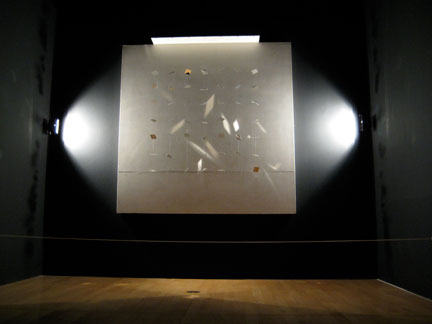
Julio Le Parc's Continuous Mobile, Continuous Painting

Julio Le Parc's Continuous Mobile, Continuous Painting

This Julio Le Parc was somehow resonant — it’s an obvious result from the era when artists did anything and everything to get off the wall, but I still like it.

Peter Halley’s The Place struck me in a way Christopher Wool‘s work first impressed me — as a painting that follows in a tradition, but slightly off, tongue-in-cheek. At first glance it looks like your basic grid abstraction, with some wonky, sort of tacky textures, but the neon colors suggest pop culture, and the form itself is a bit like a computer chip. This undermines the purism of abstraction, which doesn’t do much for me in theory, but is pretty entertaining in practice.

There were many strong contributions from contemporary women artists too:
Sarah LucasBeyond the Pleasure Principle junk installation on sex and death included raw light bulbs and a coffin of corrugated cardboard.
Mona Hatoum‘s Home is an installation where metal kitchen gadgets buzzed with a live current (or so the illusion suggested).
Melanie Smith’s Six Steps to Abstraction was a collection of Bridget-Riley-esque paintings stacked abjectedly against the wall, with hanging piles of colored string, and videos shot in Mexico, including one where a bossy customer tries to get a street vendor to re-upholster a cushion in modern art way. The concept seems like something you’d see in any art school grad show, but Smith pulled off a cool, museum-worthy iteration.

Liverpool John Moores University
Finally, I attended a lecture by Garry Charnock, who spearheaded a campaign to make Ashton Hayes, his hometown, the first carbon neutral village in England. Though the campaign is grassroots and has only been going for a few years, they’ve made remarkable process, reducing their energy consumption, attracting a lot of press and empowering the local community. Charnock’s got a background in engineering and journalism, so he tells a convincing story, but his success as a community organizer is the most inspiring.
Visit the project website or watch the video on YouTube.

Standard
Art & Development, Travelogue

Dinu Li at the Manchester Art Gallery

Yesterday, I attended the lecture by Mancunian photographer and video artist Dinu Li, whose photographic series, Press the * and Say Hello, are on view in the Manchester Art Gallery. I also saw these works commissioned by Autograph ABP in the inaugural show at INIVA during my visit to London one and a half years ago, and I thought it was a great body of work. The photos are documentary-style portraits of immigrants talking on the phone in call centers, and it captures a wide diversity of the people from around the world who find themselves in the UK.

My jetlag hit me hard yesterday, but Dinu’s talk was very compelling nonetheless. I was surprised to hear him speak at length about a primary inspiration of his: a painting by Vermeer. It really contextualized his interests nicely—the duality of light and dark and ambivalence between internal reality vs. external world. You can see these principles played out in his works, which started out with a documentary look (he was a commercial photographer in advertising before becoming an artist) and has recently become more cinematic and poetic.

The Manchester Art Gallery (really a mid-sized museum, with many permanent works from the collections) is always free — and I think it really makes a difference that visitors can come and go as they please. In the states, monthly free days at museums are madhouses.

Other unsolicited opinions:

YAY:
HearManchester.com, a great audio portrait in 10 episodes. Nicely produced, hosted by John Robb, a soothingly-voiced local punk rock impresario. Beautiful web design to boot!.

The Chinese Art Centre kitchen has an electric grill. I’ve always wanted one but could never justify it. Cheese toasties, here I come!

Detail of an amusement attraction at the Chinese New Year Festival in Manchester.

Detail of an amusement attraction at the Chinese New Year Festival in Manchester.

BOO:
The City of Manchester has no curbside recycling program. What!? For all of Manchester’s innovation in industry, science (the first atom was split in Manchester!) and music… no recycling?

Standard
Art & Development, Travelogue

breathe begins

9flashes
ready-made fluorescent-ink printed paper, die-cut in flashes

I’ve just started the Breathe Residency at Chinese Art Centre in Manchester, UK, and it’s quite an honor.

I arrived in the UK yesterday morning, and the residency program manager, David Hancock, has generously lent his past two days to get me situated in the studio and introduce me to Manchester’s resources and galleries. I visited Manchester briefly in 2007, but it is like day and night compared to having a local point the way.

Chinese Art Centre’s staff have been very welcoming, forthcoming and professional. The signage is up, the spaces are clean, and a manual with pretty much everything I need to know is in hand. They’ve allowed me lots of space: a 20 x 15′ gallery with high ceilings and an attached utility room/tool closet, a private bathroom and marginally shared kitchen, a sleeping loft, and access to the CAC’s library, which is stocked with books and catalogs. The staff has been really sweet, and very considerate of my privacy. Though I’m technically inhabiting a live/work studio in an art center, it feels more like having an apartment adjacent to the art center. This, along with David’s generous assistance, has truly underscored the privilege of being an artist in residence here.

I’m excited about what’s nearby:
–two art supply shops
–restaurants
–very cool bars (don’t think pubs, think lounges)
–the gigantic Arndale mall, which is replete with anything I could possibly need, from the dollar store (“Poundland”) to fast-food pasties (Gregg) to fresh shark (!) steak at a seafood market.
–just on the other side of the mall is Tesco, the supermarket, which will be a key to living inexpensively in England. The lower end of the price range is bafflingly cheap: £1.18 ($1.66), loaf of flax/soy bread. £0.86 ($1.21), quart of milk. £3 ($4.22), 4-pack of 330ml ciders. I’m curious about why the cost of food is so high in the U.S., even with all of our subsidies.
–a wonderful little shop named Clark Brothers, which stocks old signs and fake decorations. There’s a display of flower garlands that looks like a Wofford/Mail Order Brides dream set. But the other side of the room is lined with shelves full of fluorescent two-tone store signs. The signs are printed, but the text is just idiosyncratic enough to signal hand-lettering. It’s like a wall of ready-made Ruschas or something. I can’t get enough of it.

While I’m looking forward to diminishing my sense of disorientation, I’m also savoring the prickliness of the linguistic textures I’m hearing. It’s peculiar to be speaking the same language as everyone here, but not at all in the same way. When people speak, I have to listen hard, and I have to ask people to repeat themselves much more often than I’d like. Even when I do make out the words, I also find myself hung up on slang — pondering the etymologies of skally and chav, or just mulling over the wondrous glottal stop in grotty. Then there’s the getting used to the nearly ubiquitous “All right?”, a greeting that sounds to me like a question, but is typically answered with another “All right?” And I’m getting accustomed to the slightly emphatic, sing-song “‘Bye!,” which is neutral here, but reminiscent of a sarcastic American Valley Girl’s “‘Bye!”

The next three months are like a blank slate, but I’m confident that there is lots of time to develop and experiment. I got here; now I think the art process will take care of itself. And there are a few constellations that are already forming for the near future:
–a trip to Liverpool. I missed it on my last visit, but it’s close to Manchester and bursting with culture, like the Tate Liverpool and Anton Gormley’s installation at Crosby Beach.
–tomorrow’s lecture by Dinu Li at the Manchester Art Gallery
–a lecture by Antony Hall at Cornerhouse. Hall contributed a provocative installation featuring a soundproof booth for communicating electronically with a live fish in Interspecies, Cornerhouse’s current exhibition.
–artists’ salon-type events, which David mentioned he’d organize soon.
–Manuel Saiz’s “Private Party. Keep Out” exhibition at Castlefield Gallery.
–the opening of “Subversive Spaces: Surrealism And Contemporary Art” at The Whitworth Art Gallery, The University of Manchester. It’s a great space and it looks like it’s going to be a great show. I’m so excited.

Standard
Art & Development

One week until Breathe

If I’ve pulled back from local art, it’s because I’m preparing for an artist’s residency at Chinese Art Centre in Manchester, UK. The residency program is called Breathe — and the title couldn’t be better. I feel like I’m holding by breath until I get settled into the studio late next week.

Anticipation. From my current predictable perch (wake-eat-work-sleep), uncertainty seems terrifying. Luckily, I was able to visit Chinese Art Centre and Manchester in 2007, so I have a good sense of where I’m going, and the fantastic resources that will be available to me. I also know I’m in good hands with this organization… a relief.

Worried about money. (You write four rent checks in advance! Very sobering.)
Excited about:
Time to do nothing but make art.
Going to my first art opening in the UK. Whitworth Gallery, here I come!
Meat pies.
Graphic design and architecture. There’s so much great packaging and signage design for newcomers to appreciate… The Manchester Piccadilly rail station, for starters. Or a bag of Leicester cheese flavored crisps! Amazing.

Thankful for:
The hubby’s visit in March. So necessary.
Technology. I’ve accepted that I’m too attached to my computer to leave it behind. I’ll sleep in a strange bed in a new city for three months, but at least I’ll have my own virtual desktop.
And, finally, being able to talk about my president with pride.

Standard
Art & Development

new year, new software

One of my take-aways from the Creative Capital Professional Development workshop was improved bookkeeping. Artists, stereotypically, are “bad” with money. But the idea is this: manage your time better. Spend less time on money so you can focus better energy on art. Stop wasting time doing things the hard way. Utilize productivity tools.

The only way to find what works for you is to jump in. Here’s a re-cap of the software I’ve tried:

I was burdened with a series of Excel spreadsheets for tracking everything — bookkeeping, tax prep, and time. They were reliable but time-consuming.

The Mac version of Quicken looked dinky, so I tried Quicken Home Business for PCs ($80) in 2007. It was nice to automatically download my credit card transactions, instead of manually entering a pile of receipts. Still, the program was an over-complicated clunker. I was worried about security, but all the embedded passwords to download transactions through Quicken (rather than a browser) were a pain. Not only did log-in take ages, it locked up the program! I’m a multi-tasker, and I want my software to be, too. I was also turned off by all the annual fee-based upgrades. My tax prep was simpler from the year before, but still ended up a bunch of messy Excel sheets. I gave it a shot, but Quicken PC wasn’t worth the cross-platform bother.

Last year, I switched to Quickbooks for Macs ($199). Refreshingly, Quickbooks actually lives up to its name. It’s zippy, and seamlessly blends simplicity and high functionality. Daily tasks, like entering invoices, expenses and receiving payments, are a breeze. The app is smart but not pesky — it remembers and suggests names and categories, but accepts overrides effortlessly. It’s easy to get the bigger picture too: what I’ve spent, what I’m owed, if I’ve been paid. I can also track how much I’ve spent on a specific exhibition — this is really helpful. For artists, money can be too emotional anyway; better to know how much you’ve actually spent vs pondering Is my artwork worth so-and-so expense?)

To download bank and credit card statements, Quickbooks simply opens your institutions’ websites in your browser: simple, secure and familiar. (There’s a wrinkle, but it’s with my bank: downloading statements for Quickbooks is a feature available to all business account holders except sole proprietors. WTF?)

For tax prep, users are only two clicks away from a full profit and loss statement that includes all income and expenses for the year, which flawlessly exports into Excel. For the first time since the 1990s, I’ve whittled down all my tax info down to one Excel document. (I know! Nerdy! But, when you’re leaving the country from Feb-May, like I am, it’s a huge relief.)

I’d recommend Quickbooks for all artists and freelancers, especially because it includes short videos that painlessly acquaint users with set-up and work flows. It’s not cheap, but you get what you pay for in speed, functionality and convenience. I spend 20-40 minutes per week on bookkeeping, and have finished the bulk of my tax prep in three or four hours. It’s sooo much better than going through a pile of old receipts and bills.

While Quickbooks includes a time-tracking feature, it’s not detailed enough for tracking my freelance hours. Previously, I used to use a long Excel sheet with a simple formula and shortcut keys that enter the current date and time. It involved a lot of copying, pasting, and scrolling.

For 2009, it seemed like a good idea to graduate to proper time-tracking software, and after doing a few trial downloads, I’m giving Fanurio ($39) a shot. It’s still in its early versions, so it’s simple and clunky, but has the primary functions I was looking for:
1. Starting, stopping and pausing a live timer,
2. A high degree of control, including adding past hours to a log (a helpful feature for anyone who does any work away from a computer),
3. Quickly seeing the mode you’re in,
4. Reliability / back-ups.

I also like the ability to minimize the window into an iTunes-like controller, with a live timer display. If you’re going to have an app open all the time, it has to disappear and re-appear nicely. Fanurio is really designed for freelancers, and tracks time and rates, and keeps a running total of hours and profits for each job. Hopefully, later versions will bring improvements to the interface and speed, such as allowing users to customize window views and single-click to change jobs.

While anytime is a good time for artists to get more organized, January is a great time to make the switch to new software.

Standard
Art & Development

Delorean Mac Mini

The web can be a scary place. In the past few weeks, I’ve had the sad realization that there’s people out there who are reactionary and cynical (and they’re all driven to comment on message boards). Witty sound bites are generously rewarded. So it was really nice to come across a wonderful little corner of the internet today. I’m reminded that the internet can brighten my day, just by virtue of exposing me to something strange from afar. And I never would have heard about it without the web.

The Deloerean Mac Mini guy is no artist, but I admire his obsession with integrating his computer with his charismatic, stubbornly iconoclastic car: I can relate to his obsession, problem-solving, documentation…

Standard