Art & Development, Citizenship

Kempinas, Happiness, Democracy

Zilvinas Kempinas’ Double O (2008) at the MoMA
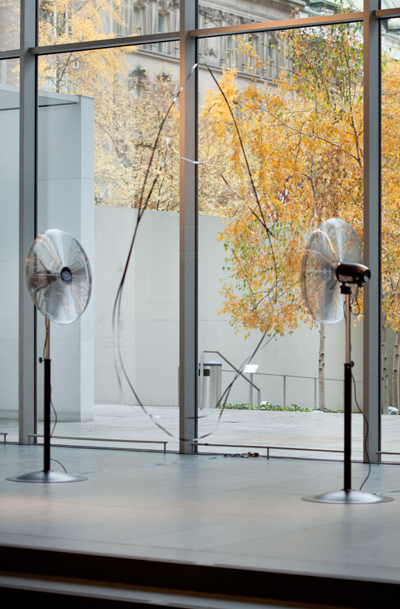
Zilvinas Kempinas. Double O. 2008. Installation view at MoMA as part of On Line: Drawing Through the Twentieth Century. Photo by Jason Mandella

Zilvinas Kempinas. Double O. 2008. Installation view at MoMA as part of On Line: Drawing Through the Twentieth Century. Photo by Jason Mandella. Source: MoMA.org

Zilvinas Kempinas’ Double O (2008) at the MoMA is a mesmerizing, extraordinarily simple installation in which fans suspend two loops of VHS tape in their intersecting currents. Have a look at the video on the MoMA site. The examples of Kempinas’ work that I first encountered seem like larger-than-life explorations of form and optics. Double O is a miraculous combination of simple materials, which prove to be just as effective as labor-intensive, perfect installations.

And the Pursuit of Happiness
A panel in the Live from NYPL! series and the Walls and Bridges Festival

This Franco-American panel of theorists and artists was a mishmash of languages, somewhat esoteric areas of academic research (via French Revolution specialist Sophie Wahnich and Ancient Greece expert Barbara Cassin), American common sense (no-nonsense artist/illustrator Maira Kalman), and likable, self-effacing irreverence (the author Daniel Handler, AKA Lemony Snicket). The Americans seemed like they couldn’t hang with the intellectual rigor of the French academics, while the French seemed oblivious to the idiomatic phrases and physical cues that made the Americans seem warm and entertaining to the audience of New Yorkers.

Unintended absurdity, evident investment in the topic, and the chance to see and hear examples of Kalman’s and Handler’s work and process kept me in my seat. However, at the end, I could hardly contain myself. The concluding question was “What makes you happy?” and nearly all of the respondents talked about losing oneself in skilled activity–yet no one mentioned Mihaly Csikszentmihalyi’s concept of flow.

Further, Handler divulged that happy conditions don’t inspire him to write. Italo Calvino’s short story, “The Adventure of a Poet”—which I wrote a post about a few days ago—is exactly about how much easier it is to represent the mundane, while the transcendent often begets cliché.

I was also interested to hear Wahnich discuss the centrality of the political self in the search for happiness. If I understand her—or her interpreter—correctly, she explained that the freedom to act politically—not necessarily in the civic sense as an activist or voter, rather the basic liberty of movement, speech, thought, and action—is fundamental to the pursuit of happiness. Handler said that the Declaration of Independence is a statement about how democracy must be homegrown; it cannot be installed by foreign powers, and it must be fought for by the people. Still, no one on the panel connected this talk about self-determination and the struggle for democracy with the grassroots democracy movement in Egypt today.

While the Declaration of Independence sought liberty for some men, and the struggle for civil rights in this country is far from over—gay marriage being the most obvious liberty, to me, that the state ought not deny its citizens—its passage on happiness and building democracy seems worth remembering at this time.

We hold these truths to be self-evident, that all men are created equal, that they are endowed by their Creator with certain unalienable Rights, that among these are Life, Liberty and the pursuit of Happiness.–That to secure these rights, Governments are instituted among Men, deriving their just powers from the consent of the governed, –That whenever any Form of Government becomes destructive of these ends, it is the Right of the People to alter or to abolish it, and to institute new Government, laying its foundation on such principles and organizing its powers in such form, as to them shall seem most likely to effect their Safety and Happiness.
Standard
Meta-Practice, Projects, Research

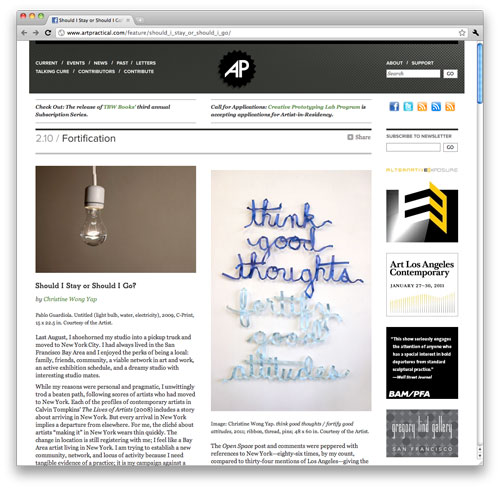
Should I Stay or Should I Go? on Art Practical

Art Practical, Should I Stay or Should I Go? Christine Wong Yap

My feature on artists staying or leaving the Bay Area is finally out in the current issue of Art Practical. Thanks to the interviewed artists—Michael Arcega, Pablo Guardiola, Stephanie Syjuco, Emma Spertus, and Jenifer Wofford—for their time and insight. And a deep bow to Editor-in-Chief Patricia Maloney, Copy Editor Victoria Gannon and the rest of the Art Practical team for their support and guidance!

“Should I Stay or Should I Go?”
Feature story published on
Art Practical, Issue 2.10

Standard
Artists

Rosemarie Fiore’s Scrambler Drawings

Amusement park ride + art materials + someone with serious means and a taste for adventurous art = Awesome drawing machine. Watch the video on Rosemarie Fiore’s website.

Though I first came across her Subway Window prints in the sadly now-defunct Art on Paper magazine in 2005, the idea of them is still marvelously exciting to me. How is it possible no one ever thought to ink and wipe, intaglio style, those scribed windows?

Standard
Art & Development

SF to NY, 5 months later

In the San Francisco Bay Area, going to openings was a form of reciprocity for me. Showing up was a way to share my gratitude, interest, and participation. Running into friends and alumni was a common bonus. Some circles became as warm and familiar as an episode of Cheers.

New York is a different story. I bailed on a few openings last week. First of all, it’s cold. It’s 28ºF right now – bearable, but bundling up and braving the slippery, slushy, icy sidewalks is not exactly enticing. It’s also time-consuming in terms of transit—from my leafy borough to downtown takes 45-50 minutes (sometimes more with service changes). And, of course, I’m still very new here, which makes showing up sometimes feel like networking; I can’t wait until I gain a sense of community — that magical sense of participation and reciprocity…

Standard
Art & Development

Happiness and pathology

My art has concerned happiness for the past two years, so I was fascinated to learn about a man who is forced to avoid joy and pleasure.

Neurologist Matt Frerking suffers from narcolepsy with catoplexy, a disease that results in momentarily losing the ability to move one’s muscles. In his case, the attacks are triggered by strong positive emotions. As Chris Higgins, the storyteller, narrated on This American Life (Episode #409, “Held Hostage”, originally aired June 4, 2010):

When Matt gets really happy—when he feels the warm fuzzy stuff—he becomes paralyzed by his emotions. Literally. Paralyzed.

Since I’m also interested in knickknacks and decorations, and how important and valuable they are, it was fascinating to hear this:

Frerking:

It can be a triggering condition just to discuss [looking at a wedding photo.]

Higgins:

At this moment, Matt is having an attack… Think about this: Matt had this attack while he was talking about a photo he has never seen. If just talking about a picture can cause this, imagine the other things Matt has to avoid.

It’s this kind of deep personal meaning invested in personal effects that fascinates me. How can an object can be invested with such strong memory, emotion and meaning, and yet be distinguished from art?

Higgins goes on to describe further negative impacts of the disease on Frerking’s life:

After living with this disease for four years, with being punished every time he experiences happiness, Matt’s adapted, though the way he has adapted is sad: He tries to enjoy things less. He told me he tries to think of himself as a robot, and not engage too emotionally. He’s told me he even has to be careful how he speaks, not to get too enthusiastic or worked up.

I find this tremendously tragic—and ironic, considering how much some of my past work advocated for modest pleasure. Certainly I was not talking about moderation in lieu of irrational exuberance, nor for the hostages of such diseases. If you are in good health, be grateful. It allows you the ability to feel as much happiness and express as much exuberance as you like.

Higgins ends on an optimistic note:

But it’s important to point out, even though Matt is being trained by his brain everyday not to feel these emotions, he still has them…. Although Matt tries to avoid happiness, it’s still part of his life. He’s proof that you can’t avoid happiness, it’ll still find you no matter what.

Standard
Art & Development

The delectable joy of precision

circular saw and alumicut

When M asked me to build a pedestal for his project, I asked him for a figure on the Barreto scale: Is this a 1 or a 10 project? Ten indicates a flawless level of finish. Five means be efficient and don’t let the details take more time than necessary. I like to uphold high standards, but rarely can everything can be 10s all the time in preparator work. That’s just the nature of changeovers: your deadline is the opening. Several perfect elements won’t make up for one unfinished element.

M paused. I remembered that I was talking to a Virgo, and knew my answer: 10.

The motor on my hand-me-down circular saw sometimes loses power mid-cut, causing a skip and an ugly cut. This was fine for things like crates (a 1 or 2 on the scale), not ok for a pedestal. It was time to get a new saw. I chose a Rigid because it looked well-made (the base plate didn’t seem like an afterthought), the guard spring was not obnoxiously tight, it was light, and it was moderately priced. When I took it out of its box, it seemed surreal how pristine it was.

As soon as I lined up my first cut, the kerf cutout (which indicates where the blade will go) lined up exactly with my cutline and the blade (see pic) and I felt a surge of bliss. So much certainty and confidence! I saw my (near) future and it was a cut exactly where I needed the cut to be. Push the button. Smooth sailing. For a brief moment, I experienced a kind of Virgo’s nirvana.

Standard
Art & Development

pet peeve: mark-ups

I just paid $20 for a pad of vellum (Borden & Riley #90 Sheer Trace Vellum, 9×12 inches, 50 sheets) at Sam Flax in midtown Manhattan. Why? Because I received the materials list for a class 46 hours before it starts, and I haven’t got the time to take the trip to the art stores downtown in the next two days. So Sam Flax it was, and whatever Sam Flax wanted, I paid. Apparently, they want $4.50 over the list price (other stores, like Blick and Utrecht, charge less than the manufacturer’s list price of $15.54—respectively, $12.39 or for a comparable product, $13.99).

I want to support the little guy. I understand that mom & pop shops can’t offer the same pricing that chain stores dealing in much larger volumes. But it’s not like their staff were any less aggressively apathetic. (Three customers waited to checkout as a staff member giftwrapped something, while three other staff stood around; one of them clipped his fingernails. Gross!)

I dislike being so negative, but not as much as my distaste for feeling ripped off. I’ve learned my lesson.

Standard
Art & Development

Cool Tools

The best instruments become extensions of your consciousness. To use a favorite tool is to exploit its familiarity and dependability–the flow of a favorite pen, the rightness of a sharp, well-balanced knife, the haptic response of certain power tools. In celebration, here are some tools I’ve held or used recently — one novel, the other, ingenius.

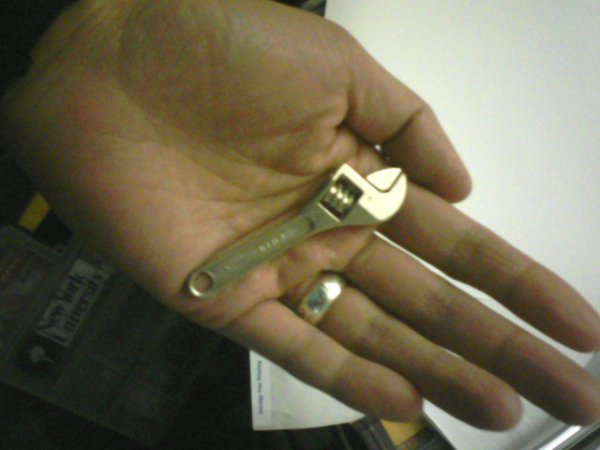
Tiny wrench

Found at the studio of HWT.


Handmade compass

O's handmade compass consisted of two 1/2" square dowels threaded with a wingnut. One dowel was tipped with a pin, the other with a tiny spring clamp with which to grip a pen or marker. A second spring clamp forms a cap for the sharp pin in transit. It worked brilliantly.

Standard