Meta-Practice

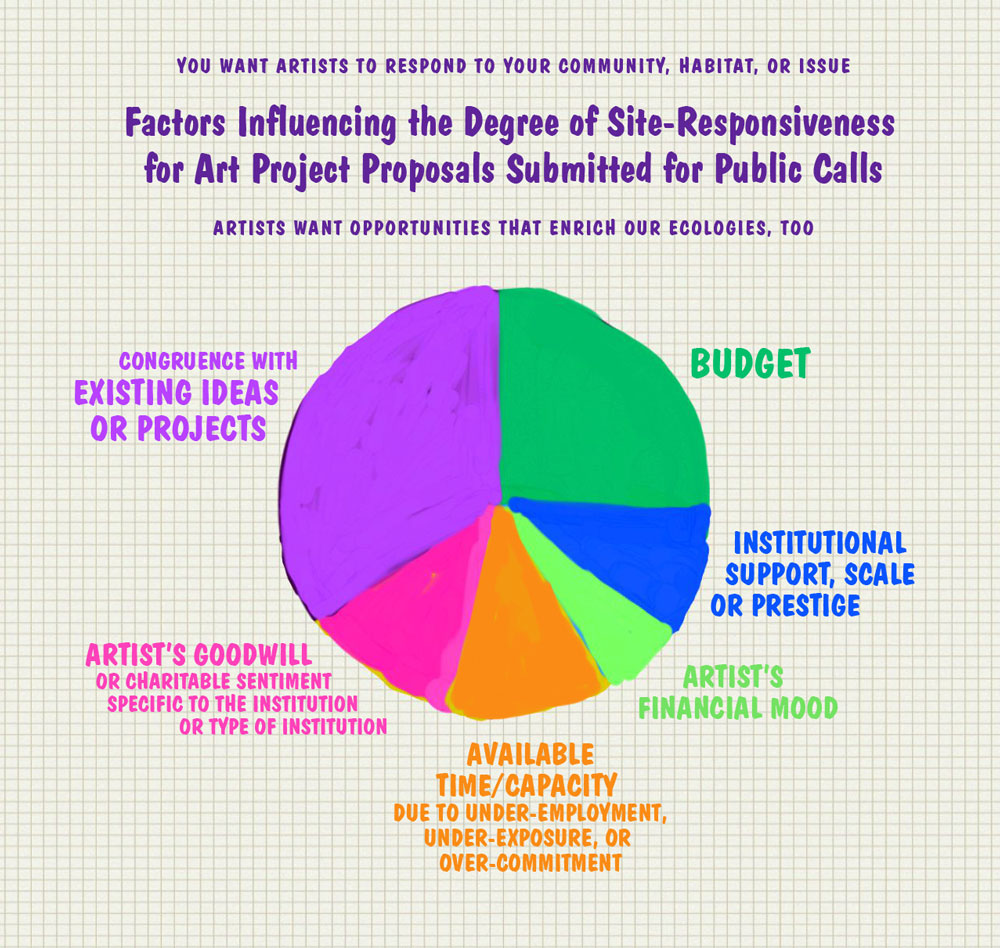
Site-responsive proposal factors

Not all calls for site-specific projects are created equally.

Competitions reward ambition, but ambitious projects aren’t always adequately supported. I am guilty of having breathed a sigh of relief upon hearing that I didn’t receive an award for an overly ambitious or under-funded opportunity. Sometimes things change. Ideas become less attractive, or other commitments become more engaging.

Site-specific calls are especially labor-intensive, so perhaps savvy artists embrace degrees of site-responsiveness. These are some factors that influence to what degree I push speculative projects. Enjoy.

Site-responsive proposal factors

Site-responsive proposal factors

Standard
Citizenship, Meta-Practice

art sales scams

Amazingly, internet scammers have found a way to become even lower low-lifes, now targeting artists with sales. Just received this email:

Hi,

I’m Betty Hammond from California. I was going through your works and my eyes caught this particular piece,I want to purchase it as I am moving to a new apartment next month. Kindly let me know if you still have the piece available and also let me know it’s final price and more information about it. I will be waiting to read from you.

Regards,

Betty.

Luckily, when I googled “Betty Hammond California,” this post by this fellow artist and anti-scam blogger showed up, exposing the scam. Basically, they get your mailing address and send a check in an amount way over the sale price, then ask you to forward the balance to a fictitious shipper. When the check turns out to be fraudulent, your money and possibly your art are gone.

The sad part about this is that authentic collectors may contact artists via email, and they may have different language abilities, making screening out fraudsters trickier. A commenter at the above blog post recommended only accepting payments via Paypal as one method for avoiding this scam.

Standard
Meta-Practice

Saltz, NYC galleries, and spaces for dialogue

Jerry Saltz makes some interesting observations in “Saltz on the Death of the Gallery Show” in NY Mag (3/31/13).

His main point is that

A great thing about galleries …  is that they’re social spaces….  places where one can commune with the group mind.

But due art fairs, mega-collectors, and skyrocketing rents in Chelsea, galleries are

playing a diminished role in the life of art.

The problem is

When so much art is sold online or at art fairs, it’s great for the lucky artists who make money, but it leaves out everyone else who isn’t already a brand. This art exists only as commerce, not as conversation or discourse.

….Many artists are now in “abundant production,” seducing collectors on the prowl for stuff to fill their oversize atriums.

Baffinglingly, Saltz goes on to make these statements about NYC-centrism:

Art doesn’t have to be shown in New York to be validated. That requirement is long gone. Fine. But… a good Los Angeles dealer chided me for not going to art fairs, not seeing art in L.A. and London, and not keeping track of the activity online. He said I “risked being out of touch with the art world,” and he was right….

I brooded for months over this. Then … I started thinking about “the art world.” Something clicked and brightened my mood. There is no “the” art world anymore. There have always been many art worlds, overlapping, ebbing around and through one another. 

This last realization seems a bit belated. Artists outside of NYC have had to cultivate their own art worlds for ages, not because of the recent overabundance of fairs, but because of long-standing NYC-centrism. NYC is home to major publications and art commerce, yet artists outside of NYC have found ways to persist—regardless of the facts that NYC critics focus on NYC shows (ahem!), and art fairs diminish Chelsea galleries’ audiences.

And, paradoxically, it seems as if Saltz is using the de-centralization of the art world to justify his own NYC-centrism. No one critic could see all the art in these different art worlds, but could certainly try harder to get out of his own city—and borough—more often.

He ends on an upbeat note:

When I go to galleries, I now mainly see artists and a handful of committed diligent critics, collectors, curators, and the like. In this quiet environment, it may be possible for us to take back the conversation. Or at least have conversations. While the ultrarich will do their deals from 40,000 feet, we who are down at ground level will be engaging with the actual art—maybe not in Chelsea, where the rents are getting too high, but somewhere. That’s fine with me.

That Saltz has been able to seek out dialogues in commercial galleries seems like a fluke, in my book. Most Chelsea galleries feel too-cool-for-school to strike up conversations.

Those spaces where dialogues happen, where art by artists’ artists is shown, are non-profit, alternative, and artist-run spaces. NYC has its share, but nothing like the vibrancy of SF Bay Area’s community, in my opinion.

I also sense that many NYC alternative spaces show a higher proportion of artists with commercial gallery representation (artists further along in the “emerging” spectrum) than those without. It would be fantastic to take a survey comparing the proportion of represented artists shown at Artist’s Space, White Columns, Sculpture Center, Socrates Sculpture Park, Smack Mellon, Momenta Art, Art in General, Apex Art and Flux Factory against those at Southern Exposure, Intersection for the Arts, The Luggage Store, The Lab, SF Camerawork, Pro Arts, and San Jose ICA. It would beg the question of what alternative art organizations are for, who they serve, what kind of dialogues they  create, and with whom.

What if more commercial galleries fold in NYC, but an equal number of new non-profit and alternative spaces sprung up in their wake? What if they focused on truly emerging artists—not trying to compete with commercial spaces, but were real, imaginative, risk-taking alternatives? What if big-time critics visited and wrote about alternative spaces more often, not just when they mount shows by established artists or shut their doors? What if, essentially, NYC can learn a thing or two from other cities like San Francisco?
Standard
Art Competition Odds

art competition odds: Lower East Side Printshop’s Keyholder Residency

The Lower East Side Printshop’s 2013-2014 Keyholder Residency Program received over 260 applications for 4 recipients and once reserve.

///////////////////////////////////////////////////////////////////////////
///////////////////////////////////////////////////////////////////////////
///////////////////////////////////////////////////////////////////////////
///////////////////////////////////+ 

or about 1:65, or 1.5%.

See all Art Competition Odds.

Standard
Art Competition Odds

Art Competition Odds: Blue Mountain Center Residency Program

This year, the Blue Mountain Center received over 330 applications for 42 residency spaces.

///////////////////////////////////////////////////////////////////////////
///////////////////////////////////////////////////////////////////////////
///////////////////////////////////////////////////////////////////////////
///////////////////////////////////////////////////////////////////////////
/////////////////////////////+

or ~1:8, or ~13%

See all Art Competition Odds.

Standard
Meta-Practice

Here’s to Doing Things the Wong Way

There’s a printmaking technique named after me.

It’s called, “The Wong Way.” The pun is intentional.

In undergrad, I was an eager student of woodcut printmaking, but not of color registration. Ken Rignall demonstrated a system involving metal buttons at the California College of the Arts, but he warned against leaving the buttons in the press. That would destroy expensive blankets and thus incur the wrath of fellow printmakers. To this day, I’ve never left the buttons in the press, because I’ve been too afraid to use them.

Either due to early twenties overconfidence or mechanic’s daughter ingenuity, I thought, if all you’re trying to do is line the block up with the paper consistently, why can’t you just jam them both into a corner? I made a 90º angle out of wood and tried it out on a block with a margin carved out. If your block or paper is less than square, you pick an edge to line them up with, and, Presto!

It wasn’t the most precise, but it was the most idiot-proof. (If there is an essence to the Wong Way, that might be it.)

Ken caught wind of this method and admired it. He coined the name and taught the technique in subsequent semesters. The pun in the name suggests that this is not how you should do it, but this is how you can do it.

I finally bought some sewing reference books—six years after buying my sewing machine, and experimenting with many combinations of needles, threads, and fabrics, not to mention patterns of my own devising. I’d been rambling between states of unconscious and conscious incompetence—sometimes completely unaware of incorrect thread tension, sometimes painfully aware that the bias in the fabric was exacting a toll for my poor cutting.

The reference books point out the sheer volume of fundamentals I’ve skipped over.

You might be thinking that I’m kicking myself for putting the wagon before the horse, but actually, I’m grateful and elated to learn these fundamentals now. I know WHY I need to acquire this knowledge, and am able to ground it in prior experience. I appreciate it so much more.

My Dad taught me to problem solve fearlessly. He’d take broken things—from toys to toaster ovens—down to his garage tool bench, rattle around in his toolboxes, crack the thing open, and have a look-see. Sometimes he repaired it, sometimes he didn’t, but he always gave it a try. Dad went to automotive school, but he learned a lot by doing. No one taught him how to re-roof our house or make a kid’s play structure from an old barrel and a car rotor. He just figured it out. He showed me that I too could figure things out, and that there’s no reason to shy away from trying.

Here’s to jumping in with both feet. To the confident leap into the unknown, that the things around us are not too complicated, that fear can be rather useless, and that curiosity is intertwined with survival.

Standard