Meta-Practice

Be Here Now: Artists’ Majority Power

Lately among my colleagues, sharing information and support has been especially active and enjoyable. We usually send links to art opportunities,* and I’ve also been contributing ideas to CF’s curriculum. In a virtual book club, we share intellectual discourse as well as a sense of camaraderie.

I was reminded to be grateful for this generosity after hearing from a disenchanted colleague recently. He was frustrated and fatigued, but worst of all, he seemed to feel hopeless about his position in relation to the art world.

So many artists feel like there aren’t enough resources to go around; that we are all competing for a limited number of opportunities/commissions/gallery rosters/fashionably “in” careers as art stars, and only the already privileged, networked, and fashionable win. It’s true that the art world is structured so that it can’t accommodate all of the artists who would like to make art for a living. As an artist, the odds are that you win some, and lose most. Rejection is unavoidable, and it can result in

an increase in sadness, despair and hostility, and a decrease in self-esteem, belonging, sense of control and meaning in life

according to Todd Kashdan, George Mason University professor of psychology (“Understanding Rejection’s Psychological Sting,” Huffington Post, September 16, 2011). To counteract the effects of rejection, Kashdan suggests cultivating

those powerful human capacities for awareness, openness and compassion

As artists, we have to help each other. We’re in the best positions to understand what our peers are going through, and to hear of opportunities that might be perfect for a colleague. After participating in a public art program in Poland last year, a friend and I shared this year’s call, and colleague’s work was selected. A deserving artist and an interesting program connected.

Christine Wong Yap, Positive Sign #40, 2011, glitter gel pen on gridded vellum, 11x8.5".

Christine Wong Yap, Positive Sign #40, 2011, glitter gel pen on gridded vellum, 11×8.5″.

People assume that optimism is simple minded, but it’s actually pessimism that’s all too easy. If you look for reasons to be cynical about the art world, it will provide in abundance. But if you cultivate optimism and enact your principles amongst your peers, I think it will be more rewarding ultimately. Cooperation, not competition, is the best approach for a life in the arts.

Disenfranchised artists might consider RY’s advice:

Pressure leads to perseverance; perseverance to character; character leads to courage; courage to hope.

Since my birthday, I’ve been grappling with a personal achievement gap of sorts—what I’ve done or am about to do, versus some ideas that drifted down from aloft like stray pigeon feathers about where my art career and personal life should be now.

Just like everybody else, artists can easily mistake career achievement for happiness. A lawyer might think, “I’ll be happy when I finally become a partner,” and artists might think, “I’ll be happy when I my career takes off.” The challenges of working day jobs to support art practice are in ample evidence in our daily lives, so we assume that selling enough art to live on will unlock a more authentic state of creative freedom.

But as AV pointed out (in a book club meeting!), art stars aren’t necessarily more free or happier. They may feel like sovereigns of mini-empires, compelled to pump out increasingly higher priced products in order to sustain multiplying sectors on organizational charts, while terrified by the thought of ceding relevance and influence to other artists.

Two ways of looking at the art world. Left: A conventional model where the majority of artists are struggling and strive to become a member of the tiny percentage of art stars. Right: A different perspective, extolling the  benefits of not being darlings of auctions, media, collectors, etc., and appreciating the kinship of peers who are hardworking, inventive,  tenacious, and generous; free to re-invent our practices and shape the communities in which we would like to participate.

Two ways of looking at the art world. Left: A conventional model where the majority of artists are struggling and strive to become a member of the tiny percentage of art stars. Right: A different perspective, extolling the benefits of not being darlings of auctions, media, collectors, etc., and appreciating the kinship of peers who are hardworking, inventive, tenacious, and generous; free to re-invent our practices and shape the communities in which we would like to participate.

I’ve written before that the “art world” is too often equated with a tiny sliver of artists, auction houses, collectors, galleries and critics, who, in my view, are actually on the margins of most artists’ (and people’s) experiences.

Similarly, I’d like to re-frame a pyramid of working artists. I’ve always thought of the vast majority of artists as underlings, trying to claw their way into inclusion into that elite world of international art stars. But just as one chooses whether a half-glass of water is half empty or half full, we can choose to imbue the majority of artists with the majority of relevance (the beauty of majorities!). My peers are vibrant, meaningful, and no less creative and worthy of attention. To complain about this disparity is to reify the minority’s hierarchy. To acknowledge our majority power is to assert our freedom over our attentions. 
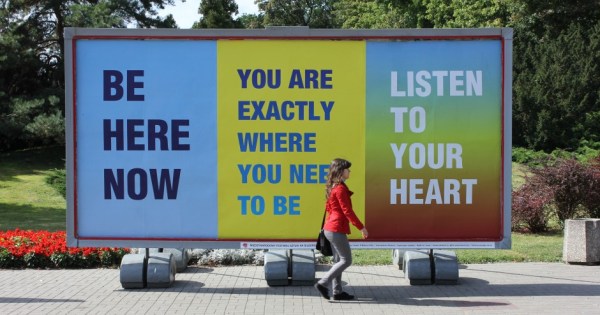
Susan O'Malley, Inspirational Posters: Be Here Now, You Are Exactly Where You Need to Be and Listen to Your Heart billboard, Rapackiego Square, Art Moves Festival, Toruń, Poland

Susan O’Malley, Be Here Now, You Are Exactly Where You Need to Be and Listen to Your Heart billboard, Rapackiego Square, Art Moves Festival, Toruń, Poland // Source: SusanOMalley.org.

*RateMyResidency.com is an artist-initiated website that offers users the chance to review residencies. I love this idea, and have been hoping for something like this appear for some time. This site is still pretty new, so not many residencies have been reviewed, and I think the interface could use some tuning up, but in the meantime, it’s a great resource for upcoming deadlines.

Standard
Citizenship, Meta-Practice

A Declaration of Principles (for artists, cultural workers and supporters thereof)

By Justin Langlois:

By posting this page, we submit that we are an artist, cultural worker, or a supporter thereof and declare the following: we are no longer interested in participating in consultancies, asset maps, or activities that offer us “promotional opportunities” in absence of clear financial or strategic gain. We will not support the exploitation of artists or other cultural workers or their works for the sole purpose of further municipal or economic planning, fundraising, or marketing. We refuse to acknowledge the existence of the politically-invented term, creative economy, which lumps together practicing artists with video cassette duplication services. We can no longer participate in activities that knowingly disadvantage artists with less experience and we vow to make accessible opportunities that we have to these same artists. We hereby decide to stop playing prescribed games and to start making it up for ourselves. Henceforth, we will support one another by adhering to this declaration.

By posting this page, we submit that we are an artist, cultural worker, or a supporter thereof and declare the following: we are no longer interested in participating in consultancies, asset maps, or activities that offer us “promotional opportunities” in absence of clear financial or strategic gain. We will not support the exploitation of artists or other cultural workers or their works for the sole purpose of further municipal or economic planning, fundraising, or marketing. We refuse to acknowledge the existence of the politically-invented term, creative economy, which lumps together practicing artists with video cassette duplication services. We can no longer participate in activities that knowingly disadvantage artists with less experience and we vow to make accessible opportunities that we have to these same artists. We hereby decide to stop playing prescribed games and to start making it up for ourselves. Henceforth, we will support one another by adhering to this declaration.

Standard
Meta-Practice

New research on equality in the arts

Yesterday, the Strategic National Arts Alliance Projeect (SNAAP), a consortium of educational institutions, released its latest report, “An Uneven Canvas: Inequalities in Artistic Training and Careers” (PDF). Long-standing issues of racial and gender parity are elucidated in this survey compiling data from over 65,000 arts graduates. I noted some interesting points:

Female alumni are less likely than male alumni to ever work as artists and to do so currently.

(page 15)

(As JW put it, female artists continuing to work as artists is sometimes a matter of a war of attrition.)

Across all racial/ethnic groups, Black graduates and Hispanic graduates are the least likely to ever work as artists—with 76% of both groups ever working in this capacity.

(page 15)

Black and Hispanic alumni are much more likely to cite both lack of access to networks and debt (including student loan debt) as barriers to artistic careers, compared to White respondents.

(page 16)

SNAAP reveals sharp disparities in earnings by gender. Among alumni currently spending the majority of their work time in an arts-related job, men out-earn women. For example, among undergraduate-level respondents who currently work primarily within the arts, 56% of men earned more than $50,000 in the past year—compared to 36% of women.

(page 17)

The Question of Who Qualifies as “Artists” in the SNAAP Study

SNAAP uses the labels “art” and “artist” to refer to a broad spectrum of practicioners, including performers and creative writers. They also include workers in fields that often hire salaried employees, such as in architecture, design, film, illustration and animation—which I would consider creative industries (see also Ben Davis’ recently published 9.5 Theses on Art and Class, 2013).

I strongly believe that the inclusion of workers in creative industries skew the data—a criticism I’ve voiced about past reports. “An Uneven Canvas” seems to make a more conscious effort to acknowledge this:

Differences in the artistic fields … partially account for some disparities between groups.

(page 19)

Gender Disparity

SNAAP does a great job investigating general trends of gender-based income disparity:

the income gap between male and female arts alumni persists regardless of how long ago they graduated from their institutions

(page 21)
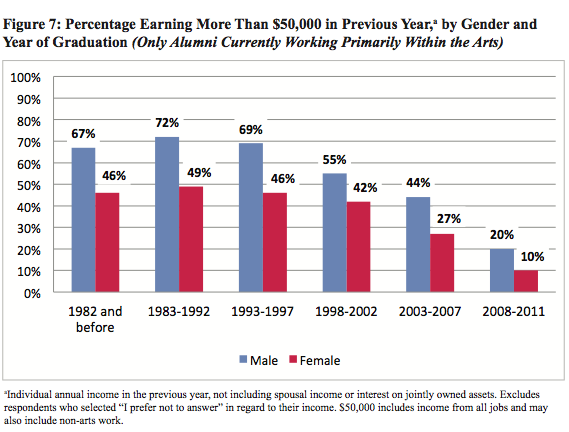
SNAAP's "An Uneven Canvas," Figure 7: Percentage Earning More than $50,000 in the Previous Year by Gender and Year of Graduation (Only Alumni Currently Working Primarily in the Arts). Those who graduated in the 80s and 90s (who are likely older), clearly make more than recent grads with less post-graduate work experience. However, the key point of this bar chart is that income disparity by gender in the arts is an ongoing trend over the past 30 years. The pay difference is highest among those who earn more; for recent grads, the 10% more of men who earned $50k is also 100% more of women who earned $50k.

It’s easy to misinterpret this bar chart as showing the reduction of income, and gender-based pay disparity, over time. What it actually shows is gender-based pay disparity in 2011 according to graduation year ranges. Those who graduated in the 80s and 90s (who are likely older and further along towards maximizing their earning potential) see the highest gender-based pay disparity. For the most recent grads, the there is relatively less pay disparity in percentage points, but, in this cohort, you could also say that the number of men who earned $50k is 100% more than women. 

One salient feature of this graph is that male artistic workers out-earn females within every cohort group. …income differences are not simply the result of men’s and women’s different work commitments, but rather reflect persistent patterns of discrimination. Furthermore, these data provide compelling evidence that gender inequalities continue to exist for the newest graduates and are not simply a relic of an older time.

(page 24)

The Data We Get vs. the Data I Want to See:
Free the Fine Artist Subset

SNAAP’s wide definition of “artist” may be useful for including the majors offered at its member institutions, but its analysis can only be applied to fine artists with remote and questionable extrapolations.

The fine arts is worthwhile of analysis as its own data subset. The fine arts are exceptional. In other words, the economics of fine arts operates does not follow any logic found in other fields (see Hans Abbing’s Why Are Artists Poor? The Exceptional Economy of the Arts, 2004).

Most pressingly, the fine arts are well-known for its huge disparities. The vast majority of artists work non-art day jobs to support their art practices, while only a tiny fraction of artists garner dramatically higher income levels from their art sales. Thanks to the media’s obsession with auction sales, gender-based income disparity is well-documented for the highest earners, but this data ignores most working artists.

SNAAP’s subset of data relating specifically to contemporary fine artists is robust, according to the interactive SNAAP Shot 2012, with about 21,000 respondents who majored in Studio/Fine Arts. This is no small data set. SNAAP should make this data set freely available, like many contemporary federal- and city-level governments, or the UK Guardian, for statisticians and information graphic designers to interpret and share.

I would love to see this data set analyzed to address questions such as:

  • What can be learned about the lives and working conditions of contemporary fine artists?
  • What percentage of fine artists’ primary means of income is from their art?
  • For fine artists whose primary means of income is not based on their art, how much of their income is?
  • How much gender-based income disparity do fine artists experience?
  • How does this change over the graduation-year-separated cohorts?
  • What are the breakdowns of racial inequality in the fine arts—how many artists of different races persist into the field of fine arts, over what period of time, and to what degree are they able to transition their art-making into a viable profession?
  • In addition to comparing people of color and women to the responses of White men, I’d like to see intersectionality integrated into this report—what can we learn about the experiences of women of color?


Standard
Artists

Notes on Things, from Manchester UK

The Living Room, Lee Mingwei’s show at the Chinese Arts Centre (through July 27) sounds fascinating.

The NYC-based artist arranged a vibrantly wallpapered space for local collectors to use for display and discussion of objects. It seems that they’ve found quite an interesting and diverse range of hosts to participate.

You can learn more on the TheLivingRoomProject.co.uk. The questions posed,

“Why do we collect?”

and

“What do our collections say about us?”

however, seem harder to grasp via the site; perhaps it is more discernible for those who attend the events in person.

On the site, there’s a video of an audio recording of Lee’s artist’s talk—an overview of past projects. As an audio recording, there aren’t any images, but I found it worthwhile because of the open-ended, conceptual and participatory nature of his work does not demand images as much as more formal artworks would. The audio-video shed light on his practice overall, but I wanted to hear more about the above two questions. The researcher in me wants to inquire about the projects’ outcomes, and the artist in me shudders at the thought.

More things examined in Manchester and viewable at:
PrizedPossessions.co.uk

Standard
Art Competition Odds

art competition odds: 2014 Triangle Residency

The Triangle Arts Association (Brooklyn, NY) received over 600 applications for five residencies awarded.

///////////////////////////////////////////////////////////////////////////
///////////////////////////////////////////////////////////////////////////
///////////////////////////////////////////////////////////////////////////
///////////////////////////////////////////////////////////////////////////
///////////////////////////////////////////////////////////////////////////
///////////////////////////////////////////////////////////////////////////
///////////////////////////////////////////////////////////////////////////
///////////////////////////////////////////////////////////////////////////+

 or about 1:120, or 0.83%

See all Art Competition Odds.

Standard
Art Competition Odds

art competition odds: Kala Art Institute’s 2013 Fellowship Award

The Kala Art Institute’s 2013 Fellowship Award received 274 applications for nine Fellowships and six Honorable Mentions awarded.

///////////////////////////////////////////////////////////////////////////
///////////////////////////////////////////////////////////////////////////
///////////////////////////////////////////////////////////////////////////
/////////////////////////////////////////////////

Fellows comprise about 1:30, or 3% of applicants.

Fellows and Honorable Mentions comprise 1:18 or 5% of applicants.

See all Art Competition Odds.

Standard
Meta-Practice

Straight talk about why you shouldn’t apply

Things to think about, artists. The Roswell AIR program application page includes this note:

A word of caution:

Artists considering applying to the RAiR Program should think carefully about what is actually involved in a year-long residency.

Do not apply if:


1) You will have a number of exhibitions opening during the period of your residency.  Roswell is a long way from most places. Transportation to and from Roswell can be costly and time consuming.  Organizing exhibitions and shipping work can be difficult and expensive from Roswell.  Extended absences from the studio breaks up the creative process and undermines the rationale for the residency.

2) You find the idea of the residency a flattering notion.  The purpose of the residency is to provide time to immerse yourself in the creative process and not just to add another line to your resume.  Artists should actually need studio time to focus on their work.  Otherwise you might be supplanting an artist just as deserving, who could use the residency year productively.

3) Your spouse or partner is not committed to the residency.  The residency is located on the outskirts of a town of 50,000 people.  There are few  employment opportunities.  A year can be a long time in some career areas.  While the Roswell area has some decent schools, no special or ‘outstanding’ private schooling is available in this part of rural New Mexico. In addition there can be considerable challenges returning to one’s pre-residency life.

4) You have unusual heath issues or heavy debt.  Our goal is to support the artists’ creative process over a period of time.  We can not, however, solve all of the artists’ life problems.

5) You are uncomfortable living alone or often find yourself at odds with your neighbors or colleagues.  The residency is small.  As few as five other artists might share the residency with you at one time.  For some artists, but not all, this is an ideal situation.

6) If you have no means transportation.  While the residency itself is essentially self contained, the facility is three miles from the nearest retailers.  In the past some residents have managed with only a bicycle but keep in mind that this is the American West and conditions vary considerably.  A drivers license and an automobile are generally considered essential to everyday living.  Additionally, numerous destinations of interest can only be accessed by car.

7) You can not live without your dog for a whole year.

For many artists, recognizing the difference between tackling bigger challenges (good) and biting off more than you (and possibly your spouse or dog) can chew (bad) is an ongoing skill, but an important one for the sake of the community of AIRs and residency programs. Residencies should be a balance of productive activity and restoration; artists should be able to contend with the site, schedule, isolation, and community structure, and tap into the self-discipline it takes to stay productive.

I’ve seen cases where an artist accepted overlapping opportunities, and people were rightly scandalized that a beautiful studio sat empty and mostly unused while the artist took the stipend and hightailed it to the opposite coast. An ethical action is declining.

As much as artists want to take advantage of opportunities as they come our way, we should also sympathize with our fellows who are runners-up. To restate in RAiR’s statement:

you might be supplanting an artist just as deserving, who could use the residency year productively.

Standard
Techniques, Travelogue

Printmaking minutia

image

Proofs in the printshop windows. I'm too shy and easily distracted to print with focus on the etching press nested in the storefront.

[If you print readily and often, these notes may seem trivial or obvious. Since i don’t, these tips were useful  time savers and I hope to share them with others as well as my future self. Enjoy.]

image

New woodcut prints on linen and cotton, to be sewn into banners.

I’ve been cranking away in the print shop for the past 2.5 weeks in this Studio Works residency at the Tides Institute and Museum of Art. It’s been great reaching far back into my memory and bringing my old woodcut and letterpress knowledge into the present.

Luckily, traditional printmaking techniques are antiquated, so they are pretty much the same as when I last printed (only less toxic, due to solvent alternatives and less showy bravado on my part). Still, there is always room for invention.

image

On-block registration.

For example, its fun to embellish upon established registration methods to suit your needs. I’ve taken a basic centerline and overlaid axes, with each direction labeled N, S, E, or W.

image

Annotated print-in-progress. It doesn't look like much but you'd be surprised how many prints I made before I realized how much a few notes would help.

I’ve annotated each print with the direction and offset distance of each pass (i.e., S 0.25″). Then if I want to do a series of passes on a 45 degree angle, my notes will remind me how far I’ve gone, and what the next pass should be (i.e., SW 1″, SW 0.5″, 0, NE 0.5″, etc.).  

image

Woodcut prints on fabric adhered to plastic backing sheets for printing and registration.

I’m really pleased with the materials I got for mounting fabric during printing. I’ve only printed on fabric once or twice before this, and I knew I needed to keep the fabric rigid for registration across multiple passes. At the old CCA printshop, which included stone lithography equipment, there were plastic tympans to use instead of blankets between your plate or block and the press drum. Eastport is small enough that I knew I had to order my materials in advance, so I got HDPE sheets–they’re flexible,  durable, easy to cut with scissors, and, most importantly, chemical resistant. I also knew from screen printing that I’d need spray adhesive. Low tack repositionable spray adhesive behaves just like it sounds, and so far has left no residue. Together, these two things have made printing on fabric a breeze. I spray a light mist of adhesive on the plastic sheet, lay down my cut fabric, smooth it out like vinyl, and it stays perfectly in position through multiple passes through the press.

Instead of laying my printing substrate down on the block and then turning the press handle, I’ve found another method to print cleaner: register only the front end of the tympan, then push the bed forward so the drum grabs, then release that hand to crank. Keep the back end high throughout, so the fabric only makes contact to the block when both are under the drum.

image

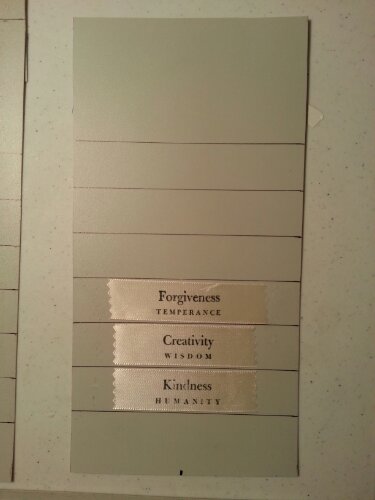
Labels for character strengths semaphore flags. Lead type printed on ribbon.

The same materials, though smaller in scale and manifold, has been working out really well for printing lead type on ribbon to make labels on a proofing press.

Standard