If lucid writing is the sign of a moral state, it’s the moral state of hard work, keener effort, acquired craft—a desire to communicate rather than intimidate, to have fun with a fellow-mind rather that bully a disciple.
—Adam Gopnik, “Word Magic,” New Yorker, May 26, 2014
Category Archives: Art & Development
Intersection for the Arts as We Knew It
San Francisco’s relentless economics cuts close to the bone, dismantling Intersection for the Arts.
I had the honor of exhibiting at San Francisco non-profit art organization Intersection for the Arts in 2004 and 2012.

Backlit curator Kevin Chen speaks at the opening of “In Other Words,” 2012. My Positive Signs drawings are on the wall behind him.
In particular, curator Kevin Chen has been a major ally to me (he’s the “k” that kicks off this sequence of artistic advancements on Works Make Work). Moreover, he’s been a thoughtful, dedicated contributor towards keeping SF’s art programming current, diverse, and critical. (Here’s a great 2008 SFGate profile that captures his essence, i.e., “Placid, soft-spoken, with a low, late-night-radio kind of voice, Chen brings to his work a combination of sangfroid and compulsive work ethic.”) He’s worked countless late nights personally installing exhibitions; his work as a curator has really been curator/exhibitions manager/installer/art handler/framer. He could also be found delivering erudite introductions to Intersection’s jazz performances, and donating his time and expertise to classes and likeminded arts nonprofits. He’s a practicing artist, drawing detailed graphite drawings inspired by San Francisco’s skyline.
I came away from my first exhibition at Intersection’s Valencia Street location impressed with the staff’s commitment to excellence and inquiry despite a shoestring budget.
They’ve stayed afloat amidst recessions and busts, but they won’t survive San Francisco’s current climate intact. They’ve laid off curators including Kevin, and will suspend programming. See Christian L. Frock’s “San Francisco’s Intersection for the Arts Suspends Programs, Lays Off Curators” on KQED Arts (May 22, 2014) for more info. For many artists, this is another painful, irrevocable loss in the art community, as documented in Frock’s “Priced Out” series.
Since I moved away in 2010, people ask if I’ll return to the Bay Area. Its clearly hostile conditions, and the tolls they’re taking on the arts community, do not beckon.
What is to be done? Perhaps, as MA implored,
Everyone, go to galleries, museums, performances, and any and all cultural events!!! Invest in your local cultural institutions before they are gone…. please!

Mirror hanger in rotary cutter. Locks blade cover in place for transport.
my submission for things fitting perfectly into other things
Middle grounds
Grappling with how to find a middle ground in an art career.
In the Bronx Museum AIM program, about a third of us don’t necessarily aspire or expect to be represented by a blue chip gallery, or run an art studio as a vertically-integrated business with permanent staff. At the same time, we do want something more—I think we would like to avoid still working as adjunct professors or art handlers when we’re 50. These jobs are too demanding and precarious for artistic growth and financial viability.
I’ve also spoken to undergrads about professional practices. I advised them to devise their own self-concordant goals and to be wary of adopting conventional success models not their own.
How to find a middle ground—where artists can flourish in an expensive city and an economically polarized art field—seems to be the puzzle we’re all trying to solve.
In the popular imagination, artists tend to exist either at the pinnacle of fame and luxury or in the depths of penury and obscurity — rarely in the middle, where most of the rest of us toil and dream….
The middle — that place where professionals do their work in conditions that are neither lavish nor improvised, for a reasonable living wage — is especially vulnerable to collapse because its existence has rarely been recognized in the first place. Nobody would argue against the idea that art has a social value, and yet almost nobody will assert that society therefore has an obligation to protect that value by acknowledging, and compensating, the labor of the people who produce it.
—A. O. Scott, “The Paradox of Art as Work,” N.Y. Times, May 9, 2014
Actually, there’s a small but growing contingent of us “almost nobodies” that would claim otherwise, such as the #payingartists campaign by Artist’s Network in the U.K.
For me, the issue is crystal clear: if a non-profit organization receives funds to hold exhibitions, some of those funds should go to the artists who contribute the actual artwork—without which an exhibition would not be possible. And, when artists contribute to exhibition-making with our time and labor—registration, transportation, installation, curation, writing, photo documentation, administration, etc.—we should be compensated with a fair and living wage. Larger institutions pay staff, freelancers, or outside service providers to do these tasks; funders should enable and require organizations of all sizes to pay the providers of the labor required by the institution’s programming, regardless of who it is.
Fair compensation would be a start in creating a middle ground for artists. It’s not an outlandish, and I think it’s rational and appropriate.
[Buddhist economist E.F.] Schumacher calls for economic solutions to globalization that are founded on principles of self-empowerment, self-reliance and decentralization, and local control. He advocates for decentralized working methods, or “smallness within bigness,” in which interrelated but autonomous units work together toward a greater goal. Furthermore, he presents the philosophy of “enoughness,” a Buddhist approach to economics that advocates for self-sufficiency: producing from local resources for local needs at a modest scale, appropriate for a balanced life.
—Abigail Satinsky, “Appropriate Technologies,” Art Practical, April 3, 2014
Addendum: See Christian L. Frock’s “Beyond the Studio: What Do Artists/Writers/Curators Need?” (KQED Arts, May 12, 2014).
Katharina Grosse on Impermanance
Valuing vs. being indifferent to permanence.
Katharina Grosse’s Public Art Fund artist’s talk at New School last night was inspiring. Her large scale, site-specific spray paintings were a revelation to me. I enjoyed how she constructed her talk from a studio perspective, revealing how the questions she asked herself led her to new questions and techniques in subsequent works. Her practice seemed experimental, and her thinking fearless.
Frustrated with the NYC’s market orientation, and its emphasis on permanence as a way to protect artworks’ commodity values, I asked Grosse about how impermanence shapes her work. She said she doesn’t think about it. She is most excited about making the work, rather than looking at the work. Before she moved on to a new question, she added that thinking about permanence may hinder one’s studio development.
Maybe I have been privileging permanence. When I look at recent projects, I have been making art objects that are easily shipped and exhibited. It’s been a matter of logistics and productivity—my capacity is such that I feel the need to take opportunities even when I have limited time and budget, and having works ready to ship makes that more feasible. At the same time, maybe to some extent I am limiting myself with values and conventions of the art world that are not my own.
I admire how Grosse is simultaneously unpretentious and confident about her practice: there seems to be no gap between this is what I’m interested in, and this is what I’m going to do. It’s an unrestrained way of working. I wondered how my art would grow or change if I had 5% more of this fearless quality. Or, what might my work look like if I spent a year making only temporary, ephemeral projects?
A Week in Review: Seven Days in My Art World
Art and art experiences from the past seven days.
So I haven’t been to the Whitney or MoMA lately. Does that mean I’m taking living in NYC for granted? Possibly. But over the past eight days, I’ve experienced art and art dialogues in lots of ways….
- Self-organized studio visits among Bronx AIM participants (Margaret Inga Wiatrowski, Didier William, Tatiana Isotomina, and Anna Ablogina). The cohort’s practices are quite developed; members ask very thoughtful questions; and we stay fueled up on candy and snacks. There’s a lot of mutual goodwill and I’m so thankful to be part of it.
- A few Chelsea galleries off the beaten path. Making a highly-edited list on artcards.cc forced me off my usual four-block slither…. Killer charcoal drawings by Robert Longo at Petzel—an art school fundamental, executed to perfection. Peter Dreher painted the same glass of water, over and over (Koenig & Clinton); hardheaded persistence seemed winsome to me. Insignia intermixed with Thai embellishments by Jakkai Siributr at Tyler Rollins Fine Art…. My list exceeded my time; yet to see the shows by Justin Matherly, Lisi Raskin, David Maisel, Kristen Morgin, Josephine Mekseper, and Adam Pendleton. [Funny, all but one of these artists I have worked with, or handled their artworks, or heard them speak. This makes me think that Chelsea is less predictable than I usually give it credit for, or galleries are putting their best foot forward for this month’s fairs. Or maybe I’m just getting around more.]
- Artist’s talk at a Parson’s undergrad class.* Under-slept and over-caffeinated, I delivered a zippy talk about my work, opinions on the art world, and professional strategies. Seeing the students sprawled out on the model plinths, half-broken stools and paint-splattered floor made me a little nostalgic for art school.
- My studio. Finishing up a new ribbon text—actually a translation of an existing text—for a forthcoming billboard overseas. (Details will be announced soon.) Starting a new project—the hardest part. I remembered the art school assignment to do 100 drawings—it’s still a great way to declare a no-judgment zone, overcome self-critical inertia, and get to work. Patti Smith’s descriptions of her and Mapplethorpe’s passion for getting lost in creative activity in Just Kids helped too.**
- LMCC’s Open Studios. Visited one of the strangest settings for art—an entire semi-reconstructed floor of a corporate high-rise in the financial district. Lots of great artists in this highly competitive studio program. I was also very moved by an interactive play-in-progress by Aya Ogawa.
—
*Thanks, SAS, for inviting me!
** Thanks for the book trade, CLF.
My Imaginary Group Show
A few weeks back, I posted about an assignment for artists to describe their own dream group show.
I came up with one version of my own dream group show—it’s local, site-specific and combines numerous interests. I was so excited by all the projects and artists, the only way I could keep my presentation under the six-minute limit was to read out a script of only keywords, and that’s what I’ll include here. Enjoy! And consider coming up with one of your own—it’s a fantastic, liberating exercise.
1,000 Single Steps
For Jeremy Deller,
art isn’t about what you make
but what you make happen.
Inspiration.
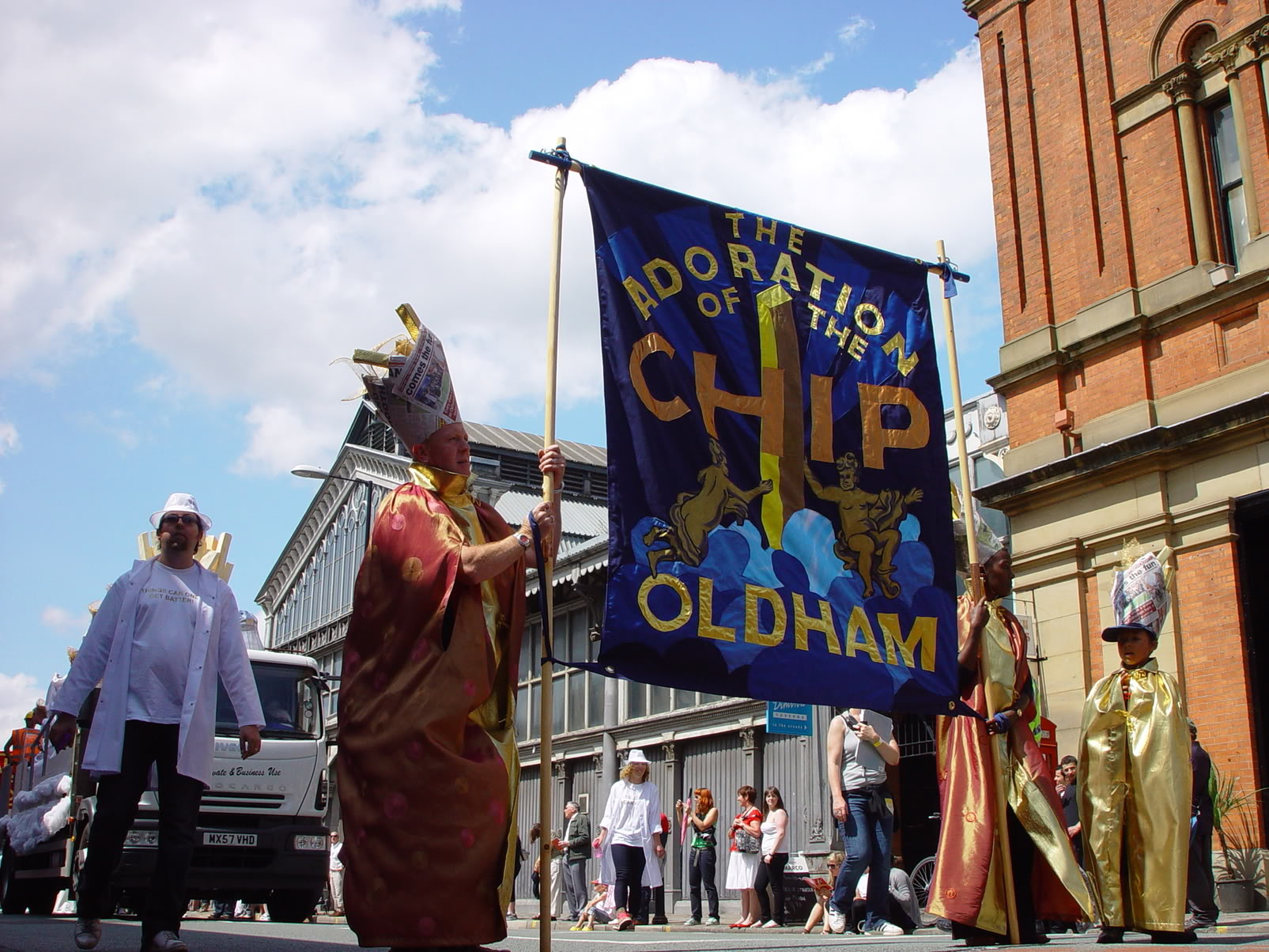
Jeremy Deller, Ed Hall, (Banner Maker), Procession, 2009
Manchester Int’l Festival.
Manchester History.
Industrial Revolution.
Workshop of the World.
Birthplace of Socialism.
Textile Mills.
People’s History.
Tradition of Banner-making.
Participation.
Contemporary groups working with a banner maker.
Parade.
Absurdist.
Crown of french fries.
Even the emo teens.

Participants. Jeremy Deller, Ed Hall (Banner Maker), Procession, 2009
Proposed Site: The Queens Way
Summer of public programming as grand opening.
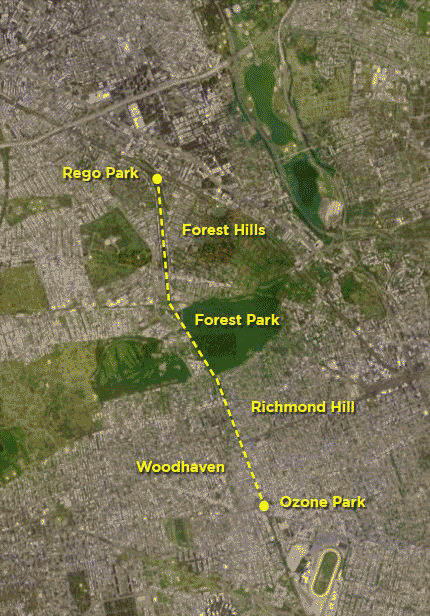
Map of the Proposed Queens Way. // Source: TheQueensWay.org.
• 3.5-mile portion of the abandoned Rockaway Rail Line
• community-led effort
• current status: feasibility studies

Present conditions of the Queens Way. // Source: TheQueensWay.org.
I am not a natural optimist.
Anxiety and rumination, humans’ natural states.
Exercise, surefire mood-elevation.
Importance of access to clean, green open space.
For Physical health.
For Psychological health.
A society where women can go for a run in their own neighborhoods without fear.
Improve quality of life for generations.
Artists and Projects
Susan O’Malley, Community Advice, 2012.
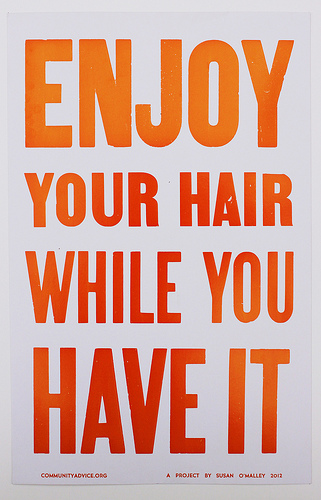
Susan O’Malley, Community Advice, 2012. // Source: susanomalley.org
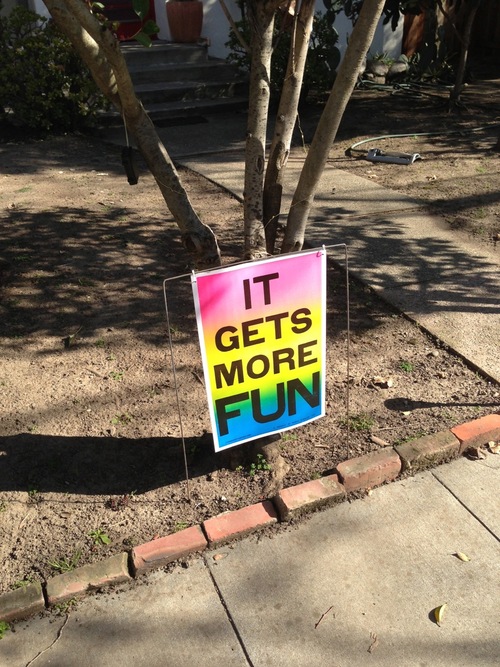
Susan O’Malley, Community Advice, 2012. // Source: susanomalley.org
Classmate, friend.
Based in California.
Site-specific variation on project.
100 participants.
2 questions.
What advice would you give your 80-y-o self? 8?
Collaboration with printmaker.
Wood type posters
Posted in the community.
Carlos Cruz-Diez, Transchromie Mécanique 1965, 1965
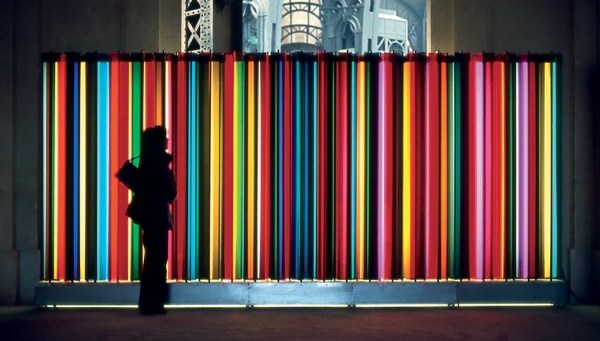
Carlos Cruz-Diez, Transchromie Mécanique 1965, 1965 // Source: cruz-diez.com
Immersive phenomenological optical installations.
Like Eliasson, but earlier.
Like Turrell, but happier.
Commission:
Shadows underneath elevated tracks.
Transformed to spaces of light and color.
Michelangelo Pistoletto, Lunch Painting, 1965

Michelangelo Pistoletto, Lunch Painting, 1965 // Source: afasiaarq.blogspot.com
Arte Povera.
Transition from gallery oriented art object to direct social engagement.
Seminal work.
Blue-chip artist.
Museum collections.
Do not touch.
Proposed exhibition copies as public sculptures.
Please touch.
Bob and Roberta Smith, The Art Party, 2011–ongoing

Bob and Roberta Smith, The ArtParty Conference, 2013 // Source: suegough.blogspot.com
Artist mostly known for twee sign paintings on junk.
Recent years’ increasing activism.
Reaction to Tea Party.
Opposition to cuts in Art Education in UK.
Paintings, installations, videos, events.
Defense of accessibility of art education and therefore art.
Earnest.
Populist.
Art is not elitist.
Everything is made.
Agnes Denes, Isometric Systems in Isotropic Space—Map Projections, 1979
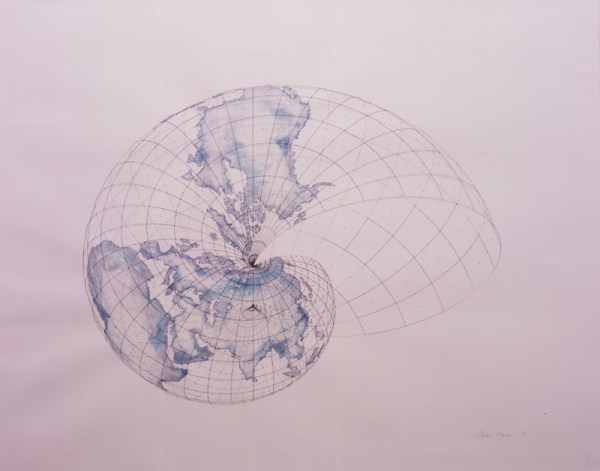
Agnes Denes, Isometric Systems in Isotropic Space—Map Projections, 1979 // Source: students.concordiashanghai.org
Proposed billboards.
Artist mostly famous for wheat field in Lower Manhattan.
Beautiful drawings of world maps.
Cube, pyramid, donut.
Love diagrams.
Queens demographics.
Always changing.
Always diverse.
Michael Jones McKean, The Rainbow: Certain Principles of Light and Shapes Between Forms, 2012
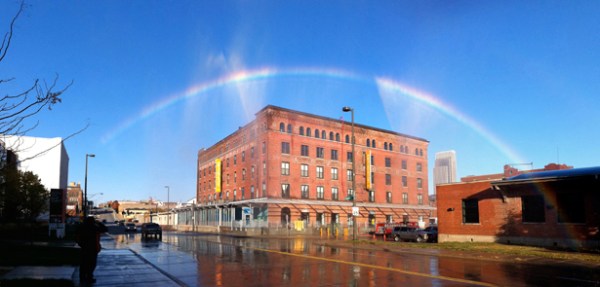
Michael Jones McKean, The Rainbow: Certain Principles of Light and Shapes Between Forms, 2012 // Source: therainbow.org.
Bemis.
Artificial rainbow.
Water hoses.
Experiment.
Unpredictable results.
Depends on weather.
Ironic.
Makes it even better.
Fourth of July 2012: San Diego Pyrotechnic Accident

San Diego 2012 fireworks display
Not art.
Curatorial influence of Jenns Hoffmann.
Contemporary art alongside historic art and artifacts.
Contextualizes art practice in wider cultural production.
7,000 fireworks in less than 60 seconds.
Holiday ruined?
Or expectations exceeded.
Grand Finale.
—
Addendum:
I also recently learned about this other spectacular fun-but-relatively-safe disaster, which I love for the same reasons as the fireworks display:
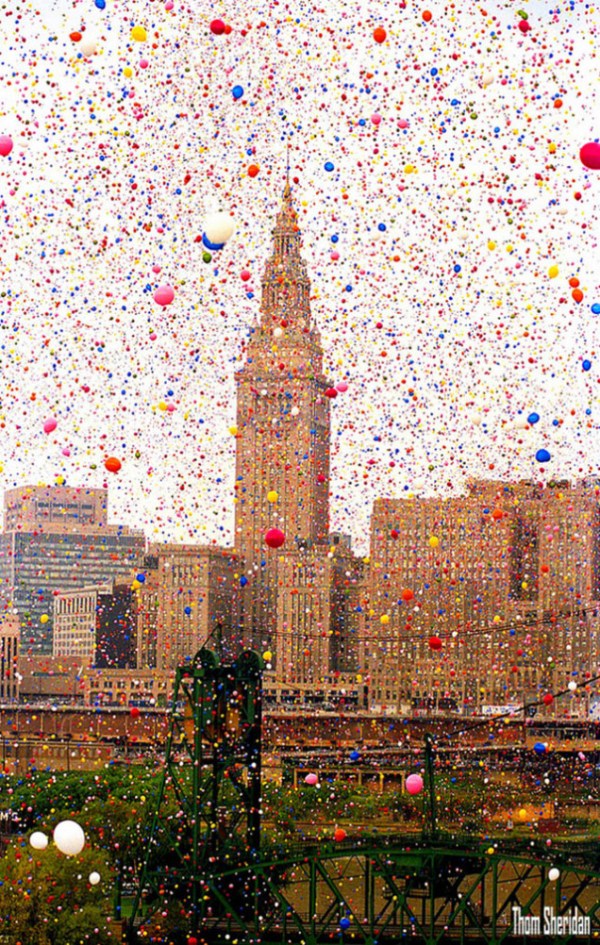
1986 Cleveland accidental 1.5 m balloon release. // Photo: Thom Sheridan // Source: Gizmodo
Bay Area Artists, bright people are going to take your experiences and turn them into data that can be used to advocate for all local artists! Take the survey! Share it!
http://compensationfoundation.org/bayareaartistsreport#/survey
 R+D
R+D 