Research

Hidden History

Despite the web site’s use of Papyrus (never mind, it’s a snooty graphic designer in-joke), I love me some East Bay hidden history, and were I not predestined to attend THE JOURNEY SO FAR: 35 YEARS OF ACTIVISM, I’d be at the screening of Shellmound.

CCA Center for Art and Public Life and the Introduction to Community Arts Class presents:
A Film Screening of Shellmound, A Documentary by Andres Cediel
Followed by a Question and Answer Session with the Filmmaker
Tuesday, November 27, 7:30pm
Nahl Hall, Oakland Campus, California College of the Arts, 5212 Broadway, Oakland
For more information, please contact John Leaños at jleanos@cca.edu

Standard
Research

Getting Back on the Screenprinting Horse

“Art takes you to some funny places.”– Mario Ybarra Jr.

Just got back from Creative Screen Tech of San Leandro, CA. It’s a screen equipment and service shop, and was recommended by Thien Pham, the artist behind the brilliant I Like Food restaurant-review-as-comic-strip. CST will output film from my digital file and burn a stencil onto my screen.

The last time I used my screen was 10 years ago. I don’t have access to vacuum exposure units, and besides, I never did well with photo emulsion anyway, so CST’s help is crucial. I’m working on a booklet project, and I think screen printing is going to be the best method for achieving a desired effect.

The only thing I’m worried about is that my screen needs to be washed out. The stencil was hand painted with Speedball screen filler. I hate Speedball products — they’re for hobbyists, and are low quality. But when you’re inspired and faced with the task of supply procurement, which could take hours, Speedball’s wide availability is dangerously appealing. As Leland Wong points out, screenprinting is getting more specialized and expensive. When I took my screenprint class 10 years ago, there seemed to be many more local vendors.

I just hope these CST guys are able to wash out the embarrassingly nineties stencil.

Standard
Art & Development, Travelogue

Art Highlights: Los Angeles

Santa Monica • Chinatown • Culver City • Fairfax

Click on the images to see a larger file.
gallery_la_art_p1_sm.jpg

gallery_la_art_p2_sm.jpg

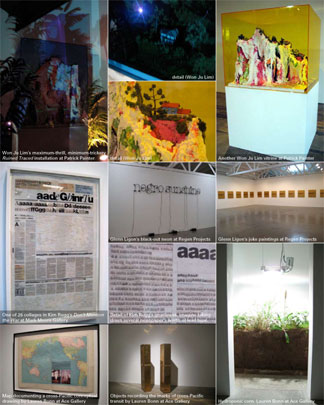
Two days, 50+ galleries, 4 museums. Here’s what stood out:

Won Ju Lim at Patrick Painter
Maximum effect with minimum trickery: digital projectors, colored plexi vitrines, poured paint sculptures, and some fake plants with gooseneck clamp lamps. The effect is truly astounding, and somehow very pertinent after the Southland fires. Lim may be my new favorite artist.

Lauren Bonn at Ace
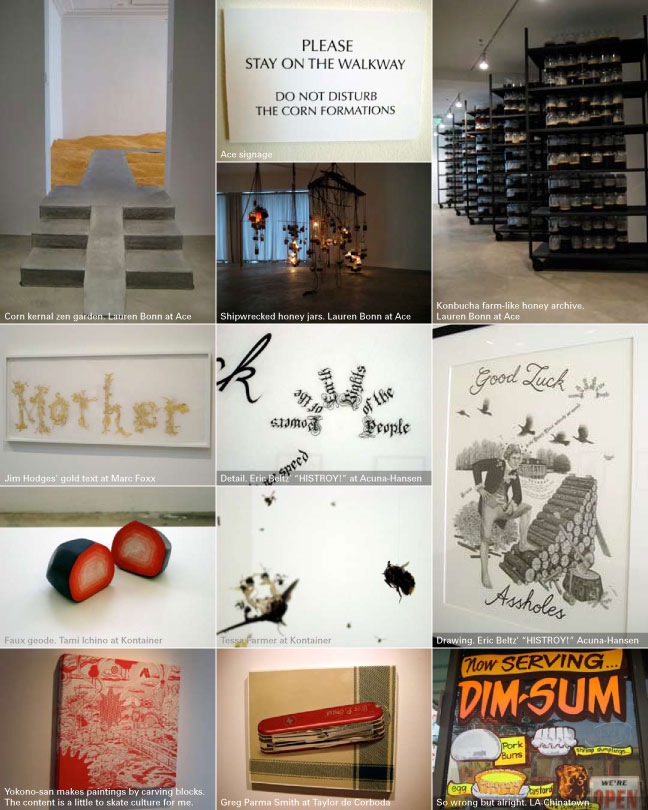
Bonn’s Not a Cornfield cornfield was massive in scope and social programming, and she fills Ace with massive and terrifying psychic spaces which are somehow related to the cornfield and her study of bees. The scale is stupefying. I don’t know how Bonn orchestrates it, or Ace sustains it. But it’s amazing.
A side note: Bonn is also exhibiting the residue of a conceptual drawing piece involving an object recording the marks of a cross-Pacific passage. Sounds very similar to my Regalos project, doesn’t it?

Glenn Ligon at Regen Projects
A perfect example of why object-based conceptual practice is great: there’s so little mass in Ligon’s show, but there’s so much to think about. Thirty-six near-identical gold and black text paintings and one black-out neon text sculpture. Joke paintings invoke Richard Prince, but the racial content begs more conflicted social terrain. The neon text sculpture, of course, resonates with other (White) Conceptualists’ work, but again, Ligon’s content diverges into a realm of his own determination. My next stop was to look up Ligon’s article, “Black Light: David Hammons and The Poetics of Emptiness” (Artforum, Sept. 2004), a really beautiful artist’s writing/critical essay/statement about making art, resistance, the artist’s refusal, the “emptying out the self as a critical strategy,” and light as a material.

Kim Rugg at Mark Moore
Twenty-six re-assembled newspaper covers comprise Rugg’s “Don’t Mention the War,” in which she’s sliced and diced single letters and alphabetized them. I think she’s set a record; she’s broken an OCD-Art barrier. I’m impressed with the artist’s commitment to this massive project in an non-archival, unstable material. Furthermore, the craftsmanship is amazing, with hardly any relief in the collage.
Also at Mark Moore was Kenichi Yokono. I’m including this because I would have liked to explore this medium about ten years ago, when I was really into carving woodcuts, but not only interested in making prints. Yokono carves wood as if for printing, then displays the blocks as paintings, screens or skateboard decks. The content is punk-skate-pop culture, and the cut-out forms seem a little all over the place to me, veering towards hand-carved souvenir shop variety.

Group show at Marc Foxx
Lots of text-based work floated my boat here, including Jim Hodges‘ gold-leaf “Mother” on vellum. Francis Stark exhibited more good-bad-ugly work, which was awkward but intriguing nonetheless with its Alhambra delivery truck sized hanging sequins. While some artists cultivate the artistic persona of a naif through the use of odd materials, you get the sense that she isn’t faking her intuitive process.

Wild Women group show at Kontainer
This quietly installed group show was very smart. Tessa Farmer has assigned herself the dreadful task of creating minature (think: convert to microns) skeletons and attaching them to insects, and then hanging the dead bugs from monofilament. It’s a mind-blowing artistic practice. Tami Ichino‘s ceramic faux geodes are beautiful objects that manifested her paintings’ spacey psychedelia into three dimensions.

Eric Beltz’ “HISTROY!” at Acuna-Hansen
I resisted these drawings. They’re too slick: the gothic calligraphy and cursive script is too cool, the dead presidents theme seems so trendy, the literary references are very pop-goth. But these drawings have to be seen in the flesh, and I have to admit, Beltz’ self-described “high definition drawing” provides a truly enjoyable, memorable experience. Bonus: the title is wickedly funny, yet fitting.

A Great Delicacy group show at Taylor de Cordoba
Clearly I don’t connect often with paintings these days, but Greg Parma Smith‘s painting of a Swiss Army knife with a fabric pattern that escapes the still-life’s margins surprised me. It didn’t seem to take itself so seriously, which is hard to find among photo realist works. Rebecca Veit‘s and Kathryn Hillier‘s tense food-porn photos were convincingly reminiscent of Sunset Magazine, and Danica Phelp‘s charts were pleasingly ‘drawing-ly,’ if one could make up a graphite corollary to ‘painterly.’ McKendree Key‘s color photocopy stop-motion animation had a nice storm-at-sea rhythm while man-made garbage tumbled by as if on a watery freeway.

I had the pleasure of crossing paths with some Halloween- and Thanksgiving-themed sponge painting on the tinted windows of a dim sum shop in Chinatown. You haven’t lived until you’ve seen sio mai rendered in florescent sponge paint.

No photos, just strong impressions:

Slater Bradley‘s CGI rain cloud and singin’ in the rain dandy at Blum and Poe.

William Pope.L‘s show at the Santa Monica Museum of Art, “Art After White People.” Think about it.

Jamie Isenstein‘s deliciously restrained and curious “Welcome to the Egress” at Hammer Projects.

Francis Alÿs‘ “When Faith Moves Mountains,” also at the Hammer (whose exhibition title, “Politics of Rehearsal” could also be “Poetics of Reversals”).

Standard
Research

Optimism in the news!?

“Scientists have identified the neural networks in the human brain that generate feelings of optimism in a person….”
“Cradle of optimism pinpointed in the brain,” DailyIndia.com, October 25, 2007

Americans are, characteristically, optimistic about thier lives, but pessimistic about our institutions.
“The Happiness Gap,” by David Brooks, NYTimes.com, October 30, 2007
A few good lines:
“This happiness gap between the private and the public creates a treacherous political vortex. On the one hand, it means voters are desperate for change. On the other hand, they don’t want a change that will upset the lives they have built for themselves.”
“In a segmented nation, [Americans] have built lifestyle niches for themselves where they feel optimistic and fulfilled.”
“[Political candidates:] don’t try to be inspiring or rely on the pure power of authenticity. In these cynical days, voters are not interested in uplift.”

Standard
Citizenship, Values

So You’re Planning an Art Auction: Do’s and Don’t’s

If you’re thinking about organizing an art auction, be aware of what makes an auction effective, and what is attractive to artist-donors. The Bay Area has a thriving arts scene, wonderful progressive culture and vibrant non-profit community, but with so many good causes to support, artists have to consider where their contributions will be most effective.

These are the criteria I use when I receive invitations to donate art:

Values: Is the cause worthy?
I want to help groups whose values match my own, especially those with under-served and under-funded constituencies. The need should be identifiable. Groups with a commitment to the the arts (and not just via “exposure” in your art auction) especially appeal to me.

Track record: Is the organization worthy?
I want to see evidence of an effective track record. Ideal groups make miracles on a shoestring, but are not so broke as to cultivate a culture of scarcity, crisis and turnover. Interest groups and collectives should demonstrate real capacity; initial enthusiasm to start a pet project is rarely convincing alone. Also, be transparent about your non-profit 501(c)3 status.

Art and Auction Experience: Will the auction be effective?
An art auction is only successful when the organizer sells the art. I look for groups with the ability to attract art-loving audiences and create bid-friendly environments. Having proven curators or installers on board tells me that (1) you’ve got the know-how to handle and install art, and (2) you are more likely to value my time and labor. Big red flags: You’ve never organized an art auction or installed art before. You don’t have a sense of what price range is reasonable at your event. Your publicity strategy involves hoping that my name on a flyer will be enough to attract an art-buying audience (wish it was, but it’s not… yet).

Exposure: To whom? For what? Under what conditions?
Most artists don’t just want any exposure. If you were an artist, what kind of exposure would you want: your work hung in a narrow hallway, bumped by drunk party-goers and sold for a low price? Or hung in a tasteful gallery populated by engaged viewers and interested bidders? I want useful exposure, such as sharing my work with collectors, curators and critics, to get positive responses about the work, under advantageous conditions — the best possible presentation, where the work is not undervalued.

Presentation: To complement or diminish my profile?
Publicity materials should be attractive and professional. If they are not, artists will not send them out to their own lists, and art buyers will not attend. Mail a stack of postcards to the artists well ahead of the event date. Ensure the venue will be appropriate for an art exhibit. Publicize the artists’ names on your press releases and web site. After all, artists are donors as much as anyone else.

—–

What to Do

• Use a lender form.
• Agree on the terms of the auction.
• If possible, insure the art in your possession.
• Help struggling artists offset shipping and/or framing costs.
• Invite the artist to the auction (sounds obvious, but you’d be surprised). Put them on the comp list if there is an admission fee.
• Hang the art properly. Don’t damage it.
• During and after the event, deal with the buyers. Do not expect the artists to sell their own work, or deliver the work to the collectors after you collect the funds.
• Pack unsold art properly. Don’t damage it.
• Return unsold art and send tax letters and checks promptly.
• If, in addition, you ask for artists’ time, be courteous.

—–

What Not to Do: A Case Study

I’ve learned the above lessons through good and bad experiences donating art. Here’s one story that taught me to donate with caution.

I was asked to show up three hours in advance of the auction to talk to the media — but the media were not expected to arrive until an hour before the auction. My two hour wait, it seems, was intended to allow the communications officer 10 minutes to go over his talking points with me. I was happy to be a mouthpiece for a worthy cause, but the long wait was a huge waste of time. In the end, I didn’t see one press person. My patience ran out 30 minutes before the auction. I slipped out because I was so annoyed that I wouldn’t be able to enjoy the auction, nor help others enjoy it.

My art sold, but it was delivered back to me — damaged. I spent months having the work re-framed and scheduling pick-up dates with the buyer.

Perhaps most egregiously, the organization was inconsistent about the logistics of the monetary transaction. The buyer paid the organization at the event, but I was told to ask him for a check. In my opinion, an organization should never put me (a donor) and the buyer (another donor) in the awkward position of trying to collect money from each other.

Not everything was awful: the volunteer curator was delightful and professional to work with. Cheap Pete’s replaced the frames free of charge. And I still believe that this particular organization fulfills a necessary role.

But I would think twice before entering any agreement that asked so much of donating artists, especially organizations with whom I have little to no relationship before and after the auction.

Standard
Art & Development, Research

Ephemera

Making ephemera has become an important part of my art practice. I began by making small batches of laser-printed posters, which fold to become brochures. They supply additional texts outside of the work and the wall texts, yet within the gallery space. They draw attention to the concepts behind the works without literalizing them in an artist’s statement.

I think making collateral and multiples is related to my background as a printmaker. But though I know how, I don’t print this collateral by hand, because they are free for anyone to take, because I can easily make more at any time.

This is one example of the glacial change my work seems to be undergoing. Like my other work, the brochures de-emphasize visuality, so the word “visual” in “visual art” seems too finite to describe what do.

I suppose that I’ve always been interested in ephemera, but had previous notions about graphic design, printmaking and zines. Thankfully, Ted Purves and Steven Leiber helped me to embrace ephemera as a legitimate form in itself.

Ted, by the way, also contributed an essay to Extra Art: A Survey of Artists’ Ephemera, 1960-1999, a beautiful catalog of thousands of inventive invitations, posters, buttons and wacky one-off objects in a show curated by Steven Lieber…

You might find Extra Art in the stacks at 871 Fine Arts at 49 Geary Street, Suite 513 in San Francisco. Unlike the boutique-like museum stores I’ve visited lately, this book seller and gallery has a drool-worthy selection of art books and catalogs. Their gallery seems to show only works on paper or ephemera, focusing on minimalism, concrete poetry and fluxism, with a few contemporary artists like writer/designer/book artist Emily McVarish. During First Thursday gallery openings (No! More! Paintings!), 871’s idiosyncratic shows can be quite refreshing.

In September, I was delighted to see an exhibition of art posters at 871. What follows are my awful photos of some of my favorite posters. Sorry I didn’t get information about the designers.

duchamp
This is my favorite by far. It’s of Marcel Duchamp with a piece from “The Bride Stripped Bare.” Like Duchamp, the poster designer selected materials minimally and purposefully, using foil stamping to represent the metalwork, and a high-gloss spot varnish only where the sheet glass appears. The rest of the poster is printed in economical evergreen and carmine red inks.

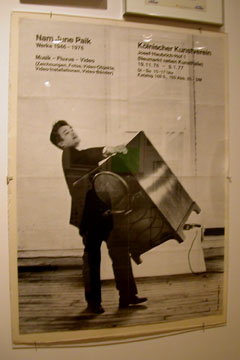
paik
A really handsome Naim June Paik poster. It’s just a black and white portrait of the artist with text set in Helvetica: two sizes, two weights. And while the photography and typography are perfect, the whole thing is restrained but somehow avant garde.

weiner
I’m not a big Lawrence Weiner fan (the unblinking monotone!) but the use of selectively-placed die cuts are satisfyingly conceptually-sound.

sandback
I was really happy to see this Fred Sandback poster, because it’s an elegant conveyence of the ideas in minimal work. Also, many artists find gridded paper attractive, but in Sandback’s case, it seems to be an entirely appropriate usage.

What I really love about these posters is that the designers understand that it’s not possible or desirable to represent conceptual art in purely visual terms. All the posters do is suggest or supplement.

Standard