Citizenship, Community

Shop here

Hope you’re excited as I about these organizations/businesses.

Cacao Anasa and artist April Banks’ Organic Fair Trade Chocolate Bars

Dagoba Chocolates. I’ve tried the dark chocolate bar — bliss slowly unraveling.

Global Exchange’s Fair Trade Online Store

Oxfam America’s Unwrapped. Gifts that make a difference for those in need around the world.

Or, instead of a gift card, try Kiva micro-lending gift certificates. Recipients lend to entrepreneurs around the world and can withdraw the funds upon repayment.

Of course shopping at eco-friendly or social justice oriented businesses is no substitute for activism, but it beats supporting corporate pet-projects (that donate only a small amount of proceeds to a good cause) or just increasing corporate profit margins.

Standard
Community

Down with Sofa-Beds

At a panel on Access & Activism with Favianna, Keba, Marcel Diallo and others at the Oakland Museum of California today, Jaime Cortez quoted Arundhati Roy about why he doesn’t sit well with the term “artist-activists”: it remindes her of the word sofa-bed, uncomfortable as both a couch and a “piss-poor” mattress, and with the implication of lowered expectations in the realms of art and activism.

I love the analogy!

I once called myself an artist-activist, several years ago when I was working as a youth educator, and was more of an idealist than an optimist. But Jaime’s comment resonated with me — my art really suffered while I worked at unsustainable jobs at non-profits. Cortez’ comments was especially meaningful in relationship to museums, where community engagement departments diversify the museum’s attendance while the exhibitions departments try to correct the imbalance of representation in the collections.

I had a lot of history with some of the panel members. And though at first I felt oddly disconnected, today’s discussion made me excited about OMCA returning to its more radical roots. After Art Murmur yesterday, it’s nice to feel hopeful about art in Oakland.

Standard
Community

One more art school critique

Sat in on Keith Boadwee‘s class at CCA yesterday. It was a great experience, and I really enjoyed being a guest at art school again.

I was a guest for four 40-minute critiques at the end of the first semester of the MFA program. I remember the first semester of grad school as intense and crazy, a time of getting unhinged and cramming to produce work for the review. The MFA program is designed with an inherent paradox: students are to experiment under intense scrutiny. I sensed that many of the students felt the pressure and uncertainty. But I think while the critiques can be severe, the criteria for this evaluation are modest and fair: I think students are expected to demonstrate vigorous work habits, experimentation, and self-examination.

It took almost the whole 40 minutes, but I ended up liking the work of the ironically-named Justin Hurty, whose project encompasses walking around while carrying super-heavy assemblages of fired clay, cardboard, wire and packing tape. He literalized the burden on artists and on straight white men — he punished his body as a project. In fact, for the following two hours, he carried the objects to the other critiques. His hands got red and veiny, and you could see how much it strained his back. It inspired both schadenfreude and sympathy. While I think the class gave Hurty the hardest time (three cheers for his exemplary grace under fire), I think his earnestness, persistence and willingness — to run with the project and the critical input — are characteristics that will pay off.

An artist named Crow, whose last name I missed, presented photographic and cinematic documentation that formed the research and proposal for a series of objects. It was about Toulouse Lautrec, dwarfism, bodies, and involved a lot of theory about difference, gender and identity. It sounded like a good idea. But this kind of work, so heavily grounded in theory, is maddeningly complicated. I think it parallels OCD art, only the wow factor here is how theoretically sound a project can be. You can’t really critique a project that’s still in its planning stages, but Crow also strikes me as competent and much more informed about theory than I, so I’m sure he can accomplish whatever he decides on.

Josh Ferris showed photographs of a miniature landscape, with the intention of commenting on both global climate change and the sublime. The good news is that he exhibited beautifully-executed prints. The bad news is that I have seen work like this before. Thankfully, Ferris recognized that the work was problematic in how it created a conversation that focused too much on representation. Ferris, like Crow, seems to be biting off a huge can of worms, and it will take a lot of persistence and creativity to come up with an interesting artistic statement. I hope that the work of Richard T. Walker, whose work is about literally conversing with Romanticized landscapes, will be a good reference point for Ferris.

David Gillespie (corrections welcomed) showed diagrams and photographs representing his research for projects investigating subjects as varied as airports to brain implants. The display formed a wall of information that was difficult to scale. If I felt combative in Gillespie’s critique, it’s probably because I see similarities in our practices: a disinterest in visual interest, and an exploration of “meta” art methods or expectations. One project is an attempt to quantify metaphor as a requisite aesthetic unit in art. The terrain and method is valid, but as a viewer I needed more ways to engage with his process-product spectrum.

I’m sure all these projects will mature by the MFA show in 2009. Looking forward to being delighted and impressed. Good luck guys!

Standard
Art & Development

Game Time: Sports Adages for Art

Artists, supposedly, are not good at sports. But since art can be extremely competitive, I propose that artists embrace a competitive spirit and the values of sportsmanship (or is it sports-person-ship?).

To help get the ball rolling (ahem!), below are some sporty expressions. They’re the sand, you’re the oyster, and one day, you’ll have pearls — of wisdom! — at just the right art moments…

Preparing for a critique or meeting with a gallerist? Try slapping both your cheeks simultaneously and shouting, “Game time, baby!” If that doesn’t work, try throwing lots of uppercuts into the air and repeating, “Who’s the boss?”

Bummed about how hard it is to be an artist? Bemoaning scarcity? Try saying, “Suck it up!” Then go “walk it off.”

Can’t decide if your photo is worth the $400 back-mounting you envisioned? Even though it’s Nike’s slogan, I like “Leave nothing.” It’s about sacrifice, performance, action over words — in essence, “Give it your all” so you won’t have any regrets.

When the art ideas are facile, remember: “Don’t be a three page book.” (Paris Alexander)

There are almost always more deserving artists than available rewards. Remember: “Winning isn’t everything.”

Let’s commend artists with lots of “heart.” Not everyone can be the champ, but you can put on a good show with extraordinary persistence and courage. Lots of people root for the underdog.

Graceful concessions: I wish more artists could say “Good game.” Be happy for others’ successes, instead of comparing others’ accomplishments with their own.

Got the drill? Try to come up with art scenarios for these:

“Go big or go home.”

“It’s not the size of the dog in the fight, but the size of the fight in the dog.” (I’m not Michael Vicking it — the metaphor’s for boxing, OK?)

“Lesson No. 1: How to take a fall!”

“He’s just doin’ moves.” (This newfangled adage, from mixed martial arts, is a criticism of a fighter who is not trying hard enough to damage his opponent. “Doin’ moves” is similar to “going through the motions,” but with the intent to appear active.)

“He’s not made of wood.” Bunkerd Faphimi, a Muay Thai fighter, explains why he approaches fights without fear this way: Any opponent “will only have two arms and two legs, like me. He’s not made of wood.”
Standard
Art & Development

Unmonumental Tendencies

Would love to see Unmonumental, the inaugural exhibition at the New Museum of Contemporary Art in New York. It sounds like a really smart, timely curatorial proposition around un-heroic, modest tendencies in sculptural assemblage. 

In my own work, I’ve become more interested in art that just is, and doesn’t attempt to transcend its base materiality with illusion. Or allusion.

When I look at art now, I’m hyper-aware of artistic decisions that beg viewers to ignore conceptual or material details. I’m skeptical of modest scales that seem more to do with an economy of means, than how a work interacts with a space. I’m especially skeptical of materials that don’t reinforce content or concept. Objects (and art materials) have a life of their own — a manufactured history, a cultural value — and the act of incorporating something into one’s art doesn’t mean it’s become an object limited to visual significance. This is why I responded negatively to Louise Nevelson’s work at the De Young Museum: as a viewer, I felt compelled to ignore the spray paint, moulding and table legs, and felt that I would only “get it” if I could see compositions of shape and gradients of light. In contrast, Isa Genzkin, whose work is in the New Museum show, allows the viewer to see the crappy objects of her assemblage as what they are: blinds, PVC hose, all the useless junk crowding our garages and filling our landfills. 

This is in contrast with engaging with art on visual or formal terms. Sure, I’m still interested in how a thing looks or how it’s made, but using those criteria only can result in seeking only the most visually stunning or technically baffling. This feels to me more like channel surfing, than really engaging with art.

Standard
Art & Development

Back on the Screen Print Horse, Part II

studio_screen.jpg
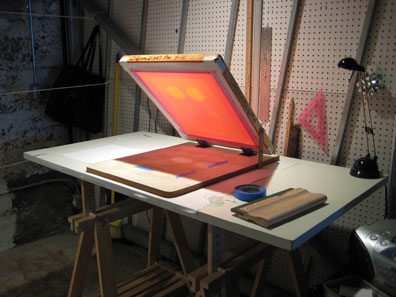
Creative Screen Tech burned a meticulous stencil. I would never have guessed that I could screen print 1 pt. line weights or 12 pt. text. Who knew? The services cost more than I expected ($50 to reclaim the screen, output film and burn a stencil), but I got a great deal on a squeegee with a chipped handle ($5). Sixty prints took no time at all. See a preview image on the home page of my site. Details of the finished project will be posted in February.  

Standard
Art & Development

Oh — it’s a drawing!

Went to the opening of The Little Show at Swarm Gallery in Oakland last night. I thought Swarm directors Svea and Andrea did a great job making sense of the huge amount of work (75+ artists!). Earlier that day I just moped around the house with a sore throat, but I was glad I made it out… Oakland people out at a great time in an Oakland gallery. 

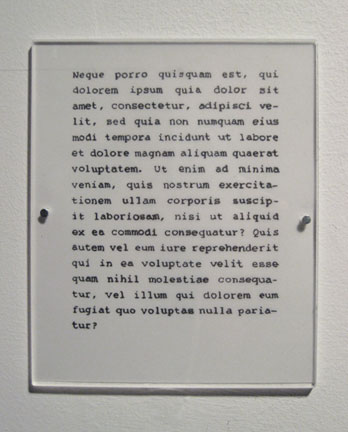
loremipsum_no3_courier.jpg
Lorem Ipsum #3, 2007, graphite, vellum, acrylic sheet, nails, 4.5 x 5.5 inches

Ran into Casey Jex Smith, who asked me about my contribution to The Little Show. I selected a piece from a new project called Lorem Ipsum. The work is meant to look like a wall text. I wasn’t worried about it looking too much like a print — until Casey mentioned that he didn’t know it’s actually a drawing!So, erm, in case you, too, were wondering — it’s a drawing. Cheers!

Standard
Community

Wofford’s studio sale!

Check out the artwork available by Jenifer Wofford, a friend, fellow artist, and the grassroots initiator of Galleon Trade, which enabled me to visit Manila last summer.

I think Jenifer’s work is accessible, finely crafted, and deeply personal.

We acquired one of her drawings from her Nurse series a year ago. I first saw the series at an auction to benefit an APA AIDS organization. The drawings of Filipina nurses resonated. Her statement — which describes a childhood memory of worrying about her mother handing syringes during the AIDS epidemic — made them even more powerful.

We still love the drawing. It’s really nice to support a friend who’s believed in me so much. Plus, as an artist, I believe the only thing differentiating collectors from non-collectors is the willingness to purchase art — you don’t have to know anything special, just know what you like and make it part of your home.

I know for a fact Jenifer believes in pricing her work affordably. Works on paper are great for beginning collectors because they’re affordable, modest in scale and easy to frame and display.

So, if you know of anyone who might be interested in supporting an artist by owning a work of art, please pass this on. If you’re interested (I don’t give advice about investments often, but…) I’d recommend acting now!

Standard