Values

They just don’t make things like they used to…

Pessimistic and curmudgeonly as this sounds, I wish that more things were built to last, like in the old days.

I’ve never had a portable cassette player that was as indestructible as my first one, a hand-me-down Panasonic. It was heavy and bulky, and it lasted, to my embarrassed pre-teen dismay, for years. But after tearing through a few cheapie cassette players, I realized I didn’t know what I had and quality like that was gone, existentially, into the dustbin of history.

Among the many tools I’ve inadvertently pilfered from my dad’s garage over the years, is an ancient Black and Decker jigsaw. It’s the only electric saw that feels right in my hand. The only problem was that the 20-year-old saw screamed like a pack of hellhounds. I hoped to replace it with one I might give to my future kids.

Too bad the new model suffers from a fatal design flaw: a spring-loaded lever secures the blade (and allows for quick blade changes) front to back, not side to side. The result is that the blade rests askew a few degrees, and within a few inches into a cut, the blade has traveled about 1/8″ to the left, even with clamps and a rip cut guide.
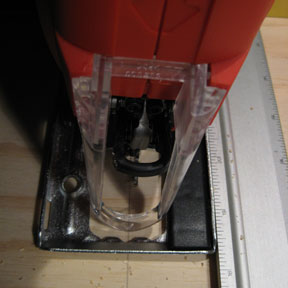
jigsaw

The old model secured the blade with a rock-solid flat-head machine bolt. Changing blades took one minute, tops. What was Black and Decker thinking? What potential jigsaw buyer doesn’t already own a screwdriver? Sacrificing basic function for a dispensable design feature is bad design. And when a tool shows signs of planned obsolescence, it’s a terrible sign of the times.

Like all shitty manufactured goods at the mercy of global trade agreements, Walmart and an insatiable consumer culture, this jigsaw was built to last for about one or two seasons, not one or two generations. Jigsaw for 2008, landfill for eternity.

Standard
Community

Get out

You say January, I think cold and credit card debt. These kind souls are giving me reasons to step away from the space heater…

Friday, January 11, 2008
Four projects at SoEx
Jenifer Wofford, Chris Bell, Elaine Buckholtz, Bruce Tomb

6:30 pm: Artist talks
7-9 pm: Opening reception
Southern Exposure, 417 14th St (at Valencia), San Francisco

Saturday, January 26, 2008
MFA Selections | A Salute to Bay Area Emerging Artists

Includes the aforementioned Jenifer Wofford and Chris Bell, plus Kamau Patton, Ali Dadgar, Joshua Eggleton, Dan Lydersen, Renee Gertler and Elizabeth Mooney.
Reception: 6 – 8 PM
Exhbition: January 26 through March 15, 2008
di Rosa Preserve, 5200 Carneros Highway 121, Napa, CA

February 3, 2008
Close Calls
Includes April Banks, Val Britton, Julie Chang, Renee Gertler, Liz Hickok, Casey Jex Smith, Weston Teruya, Richard T. Walker
Reception: 2-5 pm
Exhibition: January 13 – February 25, 2008, Tuesday-Friday, and Sunday, 12 – 5 pm
Headlands Center for the Arts, 944 Fort Barry, Sausalito, CA

Standard
Research

What kind of smile is that?

Its USA-Today-level feel-good factor aside, Jennifer Viegas reports for Discovery News on a new study about 4 kinds of smiles, selected from among the 50 varieties there are believe to be

ranging from triumphant ones to those that convey bitterness. … [Lead author Amy] Drahota described the first as an open smile “in which the lips are drawn back, the cheeks are raised and crows-feet wrinkles appear around the eyes.” Technically this is called a Duchenne smile, which may be the truest and most intense of all. The second smile type is like the Duchenne, only minus the “smiley eyes.” The third is a suppressed smile, “where the speaker is trying to hide their smile by pulling their lips in or down as they speak.” Finally, they denoted times when the speakers weren’t smiling at all.

I like the idea that not all smiles are alike. But is not smiling a fourth form of smiling?


Untitled (Lens Flare, Large Mirror) (detail), 2007, mirror, frame, lights, 26″ x 32″ x 2″

Standard
Activist Imagination, Art & Development

Sports Metaphors + the Burden of Representation

In his profile of Kara Walker (New Yorker Magazine, October 8, 2007), Hilton Als describes a contingent of African American artists and their attempt to ostracize Kara Walker because her art didn’t ennoble African Americans. Elder stateswoman Betye Saar called Walker’s work “revolting” and asked if African Americans were being “betrayed.”

Walker, who was then pregnant, dug deep: “I felt, Well, I have to re-double my efforts if I’m going to keep all this going, and I’ve got to take this child and go charging through, like in football.”

I don’t think she set out to antagonize her predecessors, but I really admire her resolve, even as a young artist, to stay committed to her artistic practice, despite the costs.

I Am Not Making Activist Art for Activist Imagination. I’ll keep in mind the vision of Walker juking a field full of opponents.

Standard
Art & Development

Dark into Light: Multiple Pre-sale

dark into light cover
mock up of Dark into Light multiple, glow in the dark screen printed cover, 4 x 4 inches

In conjunction with the Dark into Light exhibition opening at Swarm Gallery on February 8th, I’m pleased to release a new multiple. The multiple is a limited-edition artist’s book featuring a phosphorescent cover screen printed by the artist. The book also includes color reproductions of the installation, a diagram and an interactive element.

Order it now for $10. The pre-sale price lasts until February 7th.* Includes S&H within the U.S. Please allow 6–8 weeks for delivery.

*After February 8, the multiple will be available for $12 retail.

Standard
Art & Development, Community

Grounded?

Fighting off a sore throat, I ran through the Grounded and Grounded? exhibitions at Southern Exposure and Intersection for the Arts a few weeks ago. Though I would have liked to have seen more of the interactive works, which painted the town pink as well as other things, here’s what “took.”

Jessica Miller at Grounded?
Jessica Miller‘s time-lapse videos / stop motion animations. I liked this lego-glacial-pattern piece, and a mesmerizing video of pink tape filling up the negative shapes in the shadow of an iron gate. As the sun went down the florescent tape filled the frame. I liked Jessica’s earlier baroque-pop photo-installations, too — those were funny and pretty — but these new videos are rough around the edges, and it’s exciting to see what she’ll do next.

scholz.jpg
Zachary Royer Scholz‘ b/w print of a site-specific/found sculpture. I remember seeing this piece in 2006, and was happy to see it again. I think I like Zach’s work because it seems to involve so much chance and discovery, like Daniel Spoerri filtered through a more formal language.

grounded_photo.jpg
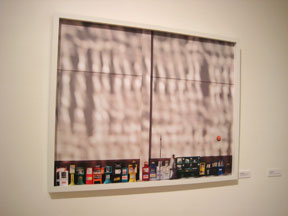
This photo by Moshe Quinn (Thanks Kevin Chen!) of light rippling on a mundane stuccoed building with street-level newspaper boxes and a passerby = Genius.

nold.jpg
While there were other interesting works, Christain Nold‘s Emotional Mapping poster, which was the result of a previous project at Southern Exposure, really caught my attention. First, the poster’s beautiful, in a micro-macro, Tufte/information-graphics-fan way. The content, consisting of mapping daily minutia, is personal, revealing and engaging. The map is a successful poster and also works as a book with multiple readings. But the project is interesting because the map is just a sliver — albeit a beautiful one — of a larger work that resides in the outside world.

Work about minutia is not new. I’ve made some, I’ve seen a lot. But Nold’s seems exceptional because it acts like a book, but you don’t have have to be bookish to find yourself immersed in the details.

If you’re like me, and are impressed by scary-smart programmer-artist-designers who make technology elegant for art applications, you’ll want to check out Nold’s site.

Standard
Art & Development

Work vs. The Work, and Working

I must have been an optimist. Only an optimist would expect that I could maintain a super-high level of art production, and ignore the realities of work, money and logistics (the Good, the Bad, and the Ugly?).

I love being an Affiliate Artist at the Headlands, but with the winter chills and funding shortages, I’ve had to psych myself up for the one-hour drive to the cold, damp studio… Of course there’s nothing better than the feeling of putting in a long day at the studio. I just have to remind myself that, in the end there’s the work, but day to day, it’s all about working.

See also Martin Creed’s If You’re Lonely, Work No. 470, 2005.

Standard