Activist Imagination

Know how to work a paint brush?

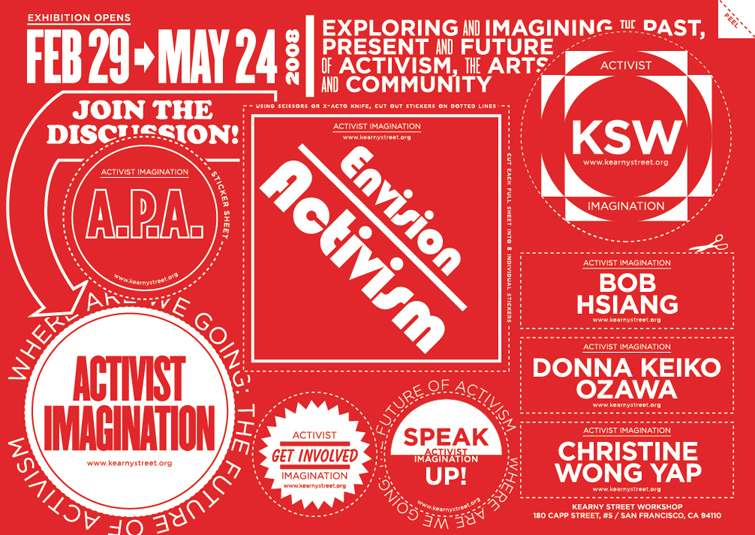
Activist Imagination exhibition postcard (front)
Activist Imagination exhibition postcard (back)
(postcards designed by jon sueda)

I’m really excited for the Activist Imagination exhibition at Kearny Street Workshop. It opens in 10 days and in the meantime, I’ll be furiously trying to finish three site-specific pieces. Sam Chanse, KSW’s stellar former Artistic Director, is staying on as a part-time consultant. She stepped down and just completed her one-woman show on Sunday. Amazingly, she’s the only staff during installation!

If you’ve got a few hours to help out in the next 10 days, we would really appreciate volunteers — Sam especially has a huge job of dismantling a stage, spackling/painting, getting the gallery looking spic-and-span, adjusting lights, etc. I could also use an extra hand with joint compound/sanding/painting too. We would be really grateful for a few hours of help.

Standard
Values

Revenge of the nerds

In “Dumb and Dumber: Are Americans Hostile to Knowledge?” (nytimes.com, 2/14/008) Patricia Cohen profiles Susan Jacoby, author of “The Age of American Unreason.” Jacoby laments the “generalized hostility to knowledge” in American culture today.

On a similar note, I think common wisdom can be anti-intellectual and cynical. I’ve been wondering about impact of such pervasive pessimism.

Have you noticed that everyday conversations, especially with acquaintances, slide easily into expressions of co-miseration? It’s more common to express stress (about jobs, bills, or among lefties, the latest political outrage) than it is to express beauty, joy and gratitude.* People bond by co-miserating; they find affinity through “other-“ing.

Similarly, groups form their identities by distinguishing themselves from others. So working classes disdain the values of intellectual classes. But the don’t-be-too-smart attitude seems to pervade American culture—you might as well be uncouth or snobby.

As a kid, I figured that my peers would grow out of the too-cool-for-school mentality. But the peer pressure to not appear too earnest about learning hasn’t disappeared entirely. Even in graduate school, and especially among artists and professional development, enthusiasm for knowledge can be suspect.

But here’s what I can’t reconcile: Working-class culture and the American spirit—the high esteem of hard work, skill and fairness—are intimately tied. So how did rugged individualism—so optimistic: Pulling oneself up by the bootstraps! The dream of equal opportunity!—beget cynicism and materialism?

In the article, Cohen casts Jacoby as a curmudgeon. And while Jacoby is going against the grain by speaking out about a theme that pervades our culture, I think Cohen could be considered curmudgeonly. Her journalist’s skepticism seems to convey the sentiment that the mere discussion of intellectualism is too self-aware, too critical, too… nerdy.

*Why is it that “beauty, joy and gratitude” sounds so cheesy? The phrase “the good things in life” might be more common, or sound cooler, but it’s vague.
Standard
Community

One woman. One show.

Just saw Lydia’s Funeral Video, Sam Chanse’s (debut?) one-woman show playing at the Dark Room Theater in San Francisco. I knew Sam from her prodigious efforts in keeping Kearny Street Workshop forging ahead through challenging staff changes with grace. I believe director Wilma Bonet is a respected colleague of a theater-friend of mine. But I had only seen Sam do stand-up, not acting, and I guess I assumed this first go-round might be rough around the edges. I was delightfully surprised.

The show started off with Sam bursting out into the small theater in character, delivering a monologue at full throttle. She kept up a remarkable pace, changing characters with precision, using the range of stage area and lights to great effect, never breaking character and always putting well-rehearsed skill into each scene. The set was bare, the costuming was economical and efficient. And it worked great. Most importantly, the writing (Sam wrote the play as well) was really good. Sometimes one-person shows can feel patchworked, or too much like a series of vignettes, but Sam was sure to include a narrative arc with a surprise at the end that brought everything together nicely. I expected the show to be like Sam in real life: funny and dark. Lydia’s Funeral Video was also moving and smart.

The show runs through next weekend (see manja.org for tickets). Enjoy good karma and a good time if you support this young artist who has done so much to support emerging artists through her ceaseless work at KSW. Even if you can’t make it to the run of the show, I’m sure Sam would appreciate contributions, as she really pours herself into these exuberant performances.

Standard
Art & Development

Dark into Light is now open!

Thanks to everyone who came out to Swarm Gallery last night. I’m really really pleased with how Dark into Light came out, and the themes that seem to unravel between my work and the work of Zachary Royer Scholz and Ricky Allman. I think it’s delicately curated and installed, and I hope you get to see it.

Check out photos and a video of Dark into Light at John Casey’s blog and Gareth Spor’s photo on Flickr.

Standard
Art & Development

Diagram as sketch

dark into light installation guide
Christine Wong Yap, Schematic for Dark into Light, 2008, computer drawing, dimensions variable.

Design skills come in handy, now that I’m starting to think of diagrams as sketches. I’ve been using InDesign with a 1-inch grid with 12 subdivisions. This is great for drawing large installations to scale. Sure beats 1/4″ graph paper.

Nerdy, I know. But skills make life easier. Just the other day, D.G. explained a concept of electrical circuits to me. I thought it was pretty cool, until he said, “That’s the only thing I remember from second grade electronics.” Which made me realize that I didn’t take second-grade electronics — or any electronics for that matter! I bought a book, “Wiring 1-2-3,” a few weeks ago, but it seems like I’ll never catch up. I guess better late than never.

Dark into Light won’t be the most effective electrical circuit, but I still think it’ll be cool. Come to Swarm Friday night to see what I mean.

Standard
Art & Development

Points of Reference, new addendum

A.
My studio, filled with several light-based art works and light boxes, made me think of the cellar in Ralph Ellison’s Invisible Man.

jeff wall after ralph ellison
Jeff Wall
After “Invisible Man” by Ralph Ellison, the Prologue 1999–2000
Transparency in lightbox 1740 x 2505 mm © The artist. From the Tate Modern website, Exhibitions section, Jeff Wall page.

“Light confirms my reality, gives birth to my form…. Without light I am not only invisible but formless as well; and to be unaware of one’s form is to live a death…. The truth is the light and light is the truth.”
—Ralph Ellison, “Invisible Man,” as quoted on the Hammer Museum website, Hammer Projects section, Jeff Wall page.

When I first read Invisible Man, I was too young to understand the lead character’s agony and rage. But Ellison’s words above strike a chord now… The character needs light—something that we think of as immaterial—to have form.

I am afraid that my interest in optimism and pessimism is mistaken for a scratch at a simplistic duality. But Daniel Spoerri too articulated the need to oscillate between form and formlessness, the “two poles of the inseparability” of the container and contained.

B.
Herbie Hancock in an undated photo
Herbie Hancock double-majored in music and electrical engineering. (undated photo)
From the Herbie Hancock site, media section.

C.
Scene from The Prestige
Alley (Andy Serkis), Tesla (David Bowie), and Angier (Hugh Jackman) in The Prestige, 2006, directed by Christopher Nolan. From the Andy Serkis site.

David Bowie as Nikola Tesla, an incandescent giant and a giant incandescent.

D.
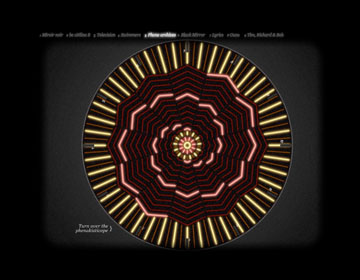
Phone archives animation from Arcade Fire’s neonbible.com
Screen grab of a neon rose window. From The Arcade Fire’s neonbible.com. The site in its entirety is so beautiful. Gothic but not goth, disenchanted and achingly beautiful, with abundant neon and filmic use of light.

Standard
Art & Development

February

I’ve never been so excited for the month of February as I am now. I’ve got two shows opening in February, and I think both are going to be awesome.

The first is at Swarm Gallery in Oakland. I’ll be showing a NEW SITE-SPECIFIC INSTALLATION* in the Project Space. In the main space will be Zachary Royer Scholz, who’s a CCA alum whose work I really admire, and Ricky Allman, a painter-friend of Casey Jex Smith‘s. I think it’ll be a really fun show, and I’m really looking forward to working with Swarm. The directors are really cool. Even M, who’s usually lukewarm about the art world, is totally rooting for Swarm, who M says is really doing something for art in Oakland.

After that, I’ll be in full throttle installation mode for Activist Imagination, at Kearny Street Workshop. This is a project that’s been in the works since the end of 2006! (Big thanks to Sam Chanse — the curator, the glue that holds together the collaborative effort — even during the run of her one-woman show, which just opened tonight.) So it’s really cool that this is coming to fruition. But I’m especially pleased about the NEW, SITE-SPECIFIC* projects I’m going to contribute. I think they’ll be large but quiet, and I hope it’ll be really unexpected for visitors of the show. My ideal wish is to have some really good conversations with respected mentors about where this new work has gone…

I feel really lucky about these opportunities because they’re giving me a chance to show what I’m made of. I’ve participated in so many group exhibitions that felt piecemeal, or too limited to be representative of me. So it’s been great to enjoy the capacity** to work towards something extra-ordinary.

In the meantime, though, I’ve got a zillion loose ends to tie, involving:
• theater gels
• Japanese office supplies
• motion-sensor DE-activating sockets
• sandbags
• latex paint
• a lab coat
• color copies
• sewing needles
• light bulbs: par 38s spots, 25 watt whites, 60 watt pinks…

*Emphasis for temporality. You can see the pictures online later, sure, but I’m just saying, if you miss the opening and then don’t make it to the exhibition run, it’s like the show could have happened in 1908 or 2008, it doesn’t matter. The world doesn’t have to be flat.
**Thanks to KSW, SFF, CWF, and individual supporters!!!

Standard