Community, Uncategorized

What excites YOU about contemporary art?

A few years ago, I was stuck in a catch-22: I only liked art I felt I could learn from, but I didn’t like what I was seeing, so I went to see less art, and so limited my chances of discovering exciting contemporary art.

Things have changed. First, I’m more receptive. I’ve expanded tastes in art beyond painting and drawing. I put aside preconceptions (as well as feelings of intimidation at fancy galleries). Second, I’ve built up my art endurance. Since I know more about art, it’s easier to look at art for longer durations — to contextualize it, file it away, and recall it — before feeling overwhelmed. It’s like eating: don’t fill up on the bread. Be selective. Cleanse the palette. Save room for dessert.

Most importantly, I’ve become a believer in reciprocity — that the more I look at art, the more I’ll be able to find what excites me. Sooner or later, I’m always delightfully surprised.


I hadn’t explored art in the South Bay much — until today.

The San Jose Institute for Contemporary Art‘s large windows let natural light into the meticulous, winding exhibition space. This Show Needs You is a friendly show of interactive social practice projects, including works by the veteran Linda Montano, and the esteemed professor Ted Purves and his partner Suzanne Cockrell. I appreciated SJICA’s reading room, chock full of printed matter and sited in a welcoming foyer just inside the front doors. The Print Center looks modest but immaculate. A show by San Jose State University MFA grads opens this weekend — don’t miss the impressive ceramic tableaus of Amanda Smith.

Making our way back up So. First Street, we popped in to the San Jose Museum of Quilts and Textiles‘s shop and foyer: cat earrings and donut-shaped coasters in the former, a cool minidress knit of VHS tape in the latter. Did I mention the tape is wound through a video camera, purported to be taped or played back in a later performance? Badass. (Knitter’s Tapestry by Daniela K. Rosner and Kimiko Ryokai). In conjunction with the ZeroOne festival, the Museum is exhibiting textiles using digital technology.

Movimiento de Arte y Cultura Latino Americano (MACLA) is exhibiting works for auction. A fair amount of figurative painting, some fine relief prints by Juan Fuentes, and Jaime Guerrero‘s uncanny luchador mask in dripping hand-blown glass. I also really liked a mysterious photo of a falafel “totem,” perhaps a double-exposure of signage and a drive-in.

I was feeling all of my 30 years in Gallery Anno Domini (I’m just too damn old to appreciate the youth/skate curating / pop culture consumerism), so I found myself admiring the minimally-renovated theater the gallery and store are now housed in. With a huge central space, and a massive screen, I wondered why AD doesn’t present more media work. Maybe showing art that privileges evidence of the hand, i.e., drawing/painting and modestly-sized sculptures, is a form of rebellion in Silicon Valley.

Unfamiliar with San Jose (and with lunch calling), I totally forgot to stop by Space 47, around the corner from AD. I’m excited by the idea of an artist’s run outpost among San Jose’s chain stores, and hope to visit it soon.

The deSaisset Museum at Santa Clara University is nice campus museum, and the Woff and I had our socks knocked off by their current show, Eye on the Sixties: Vision, Body, and Soul: Selections from the Collection of Harry W. and Mary Margaret Anderson. Like Woff said, it was like seeing old friends: a choice Nauman print, a Ruscha gunpowder drawing, a Nathan Oliviera work on paper, a David Park’s impassive faces in full color. I also loved several hilarious Oldenbergs, like screenprints of 2-D Mickey Mouse structures, and a semi-transparent plastic relief of a car obstructing a lithograph behind it. I even found a deliciously tactile lithograph with silver ink on gridded paper by Frank Stella, whose God-is-in-the-details geometric abstractions don’t often appeal to me. The show also reflected the burgeoning use of new materials: I found Sam Richardson’s cast plastic landscape cross-sections to wonderfully ambiguous, and somehow contemporary. There was also a kinetic “painting” with stripes of translucent color gently waving across a screen reminiscent of a television. James Grant’s #14, Bright Circle (1970), a rainbow-colored oculus of cast resin, takes the cake.

James Grant, #14, Bright Circle, 1970, cast polyester resin, 29 1/8 x 29 1/4 x 5 1/4 in., Collection of Harry W. and Mary Margaret Anderson, © The Estate of James Grant

Go see the show, and be sure to ask the attendants to turn on the kinetic works (they’re usually off, to minimize wear-and-tear, but it’s quite ecologically sensitive, isn’t it? Thanks, P, for lending the hybrid. Happy earth day.)

Standard
Activist Imagination, News

Artist’s Talk at KSW on Thursday

Thanks to everyone who made it out to the Artists’ Talk at Frey Norris Gallery on Thursday, or to the Headlands Open House on Sunday.

It’s really great to have the chance to talk about the ideas behind the work in depth with supporters. (Thanks FNG for the opportunity!) It’s amazing how the social nature of openings shapes conversations — so while I like many artists who I see at openings around town, the talk at FNG was the first time they were able to hear about my art in any depth.

If you haven’t been to an artist’s talk at a gallery, I’d just like to point out that the format is usually less formal than an artist’s lecture in a lecture hall — and while most artists use jargon in their written statements, many artists can speak in frank, colloquial terms about their work in more casual settings. So if you’re interested in art, artists’ talks are really painless ways to get familiar with an artist’s body of work and methodology. And you’ll usually also have the chance to ask questions — biographical, advisory, technical, intellectual, whatever: “How long did it take to make that?” “Where did you go to school?” “What is that made of?” “Did you hear about the Society for Cynicism? Like they need your support.” “Is your work influenced by Nauman?” etc.

So if you want one more opportunity to hear me talk about my work, please come to the Activist Imagination Artists’ Talk this Thursday, April 24, at 7 pm at Kearny Street Workshop. Donna, Bob and I be doing a gallery walk-through of the new work we created for the show. Many of my pieces are site-specific installations, and I’d love to have to chance to fill in any gaps or answer any questions you might have.

The talk starts promptly at 7. If you’re interested in my work, note that I’ll be the first artist to speak. Refreshments and snacks will be served; grazing commences at 6:30.

In the meantime, here are some pics of a new experiment I showed at yesterday’s Open House.

Sun-catching mirror near the sun-drenched neighboring building
A mirror placed near the sun-drenched neighboring building, casts sunlight into my basement studio.

At first glance, two mirrors on a shelf make for a minimal installation.

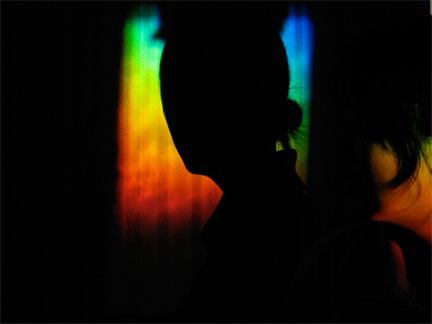
Strategically placed prism and mirrors casts a spectrum on participants\' faces.
A strategically-placed prism and set of mirrors casts a spectrum on the faces of those participants curious enough to explore the mirrors up close.

Standard
Research

Cotter on Eliasson

Holland Cotter’s review of Olafur Eliasson‘s show (nytimes.com, April 18, 2008 ) at the MOMA and PS1 includes elegant observations.

Eliasson’s art is highly perceptual, often involving optical illusions, so the viewer’s task is refreshingly straightforward. Cotter explains:

…like certain kinds of jazz, or ragas, or New Age ambient sound, this is an art of variation rather than destination. It lays out a visual theme, then asks you to wait, watch, wait some more and discover things happening.

Check this out. Poke your head in here. Slow down.

I think viewer-centered experiential art can be very generous to viewers, but Cotter susses out a nuanced indifference:

Like abstract painting, Mr. Eliasson’s art can be slow to reveal itself. In an installation called “Beauty” a rainbow emerges from a curtain of mist and vanishes. Maybe you see it; maybe you don’t.

I really enjoyed Eliasson’s show at the SFMOMA. First, I was proud that a the first retrospective of such an important contemporary artist was organized in our home city. Second, it was a surefire crowd-pleaser. The exhibition reminded me of San Francisco’s Exploratorium—light, color, play, wonder—but where the Exploratorium is dark, whirring, and a little musty and nostalgic, Eliasson’s show was bright, contemplative, straight as an arrow.

It’s a fun, pleasurable show, that appeals directly to audience members, regardless of what they think of or know about contemporary art. I can’t remember the last time I could whole-heartedly endorse a show for artists and non-artists alike.

Still, Cotter’s a professional, and he offers one more insight:

A fair amount of his work, in a witty way, is about disruption and disorientation. Rooms tilt; doors are not doors. At P.S. 1 a waterfall flows upward; a rotating metal fan, propelled by its own wind power, swings from a cable, just above head height, in MoMA’s atrium. This is art that teases and even, a little, humiliates, as we hesitate before the false doors, or are blinded by flashing lights, or duck the buzzing fan.

That hint of not-niceness is a crucial ingredient in Mr. Eliasson’s audience-pleasing art. It keeps it from being too sappy or flashy, all disco balls and special effects.

Maybe Cotter’s petting makes the following slap sting so much more:

And how radical is Mr. Eliasson’s art? How market-challenging or expectation-shifting? In the end — so far — not terribly. “Take Your Time” looks anomalous enough in an object-fetish moment…. At the same time the work is too intent on appealing to our appetite for passive sensation and too readily adapted to corporate design….

The writer goes on to contrast Eliasson’s enchanting work with directly political work associated with PS1’s “Wack! Art and the Feminist Revolution.”

I believe good art is good art, regardless of politics. So when Cotter says that

In others ways, though, [Eliasson’s show] reminds us how far in the current decade art has not come.

I am skeptical of the validity of this criteria for judging an exhibition. Certainly contemporary arts should consider the political implications of their positions, but the prospect that art exhibitions — particularly individual shows — are barometers of political progress is a little frightening. As an individual artist, my thinking may be self-centered or conventional here, but I think progress can be measured with more quantitative data in the galleries neighboring Eliasson’s shows — namely, displays from museums’ permanent collections.

Standard
News, Research

Points of reference: on mirrors

Most things which appear in a mirror duplicate what can be seen in its immediate vicinity…. But for each of us there is one item whose appearance is inescapably confined to the mirror, because there is no way of seeing it except in a mirror…. For all these reasons, the mirror, in art as in life, has assumed complex metaphorical significance, epitomising both the vice and vanity and the virtue of prudent self-knowledge.

—Jonathan Miller, “On Reflection,” London: National Gallery Publications Ltd [1998] p. 12-13

Dispersion experiment

I’ll be showing a new experiement in my studio during the Headlands Open House this Sunday, 4/20.

Or, stop by the artist’s talk at Frey Norris Gallery on Saturday, 4/19, or the talk at Kearny Street Workshop on Thursday, 4/24.

Standard
Community

Upcoming

Kearny Street Workshop artists, including Zand Gee, Nancy Hom, Jack Loo, Mitsui Murai, Leland Wong and others

In my research for Activist Imagination, I learned that Kearny Street Workshop’s early poster activities were heavily supported by the San Francisco Arts Commission’s Neighborhood Arts Program. So it’s really beautiful that this year, KSW is celebrating is 35th Anniversary while SFAC is putting on a big Neighborhood Arts Festival. And the festivities sound terrific.

SF Arts Commission’s Neighborhood Arts Festival
Featured events include:
Monday, April 21: Mapping Survival panel discussion
Wednesday, April 23: The Money and the Madness panel discussion
Saturday, April 26: Unveiling the Future town gathering
Friday, May 2: Poetry Potluck reading
Saturday, May 3: 40th Anniversary Bash
Arts Fair
Speed Dating (RSVP requested)
Doctor Session (RSVP required)
(A sampling of community arts events put on by our Community Partners can be found here)

The Activist Imagination exhibition continues through May 24; there will be an artists’ talk and reception on Thursday, April 24 at 7 pm, and a closing reception and catalog release on May 24th at 6:30 pm.

image: Kearny Street Workshop artists, including Zand Gee, Nancy Hom, Jack Loo, Mitsui Murai, Leland Wong and others
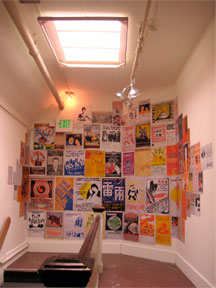
An exhibition of reproductions of Kearny Street Workshop Posters, curated by Christine Wong Yap
1974–1983, digital prints, 10 x 10 x 10 feet (installation) Photo by Christine Wong Yap.

Reproduce & Revolt By Josh MacPhee and Favianna Rodriguez is coming

An extensive collection of contemporary political graphics collected from around the world, including art from many of today’s most exciting street artists, poster makers and graphic designers. All of these images are granted to the public domain, to be freely used for political purposes.

Order it now at JustSeeds.org.

Standard
News

April 19: Sorry! Artist’s Talk

sorry

Artist’s Talk
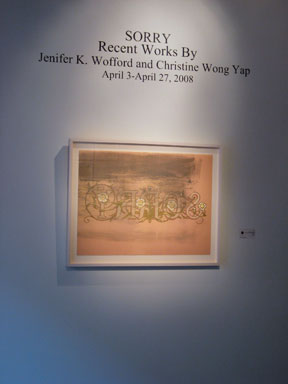
SORRY: Recent Works by Jenifer K. Wofford and Christine Wong Yap
Saturday, April 19, 2008
1:00 to 3:00 pm

Frey Norris Gallery and Annex
456 Geary Street
San Francisco, CA 94102

Standard