Art & Development, Community

LA Art Trip 2008

Four days.
Five museums.
Thirty-five galleries.
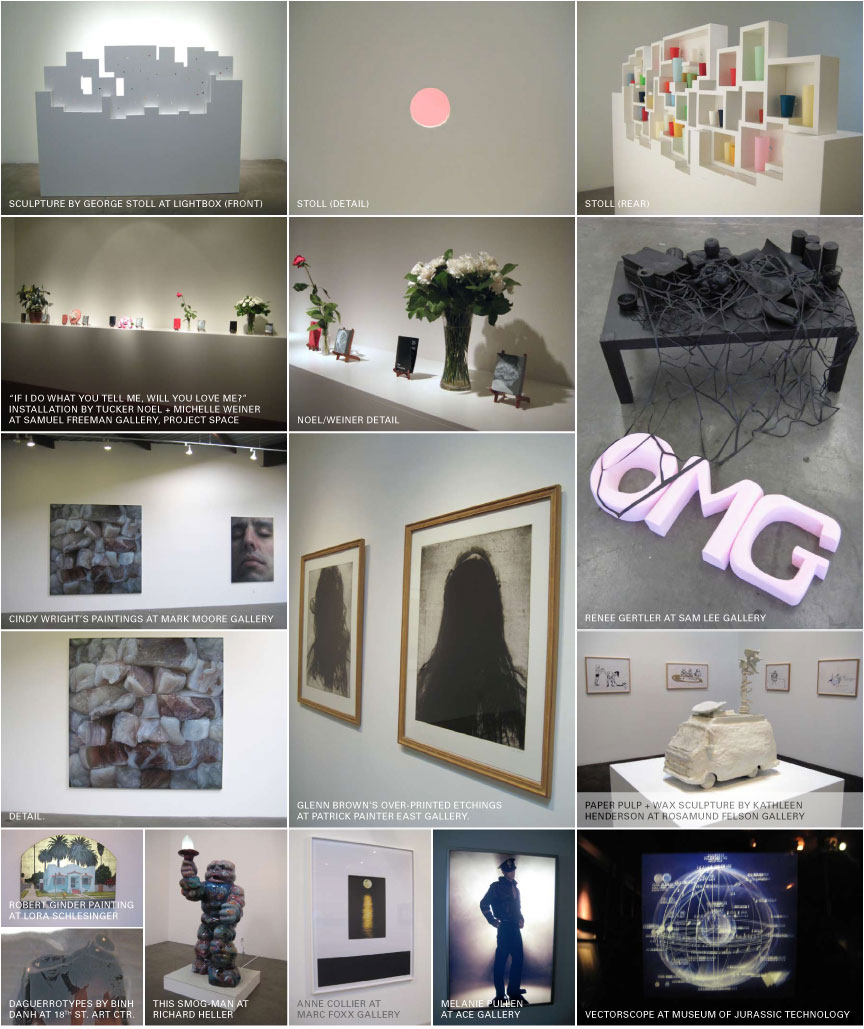
I saw innovative, fresh exhibitions in museums, and only a few ambitious shows in galleries. Many galleries were closed for the holidays, though a few have folded since my last visit a year ago (too bad, I really liked Anna Helwing’s gallery).

Click on the image below for a larger view. It’s a big file, give it a sec.
la_art_trip_photos

High points:

1.
California Biennial
Orange County Museum of Art

A fantastic show that counterbalances a surprisingly pointed emphasis on war and borders with utopic, phenomenological experiments. Curator Lauri Firstenberg pulled off a multi-site show featuring many excellent artists of color and women. I saw the museum show, the site of work by only about 30 of 50+ artists. I really enjoyed the work of Erica Vogt, whose small-scale projector-based installations were intimate reflections on media as framing devices. Mike Arcega‘s installation of two-by-fours looked great, and worked well sited near the port of Long Beach, as did Jebediah Ceasar’s 4x4x8’ polyurethane block. Anna Sew Hoy‘s site-specific sculptures for a dance performance were Isamu Noguchi-esque and a little cuddly. Justin Beal presented an intriguing installation of objects, furniture and wall-based works at the intersection of industrial production and war profiteering. Daniel Joseph Martinez‘ installation with an animatronic human figure was cold and discomfiting, effectively conjuring (for me) our complicity in acts of torture. Jordan Kantor and Mark Hagan both present satisfyingly odd, brainy paintings. (If commercial galleries only exhibited drawings and paintings as thought-provoking as Hagan’s and Kantor’s, gallery goers would be spared so much mediocre art!) Edgar Arceneaux‘s installation of shiny things, broken mirrors and haphazard projectors looked like a set for a Pink Floyd video, while his video reminded me of Politics of Rehearsal, Francis Alÿs’ show at the Hammer Museum. Arceneaux’s search for meaning seems highly provisional, reflecting the times’ uncertainty. In the same vein, I found Amanda Ross-Ho‘s excised studio walls — assemblages of found objects upon found marks — a little too totemic for my tastes, but I could appreciate the inward-looking search for authenticity, especially as institutions are crashing down all around us.

2.
Other People: Portraits from Grunwald and Hammer Collections
Oranges and Sardines
Gouge: The Modern Woodcut 1870 to Now
Armand Hammer Museum

I like the Hammer a lot. My current investigations don’t overlap with any of these shows’ themes — woodcuts, new abstract painting, and portraits — so it’s a testament to the institution that I found all of these shows elucidating, richly textured and curatorially interesting.
Other People mixed contemporary and historical portraits. It was a treat to see 400-year-old engravings by Dürer next to narrative photographs by Wolfgang Tillmans and Catherine Opie. I also really liked Mike Mandell‘s baseball trading cards featuring photographers. The photos are dorky and fun, and a little bit cringe-worthy like Mike Smith’s photos.
In Oranges and Sardines, six contemporary abstract painters selected art to hang alongside one of their own works. I’m not crazy about Wade Guyton’s inkjet prints on canvas, but his selections — which included a light by Dan Flavin, a stage for a go-go dancer by Felix Gonzalez-Torres, and a photograph of a hammer, sickle and slice of pizza by Andy Warhol — were sensational and funny, and they inspired a new look at his work. Oranges and Sardines is a great chance to see painters’ points of references firsthand.
I’m familiar with woodcuts, but I still enjoyed many surprises in Gouge. Indian prints from the late 1800s were endearingly stylized; they seemed to be evidence of early modernism’s appropriation of non-Western visual languages. I was amazed by a detail of Thomas Kilpper’s ambitious project, “The Ring,” a woodcut made from a 4,000 square foot parquet floor. I also found Christine Baumgartner’s engraving-style woodcuts based on video surveillance satisfying in its visual and conceptual integration. And Edvard Munch’ timeless variations on the Kiss (see image) were moving as always.

3.
Anne Collier
Marc Foxx Gallery

Really nice photos about photography / framing framed things like albums, prints, works of art. It’s a tight grouping of images that compels the viewer to construct a narrative from these disparate, but beautifully made and installed, images.

4.
Violent Times
Melanie Pullen
Ace Gallery

Ninety-five massive prints and lightboxes feature models dressed as soldiers in action. The show is a sexy indictment of the valorization of youth, masculinity and war.

5.
Ambitious programming, like Rain Field by Jake Lee-High at Fringe Exhibitions, and Nail to Nail by Darren Almond at David Patton Projects
Honestly, I’m most impressed by the scale and ambition of these works. Lee-High presents a 117-channel audio and weather installation in nearly complete darkness. Almond presents a beautifully-shot, comment-free documentary-style video of a worker mining sulphur in Indonesia. The work is interesting and good, but considering that most galleries of this size are content with simply putting pictures on the walls, I especially admire the galleries for committing to this risk-taking art.

Low points:

The Grapevine was closed due to a severe storm, forcing us to take a lengthy detour to Highway 101. The drive takes twice as long as it should have.

A disgustingly artificial tea. I asked for an unsweetened chai and receive a drink loaded with “No Sugar Added®” sweetener. The English language is being supplanted by branded corporate-speak.

Standard
Art & Development

oh, the irony!

About ten or fifteen years ago, I was a twenty-something-year-old woodcut printmaker primarily concerned with expression. I felt that big expensive art was tacky and elitist, while prints were affordable and proletariat.

One day, in a tony downtown gallery, I was completely bored by an outlandishly expensive work of art. It a cube of glass about 4x4x4′, raised to eye-level by a simple chrome structure. The glass transitioned from clear to two-way mirror, creating a few optical tricks. My knowledge of art after modernism was pretty weak. I felt that it looked like corporate art scaled down for a rich person’s home. The artist, Dan Graham, didn’t ring a bell; the price, $100,000, made me laugh out loud. Who would pay that much money for this thing! It had no content, no beauty.

Which, I’ve since learned, is exactly the point of Minimalism. It’s not about expression or representation, but about the viewer’s relationship to the art-object.

Lately, I’ve been working with mirrors and have come around to studying Dan Graham’s work. He is interested in power and public versus private space (there is content, after all), so the corporate feel is probably intentional.

Conceptual art is often hard to “get”—the clues to content and context are hidden, so viewers often need to be armed with information to appreciate the art. When I first saw Graham’s work, I saw a content-less structure in the context designed for private sales. But I can appreciate this work now because I have more information about Minimalism, Conceptualism, Graham’s interests, and the ideal context, which is a public park, like his project with Dia:Beacon.

[I also don’t find the cost of the work so outrageous anymore. Here’s why:
• Galleries sometimes offer discounts to long-term collectors.
• The gallery (and there can be more than one) gets half.
• Graham gets the other half, to allot to his costs: labor (including architects, fabricators, engineers, designers), studio costs, health care, materials, assistants, etc. Shoppers are used to paying for corporation’s overhead costs, but sometimes approach products and services by individuals differently. For example, it might only cost $5 to manufacture a shirt, but that doesn’t deter shoppers from paying $50 for it.]

Standard
Research

I enjoy taking photos, but I only find satisfaction from printed photographs on occasion. I find the idea of presenting my own photos fraught with pitfalls. So I’ve turned to books for help.

Roland BarthesCamera Lucida: Reflections on Photography (translated by Richard Howard {Hill and Wang, 1981}) is a primer in the study of photographs and semiotics. It’s also a good starting point because it’s Barthes’ personal investigation of the photograph, written in the first-person and in the present-tense. He begins with his understanding of the photograph and concludes with an examination of the role of photographs in his grieving process for his late mother.

James Elkins, though, has criticized Barthes for taking too sentimental an approach to photographic theory. Elkins’ books include:

Visual Studies: A Skeptical Introduction
Master Narratives and Their Discontents
What Happened to Art Criticism?
Why Art Cannot be Taught
On Pictures and the Words That Fail Them

These polemical titles may seem off-putting, but I admire Elkins’ rigor and multi-disciplinary scholarship. I’ve taken a crack at his latest book, “Six Stories from the End of Representation: Images in Painting, Photography, Astronomy, Microscopy, Particle Physics, and Quantum Mechanics, 1980-2000” (Stanford University Press, 2008) and it’s quite good. He reviews principles in modernism and postmodernism, such as a historical and Kantian definition of the sublime, in contrast to the “overused” Romantic notion. He also identifies artistic strategies in modernism and postmodernism, including “The Ladder,” with which an artist descends into darkness, leaving behind the clarity of illusionistic representation. Lower rungs of the ladder include the strategies of the blur and darkness.

Elkins’ writing is methodical and exact, so one can understand why he is so critical of vagaries in art. He writes about some art that uses darkness and blurring:

The problem is that as it stands, much of the work is mediocre. The critical literature follows this lead, providing impressionistic commentaries on belatedness, the loss of memory, the affection for clumsiness, faint melancholy, the embrace of meaninglessness, obsolescence, the departure of the aura, sophisticated evasions, missing objects, ineffective repressions, loss of space, loss of language, hopelessness.

He’s right. The “loss of memory” is overused to justify decrepitude as a visual style. And so much of the stylized, narrative drawing around the Bay Area (you know what I’m talkin’ ’bout–those screenprints of telephone poles!) is romanticism masked as cultivated urbanity, and touches on similar vagaries — melancholy, obsolescence, the affection for clumsiness.

Most compelling, though, is Elkins’ methodological approach of trying to bridge the humanities with the sciences. Far from the other vague art cliché, “nature versus technology,” Elkins has the chops to execute a rigorous study of astronomy, miscroscopy, particle physics and quantum mechanics. Having recently studied astronomy for the Binary Pair project, I’m looking forward to delving into this chapter.

Standard
Community, Values

DIY, DDIY

I was pleasantly surprised by how much I liked the installation-in-progress by resident artist Daniel Nevers at Southern Exposure. His project involves accumulating and configuring ready-made materials purchased from Home Depot.

Before I saw the work, I suspected that I’d miss a sense of intervention or critique, as Nevers’ Home Depot transactions do not disrupt manufacturing or retail business-as-usual. But then again, artists still get their paper and plaster from somewhere — Home Depot may be a more notorious multi-national big box, but it doesn’t mean that Dick Blick or other chains are any better.

Nevers is interested in “DIY as the new self-help.” I didn’t see the introspective, psychological layers to the work in my quick walk-through; perhaps I was too dazzled by so much new and shiny merchandise, which is reminiscent of the work of Jessica Stockholder.

Nevers’ installation inhabits nearly every cubic foot of the storefront gallery. Liminal spaces are framed by 2x4s and sealed behind plastic sheeting. Mounds of orange extension cords on the floor are visually attractive — sensuous, even. A screen seamed with blue-green cable ties makes a 3-D fringe, and plunger heads outfitted with tiny light bulbs form beacons on the windows. Expanding foam overflows its container, lending an oozing, vegetative quality. Visitors have to find their own narrow paths through this crammed-to-the-gills installation, and every corner reveals more unexpected colors and patterns. The effect is like walking inside an overgrown window display. Through Nevers’ comically exaggerated accumulations and arrangements, the recognizable household items — push-brooms, sawhorses — outshine their mundane identities.

Recent Headlands Center for the Arts resident David Moises also uses consumer-grade appliances and tools as foundational materials in his work. Moises, though, intervenes in the objects’ functions to create viewer-interactive kinetic works, such as gasoline-powered hobby horses. He spoke about his interest in examining a tool’s potential, like liberating a bumper car from its electric floor.

Lisa Anne Auerbach‘s manifesto, “DDIY: Don’t Do It Yourself” (Journal of Aesthetics and Protest, #6), directly critiques DIY as co-opted by corporations and lifestyle magazines. In keeping with the manifesto style, the premise is indicting, the tone hyperbolic. Auerbach proposes “Don’t Do It Yourself,” which sounds a lot like the original spirit of DIY, with the revisions of hiring professionals when appropriate and trading services whenever possible. DDIY “is un-commiditized, barter-based, community-crazed and liberating.”

I have shared Auerbach’s disgust at the ridiculous extent of DIY ubiquity (e.g., God’s Eyes, the pre-school age appropriate art activity, on the cover of Readymade Magazine), and the marketing of rudimentary creative trends like scrapbooking.

As an artist and freelance graphic designer, I also agree that expertise should be valued accordingly. But though bartering can be fruitful, I think it’s an alternative to monetary compensation that should be carefully negotiated and never presumed. (Until the day landlords and HMOs accept payments in home-baked bread or knit hats, independent contractors should be spared the indignity of defending the value of their services.)

At the same time, I see nothing wrong with DIY. My parents rototilled their own land, sewed their childrens’ clothes and repaired their own home. But they didn’t call it DIY; it wasn’t a fashion or political statement, or a way of demonstrating indie community values. Their way of life has been largely abandoned because of marketing and consumer culture, true, but also due to affluence and de-skilling. Auerbach hopes to reclaim creativity and skill-building, but she disdains DIY-marketed products. But rejecting consumer culture — including DIY-marketed products — is as easy as it’s always been: shop less and do it yourself more often.

Standard
Research, Values

Odds and Ends

r+d‘s got a new look, as do my Web sites for my art and design practices.

The past few weeks have flown by. Election euphoria gave way to economic meltdown despair, which vies for attention alongside holiday shopping and business as usual. Keeping one’s head above water as an artist seems not so bad when everyone else has been thrown into instability.

What I’ve been up to:

An art review. Forthcoming.

Reading about photography, and feeling out of sorts. From Roland Barthes’ Camera Lucida:

What I want, in short, is that my (mobile) image, buffeted among a thousand shifting photographs, altering with situation and age, should always coincide with my (profound) “self”; but it is the contrary that must be said; “myself” never coincides with my image; for it is the image which is heavy, motionless, stubborn (which is why society sustains it), and “myself” which is light, divided, disperse; like a bottle-imp, “myself” doesn’t hold still, giggling in my jar: if only Photography could give me a neutral , anatomical body, a body which signifies nothing!

Sketch comparing the gap between material and ineffable as described by Daniel Spoerri and Roland Barthes

Sketch comparing the gap between material and ineffable as described by Daniel Spoerri and Roland Barthes

I was surprised to learn that the phrase “Camera lucida” is Latin for “lit room.” In a camera obscura, a room with a pinhole displays an image, functioning like the cameras we know today. But in a camera lucida — a drawing tool comprised of a mirror and a semi-silvered (or two-way) mirror — the lit room is the scene for not just an image, but for the artist, drawing substrate and subject. This emphasis on context — on the whole picture — resonates with my work, which has become less about discrete objects and more about the viewers’ engagement with the object in the gallery (another lit room, a space for viewing — a lucid camera of the mind?).

Claude glasses, thanks to Elizabeth Mooney‘s recent show at McCaig Welles Rosenthal

Consume; think again. This financial crisis/recession/whatever sucks. But I think a period of consolidation is not bad if it takes American hubris down a notch, and forces consumers to shift towards simpler, less toxic, more meaningful lifestyles. It seems to me that American consumers were in denial about the difference between what we want, need, and are entitled to (as are the auto industry giants — and see where that got them).

Like the Rolling Stones song goes: You can’t always get what you want, but you get what you need.

Consume with care. Ironically, Christmas muzak pervades but social institutions are likely to suffer this year due to the economic slowdown. As David Brooks pointed out on the NewsHour with Jim Lehrer today, during recessions, memberships to social institutions fall. The tenor of the news suggests that consumers owe it to retailers to keep shopping as usual and to help major corporations stay afloat. I disagree. I’m trying to do my part by doing my holiday shopping at non-profits, alternative art spaces and local art sales.

There’s a gazillion ‘What to give’ lists out there, showing off precocious lamps and gratuitous gadgetry, but here’s a list of for arts-minded locals:

LOCAL SALES:
Lots of alternative art spaces are having holiday fairs and sales — here’s a sample:
Blankspace Gallery
Compound Gallery
Rowan Morrison Gallery
Richmond Art Center
The Lab
Root Division

ONLINE:

Memberships to cutting-edge art organizations.
Basic memberships start at $35-65; get a full year of free or discounted admission to gallery exhibitions and/or performances, film screenings, talks… e.g.,
Southern Exposure
YBCA
Kearny Street Workshop
Intersection for the Arts
Headlands Center for the Arts
Recipient uninterested in art, you argue? Luckily, there are museums and organizations specializing in craft, design, photography, cartoons, cars, you name it!

Tickets to the opera or ballet.
(SF city arts budgets would be halved under Supe. Peskin’s budget proposal, warns SFGate. Boo Peskin! Yeah for Obama (read the Obama-Biden arts platform [PDF]) and Michael Chabon (read his postamble to the platform)!)

Not sure what seats to purchase? The SF Ballet offers gift certificates in increments of $25.

Single tickets for the SF Opera, which will feature Gershwin’s Porgy and Bess next summer, start at $16-18.
Standard
Research

Rochelle Steiner Lecture at CCA

Rochelle Steiner, Director of the New York-based Public Art Fund, gave a lecture tonight at CCA. The Public Art Fund is a non-profit organization that commissions new, temporary works of public art by contemporary artists. You have heard of Olafur Eliasson’s Waterfalls project, perchance? That was them.

I came away really impressed with the Public Art Fund’s work. The organization thinks of itself as a museum without walls, so their public works rotate after six months. Developing a new work could take years, so their commitment to keeping the art temporary is admirable.

Steiner showed Public Art Fund projects by big-name artists—Alex Katz, Mark di Suvero, Juan Munoz, Jenny Holzer, Anish Kapoor (whose Sky Mirror in Rockafeller Center might be one of the most brilliant public interventions I’ve seen), Chris Burden—so I was familiar with all of the artists. I must have been looking for art that seemed incongruous with the artists’ oeuvres, because I was a little surprised that it all looked like contemporary art. I guess I was expecting some public art works to have more of a “community art” feel. More modest, pictorial, “easier.” But it didn’t. And I think that’s wonderful. The work is top-notch, the kind of thing that audiences would flock to at the Venice Biennale. Of course, it was public art for New York, free for anybody walking by to take a gander at, and made in collaboration with city agencies or corporations, yet I didn’t see any signs of compromise, of the urge to dumb down the art for general audiences, or to simplify elaborate installations.

Lest you think that the Public Art Fund is all highfalutin’, they also do educational outreach. In the Waterfalls project, they developed, printed and distributed a curriculum to NYC classrooms, and developed boat and bicycle tours. Steiner also listed the huge economic benefit to the city. Of the Waterfalls’ $15.5 million budget, the City gave a $2m grant; but the economic impact in tourism, boat trips, etc., centered around Lower Manhattan, is estimated to be around $60m. (Not that I think art’s aesthetic payoff isn’t enough.)

I left the lecture with one small regret—there are no equivalents in the Bay Area, no nimble public arts non-profits free from the problematizing consensus-building that dominates civic agencies.


Ann Pasternak, Director of Creative Time, is talking at UC Berkeley’s Kroeber Hall on Nov. 24. Don’t miss it.

Standard
Research

Recent writing on art

Clear. Consistent. Coherent. Concise.
—A note seen taped to a journalist’s computer

As a writer, I’m more journalistic than academic. I’m drawn to elegant brevity. I believe that criticism can be both intellectually engaging and beautifully written. See examples below.

Excellent writing on art, culled from recent mainstream publications:

Malcolm Gladwell, “Late Bloomers” (NewYorker.com) October 20, 2008.
Why do we equate genius with precocity? Gladwell asks. He examines two case studies — Picasso (young genius) and Cezanne (late bloomer), and the writers Jonathan Safran Foer (young genius) and Ben Fountain (late bloomer) — and suggests the conventional wisdom that artistic talent is innate is a disservice to late bloomers, who require more time to mature and create their greatest work.

This is the vexing lesson of Fountain’s long attempt to get noticed by the literary world. On the road to great achievement, the late bloomer will resemble a failure: while the late bloomer is revising and despairing and changing course and slashing canvases to ribbons after months or years, what he or she produces will look like the kind of thing produced by the artist who will never bloom at all. Prodigies are easy. They advertise their genius from the get-go. Late bloomers are hard. They require forbearance and blind faith. (Let’s just be thankful that Cézanne didn’t have a guidance counselor in high school who looked at his primitive sketches and told him to try accounting.) Whenever we find a late bloomer, we can’t but wonder how many others like him or her we have thwarted because we prematurely judged their talents. But we also have to accept that there’s nothing we can do about it. How can we ever know which of the failures will end up blooming?

Impressively, Gladwell arrived at a conclusion that no one likes to talk about, but is a difficult real-world lesson artists often learn along the way: Not only must late bloomers persevere for decades on end, so must their patrons — or, in the case of Ben Fountain, and many artists I know (ahem!) — their spouses and families.

Sharie was Ben’s wife. But she was also—to borrow a term from long ago—his patron. That word has a condescending edge to it today, because we think it far more appropriate for artists (and everyone else for that matter) to be supported by the marketplace. But the marketplace works only for people like Jonathan Safran Foer, whose art emerges, fully realized, at the beginning of their career, or Picasso, whose talent was so blindingly obvious that an art dealer offered him a hundred-and-fifty-franc-a-month stipend the minute he got to Paris, at age twenty. If you are the type of creative mind that starts without a plan, and has to experiment and learn by doing, you need someone to see you through the long and difficult time it takes for your art to reach its true level.

…This is the final lesson of the late bloomer: his or her success is highly contingent on the efforts of others. … We’d like to think that mundane matters like loyalty, steadfastness, and the willingness to keep writing checks to support what looks like failure have nothing to do with something as rarefied as genius. But sometimes genius is anything but rarefied; sometimes it’s just the thing that emerges after twenty years of working at your kitchen table.

Special Galleries issue, New York Times, November 14, 2008
Roberta Smith takes on Chelsea; Holland Cotter peruses the LowaEside; Karen Rosenberg pads around the Upper East Side; and Ken Johnson spanks Soho. OK, that last part isn’t true…. (or is it?)

I’d love to get this kind of expansive overview of New York galleries once a month, but I take what I can get. What I don’t understand is, why aren’t there more surveys of other cities’ art galleries, of comparable clarity, consistency, coherence and concision? Well, it’s New York, you argue. Exactly my point: There’s so many more galleries in New York, that reviewing a city like San Francisco should be a piece of cake.

Standard