News, Sights

October 22: Color + Color launches at P.P.O.W Gallery

I’ve contributed images to a new artist-initiated publication. It’s launching at an interdisciplinary event at P•P•O•W Gallery, a great space that represents some really awesome artists.

Three Pieces is an ongoing series which showcases three new pieces of sound, image, text or movement from local and visiting artists. Presented by Roddy Schrock and Deric Carner in various locations.

Amanda Curreri and Erik Scollon Presenting Color&Color #0

Color&Color is an artist-curated publication guided by the duality of two thematic colors per issue. The premier issue, Color&Color #0, features Orange & Blue with work by the following artists: Deric Carner, Amanda Curreri, Renee Gertler, Jason Hanasik, Sam Lopes, Celia Manley, Jeremy Chase Sanders, Erik Scollon, Skye Thorstenson, and Christine Wong Yap.

o.blaat (Keiko Uenishi), Sound Event

In Sound Event, the first word, “Sound” swings roughly between two of its many uses in “an experiment through the course of an event”: 1: (as noun,) the sensation produced by stimulation of the organs of hearing by vibrations transmitted through the air or other medium. 2: (as adjective,) following in a systematic pattern without any apparent defect in logic—as in sound reasoning. It is also an attempt to observe the certain swing/shift between a thing “signified” and “signifying” and perhaps the process of accumulation of desire.

Sal Randolph, Language Drawings
The artist will read from a series of new language “drawings” — texts made with a manual typewriter on long rolls of paper. As a kind of spontaneous “drawing practice” the words on these scrolls are free to follow one another according to an evolving set of principles including sound, shape, semantics, syntax, repetition, punning, play and association. These are intended to be texts without result, the residue of a practice that takes place unobserved: daily, meditative, noninstrumental.

P•P•O•W and The Hostess Project presents
Three Pieces: Platform for Art and Sound
Amanda Curreri & Erik Scollon, o.blaat (Keiko Uenishi), Sal Randolph
Thursday, October 22, 2009, 7–9 pm
P•P•O•W Gallery
511 W 25th St, Rm 301
New York City

Standard
Meta-Practice, Research, Values

Enthusiasms Unbounded, Mentality, Reviews

My Art Practice as Enthusiasms Unbounded

“Enthusiams unbounded” is neither grammatically correct nor concise, but it’s the best linguistic capsule for my sentiment: that many aspects of being an artist can be seen as exercises in honoring curiosity.

I love my life in art because I’m constantly learning new things; I made a decision to cultivate areas of knowledge and skill, and they’re accumulating more or less every day. When I look at it this way, art practice is even more satisfying.

I’m starting to think that being an artist means studio work, as well as enacting one’s enthusiasms at will, anytime and anywhere. To borrow examples from my own recent past, this manifests via browsing exhibition catalogs about shopping, learning how to use a nail gun (powered with air: brilliant!), getting over my fear of hand-held circular saws, and savoring donut shop typefaces. My enthusiasms fuel my art practice, so as an artist, it’s my job to follow them.

An Observation on Mentality

My friend Stephanie pointed out that longevity in art can often be attributed to sheer determination. In other words, success in art is partially a war of attrition (especially for women, as my friend Jenifer would add). Stephanie vowed to make art, no matter what. I want art in my life, but I need happiness too. And I think there’s a way to cultivate both:

I suspect that another secret to longevity in the arts is good morale, which requires (at least) two skills:

1. The ability to welcome and accept all forms of validation. I think it’s along the lines of being a connoisseur, not an addict, of the tangible evidence of success. That means blocking out mithering resentments or bitterness in light of any successes, and not letting hang-ups limit the extent of one’s satisfaction.

2. A high tolerance, or the quick ability to recover. May the stings of rejection fade quickly. May the forgettable exhibitions be soon forgotten. May petty resentments pass, along with all the reasons to be jaded about the art world.

The goal, it seems, is to make optimism and happiness “sticky,” and to let all the rest roll off your shoulder. Duckin’ and weavin’. Stick and move.

Enthusiasms, specifically

A cursory look-see of downtown galleries less than stunning, with two major exceptions:

Kim Anno at Patricia Sweetow Gallery

Kim Anno’s paintings on metal are pretty and formal — two things I’m not usually that wowed by. But I felt that feeling of worship that I think overcomes many art lovers when I looked at her paintings — my God, the light! The works are pure abstraction, with large expanses of white paint nestled by wisps of translucent color; they “read” quite simple and gestural and yet there are passages upon passages of textures, patterns, marks and contrasting surfaces. The whites revealed themselves to be rich in color as well. They’re works that continue to reward the act of looking. Expertly executed.

Bruce Connor at Gallery Paule Anglim

I first saw one of Bruce Connor’s miraculous black-and-white inkblot pattern drawings in Lawrence Rinder’s Galaxy at Berkeley Art Museum a few weeks ago, so it’s a treat to see more of them so soon. I absolutely adore them. There are several tiny ones on view, as well as a generous series of leaf-shaped inkblots and a few fuddy-duddy assemblages. The inkblots, though, are sublime. Completely abstract, moments of recognition appear and fade away, with a variety of textures, media and mark-making devices that result in an surprising magnitude of visual experiences — some lent the sensation of solarized photographic prints, others are clearly tactile acrylic, still others suggested small infinities. They strike a balance between meticulous compulsion and the fine art of knowing when to stop.

Standard
Sights

Moby-Dick is coming!

Moby-Dick, the forthcoming exhibition at the Wattis Institute for Contemporary Arts, is gonna be a great show. It’s formed around Melvillian motifs and features new and recent contemporary art alongside historical works. The list of artists follows.

Kenneth Anger, Matthew Benedict, Mark Bradford, Marcel Broodthaers, Angela Bulloch, Tom Burr, Edgar Cleijne and Ellen Gallagher, Tacita Dean, Marcel Dzama, Felix Gonzalez-Torres, Rodney Graham, John Gutmann, Susan Hiller, Evan Holloway, Peter Hutton, Colter Jacobsen, Brian Jungen, Buster Keaton, Rockwell Kent, Mateo Lopez, Jorge Macchi, Kris Martin, Henrik Olesen, Paulina Olowska, Damián Ortega, Jean Painlevé, Kirsten Pieroth, Adrián Villar Rojas, Richard Serra, Andreas Slominski, Hiroshi Sugimoto, Orson Welles

Pretty much all these artists are amazing, but there are a few that are outstanding for personal reasons. I saw Mark Bradford speak at SFAI a few years back; he’s the kind of bright and sensitive artist I aspire to be. I was greatly impressed by Angela Bulloch‘s highly refined LED-based work in the Leeds Art Gallery. And as a one-time woodcut artist, I was also delighted (in my role as a preparator) to see the inclusion of some beautiful old Rockwell Kent prints.

Moby-Dick will be on view at the Wattis from September 22 to December 12, 2009. The gallery is open Tuesdays and Thursdays from 11–7, and Wednesdays, Fridays and Saturdays from 11–6. There will be an opening reception on Tuesday, September 22, from 6:30–8:30. For more info please visit wattis.org.

Standard
News

Last weekend: Involved, Socially at Triple Base Gallery

A few more days to catch Involved, Socially, a group show to which I’ve contributed a mail art swap featuring 32 international artists and a new iteration of the text/light installation, Unlimited Promise. You can see it today (Thursday) through Sunday, September 6, noon to 5pm.

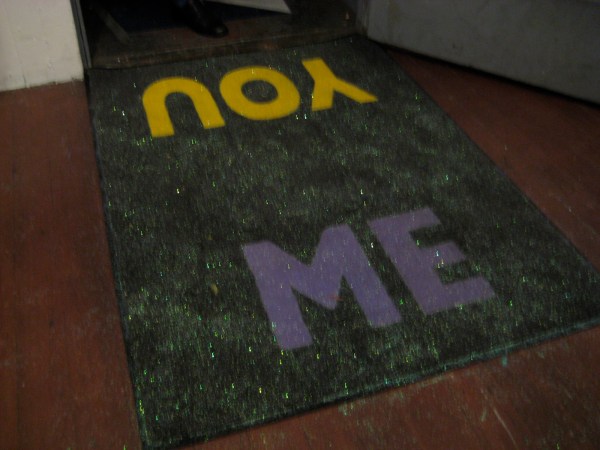
Amanda Curreri, Leveller (enamel on floor mat), 2009

Amanda Curreri, Leveller (enamel on floor mat), 2009

Involved, Socially
Curated by Michelle Blade
Amanda Curreri, David Horvitz, Mark McKnight, Jessica Williams and Christine Wong Yap
August 7–September 6, 2009
Opening Reception: August 7, 7–10pm
Triple Base Gallery
3041 24th Street, San Francisco, CA
gallery hours: Thu-Sun 12-5pm

Standard
Research

Saatchi’s all right

…let’s have no talk of temperamental, self-absorbed and petulant babies. Being a good artist is the toughest job you could pick, and you have to be a little nuts to take it on. I love them all.

Charles Saatchi, the British advertising mogul turned hugely influential art collector, is releasing a book, and he’s contributed a great interview to the Guardian.

Like Hirst, Saatchi’s name is often mentioned in diatribes as a symbol of everything wrong with art and the market, but Saatchi’s interview reveals himself to be rather plainspoken and unpretentious about his projects, influence and intuition.

I especially enjoyed the last segment on artists, curators, dealers, collectors or critics, in which he both ruthlessly critiques shady characters and pleasantly praises talent and ethical standard-bearers. Everyone gets their dues.

Standard
Art & Development

thoughts on curating: Galaxy at BAM

Usually, when I visit museums, I head straight to the contemporary shows. Sometimes I skip the “famous paintings” shows altogether, because the selections from the collections rarely change or surprise. You know the formula: in general museums you’ll find chunky oils of landscapes and uptight portraits of nearly translucent members of the bourgeousie; in museums of modern art you’ll find a Cezanne, a Warhol, a huge, prominently-placed Still, a huge Rothko (always with a bench) and voila! — Western art history through 1960.

So when my friend Erik — whose critical eye I’d trust with, I dunno, my life, if my life depended on aesthetics — spoke highly of a selections-from-the-collections exhibit at the Berkeley Art Museum and Pacific Film Archive by Lawrence Rinder, who’s the new Director, I made a point to go see it before it closes August 30th.

Galaxy: A Hundred or So Stars Visible to the Naked Eye, occupies three of BAM’s roomy bays. Upon entering the first one, I looked around and saw a bunch of etchings spanning the Renaissance through Romantic eras. Really, Erik? I thought. This is the show? But Galaxy doesn’t disappoint. Or put another way, the BAM collections run deep and Mr. Rinder’s curatorial approach delights. The works in the show are all really good, and the selection and placement of the works exhibit whimsy, unexpected turns, humor, sex and formal elegance. The exhibition guide is written with a high degree of subjectivity, bringing fun and surrealism into the viewing experience. For example, a rather vanilla classical painting based on Greco-Roman mythology is annotated with the oddball note that The Princess Bride is based on the same myth. And in a surprise pairing, a painting that is depicted in a portrait of a lapdog (if that isn’t weird enough), appears next to the lapdog painting.

Mr. Rinder wrote in the exhibition statement that the works in Galaxy are not his favorites from the collections, but they are works that spoke to him during an intensive, personal investigation. This seems true of the exhibition, and it’s refreshing. While lots of museums are doing “blockbuster” exhibitions, it seems anathema to keep the “best” or “most famous” works in storage, but it’s a welcome change to be allowed to peek into a curator’s process this way. His sensibilities emerge through the selections, but don’t overpower the work, or burden it with thematic content. Galaxy is still a mish-mash group show, but the awkward over-reaching attempt at chronology is absent, and a lot of funny formal or thematic similarities can be teased out across the centuries (such as a shockingly grotesque pair of prints by Goya and James Ensor grouped with a text-based drawing by Ajit Chauhan, or a wall of black-and-white works, including a stunning photo by Paul Shiek). Yes, there is the Still, the huge Rothko, and some oldies-but-goodies. For example, I’d seen the kinetic sculptures by Harry Kramer and Jean Tinguely at BAM before, but in this pairing, it inspired me to consider kinetic art in terms of their incidental audio qualities.

I also noticed a love of paint and line. I was really surprised how much I responded to certain works by Bruce Connor, whose inkblot drawing from 1991 gave me nothing short of a total “Wow!” moment.

The biggest surprise of them all, however, was my reaction to a section of landscape pictures. Usually I can’t be bothered with images of nature or the pastoral, which either pale in comparison to the real thing or are mere exercises in the craft, but in Galaxy, it occurred to me that landscapes are ultimately about the human condition, because they are the sites in which man’s plight occurs, and the substrate upon which we project our egos. Landscapes reflect the development of our thinking, for better or worse — they are subject to our awareness of ecology or the follies of our hubris. Thus, landscape pictures are artifacts of human development, and they seem to appear in Galaxy as reminders of distant stories. Rousseau’s painting of a forest after sunset is really a work about light; it’s about paint to an extent, moreover, the paint seems to be in service of light and the majestic intensity of that the visual experience that nature can afford us.

I’ve been thinking a lot about the provisional — how the finished state of art is highly fictional and manufactured, and that entropy, the conditional, the complicit, are more natural and sensible, and this all speaks to our contemporary conditions, and about life in junkspace (Rem Koolhaas articulates the idea of junkspace in an essay on architecture — speculative writing that would be of interest to artists, thinkers and designers of all types). So it was with great interest that I noticed this quote in the Galaxy exhibition guide, which I think beautifully sums up some of the curatorial thinking behind the show:

Aberrations, too, should be represented in the chorale of the artwork. Why not aberrations? Aren’t they human? As such, don’t they participate, more or less copiously, in the psychological mechanisms of every human being? Might they not lead to the most valuable discoveries? Doesn’t art begin with aberrations? Just what is an aberration? Isn’t living an aberration?
–Jean DeBuffet, 1945

Mr. Rinder may have simply wished to contextualize DeBuffet’s highly-stylized, “naïve” work on paper, but I take the liberty of extrapolating the thought across the show; that the works in the collections are aberrations in sidestepping the dustbin of history, and whatever quality of the works that snagged curatorial interest were due to aberrations—whether by quirk, excellence or elegance.
Standard
Research, Values

CCA / Studio Masters

[A foreword: CCA: OK.
For some, the mere mention of the acronym “CCA” is met with the mental image of “trust fund babies.” I won’t deny that my alma mater projects an image and (deserved) reputation of wealth and privilege, but to assume that its students are all rich is terribly naive. Speaking for myself, I went to public school most of my life, and it sucked! That’s why I went to CCA’s high school summer program, which I paid for with an after-school job paying minimum wage ($4.75, no joke!). Plus, I will literally pay for my decision to attend CCA for years to come, so you can understand why it’s irritating to be confronted with the perception that CCA students are spoiled, rich or lazy. Besides, in my experience, more often than not, the faculty, staff and students at CCA work crazy hard and strive for excellence and experimentation. It’s a good school — that’s why I went there. And I’m also proud to be helping out with preparator work at the Wattis Institute for Contemporary Art, which brings the work of some of the most interesting international contemporary artists to the Bay Area. What’s more, my partner is teaching in CCA’s esteemed Graphic Design program. He’s a demanding instructor with lots of energy and real-world experience to offer. So if you have critiques of CCA to share with me, please let it be based on firsthand experience, because I’ve got loads.]

I’ve been enjoying Brindalyn Webster’s Studio Masters’ website. The recent CCA MFA conducted a multi-layered examination of her classmates, and it’s presented in this beautiful site featuring b/w photos, enigmatic phrases, and original two-minute compositions. It packages precise slivers of her classmates’ diverse practices, and while the cynic in me initially reacted to the grid of portraits with a desperate sense of radical opposition (the faces are so White, indeed!), the more I poked around the site, the more I became engrossed in the content — choice phrases and tangential abstractions through instrumentals and sound. Webster’s procedure is so specific and subjective that the context — her immediate CCA MFA class — becomes just background info. What’s more interesting to me is how Webster and her collaborator Alexander Chen created entirely new, coherent works out of ideas that are in development, a nice surprise ingrained in the experimental nature of an MFA course.

Standard
This & That Mail Art Swap

shameless self-promotion (by proxies), updated

People are talking about This & That International Mail Art Swap, a project I organized that’s currently in Involved, Socially at Triple Base Gallery.

Hiya Swanhuyser valiantly connected This & That and astronomical phenomena in a write-up on SFWeekly.com (Cheers to Joshua Churchill, whose transit-specific project garnered Swanhuyer’s appreciation)

and

Stephanie Syjuco posted kind words about my curatorial efforts on her blog.

Involved, Socially is reviewed here:

sf chron thumbnail: visual art
Ari Messer’s feature for the San Francisco Chronicle’s 96 Hours section.

and here:

Cheryl Meeker blogged about my project and Amanda Curreri’s work for Stretcher.org.

Standard