Art & Development

Spring Cleaning: Introduction

Recently, I cleaned my parents’ garage, where the odds and ends my life have slowly accumulated. I got a particular snapshot of my life in things, and three strains became clear:

1. My dad’s garage was a formative place for me. I didn’t realize it then, but the “Dad things” that Dad did—fix up the house, paint, do minor electrical, crack open broken appliances—were special. When he enlisted me to help, he was really passing his abilities on to me.

M once mentioned that garages, which were formerly “man spaces,” have been taken over as storage areas for Costco-scale over-consumption. He lamented the fact that men no longer have tinkering spaces. Obviously I haven’t got such a gendered view: without a messy space, a workbench and tools, everyone loses out on the chance to learn how to work, even at very basic levels, with their hands, and to repair the things in our lives.

2. Everyone loves knickknacks. As JL and I agreed, from mansions in Atherton to 99¢ stores on San Pablo, one man’s trash is another man’s treasure.

“The meanest habit of human beings is to be suspicious of sentiment.”(unknown, quoted by David Ellis Dickerson, Hallmark card writer, on Studio 360, credit unintelligible)

What is it about mementos, those deeply personal objects that make you who you are? How can those items—even mass-manufactured, obsolete ones—elicit so many feelings, remain protected from dustbins by mere sentiment? Seeing my mementos from my childhood and teenage years was like visiting my own flea market—except all these things, these repositories of memories, were still full; they hadn’t yet been depleted of their power….

3. Student art: so bad, so great. Like everyone who decides to be an artist, I really loved being creative and expressive. I’d kept a lot of early work. All of it was bad, in terms of “Art,” but some of it was pretty good for my age. I could barely remember making some works, much less what motivated me.

I’ll post photos illustrating these three themes. Not all of it will be flattering to me. Be kind.

Standard
Art & Development

Studio peaks and valleys

Sometimes, art-making is painful. Critic Jerry Saltz summed up torments this way:

the crushing loneliness of the studio and the fear, self-hate, delusion, and shame that go into making art you believe in.

—Jerry Saltz in “What Do You See?,” a review of Red, the play about Mark Rothko, by Stephanie Zacharek & Jerry Saltz, New York Magazine, April 2, 2010.

But rewards await if you push through the valleys.

For the past few weeks, I’ve been producing small works along the themes of modest ambitions and discount-culture decoration for my upcoming solo show at Sight School in May. The projects are sweet and humorous and they fit my concept. But this new work is different than my previous work and what people might expect from me. The thought of unpleasantly surprising audiences is terrifying. Plus, I was worried about how these small projects would fill the gallery space — until today.

This morning, I unmasked some freshly painted walls (Behr Premium Plus: paint the way paint should be made), fired up a new lightbox, and installed three series of small multiples.

My exhibition mock-up delimited and finessed the objects and spaces. It was coherent, yet there was enough mass, visual interest and difference to create a sequential experience. It was optical but also conceptually intriguing (to me, anyway). In short, it started looking like a show. Relief, joy and excitement washed over me.

I’ve got a lot to do before my exhibition opens in May. Mostly, I need to match my ambition with capacity. My needs include: time, creativity, labor, money, ladders, the right kind of critical feedback at the right time, balloons, huge quantities of painter’s tape, laser cut acrylic, pegboard hooks, and more. I would also like to schedule some related programming, perhaps a guest lecture for the closing event… (Maybe this is something I can delegate. Email me if you have suggestions.)

Standard
Research

Points of Reference

Lars Tunbjörk

LARS TUNBJÖRK, LAWYER'S OFFICE, NEW YORK, 1997, 20 X 24 inches, Edition of 12, C Print. Source: amadorgallery.com

This 1997 photo by Lars Tunbjörk is pretty great. It’s from his series on corporate offices. He’s got a great eye for narrative — the feeling you get is one of hygenic oppression, like Robert Longo’s indicting drawings of white collar workers. I really like the abstraction and sense of space in this picture, and the cheeky realization that it’s the most mundane of mundane things, a garbage bin.

I’m also pretty happy to discover invisible thread. It’s not really invisible, and it’s not really thread, if you think of finely wound fibers, because it’s thin monofilament. It worked great in hand-sewing and in my sewing machine. Brush up on your knot-tying skills with animated demos by Grog.

Small victories in procurement, the art activity I love to hate: For my recent sewing/craft projects, the fabric department at the big CVS (formerly Longs/Payless) in North Oakland has been great. A $4 Fiskers portable scissor sharpener (a sharpening stone in two blade guides at the perfect angle) proved its worth within a few minutes. For more specialist items, visit Discount Fabrics in West Berkeley.

Did I mention Calvin Tompkins yet? His profiles of contemporary artists in the New Yorker have been fascinating. Recent subjects include Julie Mehretu (read the abstract), Urs Fischer (read the abstract) and Bruce Nauman (read the abstract). I found the profile of Nauman most interesting, maybe because his career and work is so unconventional, and the expressions of his psyche so singular. The Fischer and Mehretu profiles operate on surface levels more often, but readers interested in the mechanics of art star careers will find them fascinating.

Standard
Research

Why Not Blog About Art?

Do bloggers have the right to have opinions about art?

On March 28, as reported by Lisa Radon on Hyperallergic.com on March 29, Richard Flood, chief curator at the New Museum, said

I just found out about blogs three months ago…

The internet is still a ghetto.

[Does Flood really only research artists in person or via 35 mm slide?]

Blogs … are not communicating with each other. They have no idea. History means nothing to them. Truth means nothing to them. They have no mechanism in place for checking [facts].

Flood then called out New York Magazine critic Jerry Saltz, who wrote a response entitled, “How the New Museum Might Stop Annoying People” in which he advised Flood

Don’t hate the Internet.

A few days before that, on March 23, James Foumberg posted “The State of the (Visual) Art” on New City:

…information tailored to a digital audience promotes emotionally reactive and flippant responses, and somehow seems unserious. This is not, traditionally, how critics like to proceed.

As the Internet is all about audience,… the voice of the critic fades. For some types of art, … it’s an unwelcome flood of amateurs, hobbyists and Sunday critics. …the need for expertise, and good writing, will resurface….

Foumberg’s remarks strike me as rather tired re-hash of the blogger-vs-journalist debate. Personally, I wouldn’t recommend following how critics traditionally “like to proceed.” For example, I once read two reviews by Clement Greenberg in a writing course. In the first, he slams a painting by Piet Mondrian. In the follow-up, he decided that he liked it—a lot. He also recanted his initial observation about the color (something along the lines of mistaking yellow for lavender). This demonstrates two ideas. First, just because Greenberg, the critic of critics, published his ideas in print, it doesn’t mean that he enjoyed what Flood holds so dearly, “a mechanism in place for checking [facts].” Second, the appeal of tradition for its own sake is conservative, and its place in contemporary art ought not be so sacrosanct.

It’s also interesting that Foumberg appropriates the term Sunday painter in the service of maligning recreational critics. I hardly think sanctioned art critics will gain sympathy from the artist-bloggers who Foumberg sees as infringing on their turf, because just as any yahoo can open a WordPress account and call themselves an art critic (myself included), so too can amateurs set up online portfolios and call themselves artists. While I also chafe at being lumped together with hobbyists — it disregards the years of education, work and sacrifice I’ve invested into my practice — I wouldn’t make the mistakes of blaming the Internet and finding fault in other people’s right to share their hobbies online.

On March 26, Bad at Sports contributor Claudine Ise posted “Hot (okay maybe only lukewarm at the moment) Topic Alert: the Crisis in Art Criticism” in response to Foumberg and more chatter on another blog post about art criticism. She helpfully points out that

…ALL writers need editors. …writing for a publication that actually employs an editor … has become a luxury that only the luckiest of us is afforded from time to time….

From their inception blogs have always been about commentary derived from a personal standpoint…. It’s not really fair to criticize art bloggers for their lack of objectivity, or for not holding to certain journalistic or critical standards.

I stand with Ise’s points here. Most bloggers aren’t purporting to be journalists or vying to usurp seasoned art critics from their dwindling numbers of staff positions.

Readers of art blogs are fairly intelligent. We’ve got critical faculties of our own. We read, dissect and disagree with opinionated blogs and critical publishing alike.

Standard
Research

Post-Minimalism for All

In yesterday’s New York Times, Roberta Smith champions painting, and states a formal history of–and argument against–the idea that painting is dead (“It’s Not Dry Yet,” March 26, 2010).

This is a positive follow up to her negative opinion, “Post-Minimal to the Max,” (NYTimes.com, February 2, 2010), in which Smith takes aim at the current slate of exhibitions at NYC’s major museums. Exhibitions of the work of Gabriel Orozco, Roni Horn, Urs Fischer, and Tino Seghal

…share a visual austerity and coolness of temperature that are dispiritingly one-note. After encountering so many bare walls and open spaces, after examining so many amalgams of photography, altered objects, seductive materials and Conceptual puzzles awaiting deciphering, I started to feel as if it were all part of a big-box chain featuring only one brand.

…Instead [of individuation and difference] we’re getting example after example of squeaky-clean, well-made, intellectually decorous takes on that unruly early ’70s mix of Conceptual, Process, Performance, installation and language-based art that is most associated with the label Post-Minimalism. Either that or we’re getting exhibitions of the movement’s most revered founding fathers: since 2005, for example, the Whitney has mounted exhibitions of Robert Smithson, Lawrence Weiner, Gordon Matta-Clark and Dan Graham. I liked these shows, but that’s not the point. We cannot live by the de-materialization — or the slick re-materialization — of the art object alone.

Smith put it rather bluntly (I don’t think we could live by expressionistic painting alone, either), and I relate to feeling bored by monotony in exhibitions. At the same time, however, I take issue with her points, and my reaction is grounded in my identities and environment.

First, if the post-Minimal programming of New York’s art institutions sync up, who cares? In the end you still got to see the Tino Seghal show at the Guggenheim, and the Urs Fischer show at the New Museum. The phrase “embarrassment of riches” comes to mind.

Second, this is a generational and coastal difference, but I never really perceived any serious threat to painting. San Francisco’s unique history in conceptual and performance art is known amongst specialists, but many more know about Barry McGee, and the San Francisco Mission School of painting that he helped to popularize. I found the arguments against the death of painting fatiguing in my studies–along the same lines as eye-rollers like “So what is art?”–so I find it perplexing that Smith would take up arms for painting now.

To state the obvious, painting’s not going anywhere. The Everyman still considers “painting” and “art” synonymous, to the exasperation of non-painters everywhere. Most art museums house room after room of paintings. Most art stores feature a prominent aisle of paints and brushes. Ask people to draw the idea “art” and I guarantee that three of the top 10 responses you get will be: a palette with paints (you know, the round one with a hole for your thumb), gilt picture frame and canvas on an easel. Extending “pictorial history” is just not my priority, nor should it necessarily be curators’.

Third, I’m reminded of something the artist Paul Chan enigmatically said in his SFAI lecture, about “those who’ve been left behind by Modernism” — subcultures who are developing their own Modernisms, not to speak of tackling Post-Modernism (or Post-Minimalism, for that matter). I think that if thousands of tourists and students get to see the retrospectives by Roni Horn (the only female artist on Smith’s lists) or Gabriel Orozco (the only artist of color and person from the Global South; not splitting hairs about Gordon Matta-Clark, OK?), good for all of them.

Smithson, Matta-Clark, Graham and Weiner form like a board of directors of Post-Minimalism, and though I’d wonder what makes a Weiner show urgent or necessary, I’d guess that scores of art students and artists are grateful for the chances to see Smithson’s, Matta-Clark’s and Graham’s work in person, a small ameliorative for the feeling of being born too late to see Earth works and site-specific interventions of the 1960s and 70s. Smithson and Graham are significant influences for young contemporary artists, especially when you look at the resurgence of cheeky Romanticism in the curatorial work of Lawrence Rinder, the earthy Transcendentalism of shows like Alchemy at Southern Exposure and the emphasis on viewers in social/relational art.

Standard
Community

candyass is coming

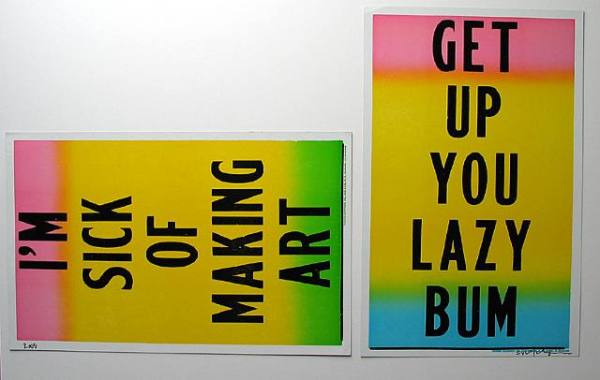
I'm sick of making art; get up you lazy bum

One of my all-time-favorite conceptual artists is coming to the Bay Area this weekend.

Cary Leibowitz (AKA CandyAss) in conversation with Glen Helfand

Cary Leibowitz mixes Jewish identity, kitsch, modernist critique, Queer politics, and design culture into dryly witty multiples and paintings. The artist will be in converation with the San Francisco Art Institute’s Glen Helfand celebrating the release of a new limited edition artwork developed especially for the Museum Store.

Leibowitz’ work was included in the landmark exhibitions Too Jewish? Challenging Traditional Identities at the Jewish Museum New York; In a Different Light at the University Art Museum, University of California, Berkeley and Bad Girls, New Museum for Contemporary Art, New York. His work has also been seen in exhibitions at the Institute of Contemporary Art, Boston; Contemporary Musuem, Honolulu; Arcadia College, Pittsburgh; Walker Art Center, Minneapolis; Kunstverein für die Rhineland und Westfalen, Düsseldorf; Cleveland Center for Contemporary Art; ICA Philadelphia; Bonner Kunstverein, Bonn; Frankfurter Kunstverein, Frankfurt; Kunstlerhaus Bethanien, Berlin; Phoenix Art Museum; National Gallery of Australia, Melbourne; the Aldrich Museum of Contemporary Art, Ridgefield, CT; List Visual Art Center, MIT, Cambridge; the Guggenheim Museum, New York; and the Whitney Museum, New York. He holds a B.F.A. from the University of Kansas, and lives and works in New York City.

Free with museum admission
www.thecjm.org

Standard
Research

Yes No Language

In “No,” Ben Zimmer’s latest contribution to his On Language column (NYTimes.com, March 15, 2010), yes and no are examined through the lens of Congressional discourse and pop culture. Zimmer lists some associations:

yes no, agreement opposition, positivity negativity, acceptance denial, getting to yes, party of no

From my personal collection, here are a few greatest hits of yes and no memorabilia:

A (lost) sticker bearing the phrase, “The Land of Yes.” It was produced by Trillium Press, which is now SF Electric Works. The motto conveyed a commitment to helping artists realize their projects.

Ugo Rodinone’s “Hell Yes!” architectural signage for the New Museum. Rounded text + rainbow stripes + in an arc = unabashed enthusiasm.

My first word was “no”—a troubling fact for an aspiring optimist—but it turns out, I’m not alone. Zimmer informs:

…the power of no is even more primal, perhaps because it is so often among the first words that English speakers learn as children.

Zimmer also discusses yes and no in terms of the “up/down” vote, an orientational metaphor with its own set of associations, as examined by linguists George Lakoff and Mark Johnson in Metaphors We Live By (U. of Chicago Press, 1980):

happy sad and other dyads

Some of these orientational metaphors cohere. For example, a person with high status might expect being in positions of control more often. Good, virtue and life/health are obviously linked. But it would be a mistake to assume that all of the concepts associated with up or down are necessarily coherent. Lakoff and Johnson describe a discrepancy between two metaphors associated with up and down, unknown (up) and known (down) does not cohere with finished (up, as in “the crate’s buttoned up” or “the shoot’s wrapped up”) and unfinished (down).

To this I might add:

transcendent mundane, concept material, ephemeral quotidian

Visual Thesaurus

I love this thesaurus for the visually inclined. The concept map is a brilliant way to group similar meanings and identify specific words.

Standard
Community, Research

Sign/Design

DON’T MISS:

Museo-rama: Joint Member Day, SF, CA

Tomorrow, Saturday, March 20 is Joint Member Day. If you’re a member the Asian Art Museum, Cartoon Art Museum, Contemporary Jewish Musuem, Museum of the African Diaspora, Museum of Craft and Folk Art, SF Camerawork, San Francisco Museum of Modern Art, or Yerba Buena Center for the Arts, you and a friend can visit participating museums for FREE admission, special events and exclusive discounts.

I’m curious about Dispatches from the Archives and The View From Here photography exhibition at SFMOMA. I’m all for exhibitions that help Americans understand China’s pluralism, and the Shanghai exhibition at the Asian Art Museum introduces the cosmopolitan city through its Western-influenced hybridized modern art and design (with a few pieces of contemporary art). Still, I thought the didactic texts shied from the mention of colonialism; this westernization seems possible because cities were forced open to British trade by the Treaty of Nanking after China lost the First Opium War. Also, pop culture afficionados: don’t expect to see lots of vintage-kitsch Shanghai lady adverts; those make up only a small fraction of the exhibition.

It’s A Sign: New Bohemia Signs at Adobe Books’ Backroom Gallery, SF, CA

Design nerds ho! The immaculate hand-painted stylizations of New Bohemia Signs, San Francisco’s own anachronistic, fedora-donning, sign painting shop, are on view at Adobe Books’ Backroom Gallery through April 3. It’s like Steven Heller’s New Vintage Type came to life in shiny, seductive enamel paint. You can purchase individual functional signs for your indie mart or design tchotchke shelves, or larger aggregations for the aesthetics, and to make an undeniable statement about your good taste.

The signs are really cute. They are examples of great graphic design, but ultimately, just signs. I had hoped to make some smart-sounding statement about semiotics or wayfinding (especially in relation to “The Secret Language of Signs,” Slate’s recent series on signs), but really, style and legibility seem to be the main point of the work. If there is something more interesting to tease out, it’s probably in regards to context: A shop selling books (so antiquated!) exhibiting hand-painted signs produced by another independently-owned, brick-and-mortar small business, and the printed/painted letters they love.

Rockin’ Paper, Swingin’ Scissors at Rowan Morrison Gallery, Oakland, CA

Sort of in the same vein of totally adorable/collectible is Ryohei Tanaka’s show of papercuts at Rowan Morrison Gallery through April 3. Ryohei’s based in Tokyo now; I went to CCA with him in the late 1990s. Back then, he was a total drawing maniac, whose work was characterized by density and a cuteness that was simultaneously attractive and appalling. Now, his explosive prolificness has resulted in figures, monsters and robots in cheery colors and a traditional Asian folk art/paper craft. Small cuts start under $100; if that sinks your battleship you can walk away, as I did, with a navy screenprint of assorted figures on a white cotton rectangle (I think it’s a Japanese work scarf or tea towel) for $8.

WINSOME:

The website for Scott Oliver’s Lake Merritt project is up!

COMING SOON, to New York:

Gormley fatigue.

FASCINATING:

“Everybody Have Fun,” Elizabeth Kolbert’s round-up of recent books on the problematic intersection of happiness research and policy in the current New Yorker Magazine (March 22, 2010).

Standard