News

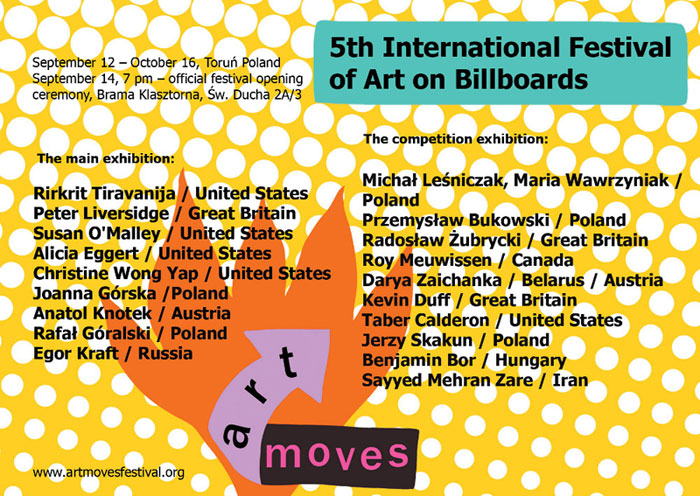
9/14-10-16: Art Moves Festival of Billboard Art

Very excited to be showing Ribbon Texts (including my first in Polish) in this art festival, alongside awesome artists Susan O’Malley (fellow CCA alum), Alicia Eggert (whose work I stumbled across a while back), and Peter Liversidge (whose conceptual works at the Armory Fair are usually my favorites). Looking forward to my first visit to Poland and meeting the other artists!

Image

September 12–October 16, 2012
Art Moves 2012
5th International Festival of Art on Billboards (Festiwal Sztuki na Bilbordach)

Opening: September 14, 7pm, Brama Klasztorna
Rapackiego Square, Chopina Street; Kraszewskiego, Szosa Che?minska/NOT; and various locations, Toruń, Poland
artmovesfestival.org

Standard
Art Competition Odds

art competition odds: Djerassi Resident Artists Program

The Djerassi Resident Artists Program received over 600 applications for 65 residency openings in 2013.

///////////////////////////////////////////////////////////////////////////
///////////////////////////////////////////////////////////////////////////
///////////////////////////////////////////////////////////////////////////
///////////////////////////////////////////////////////////////////////////
///////////////////////////////////////////////////////////////////////////
///////////////////////////////////////////////////////////////////////////
///////////////////////////////////////////////////////////////////////////
///////////////////////////////////////////////////////////////////////////+

or 1:9.2, or 10.8%

See all Art Competition Odds.

Standard
Research

Vexman.net

I’ve been sewing flags. Mini desktop ones. Full-sized ones. Scouring the garment district for woven synthetics, heftier lamés. Strategically planning grommet-hammering sessions to for my neighbors’ sakes. Very excited about opportunities to show them in  New York (Art in Odd Places, October 5–15) and beyond (details forthcoming)….

One sleepless night, I stumbled upon Vexman.net, a vexillology resource by Dave Martucci. Vexillology is the study and science of flags. Martucchi’s site harkens back to the early days of the web, when home pages expressed the depth and variety of one’s enthusiasms via long, encoded HTML pages with small, quick-loading graphics. Pages include:

I enjoyed learning about flag terms, cultural associations, and histories. I’ve been experimenting with colors, shapes, and proportions on my own, because I wanted to make my flags free of referent. They should simply express Irrational Exuberance.

Standard
Research

what i have learned, and what i have learned again

What I have learned:

Things made with Liquid Nails are very difficult to take apart. Windshield cutting wire is not nearly as effective as one might hope. There is no substitute for elbow grease.

Sometimes you need four people to move a wall. When you personalize not being able to lift one half of a wall in a walking clean-and-jerk, it means that you’re too harsh.

What I have learned again:

Mise en place is gratifying. You will feel better after you put things away.

You will always over-pay for fruit from a deli salad bar. Just get a banana.

Walk fast. Jog slow.

Running too can be a natural, autotelic rhythm. Inertia: To feel propelled, you must first impel.

Standard
Values

Resilience training

After a running-related injury earlier this year, I’ve been whining about losing the little speed and endurance I gained last season. Instead, I should be glad to remain injury-free. I should be grateful for so many things—what I have, and what I’ve been spared.

Running abounds with inspiring stories of resilience. You think you have pretty good excuses about why you can’t run today, or why you can’t faster, longer or more, but then you hear about people who overcome hurdles—in running and in life—much bigger than your own, and go on to achieve much more. By their feats, they give perspective and motivation.

The 2012 Olympics Track and Field events has featured some amazing stories. Here are the ones I’m most moved by:

The US took second place in a qualifying heat for a 4 x 400 relay race—after Manteo Mitchell ran half of his race on a fractured leg. Mitchell knew his leg was hurt, yet his performance gave no indication the the pain he was in: see a video of the race. (How fast did he run? 400 meters in 46.1 seconds. That’s over 19 MPH!) Interviewed on BBC World Service earlier today, Mitchell was a class act, speaking with high regard for his teammates, and optimistic that his team will do well in the finals even without him.

Of course, there’s Oscar Pistorius, the South African “Blade Runner.” Pistorius’ lower legs were amputated at the age of 13 months; I’d heard about him first via nasty accusations that his prosthetics gave him mechanical advantages. Having won in the ParaOlympics, Pistorius dreamed of running in the Olympics. Here’s a video of him in the 400 meter semifinals. He doesn’t qualify to move on to the finals, but he’s humbled by the chance to fulfill his dream. The race winner exchanges bibs with him in a gesture of fellowship.

Kellie Wells takes bronze in the 100m hurdles. Wells suffered a major injury (torn hamstring), but that’s just the beginning of it—she overcame significant abuse and childhood tragedies. She came public with her story for the sake of other victims of abuse. In a great race, she became an Olympic medalist, and also, despite the individual nature of the competition, and the highly nationalistic context, she shared congratulatory hugs with the other runners. Kellie Wells is huge. I’m a fan.

Everyone runs their own race, in life and in sport. I love this video of the women’s 100 meter, especially the runners’ level view at 2:45. Look at how fast they’re going! Then keep in mind all the obstacles women runners have faced. (Here’s a great slide show of female groundbreakers at the Boston Marathon.) Olympic running events were only opened to women in 1960, and the first women’s marathon wasn’t until 1984. (And of course, 2012 marks the first year of women’s Olympic boxing.) There’s so much more to come…
Standard
Research, Sights

On the Fungibility of Language: Forensic Linguistics, plus Performance Art

As an artist who works with text, I’m always fascinated with the fungibility of language.

Jack Hitt parses the gap between spoken word and constructed meaning in his article about forensic linguistics (“Words on Trial,” New Yorker Magazine, July 23, 2012):

Most people assume that meaning is embedded in the words they speak. But, according to forensic linguists, meaning is far more vaporous, teased into existence through vocalized puffs of air, hand gestures, body tilts, dancing eyebrows, and nuanced nostril flares. The transmission of meaning still involves primate mechanics worked out during the Pliocene era. And context is crucial; when we try to record a conversation, we are capturing only part of the gestalt of that moment….

According to (retired F.B.I. forensic linguist James) Leonard, words serve as catalysts, setting off sparks of potential meaning that the listener organizes into more specific meaning by observing facial expressions, body language, and other redundant cues. We then employ another powerful tool: prior experience and the storehouse of narratives that each of us carries—what linguists call “schema.” To every exchange we bring unconscious scripts; as any given sentence unspools, we readjust the schema to make better sense of what we are hearing….

Meaning, Leonard noted, is constantly bend by expectation, and can be grossly distorted.


Likewise, I was excited to hear about this performance along the same theme…

August 9, 10 & 11 @ 8:30 pm.
Emily Mast: B!RDBRA!N
REDCAT, Los Angeles

Originally conceived of for Pacific Standard Time, B!RDBRA!N is a series of vignettes that form a live collage based on the juxtaposition of an accumulation of highly stylized details that all relate to channels of communication in which language is problematic, challenging and/or inappropriate. I have been working with a stuntman, a stutterer, a sign-language interpreter, an actor, an auctioneer, a comedian and a child to investigate and interrogate language as a prop onto which we project meaning, language that hides or deflects meaning and all-out rebellion against words.

Standard