Art & Development, Community, Travelogue

new manc art highlights

Islington Mill Studios; hallway.

Islington Mill Studios; hallway.

The Dilemma of Archive
New library
Islington Mill

Islington Mill is a really cool artist-initiated studio compound with a gallery, performance venue, experimental school, and now, a new library focusing on art books. I find the whole idea of the place very grassroots, appealing and innovative.

detail of installation by Maurice Carlin

detail of installation by Maurice Carlin


detail of installation by Maurice Carlin

detail of installation by Maurice Carlin

Last night, I attended the opening of The Dilemma of Archive, a show featuring the work of Maurice Carlin and G. Leddington. The exhibition space is a disused studio — about the size of a bedroom, maybe 15×12 feet. But the modest space held a really tight grouping of four works, which were peculiar and quiet and rewarded sustained attention.
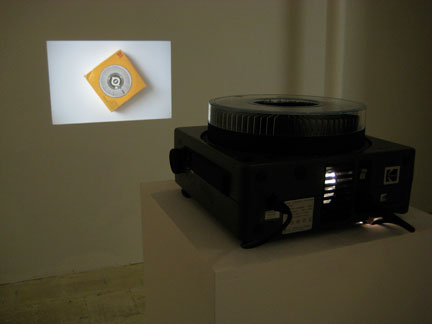
Slide show/installation by G. Leddington at Islington Mill

Slide show/installation by G. Leddington at Islington Mill

I really liked G. Leddington’s slide show of a turning carosel box, which reminded me of the work of Anne Collier and Tacita Dean. But Leddington’s accompanying works — photo prints of obscure articles, book plates and photos relating to Henri Michaux, art collector/smuggler swung the content away from the project of photography and back towards the archive.
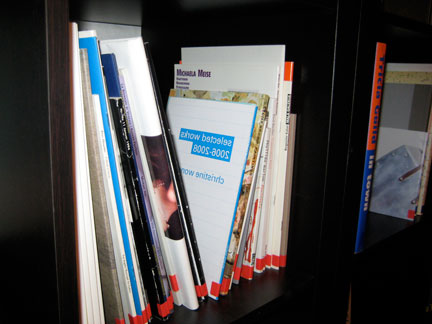
My contribution to the new library.

My contribution to the new library.

The curatorial statement is quite smart, pointing out the paradoxes inherent in any archive — exhibitions, art collections or libraries. I really liked the high conceptual quality and grassroots venue partnered with the new library initiative. I keep telling people that Manchester is a cool city, and if they can look past the binge drinking and American-style malls, they’d see the local points of vibrance like Islington Mills.

Gregor Schneider‘s Kinderzimmer
Subversive Spaces
Whitworth Art Museum

I couldn’t be bothered to see this pitch-black, one-viewer-at-a-time installation — the wait times were always long, but today, by happenstance, I was able to get in after a brief 10-minute wait.

I won’t spoil what’s inside for those who yet to see it, but I will say this:

I found it extremely effective. It was emotional — the darkness was so complete it was terrifying, and upon exiting, my sense of relief gave way to a curious ecstasy. It was provocative and I experienced a sense of convergence between:

  • Dan Graham’s interest in the just-past
  • In Claire Bishop’s Installation Art: A Critical History (Tate 2005) darkness and the dissolution of self…
  • …and how Kinderzimmer manages to include pure phenomenology, mimesis and representation
  • how Schneider exploited the flaws in human hardware
  • how the installation achieved high aspirations in spite of the humble materials
  • grief and existential subjectivity
Standard
Art & Development, Travelogue

breathe begins

9flashes
ready-made fluorescent-ink printed paper, die-cut in flashes

I’ve just started the Breathe Residency at Chinese Art Centre in Manchester, UK, and it’s quite an honor.

I arrived in the UK yesterday morning, and the residency program manager, David Hancock, has generously lent his past two days to get me situated in the studio and introduce me to Manchester’s resources and galleries. I visited Manchester briefly in 2007, but it is like day and night compared to having a local point the way.

Chinese Art Centre’s staff have been very welcoming, forthcoming and professional. The signage is up, the spaces are clean, and a manual with pretty much everything I need to know is in hand. They’ve allowed me lots of space: a 20 x 15′ gallery with high ceilings and an attached utility room/tool closet, a private bathroom and marginally shared kitchen, a sleeping loft, and access to the CAC’s library, which is stocked with books and catalogs. The staff has been really sweet, and very considerate of my privacy. Though I’m technically inhabiting a live/work studio in an art center, it feels more like having an apartment adjacent to the art center. This, along with David’s generous assistance, has truly underscored the privilege of being an artist in residence here.

I’m excited about what’s nearby:
–two art supply shops
–restaurants
–very cool bars (don’t think pubs, think lounges)
–the gigantic Arndale mall, which is replete with anything I could possibly need, from the dollar store (“Poundland”) to fast-food pasties (Gregg) to fresh shark (!) steak at a seafood market.
–just on the other side of the mall is Tesco, the supermarket, which will be a key to living inexpensively in England. The lower end of the price range is bafflingly cheap: £1.18 ($1.66), loaf of flax/soy bread. £0.86 ($1.21), quart of milk. £3 ($4.22), 4-pack of 330ml ciders. I’m curious about why the cost of food is so high in the U.S., even with all of our subsidies.
–a wonderful little shop named Clark Brothers, which stocks old signs and fake decorations. There’s a display of flower garlands that looks like a Wofford/Mail Order Brides dream set. But the other side of the room is lined with shelves full of fluorescent two-tone store signs. The signs are printed, but the text is just idiosyncratic enough to signal hand-lettering. It’s like a wall of ready-made Ruschas or something. I can’t get enough of it.

While I’m looking forward to diminishing my sense of disorientation, I’m also savoring the prickliness of the linguistic textures I’m hearing. It’s peculiar to be speaking the same language as everyone here, but not at all in the same way. When people speak, I have to listen hard, and I have to ask people to repeat themselves much more often than I’d like. Even when I do make out the words, I also find myself hung up on slang — pondering the etymologies of skally and chav, or just mulling over the wondrous glottal stop in grotty. Then there’s the getting used to the nearly ubiquitous “All right?”, a greeting that sounds to me like a question, but is typically answered with another “All right?” And I’m getting accustomed to the slightly emphatic, sing-song “‘Bye!,” which is neutral here, but reminiscent of a sarcastic American Valley Girl’s “‘Bye!”

The next three months are like a blank slate, but I’m confident that there is lots of time to develop and experiment. I got here; now I think the art process will take care of itself. And there are a few constellations that are already forming for the near future:
–a trip to Liverpool. I missed it on my last visit, but it’s close to Manchester and bursting with culture, like the Tate Liverpool and Anton Gormley’s installation at Crosby Beach.
–tomorrow’s lecture by Dinu Li at the Manchester Art Gallery
–a lecture by Antony Hall at Cornerhouse. Hall contributed a provocative installation featuring a soundproof booth for communicating electronically with a live fish in Interspecies, Cornerhouse’s current exhibition.
–artists’ salon-type events, which David mentioned he’d organize soon.
–Manuel Saiz’s “Private Party. Keep Out” exhibition at Castlefield Gallery.
–the opening of “Subversive Spaces: Surrealism And Contemporary Art” at The Whitworth Art Gallery, The University of Manchester. It’s a great space and it looks like it’s going to be a great show. I’m so excited.

Standard
Art & Development, Research, Travelogue

Travelogue Entry No. 2: Manchester, London

My last day of four in London. Too premature to sum up any concrete ideas. Immediate impressions follow:

-Manchester’s great. I was really impressed with the city’s investment in culture. Saw “Outside of the Box,” a knock-out show of media art at Cornerhouse, an contemporary art gallery and film hub, as well as a cool retrospective of work by SF-based Lynn Hershman Leeson at the Whitworth Gallery at the University of Manchester. I was so impressed with the city’s vibrance that I found the constant refrain that Manchester was trying to shake off its industrial reputation to seem outdated, but a Londoner’s slight scoff at Manchester proved me that other minds have yet to be opened.

-London has looked like this in my visit:

–Lewisham Road feels remarkably similar, at least on appearances to parts of Brooklyn: lots of immigrants from all over the world, internet cafes/call centers, low storefronts with lightboxes, fried chicken, mattress retailers. Of course on the other side of Lewisham Road is Goldsmith’s, where I’ve stumbled upon a small community of Filipino and Fil-Am expats. How funny it is to sit in a Morrocan cafe in punk-rock Camden-town and listen to Taglish.

–Quiet opulence everywhere. The city is not especially pretty, but the remarkable architecture always gives me an awareness of a sensibility of being in the seat of an Imperial power, however faded it may be in the shadow of the U.S. superpower. Even as I snap my tourist photos of Parliament and Big Ben, I’m thinking: what were the conditions that made all of this possible? The finest building materials: gold, marble. The huge consumption of tea from China, chocolate from Latin America, sugar from the West Indies? I like the idea that somehow I can subvert something by being here and sitting in Royal parks, walking through the free museums… but of course what’s more important is what I can bring home as a citizen, not just a consumer, of the United States.

I was startled and amazed and angered when, lost in the Victoria & Albert Museum in London’s swank South Kensington, I stumbled upon a view of two great halls. In one hall sat two monumental columns, which soared to the atrium several stories above. They were the two halves of Trajan’s Column, built in Rome in AD 131. On the other side sat a conservatory for antiquities, with a replica of Michalangelo’s David sitting among dozens of partially crated busts, statues and reliquaries. The view of these priceless antiquities was awe-inspiring. And I mean awe in the sense of terrific, and terrible. I am only surmising the conditions that made it possible for the Column to be cut in half and moved to South Kensington from Rome. And there are so many layers of meaning to explore: the collapse of the Roman empire, the past greatness of the British Empire, the vulnerability in the consolidation of wealth and power of that magnitude.

View of amusement park
My DIY Burtynsky. Visited the Mall of America — mega-church of consumerism and diversions — on an unplanned overnight layover in Minneapolis (Tip: Flying to London? Fly direct and avoid Northwest Air).

Victoria and Albert Museum
The wealth of nations at the Victoria and Albert Museum.

–In addition to some art and history museums, I’ve been visiting as many contemporary art spaces as possible, seeing everything from Doris Salcedo’s unsettling exhibition at White Cube on Hoxton Square to Ed Ruscha’s stunning watercolors at Gagosian on Oxford street — about £1m in small photorealist watercolors were watched over by two suited and booted guards who found my photo-taking suspicious — to group shows at Alma Enterprises, which has all the atmosphere of a decaying public high school, in up-and-coming  Bethnel Green. The standout space, however, is inIVA, the Institute for International Visual Arts, spearheaded by an international consortium of artists, thinkers and business leaders of color. It’s brand new, on a smelly alley in Hoxton, with a largish gallery, project space, and library that collects catalogs by artists of color only. I love it. It’s a beautiful building in a great location with top-notch art and huge potential to be a formidible force in London, and hopefully, the world. I find it hope-inspiring.

Rico Reyes (artist, curator, theorist and my generous host in London) and I had the good fortune of participating in Leticia Valverdes’ project, “Is London the Place for Me?” As I’ve been travelling and shooting photos of landscapes of sheeps and stone walls, neo-Gothic cathedrals and plates of bangers and mash, I’d been wondering how much I’m looking for experiences that fit my expectations of England, instead of seeing England as it is. But with Valverdes’ props and a digital studio, we were able to play with the cliches. We placed ourselves — Chinese American and Filipino American artists — into a tea room designed to display wealth and refinement. It’s a simple, ironic gesture, and I enjoyed it very much.

Standard