Meta-Practice

Artist’s Resource: Creating a Living Legacy

Artists, get organized now and so you can thank yourself later.

I stumbled upon Career Documentation for the Visual Artist: An Archive Planning Workbook and Resource Guide (7MB) from the Joan Mitchell Foundation’s Creating a Living Legacy (CALL) program. It’s a thorough introduction and guide for artists for creating physical and digital archives. I highly recommend artists take a look. It’s a worthwhile thing to get organized, maintain an inventory system, and make sure your work is stored safely.

CALL workbook

I have a few systems set up, but could use improvement. I’ve adopted practices as I see how they make sense for where I’m at. But I should be thinking about what I’ll need in the future. For example, CALL recommends signing and writing an inventory number on every work of art. I have an aversion to signing my art, but will try to create ways to at least make sure my work is labeled somehow. They also suggest including your initials in your inventory number, which makes sense for galleries that work with multiple artists, but seems overmuch for my own work. Then again, my signature is inscrutable, so I suppose initials will help others. 


I  recently revisited my one-year goals, and wrote new ones. (I started this practice in June a few years ago,  so my “goal-year” begins and ends in the summer. It’s anachronistic, but increasingly feels right to me. Since moving to NYC, my life has become more affected by the rhythm of art “seasons”—intensive fall and spring activity, followed by slower summers. The relaxed pace in June and July offers a chance to get perspective. I feel more confident entering fall with fresh energy, and having a sense of purpose in the spring. My new year’s resolutions are more like mid-year reviews, where I check my progress or modify goals if necessary.)

It was useful to see these reminders about how to write goals in the CALL workbook:

S.M.A.R.T. GOAL:

S-specific, M-measurable, A-attainable, R-realistic, T-timely.

  • Specific goals depend on who, what, where, when, which, and why.
  • Measurable is accountability and tracking progress.
  • Attainable is a goal that motivates you towards achievement.
  • Realistic is a goal within your current abilities.
  • Timely is a goal with a time frame.

Suggestions:

  • Make all goals concrete.
  • Make the goal something you can clearly state in one sentence.
  • Make a clear end point. The accomplishment of the goal should be definite and visible.
  • Make sure the goal is something you can complete—factor in time and space restrictions.
  • Set a realistic date for completing your goal.

 
It is worth pointing out that this comes from an artist’s foundation—an example of an artist (or her legacy) occupying multiple roles within art ecologies. It’s a great example of what artists (or their executors) can give to other artists. Thanks Joan Mitchell Foundation!
Standard
The Eve Of... Studio/Pop-up Gallery (During: Today)
The Eve Of...

The Eve Of: Residency Day 32 Update

After spending all August working on The Eve Of…, I’m finally feeling confident and relaxed.

The residency started off a little rough—I was antsy to secure a space yet stay productive. So I made a production schedule. It sounds a little crazy and antithetical to the creative process, and sometimes it was. But I think it was worth it. For example, when I moved into the larger space, I finished all my dust-making (woodworking and build-outs) first, painted the things that need to be painted at the same time, and then cleaned up for framing and finishing static-y vinyl projects. 

Though, maybe crazy-making is part of the deal when you’re staging your own exhibition in a pop-up gallery. As stressful as keeping a schedule was, it’d be worse if I didn’t keep one. Case in point: I thought the dust on the concrete floor was drywall leftover from a prior demolition. But it turns out it’s the floor itself, or rather, mastic, which I had been pulverizing with every step. I have to seal the concrete, and find an additional three days of drying time, as I was already planning to paint half the floor where it was tiled in lavender-and-purple checkerboard.

Thankfully I was able to wrap up art-making and get a head start on gallery changeover. You could say I’m transitioning from artist-in-residence to preparator-in-residence. Some artists find being their own technical labor tedious or demeaning, but I can’t think of a happier use of these skills than in the service of my own vision. 

Plus, it’s a nice change of pace. Painting is calming, because it’s finite. With studio projects, I never know when I’m going to be done. But with paint, you can only do so much per day—you couldn’t schedule more. Wrapping up today’s painting and heading home before 6pm was a nice treat.   

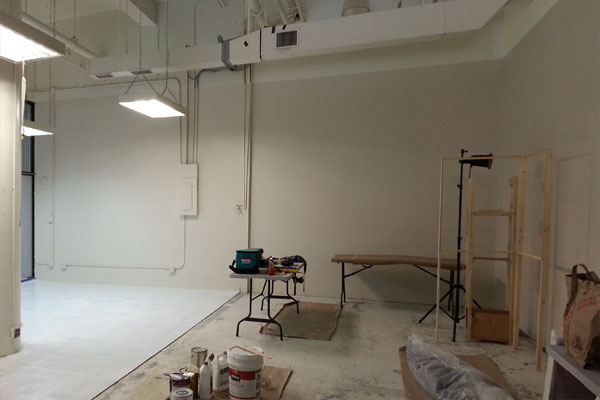
I just finished the walls, and am relieved the color works. (Wet, it looked like ivory in the pan, grey on the walls, lavender in the daylight, putty-ish under fluorescents, and stripe-y and beady all over! But dried, it’s a nice, flat, smooth, soft. I love it.) I also primed the checked tiles. With the Willy Wonka tiles covered, the space feels cleaner, bigger, and more like a gallery already.

The Eve Of.. Studio/Pop-up Gallery (Before)

The Eve Of… Studio/Pop-up Gallery (Before)

The Eve Of.. Studio/Pop-up Gallery (During: Today)

The Eve Of… Studio/Pop-up Gallery (During: Today)


I’ve habituated to turning up at this studio everyday—and, I suppose, being a full-time artist in NYC, something I’d only previously imagined. I better enjoy it while it lasts, which is not much longer….

Standard
Meta-Practice

“the market artists whose potential social worth is quite directly to serve the interests of the international clientele inhabiting the most rarefied of income heights, a highly paid service role to which several generations of artists have been trained to aspire.

But this is not the picture of ourselves that most of us artists, curators, critics wish to recognize…. The artistic imagination continues to dream of historical agency.”

—Martha Rosler, Culture Class, 2013, p 211

What artists want, per Martha Rosler, Culture Class

Quote
Meta-Practice

Keep walking toward the mountain: staying true to your goals

Author Neil Gaiman offered practical, heartening advice in commencement speech at the University of the Arts in Philadelphia last year. The speech, and his delivery of it, is warm and generous—listening to him deliver it is highly recommended.

Short of that, I love his perspectives on persistence, quoted below. If it seems that I’m obsessed with optimism and motivational inspirations, it’s because I am. Day-to-day life is filled with the mundane: hours spent commuting, generating income, sending off applications for things that may or may not come into fruition, and so on. In the muddle of quotidian distractions, the clarity of advice from a fellow traveler is helpful.

I love Gaiman’s suggestion of how to navigate over the long haul—by envisioning a longterm goal as a distant mountain:

And I knew that as long as I kept walking towards the mountain I would be all right. And when I truly was not sure what to do, I could stop, and think about whether it was taking me towards or away from the mountain. I said no to editorial jobs on magazines, proper jobs that would have paid proper money because I knew that, attractive though they were, for me they would have been walking away from the mountain. And if those job offers had come along earlier I might have taken them, because they still would have been closer to the mountain than I was at the time.

Another way of having faith in a slow process with unforeseeable results:

A freelance life, a life in the arts, is sometimes like putting messages in bottles, on a desert island, and hoping that someone will find one of your bottles and open it and read it, and put something in a bottle that will wash its way back to you: appreciation, or a commission, or money, or love. And you have to accept that you may put out a hundred things for every bottle that winds up coming back.

The problems of failure are problems of discouragement, of hopelessness, of hunger. You want everything to happen and you want it now, and things go wrong.

… nothing I did where the only reason for doing it was the money was ever worth it, except as bitter experience…. The things I did because I was excited, and wanted to see them exist in reality have never let me down, and I’ve never regretted the time I spent on any of them.

I’ve also been observing more successful peers with a mix of envy and dread, wondering how I would cope with the constraints they perceive as imposed on them. How is it that one can avoid an upwardly-mobile treadmill, in which opportunities increase while autonomy and creative freedom decrease? Gaiman perceives what some would call a trade-off for the tragedy it is:

…The problems of success. They’re real, and with luck you’ll experience them. The point where you stop saying yes to everything, because now the bottles you threw in the ocean are all coming back, and have to learn to say no.

I watched my peers, and my friends, and the ones who were older than me and watch how miserable some of them were: I’d listen to them telling me that they couldn’t envisage a world where they did what they had always wanted to do any more, because now they had to earn a certain amount every month just to keep where they were. They couldn’t go and do the things that mattered, and that they had really wanted to do; and that seemed as a big a tragedy as any problem of failure.

And after that, the biggest problem of success is that the world conspires to stop you doing the thing that you do, because you are successful. There was a day when I looked up and realised that I had become someone who professionally replied to email, and who wrote as a hobby. I started answering fewer emails, and was relieved to find I was writing much more.

That tragic entrapment of success is not an inevitability. Keep re-assessing; be led not by fears of losing what you’ve gained, but by your commitment to your practice.

Standard
Meta-Practice

Straight talk about why you shouldn’t apply

Things to think about, artists. The Roswell AIR program application page includes this note:

A word of caution:

Artists considering applying to the RAiR Program should think carefully about what is actually involved in a year-long residency.

Do not apply if:


1) You will have a number of exhibitions opening during the period of your residency.  Roswell is a long way from most places. Transportation to and from Roswell can be costly and time consuming.  Organizing exhibitions and shipping work can be difficult and expensive from Roswell.  Extended absences from the studio breaks up the creative process and undermines the rationale for the residency.

2) You find the idea of the residency a flattering notion.  The purpose of the residency is to provide time to immerse yourself in the creative process and not just to add another line to your resume.  Artists should actually need studio time to focus on their work.  Otherwise you might be supplanting an artist just as deserving, who could use the residency year productively.

3) Your spouse or partner is not committed to the residency.  The residency is located on the outskirts of a town of 50,000 people.  There are few  employment opportunities.  A year can be a long time in some career areas.  While the Roswell area has some decent schools, no special or ‘outstanding’ private schooling is available in this part of rural New Mexico. In addition there can be considerable challenges returning to one’s pre-residency life.

4) You have unusual heath issues or heavy debt.  Our goal is to support the artists’ creative process over a period of time.  We can not, however, solve all of the artists’ life problems.

5) You are uncomfortable living alone or often find yourself at odds with your neighbors or colleagues.  The residency is small.  As few as five other artists might share the residency with you at one time.  For some artists, but not all, this is an ideal situation.

6) If you have no means transportation.  While the residency itself is essentially self contained, the facility is three miles from the nearest retailers.  In the past some residents have managed with only a bicycle but keep in mind that this is the American West and conditions vary considerably.  A drivers license and an automobile are generally considered essential to everyday living.  Additionally, numerous destinations of interest can only be accessed by car.

7) You can not live without your dog for a whole year.

For many artists, recognizing the difference between tackling bigger challenges (good) and biting off more than you (and possibly your spouse or dog) can chew (bad) is an ongoing skill, but an important one for the sake of the community of AIRs and residency programs. Residencies should be a balance of productive activity and restoration; artists should be able to contend with the site, schedule, isolation, and community structure, and tap into the self-discipline it takes to stay productive.

I’ve seen cases where an artist accepted overlapping opportunities, and people were rightly scandalized that a beautiful studio sat empty and mostly unused while the artist took the stipend and hightailed it to the opposite coast. An ethical action is declining.

As much as artists want to take advantage of opportunities as they come our way, we should also sympathize with our fellows who are runners-up. To restate in RAiR’s statement:

you might be supplanting an artist just as deserving, who could use the residency year productively.

Standard
Meta-Practice

Goals: Looking back, looking forward

Be strategically optimistic. Imagine and implement advantageous conditions.

In 2012, I inserted these goals and attitude reminders into my rotating desktop photos:

  • Be active and injury-free.
  • Forgive.
  • Do six studio visits.
  • Enter [art] competitions.
  • Have a strong show of killer new work.
  • Make work that answers, “What would I do with a solo show?”
  • Be open [to new experiences].
  • Practice kindness.
  • Embrace adventure.
  • Practice gratitude, not garbage.
  • Be strategically optimistic. Imagine and implement advantageous conditions.

Most of these were attended to with solid efforts, to varying degrees of success. Many will require more time, intention and attention. I take it as a sign that these are good reminders for me, as they are not too easily achieved nor unrealistically ambitious.

All still seem like good ideas to carry forward into 2013. They’re what positive psychologists call “self-concordant”—rather than reflecting societal demands, they are aligned with my professional and personal goals.

If you’re thinking about making New Year’s resolutions, Creative Capital’s goal-setting tips might be useful. I have been using their goal-setting strategies for the past few years and highly recommend that artists espouse and maintain the practice. It is like plotting a course on an open sea.

Standard
Research

Happiness Is… Research Note #2

For my fellow artists:

For [lifelong flow] it is necessary to invest energy in goals that are so persuasive that they justify effort even when our resources are exhausted and when fate is merciless in refusing us a chance at having a comfortable life.

Mihaly Csikszentmihalyi, Flow: The Psychology of Optimal Experience (1990)
Standard
Values

Thank you for showing me what not to do

Ken, my printmaking professor, was great because he’d often demonstrate what not to do. Much of the time, he didn’t do it on purpose. In showing how to clean up an inkwell, for example, he might fumble a putty knife or splash the mineral spirits. But the gaffs were common, and it taught you how to recover when you invariably made the same mistakes. More importantly, Ken’s teaching was infused with kindness and good humor, and his unconventional ways were ultimately effective and valuable.

I am a big proponent of artists setting goals and identifying role models: Who do you look up to and why? Are they successful? Happy? Do they treat people around them well? Do they look like they’re having fun? Identifying and answering these questions for yourself helps to shape a vision for the kind of life in the arts that you want to lead.

On occasion, there are opportunities to identify negative traits and behaviors that you would not like to emulate. Perhaps these come courtesy of an unscrupulous colleague, who abuses the art field’s unsanctioned nature to claim a status that wasn’t actually gained. Or maybe a supervisor whose treatment of colleagues is unethical or morale-killing.

I choose to view the art world as a series of communities populated by bright, hard-working individuals who are in it because they appreciate art and want to share their enthusiasm. There are, unfortunately, unsavory individuals who would prove me wrong.

In the book “Why Smart Executives Fail,” Sydney Finkelstein, of Dartmouth, observes that “spectacularly unsuccessful” people (mere failure doesn’t qualify; you have to wreak havoc and ruin lives) have certain traits in common. These people see themselves and their companies as “dominating their environments.” They demand total allegiance and have the answer to every problem. (James Surowiecki, “Local Zeroes,” New Yorker, March 28, 2005)

These people are exceptional. It’s up to the rest of us to minimize the damage they do, and to defend the perception of artists, arts workers and the art field. We do that by upholding our values, and being vigilant, accountable, and optimistic.

Standard