Meta-Practice

Adventures in archiving

As a book-end to photos of my workbench and pegboard glory when I first moved into my West Oakland studio, I’ll share some pictures of the crates that will characterize my move out…

Crates!

As I’ve been decommissioning art materials and deciding which artwork to store or bring to New York, I’ve also been building and modifying crates as needed.

My painting rack (made of old paintings on plywood that I couldn’t bear to part with) will make a great crate. I can fit boxes in there too, now that I’ve added a shelf. It’s now a split-level bobber:
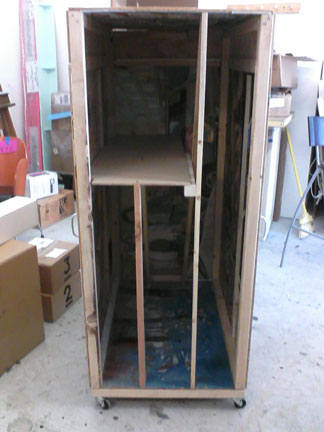
This guy will be great in storage. It’s not air- or water-tight by any means, but I’ve got poly and tape. Otherwise, it’s got a small footprint, casters and storage space on top.

For the move, I’ll put all my tools, materials and artworks into one large crate. That will be my studio in a box! Only the essentials are coming with me: very recent and pertinent art works, major tools like the miter saw and sewing machine, my first and only screen (just the hinges, no baseboard), my Alumi-cut and Alvin mats, my 24″ level-ruler combo. Gloves, goggies and a mask. Only two framed artworks, with the glass swapped out with acrylic.

I’m re-purposing the design for an old crate for my new studio-in-a-box crate. Huge time-savers were finding the original schematic and shopping list in an old notebook, and cutting diagrams of the sheet goods on an archived CD. (Between my compact car and temperamental hand-me-down circular saw, I often have the lumber yard cut the full sheets. Presenting a schematic with dimensions, as well as with the work pieces and remnants labeled, seems to help garner accurate cuts.)

Inventory software!

In the past, I kept records of artwork in two places: my website (copy and pasting to develop image lists) and my head (remembering what is where for the most part). Now that my inventory is undergoing a bi-coastal mitosis, I realized having some kind of tracking software will help.

This ArtBizBlog post was insightful:

The software below was designed specifically for artists’ special needs. Unfortunately, I can’t recommend one of these over the others….

The blogger also noted

Amazingly, most of these are unattractive.

[That’s an ongoing gripe of mine; acute reactions to user experiences are the burden of being married to an interactive designer.]

Since the price was right ($30) and the interface straightforward and functional, I thought I’d try Flick, a Filemaker adaptation created by a software developer in Australia. Having some familiarity with Filemaker helped me jump right in—even though I last used it in the early 2000s.

So far, I think it’ll work for me. It’s pretty basic. Not very powerful, and can be a bit slow when you’re scrolling through multiple records. It’s also short on shortcut keys, but for the price it works fine.

I wish I knew more about accession numbers, especially one that suits my idiosyncratic output. I can already see that my naming convention—[year]--[series]-[number]—could use improvement. It probably should have been [year]-[series]--[number]. This is where being able to do some batch processing would be nice. Luckily, I’ll have some in-house systems management know-how in New York.

Standard
Sights

Drucker @ SFAI: Enjoy in my stead

Readers of this blog will know that I’m quite a fan of Johanna Drucker, which puts me in the new position of sharing an event in San Francisco which I will not be able to attend, as I’ll be on the East Coast then.

The artist, theorist and author presents “Reversing Polarity: Aesthetics and Criticism after Adorno,” her keynote lecture at SFAI’s Art Criticism conference on Saturday, August 14th.

I recommend going with friends, as you will want to have a debate afterwards.

Standard
Art & Development

voice, perspective, position

This week I had a lively conversation with an actor, designer and musician who are all actively developing their respective disciplines. There seemed to be an unspoken balance that everyone sought between becoming established and experienced and acquiring new skills and ideas.

One person brought up the idea of finding a voice. What does it mean to have a voice in art? In one of my very first art classes in my BFA studies, the instructor had each student say what he or she wanted to learn. I said I wanted to learn how to be honest in my work. Thankfully, the nagging feelings I had as a student—that I was merely emulating styles and techniques—do not plague me much anymore. Not that there aren’t frightening similarities between my works and other artists’, of course, just that it’s rarer now, and I’ve learned how to not be hamstrung by them.

The idea of having a voice made me think about having a perspective, of which a stronger extension, perhaps, would be taking a position with your work. And this brought up the different approaches within our crafts. I asked the actor if an actor is supposed to have a voice, perspective or position? Should an actor just disappear into the role? She explained the creative challenge and collaboration of acting—that a good actor can take crappy lines and turn them into a compelling character. This is much different from my approach as a designer, where I feel like without strong content, graphic design is just surface treatment. Because it’s a communications art, the form ought be in service of the content.

For actors and musicians, whose roles are largely interpretive, how much authorship is possible? We had an interesting dialog about whether the concept of voice is always tied to authenticity or authorship. Can one have a purely formal voice? When is form content? When isn’t it?

The musician shared a current debate in music theory about whether sounds are inherently meaningful or significance is culturally assigned to sounds. He then argued for the autonomy of the work; that a piece of music retains an essential identity outside of our social and cultural associations. To take a position in relation to a piece of music would be to deny the autonomy of the work, or to capitulate to the idea of complicity or relativism.

Standard
Art & Development

R+D NYC

This blog is not meant to be a personal diary, but a major change is coming, and I must explain the circumstances.

I started this blog three years ago, in April 2007, with Four Reasons Why I am Writing a Blog:

I think of this as an exercise in Research + Development as an Artist, Citizen, and Art Community member.

1. To promote professionalism, rigor and generosity–values I hope to reciprocate within the San Francisco Bay Area art community and larger world.

2. To demystify the life of an artist. To share my enthusiasm for contemporary art.

3. To consider ethics and politics–the artist as citizen.

4. To think about what it means to be an artist, and the process of becoming the kind of artist I would respect and admire.

I’ll be sharing experiences, event listings, reviews, quotes, links and reflections. Though this writing will be grounded in my experiences, rather than writing about me, I look forward to thinking about larger issues through a localized investigation.

Since then, when I was on the cusp of finishing my graduate studies, I’ve had many wonderful art experiences. I feel like I’ve got a really strong, solid community here. There is certainly more I could do in the Bay Area, but I feel like I’ve made a respectable effort to look at art, visit new spaces, partner with diverse institutions, push my practice, contribute, and continue developing as a participant in the art community.

For the most part, my optimism was not unfounded. When my high expectations have been dashed, it ultimately strengthened my commitment to professionalism, ethics, and integrity, as well as my gratitude for friends and colleagues with shared principles. Being an artist is challenging, but without the support and generosity of like-minded friends and colleagues, it would be impossible.

Now, I’m on the cusp of a new transition: I’m moving to New York for family reasons. There are, as you can imagine, a rash of mixed emotions—of the Bay Area, sadness and gratitude; of NYC, excitement and anxiety.

The list of things to do, replace, explore, find, or restart in NY is overwhelming, but as it concerns this blog, I can say this:

I’ll continue to post musings, links to points of (art) references, information and resources. I foresee two opportunities for correcting the course of this blog, however.

First, publicizing worthwhile projects in the Bay Area seems like a community service, because there’s far more deserving projects than critical arts coverage here. NY, with its countless shows, spaces and publications, might take a different tack.

Second, I’m only one in a long march of artists who relocate to NY. This presents a conundrum for me—my coming-to-New-York, artist-in-the-big-city story is cliche, yet that doesn’t change the fact that my experience in the near future is going to be one of discovery. I’ll continue to strive to be accessible, relevant, and honest about my observations.

That said, I’m looking forward to connecting with like-minded artists, curators, writers and thinkers with strong commitments to rigor, excellence, community and ethics.

I’m excited to nurture my ties to the Bay Area: friendships, writing projects, art projects and other collaborations. I’m open to suggestions. Send me a note!

Standard
Art & Development, Community

Artist-curated shows and alumni notes

Summer is supposed to be the low season for art, but this is San Francisco and we don’t summer in the Hamptons; the fog rolls in just the same. A few galleries have mixed up their programming with artist-curated shows.

“They Knew What They Wanted”
Katy Grannan, Shannon Ebner, Jordan Kantor and Robert Bechtle curates selections from Altman-Siegal, Fraenkel, Berggruen and Ratio 3. Go see this show for insights into four interesting artist-curators, pictures and objects you wouldn’t normally get to see, and some really great works, including a communal ballpoint pen drawing initiated by Arte Povera artist Alighero e Boetti at Ratio 3.

A similar work by Alighero e Boetti, Mettere al mondo il mondo 1972 -73 penna biro blu su carta intelata 2 elementi, cm 159 X 164 cad. Source: Archivo Alighero Boetti.

If you aren’t familiar with Boetti’s work, have a look at the virtual tour at Archivo Alighero Boetti.

Over at Patricia Sweetow Gallery, abstract painter Kim Anno curates a group show called “Everyday Mystics.” I wish I could have made out the images in Ricardo Rivera‘s projections on and alongside reflective objects like helmets and metal cups. The idea was neat. I overheard the owner mentioning something about the work being about communicating with outer space, so I figured it’s just as well I couldn’t tell what was going on, since I’m not the intended audience. The MP3 player embedded in the center of a spinning turntable is crafty and chuckle-worthy.

Ali Naschke-Messing‘s thread installations shined with glitter and glowed with fluorescence. Two large floor-to-ceiling works that exploited incidental marks and holes in the existing architecture. A series of wall-based works, which incorporated some sort of putty or plaster, were striking in their simplicity and efficacy. The works are formal investigations of site and form and volume; they’re also catalysts for subtle perceptual experiences. From a distance (and in photographs), the works are almost imperceptible; I almost didn’t see one until it was right in front of me. In person—and particularly with PSG’s abundant afternoon light—the density of thread creates vibrancy. They are more materially substantial than Fred Sandback‘s string intallations, but not by much.

Suné Woods contributes some moving black and white photographs whose imagery is memorably unstable.

Woods is a recent MFAs from CCA (class of 2010). Naschke-Messing was my classmate (class of 2007); I’m proud to have studied alongside so many bright, hardworking, curious, supportive and respectful artists. They change directions, start new projects, stay connected, and keep showing. This summer, shows around town by my classmates include:

Lindsey White: Equivalent Exposures install at Baer Ridgway Exhibitions, Source: http://www.baerridgway.com/

Through July 17
Lindsey White: “Equivalent Exposures”
Quietly humorous and deceptively simple photographs, videos and sculpture
Baer Ridgeway, SOMA, SF

Through July 25
Robin Johnston : “meditations on space and time” (two-person show with Chelsea Pegram, Mills MFA candidate)
Data-driven weavings and drawings
Swarm Gallery, Oakland

Just closed July 10
Amanda Curreri: “Occupy The Empty”
Installation, text, video, participation
Ping Pong Gallery, Dogpatch, SF

Opens July 16
Erik Scollon: “The Urge”
Queer porcelain fetish-based installation
Ping Pong Gallery, Dogpatch, SF

And internationally, new media artist David Gurman is a 2010 TEDGlobal Fellow, participating in the technology and ideas conference in Oxford, UK.

Standard
Art & Development

17 things you need to know when you are a 17-year-old student who wants to become an artist, with a reminder for ways teachers can help! – Open Studio

The Getty Museum and Mark Bradford have invited contemporary artists to develop lesson plans for K-12 students. The results, Open Studio, are on the Getty’s Blog.

Even if you’re not a teacher, Daniel Joseph Martinez lays out 17 things you need to know when you are a 17-year-old student who wants to become an artist, with a reminder for ways teachers can help! – Open Studio.

Standard