Art & Development

what freelancers eat

The Ethicist chimes in on artists’ pay (New York Times, November 19, 2010).

Fair warning to non-profits and other workplaces where the culture of scarcity is king: just as two wrongs do not make a right, very right or well-intentioned causes do not make lower standards of conduct acceptable. Rent, unfortunately, is not due only when foundations send checks. And the grocer doesn’t take good karma in exchange for deli meat.

I hire freelance artists for a national magazine facing tough financial times. Must I tell them that they might be paid late or perhaps not at all? If I do, they might decline the job, and we cannot produce the magazine. If I don’t, I burn a lot of bridges. My superiors assured me that they will start paying contributors, but they said that for months with no results.

NAME WITHHELD, NEW YORK

You may not tell a lie to your freelancers, even a lie of omission, even for the good of the magazine. (Nor may you hijack their cars and use them to deliver the new issue.) You must treat your would-be contributors honestly, as I infer you know, hence your discomfort and your question. That means giving them the best assessment you can of when they will be paid, although this might induce some to turn down assignments.

And you should tell your superiors as much. Their determination to keep the magazine alive in lean times may mean giving up limousines, massages and deluxe lunches; it does not mean giving up ordinary business ethics. They may tighten their belts, but not around someone else’s throat.

Standard
Art & Development

I’m a Kafka Card carrier

Yupppp! I just got my Kafka Card in the mail today! It’s a new multiple by William Pope.L to benefit Skowhegen. More info below; Skowhegan’s press release, though, is maybe a tad euphemistic–Pope.L’s text on the back is not an uplifting message to artists; it’s Pope.L doing what Pope.L does best: poke your comfort zones.

Skowhegan is proud to announce the release of

KAFKA CARD by WILLIAM POPE.L

William Pope.L (Alum ’96; Resident Artist ’04) has generously worked with members of the Skowhegan Alliance to create an edition, Kafka Card, that is specially priced within the budget of young and emerging artists (and available to everyone). All proceeds from Kafka Card will support Skowhegan’s program and the initiatives of the Skowhegan Alliance.

Pope.L’s card plays off the idea of the legendary American Express “black card.” (Though the black card began as an urban legend, American Express later capitalized on its aura to create its own credit card with almost unimaginable benefits, available only to the most elite and powerful.) In contrast, Pope.L has created Kafka Card. This “credit” card has the image of a tsunami on the front, and on the back is a manifesto for artists to attack life, take risks, and otherwise brave the storm. The text includes humorous extensions of personal data in a world mired in a credit crisis. In addition to a signature, cardholders are asked to provide a dab of blood, pet’s sex, and a DNA sample, as well as the bank account number of a “rich dead relative.”

Kafka Card is packaged within a Hallmark-style gift card featuring the “President” (Pope.L wearing an Obama mask) holding his own oversized Kafka Card.

Edition size: 500

GENERAL PUBLIC PRICE: $30 per card (+ $3.50 shipping/handling per order)
SKOWHEGAN ALUM PRICE: $25 per card (+ $3.50 shipping/handling per order)

Price for both alumni and the general public will be raised after the first 250 cards are sold.

Limit 5 cards per person.

TO PURCHASE

CLICK HERE and select “OTHER AMOUNT” in the dropdown donation field on Skowhegan’s support page.

Enter the appropriate total for the number of cards you wish to order on the PayPal page:

GENERAL PUBLIC PRICING
1 card: $33.50
2 cards: $63.50
3 cards: $93.50
4 cards: $123.50
5 cards: $153.50
(prices above include shipping and handling)

ALUMNI PRICING
1 card: $28.50
2 cards: $53.50
3 cards: $78.50
4 cards: $103.50
5 cards: $128.50
(prices above include shipping and handling)

All cards in an order will be shipped to a single address. Please let us know if your shipping address is different from your billing address.

WILLIAM POPE.L
is a prominent multidisciplinary artist known for his conceptual, often performance-based art practice, which actively confronts issues of race, sex, power, consumerism, and social class. As the self-proclaimed “friendliest black artist in America,” Pope.L invites dialogue through provocative performances, installations, and art objects. He is best known for a series of more than 40 “crawls” staged since 1978 as part of his larger eRacism project, in which he inched his way through busy city streets on his belly, back, hands, and knees in an attempt to draw attention to the plight of those members of society who are least empowered.

Standard
Community

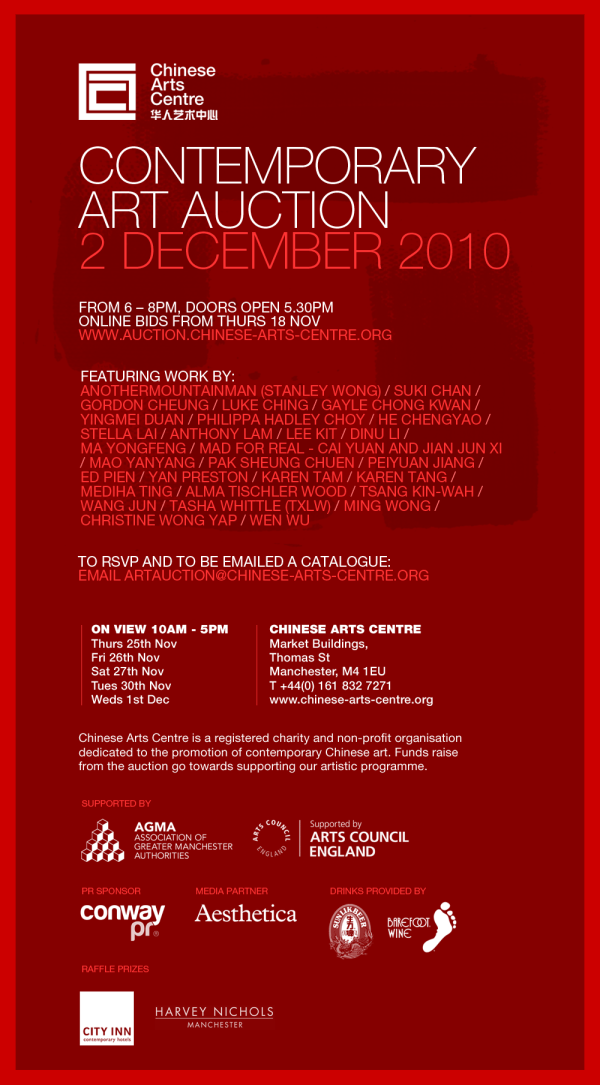
chinese art centre’s contemporary art auction

Banner No. 3, 2010, color laser on acetate, gift bag, mat board, frame, 12 x 9 inches / 30 x 23 cm. Installation view at Sight School, Oakland, CA.

I am proud to donate one of my most recent works to support the organization that hosted me for my three-month, life-changing residency in Manchester, UK last year. Online bids will be accepted. Have a look!

Standard
Art & Development

Justin Limoges’ Chocolate Fountain

I’m delighted to share with you the news of a good friend’s solo exhibition in San Francisco. I absolutely adore this image. He makes killer drawings too. I’m not on the right coast, but you are, you should go!

CHOCOLATE FOUNTAIN

JUSTIN LIMOGES: CHOCOLATE FOUNTAIN
Solo Exhibition + Opening Night Reception
December 2 | 6 – 9 PM
Art Brunch December 4 | 11 AM – 1 PM
Show on view through January 8

Unspeakable Projects is pleased to announce the representation of Justin Limoges and the opening of Chocolate Fountain, a solo exhibition of sculptures and drawings exploring the cult of contemporary luxury in all its outsize, queasy and often hilarious excess. With high-fives to both Duchamp and Kanye, Chocolate Fountain is a look at what it’s like to stay hungry when the buffet never ends.

Unspeakable Projects
735 Tehama Street
San Francisco 94103

http://www.unspeakableprojects.com

open.php?u=fe9e92f59a9de3d20ede73529&id=7292e3835c&e=2e7c3bd67b

Standard
Research

enthusiasms: art books and sporting sentiments

I’m feeling very grateful to be in New York right now. Today was 48º and brisk; my hands were numb but the sun was shining, and among the spirited events I attended today were the NYC marathon and the NY Art Book Fair at PS1. This morning, I took a commemorative run (my own personal best, yet far less than 26 miles) and headed out to Long Island City to see how the pros do it.

The ING New York City Marathon
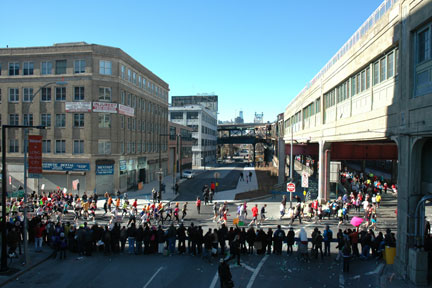
NYC Marathon, November 7, 2010

NYC Marathon, November 7, 2010, from Queensboro Station
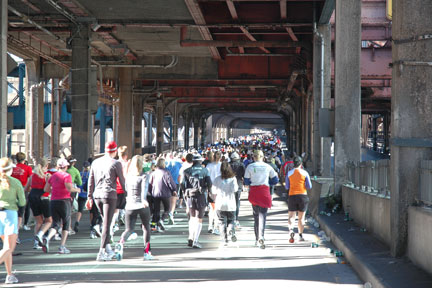

NYC Marathon, November 7, 2010

NYC Marathon, November 7, 2010. Runners heading up Queensboro Bridge.

Stepping out of the Queensboro Station, I heard cheering and turned to see a huge mass of humanity running up the incline of the lower deck of the Queensboro Bridge. The marathon. I felt like I could see thousands of runners, and something about the cheering, for strangers, fellow New Yorkers, and marathon guests—”Good work, runners!” “Go Alli!”—got me all teary eyed. There were no losing teams, no dirty tricks. Just running through all five boroughs of NYC. It was exhilarating to see runners of all ages pounding the pavement. They were on mile 15 or so, and their faces transparently conveyed their exhaustion, determination, pain, and heart. I found it wonderfully compelling. You really wanted each and every one of them to make it, to push through, and finish.

Printed Matter’s NY Art Book Fair at PS1 in Long Island City, Queens

Heading towards the Chase tower—the lighthouse of Queens—I made my way to PS1, where the marathon crowds’ ear muffs and signs gave way to creative make-up and pegged pants. Printed Matter’s NY Art Book Fair was housed in all of PS1’s galleries; there were too many vendors to count, and plenty of visitors. It was a madhouse, and it looked like many vendors were doing brisk business.

I failed to browse wares of all of the vendors; there were just too many. From what I did see, here are some of my favorites sights.

I also started to lose track of what vendors’ booths I was at. Too overstimulated to browse many books, I just let things catch my eye.
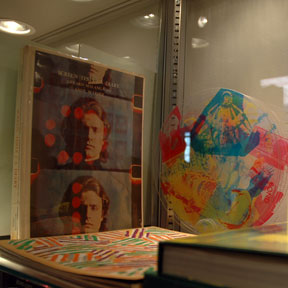
artist unknown

Artist & vendor unknown.

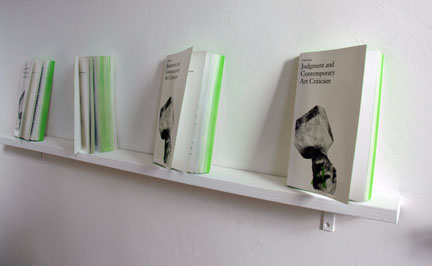
Some designer had a stroke of genius with these green edges.

Paper Placemats

Here’s a neat idea for a printed book-like thing with art that’s not an art book, from J&L Books.

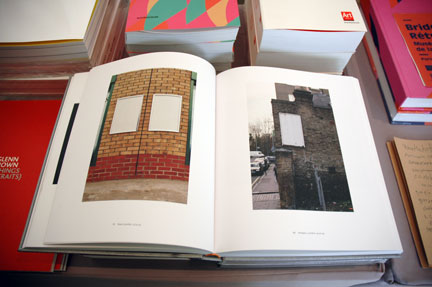
David Batchelor, Found Monochromes

A neat book of “found monochromes” around London by David Batchelor at the RAM Publications booth.

E-flux

The display and vast scholarship at E-flux, like their email list and magazine, were great all around. I missed editor Boris Groy’s talk, so I picked up “Going Public,” a book of his essays on the same subject.

Werkplaats Typografie (Arnhem) will set up an alternative economic system in which services will be exchanged instead of bought.

Werkplaats Typografie offered funny multiples in exchange for must-read art and design books. In the distance are the books that visitors contributed. In the foreground, on this side of the monstrous Ping Pong table, are the goods to trade for, sort of like the goodie counter at an arcade. The red-shirted negotiators were busy wheeling and dealing.

werkplaatstypografie box of bread

Werkplaats Typografie left a lot of room for interpretation, encouraging interaction. This pyramid of boxes of bread is positively curious.

Joseph Grigely, Information Economy photo

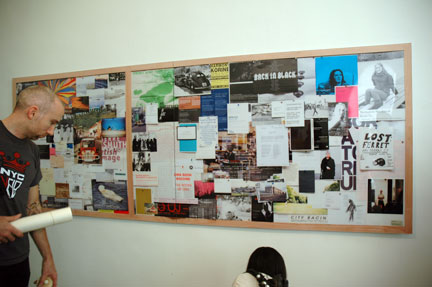
Here’s an interesting project: artist Joseph Grigely is interested in ‘exhibition prosthetics,’ the collateral involved in making and marketing exhibitions. Here, he presented a photograph of a bulletin board. (Teaser: It’s not unlike a sight you might see in Shadowshop, Stephanie Syjuco’s emporium of artists’ wares at SFMOMA, to which I’ve contributed multiples.)
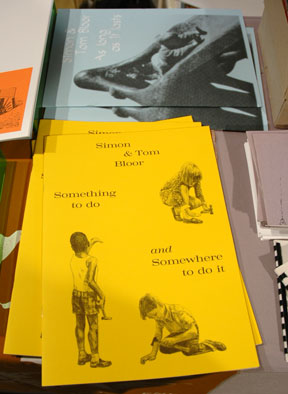
Simon and Tom Bloor

I was so excited to see Eastside Projects at PS1. I loved Simon and Tom Bloorsexhibition at the gallery in Birmhingham, UK. There were great drawings and sculptures about the intersection of modernism and children’s play structures.

What is sculpture, book by Simon and Tom Bloor

I couldn’t resist Simon and Tom Bloor’s activity book for children, which posed complex art questions as fun, accomplishable drawing assignments.

There were some spectacular names of projects too:

Lines and Shapes

Lines and Shapes wins the award for best name of a publication. The magazine also scores high in the feminine and beautiful metric. It’s the kind of art book you could get for your mom.

The Most Beautiful Swiss Books

Running in a very close second in the name contest is The Most Beautiful Swiss Books. If you think it sounds self-aggrandizing, look at the wares!

Motto goods

Naming your distribution company “Motto” makes for killer tote bags.

I also appreciated novel display strategies. (Again, maybe it’s because the next show my work is in is Shadowshop.)

DAP browser window display

DAP‘s cheeky meatspace browser window. The text is all painted by hand.

Cream and black display

Check out the cream and black palette, extending to the shopgirl, and the circle of books on the wall echoed by the hair clip.
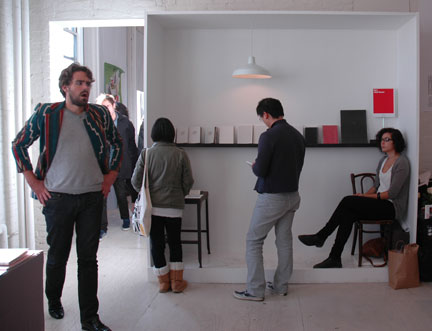
Display frame box

This vendor’s room-in-a-picture/box idea reminded me of a work of art I saw at the Walker Art Center (I can’t look up the name because I managed to lose that notebook somewhere in the gallery). Still, must the shop girl be on display like merchandise too? (Although the visitor with the party jacket probably wouldn’t have minded?)

Also, you gotta love fun graphic design:

Idea Books poster

Poster for Amsterdam-based Idea Books.
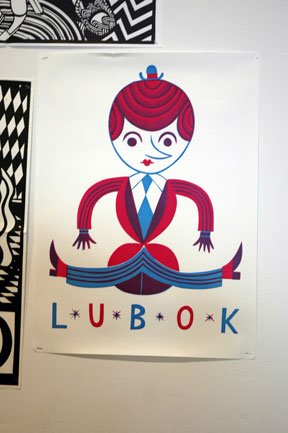
Lubok poster

Lubok‘s woodcuts, books and posters were adorable!

giant posters

Gigantic posters (5′ tall?) in the Dutch Pavilion.

And how about fashion?
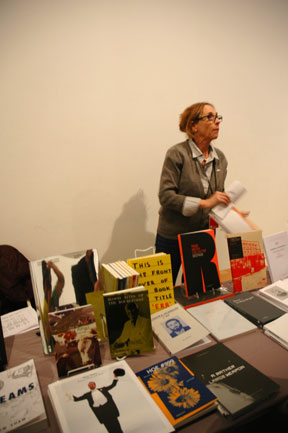
fashionable lady

I liked this lady’s outfit: a menswear dress shirt under a grey cardigan made of sweatshirt material, with a string of “pearls” in glossy silver. Plus bold glasses. New York is good for learning how ladies mature with aplomb.

fruit jacket

This blasted photo was meant to share with you an awesome puffer jacket, printed with photos of fruit (on chair)!

art metropole mr cool

What’s more exciting: Toronto’s awesome Art Metropole in NYC, or this guy’s Le Tigre shirt’s tiger’s friends?

Lubek fashion

Lubok‘s sellers of woodcut prints and books wearing graphic stripes and red-black-and-white patterns? Coincidence? Methinks not.

After browsing several rooms full of rare books—too expensive for me to buy, and too fragile for me to browse as I juggled coat and camera—I realized that I love reading books, but I don’t have to collect them. Maybe it’s because my recent cross-country-move has instilled a phobia of accumulation, or maybe I’d rather make use of the city’s libraries. More likely, I’m a cheapskate, and I’m plagued with guilt about the stack of unread books sitting on the shelf above my desk.

Whatever the reason, I found myself most attracted to prints and multiples. (Am I so transparent, to only like the things I like to make?)

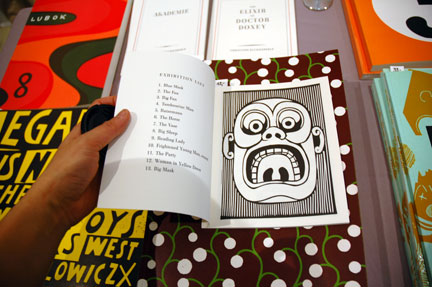
Lubok wares
Lubok book inside

Wares from the German company, Lubok Books.

NYArtBookFair exhibition of prints on photocopies

DISPATCH, “a New York-based curatorial partnership between Howie Chen and Gabrielle Giattino,” had some really fantastic screenprints. I love how they exhibited them: framed, over a crazy photocopy-like montage.
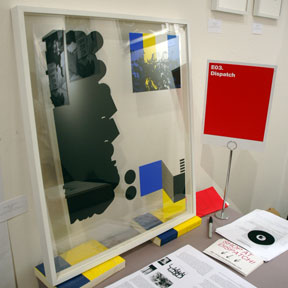
NYArtBookFair_02

Among my favorites was this screen print on acetate (2008) by Jose Leon Cerrillo.

Screenprint by Matthew Brannon

“Where were we” (2008), a screenprint by Matthew Brannon. These prints by Brannon are so cool, I try to resist liking them, but it’s not easy.

So when I rounded a corner and saw Jonn Herschend at his booth of The Thing Quarterly, subscription-based multiples, I knew I would fail to control my impulse buys.
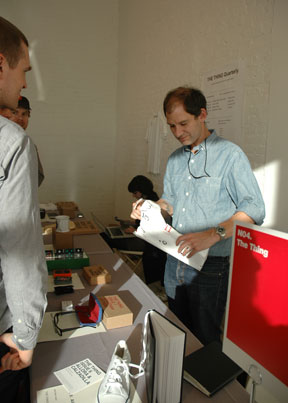
Jonn Herschend

Artist Jonn Herschend at The Thing Quarterly’s booth.

I realized, a few years ago, that I need to put my money where my mouth is. If I think more people should buy, own, and enjoy art, I need to do the same. Bartering with other artists is great, but it’s also nice to show that you really support and believe in an artist with your wallet too. My budget is small, which means that my taste for multiples (which are generally more affordable) is perfect, and so I finally accepted that there were plenty of rationales for subscribing:
1. The Thing is an awesome idea.
2. The artists involved in The Thing are uniformly interesting and exciting.
3. I’m lucky to know one-half of the duo behind The Thing.
4. I’m proud of the fact that The Thing is from San Francisco, CA.

If that weren’t enough:
5. The Thing is super affordable: $200 for 4 limited edition multiples; that’s only $50/multiple. You could spend that on pints (!) in Manhattan.
6. The upcoming artists blow my mind!
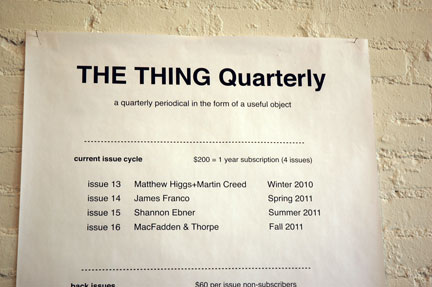
The Thing Quarterly subscription information

Matthew Higgs + Martin Creed (LOVE Martin Creed’s work!); James Franco (Sometimes his stony delivery makes me think that he’s new Keanu, but then I read about his fine art hijinx and suspect that he’s a performance art polymath. Also, M approves of his next movie.); Shannon Ebner (whose text-based work is great); and MacFadden & Thorpe (SF graphic designers who are so good, seeing their projects makes me raise my fists in mock-envy to the sky).
Standard
Research

Surprises at the MoMA

I visited the MoMA yesterday, on the last day of The Original Copy: The Photography of Sculpture, 1839 to Today. Working with studio-based compositions of sculptures and sculptural arrangements, Brancusi’s suite of beautiful b/w photos featured glints of light, while Jan de Cock [see his innovative website]‘s Studio Repromotion series were unaffected, curious color 4x6s. Cyprien Gaillard‘s Analogous Geographies (a series of groups of sixteen random Polaroids, all shot at 45 degree angles, and arranged to create composite landscapes) had a neat presentation (the photos were lain on a concave matboard-like surface in deep frames set at a low angle). Robin Rhode‘s Stone Flags (in which the illusion of flag-waving is carried out in a kind of live-action stop-motion hybrid, using real stones and a real figure) captured the heavy burden of statehood on personal identity. I was also happy to be introduced to Brassaï‘s Involuntary Sculptures, large b/w macro shots of materials like balls of dust or smeared toothpaste. The questioning of the nature of sculpture, and the embrace of chance, seems very contemporary. The cherry on the cake, though, was one of Duchamp’s valises of miniatures of his sculptures and paintings.

Still, while I toured other shows around the museum, I was most affected and impressed by three videos. This is a rarity for me. I haven’t got anything against video, it’s just that I don’t often have the patience it takes to watch enough videos to see the great ones. In this case, all three were very powerful, shared some similarities, yet are completely different.

Glenn Ligon‘s The Death of Tom (2008) is elegiac. It’s impressive because it seems to convey no content, yet ample clues point the observant viewer towards a very specific historical and cultural moment. [It’s so good I don’t want to spoil it for you, so I’ll add a SPOILER ALERT here. Skip to the next graph if you don’t want to know.] The short film consists of unintelligible streaks of white light; a hazy, nebulous, shifting blur creates sort of a monochromatic, animated Rothko. It’s unclear what you’re looking at, and when, if ever, the video will start. Yet a beautifully-recorded piano accompanies the light; its riffs and rhythms allude to vaudevillian tunes. The composition is nostalgic and playful and yet, interpretive, heavy, burdened and woeful. Being familiar with Ligon’s work, and his interest in race and the representation of Black Americans, I surmised a connection to blackface and the co-mingled feelings of liberation and weight. It’s a very powerful piece that connects strongly to Ligon’s paintings about illegibility and misreadings. Jason Moran, the pianist and composer, provides clues, context and grace in equal measure. It’s on view through May 9, 2011.

In a prime example of the multi-polarity of artists of color and ways of working, unflinching Vietnamese documentarian Dinh Q. Lê and his collaborators present a completely different video that concerns racial and national politics as well. Their giant, three-channel video is at times emotionally heart-wrenching, bombastic, borderline propagandistic, and completely unnerving. The Farmers and The Helicopters (2006) features interviews with a handful of survivors of the Vietnam War and their experiences with helicopters: elderly ladies who were terrorized as children, a militia man who fired on them, and a perplexing, passionate, self-taught mechanic, who, enthralled with helicopters and their utilitarian and humanitarian potentials, built a helicopter from scrap metals with a farmer. Le Van Danh’s and Tran Quoc Hai’s handiwork is on view in the gallery adjacent to the video. It’s massive, white like an angel, and mind-blowing. The Farmers and The Helicopters is on view through January 24, 2011.

The third video I liked was features only color fields, similar to Ligon’s black-and-white-blur, yet is aggressively gripping like Lê’s. Paul Sharit‘s Ray Gun Virus (1966) is a film consisting of rapidly interspersed fields of color, accompanied by a loud, brain-invading mechanical drone. Finding the screening room empty, I proceeded to break all normal viewing protocol: standing in the projection throw, observing the awesome retinal after-images (or colors) that occurred, and generally zoning out. I thought about looking straight into the projection when more visitors came in, and I resumed my normative viewing role. A structuralist filmmaker, Ray Gun Virus was Sharit’s first “flicker” films which aimed to alter consciousness. He succeeded. See a visitor-created YouTube video. Also on view through May 9, 2011.

Standard
Art & Development

A few observations of the New York Art World

1.
“You can charge that!?!”
On the NY art market, or as NB pointed out, art mark-up. It could not be more different from the non-profit, alternative art world in the Bay Area that I am most familiar with.

2.
Art auctions = deals and flat-out steals.

At a recent auction I attended, the starting prices were predictably much higher than those typically found in auctions for SF non-profits. At the same time, I thought that people made out like bandits. While there is a bigger pool of collectors here, there are also lots more galleries competing for their attentions. Even big names, great works, steep discounts and the NY collector base can not guarantee sales.

3.
Some gallerists have always been gallerists.
Gallery lineages are alive. They aren’t lost artifacts from the Leo Castelli-era. Assistants who have worked for big-time galleries still open their own shops. The Bay Area seems like it might have a small demographic like that (akin to the tiny percentage of high-society old money in San Francisco), but my sense was that gallery owners often had alternative income streams, or previous non-art careers.

4.
Curators can be art-slaves too.
I’m pleasantly surprised to share that, in my short time here in NY, I’ve worked with a few curators are super down-to-earth and don’t think twice to do install or preparator work. This is reassuring because it speaks to teamwork and efficacy over rigid hierarchy. Proof once again that modest expectations can yield pleasant surprises.

5. Curatorial Master’s programs are OK.
There are a few CCA Curatorial Practice alumni out here, and they all seem to be engaged in interesting, rewarding work. Note the word work, connoting being paid actual money. I’ve heard people question curatorial master’s programs, but NY shows at institutions need curators, and that the curators from CCA have interesting perspectives and they know how to work.

Standard