Art & Development, Travelogue

Printmaking in the Catskills

I’ve been in upstate NY for just over a week, and it’s been dreamy. In California, a NY artist once explained how many artists live in the Hudson River Valley, and how you can buy a house and convert a barn to a studio. I was skeptical that it would be worth being out of the city. But now, after noticing the sound of automobiles only between long stretches of rustling tree leaves and birdsong, I completely understand.

Today, I took a relaxing drive down county routes to Rosendale, NY. The address wouldn’t even register in my GPS. Navigating the old fashioned way, I took one wrong turn and was immediately happy that I did. The road circled the banks of a beautiful lake, with only a few white clapboard houses nestled among the wooded trees on the opposite bank. The light glistened off of the water; everything was either mossy green or platinum light. I felt so grateful to be there at that moment. It was as if the longing and nostalgia of a Thomas Kinkade painting were coupled with immediacy of accompanying sensations: clean mountain air, woodsy smells, a slight humidity hinting at the impending rain shower.

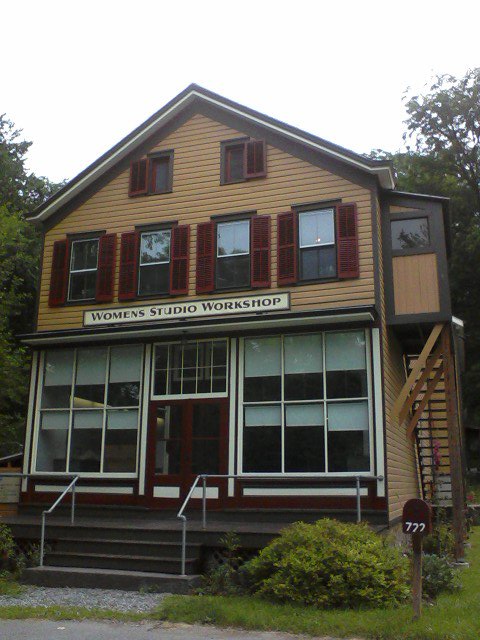
Women's Studio Workshop in Rosendale, NY.

Women's Studio Workshop in Rosendale, NY.

I finally made it to Women’s Studio Workshop, a printmaking, bookmaking, and ceramics studio in Rosendale, NY. I had heard of WSW through their residency program, and thought that it would be a perfect place to pull a series of collagraphic monotypes that I had been scheming on.

Upon my arrival, I was invited to join a lunch of salad and crispy no-red-sauce veggie pizza (which touched this Californian transplant’s heart; in some ways, I may be a New Yorker, but not when it comes to pizza). There really is nothing like a home-cooked meal to make people feel welcomed.

While I have only screenprinted since my MFA degree, pulling the monotypes came back to me: setting up the press and the blankets, modifying the inks, finding the right balance of wet paper and releasing ink. I thought I would be rusty and have to humbly ask for technical help (much like the time a drummer who’d been playing on electric pads for so long he couldn’t set up a drum kit), but somewhere in me that printmaking experience remains. Though I used much of graduate experience to explore other media, I am happy to report that I can still call on my printmaking abilities. I even figured out the less-toxic clean-up oils (which were not used at my alma mater)—thankfully, since I’ve lost any tolerance for mineral spirits that I had built up in my inky woodcarving years.

Standard
Art & Development, Travelogue

Woodstock Byrdcliffe: Get excited and make stuff

View from Mount Guardian, Catskills, NY.

View from Mount Guardian, Catskills, NY.

I’m in the Catskills for a short residency at the Woodstock Byrdcliffe Guild. I’m so honored to be here. The land is beautiful, serene, and full of wildlife. I’m giddy; it’s such a contrast from New York City and yet it so strongly recalls the Sierras in California. The colony was founded by British Industrialists seeking to build a utopian Arts and Crafts creative community. The initial attempt didn’t last long, but the Guild lives on as a series of amazing historic buildings housing 17 residents in visual arts, media arts, creative writing, and music composition.

I’ve been here just about a week, and am pretty much settled in my quaint room and a detached studio with high ceilings and skylights. I’m two-thirds through with Mihaly Csikszentmihalyi’s Flow; I started some new drawings and sculptures, and even dreamed up a staged photograph. The setting is literally invigorating—I’ve run further than I have ever before.

Inspired by a tradition I experienced as an Affiliate Artist at the Headlands Center for the Arts, I initiated a residents’ mutual presentation series. It’s basically a slide slam/listening party/clip screening/reading event, made possible with shared laptops and digital projectors and healthy doses of participation and positive intentions. I enjoyed everyone’s presentations tonight. I suspect my readers would be keen to learn more about Julie Perini’s videos. I also really liked Jane Corrigan’s paintings about sentimental landscape images. My highest hope for the series is that some parallels emerge and enliven our discourse, and it appears that some already have.

The only quandry I have now is that the event is gaining interest and we may need to add another night to accommodate fellow artists on the mountain. Seeing a little initiative returned with such participation is very gratifying.

Residencies are like slices of heaven, so that artists can envision making more of “regular” life more like residencies—to inject the space and time to create, think, breathe, stretch, learn, explore, and exchange into life more often and for longer periods.

Standard
News

6/30–9/3: summer selections in san francisco and new york

hopexpectation, 2011, ribbon, thread, pins, 101 x 18 x 1 in / 257 x 48 x 2.5 cm.

hopexpectation (2011) will be on view at Jenkins Johnson Gallery, NYC.

I am happy to exhibit my latest ribbon texts in bicoastal group shows at Jenkins Johnson Gallery. In Chelsea, I’ll unveil hopexpectation and take charge of your happiness, while unlimited promise continues its residence in the project space. think good thoughts/fortify good attitudes will be exhibited in San Francisco, at the gallery’s location just around the corner from Union Square.

June 30–September 3, 2011
Summer Selections 
Jenkins Johnson Gallery
NYC: 521 W. 26th Street, 5th Floor (near 10th Ave); gallery hours: Tue–Sat, 10am–6pm
San Francisco: 464 Sutter Street (between Powell and Stockton); gallery hours: Tue–Fri, 10am–6pm, Sat 10am–5pm

Standard
Citizenship

ai weiwei: problem or placation

Kyle Chayka posted on Hyperallergic today:

According to Ai Weiwei’s lawyer Liu Xiaoyuan, Ai’s FAKE studio has been accused (and seemingly convicted) of evading over $5 million RMB ($770,000 USD) and is to pay $7 million RMB ($1 million USD) in fines.

…At Artists Speak Out, Philip Bishop quotes Hong Kong artist Kacey Wong with an unconfirmed story of the aftermath of Ai’s release, in which the artist isn’t allowed to speak with one of his consistent collaborators:

Wong said the news on Sunday in Hong Kong was that when Ai Weiwei went to a park in Beijing to talk to Chiao Chiao, one of the video artists Ai works with, Chinese security called and reminded Ai Weiwei that “that wasn’t part of the deal,” said Wong.

…It remains to be seen what consequences and impact Ai’s release will have in the Chinese art world, and if the action is the signal of a relaxation of the government’s recent “Big Chill” or simply another gambit in a balancing act to keep political dissidents silent while the international community remains too placated to openly intervene.

Standard
Citizenship

Human Rights Watch: Ai Weiwei Case Reflects Disregard for Rule of Law

Here’s a very good position on Ai Weiwei’s release from Human Rights Watch’s website, posted June 22, 2011, with the subtitle, “Unlawful, Unwarranted Detention, and Onerous Restrictions Loom.” It sums up my sentiments exactly.

The release of the Chinese artist and activist Ai Weiwei on June 22 is a relief for his family, friends and supporters, but leaves troubling unanswered questions about his arrest, detention and conditions of release, Human Rights Watch said today. In particular, Human Rights Watch is concerned about the political nature of his arrest, the conditions under which the police may have extracted a “confession” from him, and possible restrictions on freedoms he faces following his release….

“The Chinese government’s decision to arrest Ai Weiwei was political, and so is his release,” said Sophie Richardson, Asia advocacy director at Human Rights Watch. “But it is also an example of how international pressure works, since Beijing was paying a high cost to its reputation for his detention.”

…In the past six months, the Chinese government has disappeared and/or arbitrarily detained dozens of activists, writers, lawyers, and others. Upon their release, several have retreated into uncharacteristic silence and seclusion, leading to concerns that they have been threatened with further abuses if they speak out. At least 10 others who are less well-known than Ai have been victims of enforced disappearances since mid-February. They remain incommunicado, their whereabouts unknown, and thus are at high risk of torture in custody.

“International pressure apparently prodded the Chinese government to conclude that the cost/benefit ratio of continuing to detain Ai Weiwei wasn’t worth it,” Richardson said. “The international community should maintain that same pressure for the release of the many other innocent victims of the Chinese government’s current wave of repression.”

Or as the Daily Beast put it:

Released but not free

Speaking to The Daily Beast/Newsweek by phone, Ai said he has been restricted from traveling outside Beijing or giving substantive interviews to the press for “at least a year.”

Standard
Research

Thomas Wilfred, kinetic light composer: Catnip for Neo-Transcendentalists

Via the New Yorker on The Tree of Life:

Thomas Wilfred made art objects that mechanically produced light and color. Some initial research results:

A trailer of Lumia, a 2006 documentary by 13bits, a NYC production company. In the middle of the trailer, there’s a shot of a hard-edged kinetic light display that should appeal to graphic designers and motion graphic designers.

Documentation of Opus 147 on Youtube. Artwork produced in 1957, video shot in 2006 for the documentary above.

The Eugene and Carol Epstein collection maintain some pages with a bio of Wilfredphoto documentation of light displaysa cool cross-section diagram, and other resources. (Hooray for dedicated collectors!)

Standard
Research

read: fine sentences

If I were a purveyor of fine sentences I would stock gems such as these.

In his post comparing jury duty to conceptual art, art critic Glen Helfand wrote on SFMOMA’s Open Space (“Justice Redux,” June 22, 2011):

Here’s my account of the case to which I was assigned: Ms. E drank something troubling, a crystal clear bottle of water with its Harrah’s label intact. It may have been standard transparent plastic, but was corrosive all the way down. She described burning up inside, but not as dramatically as her lawyer, who also relished, in words and sometimes pictures, the horrors of esophageal surgery….

What might be the real costs of a Drano cocktail, in PTSD dollars? It was as if there was a short circuit in my thinking patterns—all of a sudden, this was capital R real. Unlike forming a critical position on the Gertrude Stein exhibitions, our decision would have some measurable impact on someone’s life.

Lots of pleasing word-smithing here. The double duty of “capital”—both financial and figurative—is nice. Plus it’s nice to take the enterprise of criticism down a notch sometimes.

Though critics do articulate fine ideas too:

the seemingly infinite archive of world events produced by photography conflates surface appearance with psychological depth, iconicity with memory, publicity with history….

Eva Díaz paraphrasing critic Siegfried Kracauer in a review of Drawn from Photography at the Drawing Center, NYC (Artforum, Summer 2011). Díaz goes on:

Artists… hand-copy photographs and photo-based media, thereby lengthening the duration of the image’s production and, for the viewer, transforming perception by fastidiously rendering what once presented itself with glossy immediacy.

Also in Artforum, Catherine Wood previewed the Manchester International Festival and this summer’s iteration sounds equally high-brow and low-brow—and totally fun. Adding the MIF to my bucket list.

One more Artforum goodie*: Graham Bader considers Roy Lichtenstein’s Brushstrokes paintings. In doing so, he quotes David Joselit, who characterizes painting’s “reification trap” thusly:

maximum prestige with maximum convenience of display

which means, as Bader writes,

[painting] is inevitably and intimately linked to the commodity.

The Brushstroke paintings are Ben-Day dot paintings depicting painterly strokes. Very cheeky. They are funny and interesting because they’re quotations, and I can’t help but think about Jerry Saltz’ recent rant against tired postmodernism:

The beautiful, cerebral, ultimately content-free creations of art’s well-schooled young lions…

…many times over—too many times for comfort—I saw the same thing, a highly recognizable generic ­institutional style whose manifestations are by now extremely familiar. Neo-Structuralist film with overlapping geometric colors, photographs about photographs, projectors screening loops of grainy black-and-white archival footage, abstraction that’s supposed to be referencing other abstraction—it was all there, all straight out of the seventies, all dead in the ­water. It’s work stuck in a cul-de-sac of aesthetic regress, where everyone is deconstructing the same elements.

in his reaction to the Venice Biennale on Artnet. (Though he did like some things, including an installation by Argentinian Adrián Villar Rojas, who made a massive beached whale for Moby Dick at the Wattis in 2009. Congrats to AVR, and to his collaborator Alán Legal!)

The June 27th issue of the New Yorker is a good reminder of why I’m a subscriber. Rebecca Mead’s profile of Alice Walton, the Walmart heir opening a major museum in Arkansas, is quintessentially New Yorker. It’s about an individual of influence, yes, but the story is far from the stuffy Upper East Side. That I’ve yet to hear about this museum via typical art channels makes it even more intriguing. I’m also looking forward to reading Adam Gopnik’s essay on drawing. But in the meantime, Ian Frazier’s Talk of the Town contribution counterposes events in Harlem: a mostly-POC poetry reading and a mostly-white Socialist film screening. The description of the latter setting will ring a bell among radical buddies in Berkeley:

At a counter by the entry, racks of densely printed leaflets, the left’s traditional accessories, sat near new paperback editions of books by Leon Trotsky….

“O.K., everybody, can we all sit down…?” The last words were pronounced in the hopeful, rising tone that might be called the Leftist Exhortative….

The watchers in Freedom Hall roused themselves for a lusty booing and hissing of Dick Cheney when he came briefly into the frame….

…even the familiar pleasure of hating horrible things didn’t seem to buoy the Freedom Hall crowd. In the flickering dark, a palpable gloom.

Having been to a few gatherings like this myself, I found Gopnik’s humor winsome. The activists’ pessimism in the final couplet is too close for comfort. I suppose whatever inspired me to make the Activist Complaints drawings in 2007 still resonates with me.

*This issue of Artforum is called “Acting Out: The Ab-Ex Effect.” Talk about tired of Ab-Ex.
Standard