Art & Development

Art Competition Odds: The Santo Foundation

The Santo Foundation received 783 applications last year for 2 individual artists awarded.

///////////////////////////////////////////////////////////////////////////
///////////////////////////////////////////////////////////////////////////
///////////////////////////////////////////////////////////////////////////
///////////////////////////////////////////////////////////////////////////
///////////////////////////////////////////////////////////////////////////
///////////////////////////////////////////////////////////////////////////
///////////////////////////////////////////////////////////////////////////
///////////////////////////////////////////////////////////////////////////
///////////////////////////////////////////////////////////////////////////
///////////////////////////////////////////////////////////////////////////
/////////////////////////////////

or 1:391, or 0.5%

See all Art Competition Odds.

Standard
Art & Development

The Greatest of All Time

Few things impress me as much as discovering that champions are also genuinely nice people.

In Born to Run, Christopher McDougall wrote about Scott Jurek’s constant encouragement of fellow runners. After setting records at 100-mile ultramarathons, Jurek would plop down in a sleeping bag and cheer on every last runner, sometimes for 12 hours or more. During a 50-mile race in sizzling Mexican canyons, as he pursued the lead runners, Jurek stopped to brief a fellow runner on the trail conditions and aid stations ahead of her. He increased the distance he’d have to reel in his competitors so he could help a friend.

I’ve had the pleasure of learning from one of the nicest and toughest people I know. Bunkerd Faphimi is a muay thai figher and trainer at Fight and Fitness in San Francisco. He has an astounding 350+ fights under his belt. He’s known in Thailand as the People’s Champion, and as soon as you meet him, you’ll know why. He’s incredibly kind, generous, and playful. Have a look at his fight videos. He likes to take a lot of punishment, and yet, he’s often smiling in the ring. Not a showboating smile, but one of enjoyment. Better yet, watch him spar with students. He offers a near-constant onomatopoeic commentary, delighting in an activity in which he’s mostly letting himself get kicked, punched, and put in the clinch. He’s the living antithesis of both the evil Karate Kid Freudian-father archetype sensei, and, with his sheer unpretentiousness and demystified approach to muay thai, of the ‘magical Asian’ Mr. Miyagi. His love of muay thai, and of life, is like exuberance embodied.

I often find myself defending fight sports from people view it as sanctioned brutality. What they don’t understand is that these are highly evolved sports that people spend years of their lives dedicating their lives to. You don’t get to that level without knowing, in your heart of hearts, that this is what you really want, and proving it over and over again. As Chris Cariaso, the other head trainer at Fight and Fitness (and a super nice guy who rescues dogs when he’s not training, teaching, and fighting in the UFC) said, he’s “living the dream.”

This gratitude for life experiences also extends to gratitude to other competitors. Though fighters and promoters hype fights as ways to settle personal beefs, fighters also experience profound gratitude and respect for competitors when the fight is fair, their skills are closely matched, and the fight is so enjoyable that the outcome becomes less significant. When you’ve witnessed your opponent’s skill and heart firsthand—when they’ve gained your respect and you haven’t compromised yourself or your performance in any way—you recognize that there is no shame or sadness in losing to such a worthy competitor.

This is very similar to psychologist Mihaly Csikszentmihalyi’s definition of flow: the activity becomes autotelic, skills are well-suited to the challenges, and participants lose themselves to the activity.

You can see this elatedness exemplified at the end of bloody battles when the fighters, after the last bell, happy and exhausted, embrace. They also often gently touch each other’s heads or draw their foreheads together—I’ve even seen a boxer wipe another’s face. You don’t have to be a social psychologists to recognize these signs of affection and intimacy. Their wide smiles are pictures of gratitude. (Forrest Griffin vs. Stephen Bonnar, TUF1, is a classic example. I’m sure I was not the only fan rooting for both of them by the end.) Sometimes, one fighter will raise the competitor’s hand in the air, not necessarily to signal his own loss, but to acknowledge his opponent’s champion spirit. In a world of machismo, humility shines.

Premise #1: True champions express gratitude, humility, and generosity.

McDougall writes that people are born to run, and that we love running because we love being with other runners. We are part of a human pack when we run together. Though endurance running is often accompanied by pain and exhaustion, many top runners compete with smiles on their faces. The joy of the activity is self-evident; the urge to help others enjoy the activity follows.

Speculations: Art is highly competitive and individual artists often compete against each other for grants, residencies, commissions, exhibition opportunities, and teaching jobs. Who are the top practitioners in the arts who express profound generosity and gratitude?

How do artists—even as competitors—help each other? Share our joy? Express our pack-hood?

When do we help each other find the flow?

Is art practice like endurance running? Can artists find the joy even as we slog it out for miles in the rain alone, as well as when we assemble and compete?

When our skills are evenly matched how do we raise another’s fist in the air, recognizing their spirits?

Is there a lesson for artists to be learned about becoming a contender before becoming a champion?

Read the abstract of a fantastic profile of Bunkerd by Elif Batuman in the New Yorker.

Watch a video interview with Bunkerd on MyMuayThai.com, an excellent resource for all things muay thai by a true practitioner.

[Added October 16, 2011] Read a recent blog post by Jurek on running with others.
Standard
Art & Development

Art Competition Odds: Triangle Artists’ Workshop

The Triangle Artists’ Workshop Residency received 600 applications last year for 7 residencies awarded.

///////////////////////////////////////////////////////////////////////////
///////////////////////////////////////////////////////////////////////////
///////////////////////////////////////////////////////////////////////////
///////////////////////////////////////////////////////////////////////////
///////////////////////////////////////////////////////////////////////////
///////////////////////////////////////////////////////////////////////////
///////////////////////////////////////////////////////////////////////////
///////////////////////////////////////////////////////////////////////////

or 1:85, or 1.1%

See all Art Competition Odds.

Standard
Art & Development

Chinese Arts Centre’s People’s Residency

I’m intrigued by this new initiative seeking 100 members of the public to fund a residency. Since the UK’s arts budgets have been dramatically slashed, arts organizations have to be creative to continue supporting artists and providing access to the arts to the public. I’m happy to support the fantastic programming of the Chinese Arts Centre in Manchester, UK, and to help another emerging artist get the opportunity that was so valuable to my research and practice.

‘The People’s Residency’ scheme looks to fundraise an entire residency programme via the public, where we need 100 members to sign up and pay a single membership fee of £35 [about $55 USD]. With your donation not only will you be funding a critical career development opportunity for one lucky artist but you will also get the chance to vote from our four shortlisted artists as to who you want to be the next Breathe residency artist for Spring/Summer 2012. And to top it all off you get a unique insight into the residency programme with special members only events, afternoon tea with the artist, members e-newsletters, artist’s online residency blogs and members only previews!

http://peoplesresidency.chinese-arts-centre.org

Standard
Community, News

Gratitude Project: Tell me what you’re grateful for

Gratitude Project > Call for Submissions

WHAT:

I need your help! Tell me what you’re grateful for.

WHY: I’m an artist whose projects examine positive emotions, optimism, and pessimism.

My next installation—to be exhibited in the UK—will be a collective gratitude journal of sorts.

Gratitude journals are often cited by psychologists as first step towards increasing subjective well-being (happiness). Psychologists Bob Emmons and Mike McCullough found that people who wrote down five things they were grateful for each week for nine weeks had more positive emotion overall than other groups in the study. In a study that replicated the results, the gratitude journal-keepers “reported greater satisfaction with their lives, more optimism regarding the upcoming week, and greater connection with others.” (Philip Zimbardo and John Boyd, The Time Paradox, 2008)

HOW: Write your first responses, or mull it over and submit a list. Submit as often as you like. Submit by:

Comment below

or

Send me an email: gratitudeproject (at) christinewongyap.com.

WHEN:

Submit now. I’ll accept submissions through September early October. Keep ’em coming, please!

The text you submit (edited for brevity or clarity) may appear in an installation. I’ll post documentation by the end of November on my website. Your name will not appear with the work, but if you include your name/contact info, I would be happy to acknowledge your contribution on the project web page, and send you a note when the documentation is posted.

Thank you for your help. I will be very grateful for your submissions.

Standard
News

Through 8/31: Window Work @ DXDX Studio, Plymouth, UK

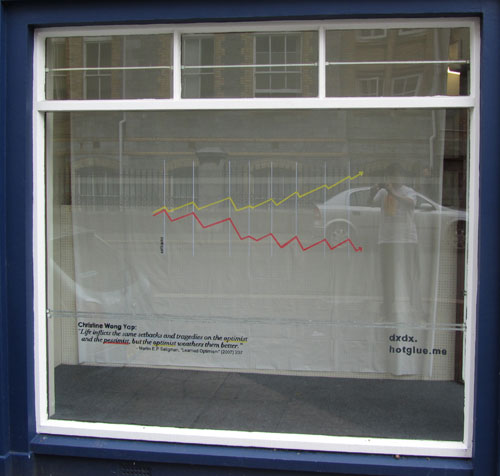
Have a look! One of my Positive Signs has been interpreted as a window drawing in Plymouth, UK.

Window Work, DXDX Studio, Plymouth, UK

Window Work, DXDX Studio, Plymouth, UK

WINDOW WORK is a programme of artworks in a display window of an artist run studio space.

The current WINDOW WORK project asks artists (through an open call submission process) to propose a text work, diagram, drawing, instruction piece, design etc that can easily be drawn (translated) onto the main studio window using chalk pens.

The selected works are drawn/traced/copied onto the window by studio members who follow simple instructions provided by the artist.

Window Work
8/16–8/31
DXDX Studio

Regent Street, Plymouth, UK

Standard