Art & Development

Jonathan Haidt on the uses of adversity

In The Happiness Hypothesis (New York: Basic Books, 2006), psychology professor Jonathan Haidt explores the uses of adversity. His points seem to validate my issues with pundits’ declarations that the recession would be beneficial for artists (elaborated in “Portrait of an Artist, Wily and Engaged” on Art Practical). Haidt explains:

People need adversity, setbacks, and perhaps even trauma to reach the highest level of strength, fulfillment, and personal development

However, we oughtn’t

celebrate suffering, prescribe it for everyone, or minimize the moral imperative to reduce it where we can.

Based on numerous studies, Haidt concludes that some conditions for the uses of adversity can be inferred:

For adversity to be maximally beneficial, it should happen at the right time (young adulthood), to the right people (those with the social and psychological resources to rise to the challenges and find benefits) and to the right degree (not so severe as to cause PTSD).

To refine my position by way of paraphrasing Haidt, it’s inappropriate to celebrate the adversities that artists endure during recessions, especially considering the artists who lack the social and psychological resources, or find the adversities too severe, to continue practicing art.

Standard
Bucket List, Sights

See: Sigmar Polke’s windows at Grossmüster, Zürich

Agate window by Sigmar Polke, 2009, Grossmuenster Cathedral, Zurich

Agate window by Sigmar Polke, 2009, Grossmuenster Cathedral, Zurich.

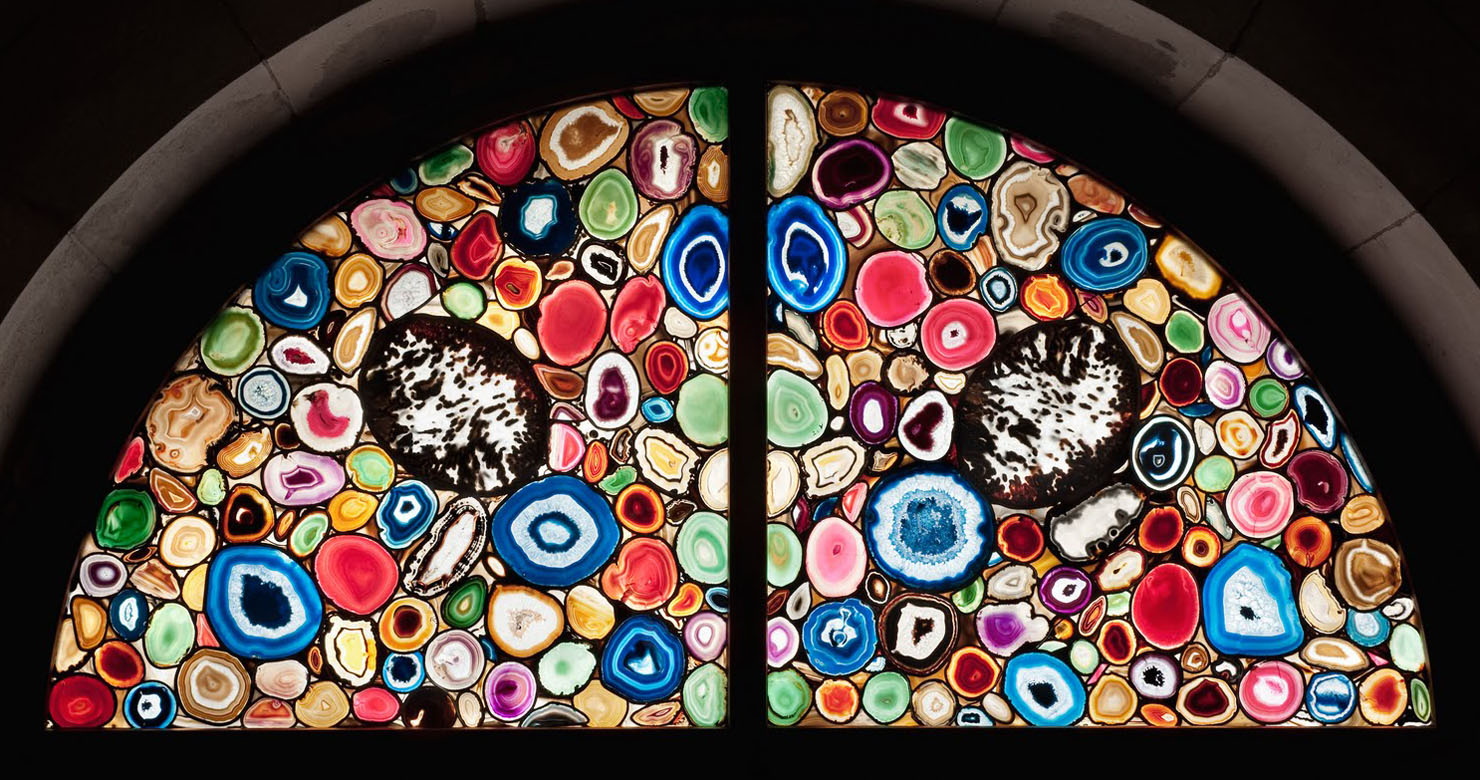
In 2006, Sigmar Polke won the invited competition to design church windows for the Grossmünster in Zürich. It has taken three years to complete this ambitious project. Seven windows in the western part of the nave consist of sliced agate, creating brightly luminous walls of stone. The five windows to the east depict five figures from the Old Testament in stained glass. They can be interpreted as precursors of Jesus and thus relate to the Christ child in the choir windows by Augusto Giacometti. Sigmar Polke has intertwined various axes and levels of time, ranging from geological and biblical times to Romanesque art and the present day.

Press release from the Grossmünster website.

This one’s for the bucket list.

Standard
Sights

see: nicholas elias’ the geometry of innocence

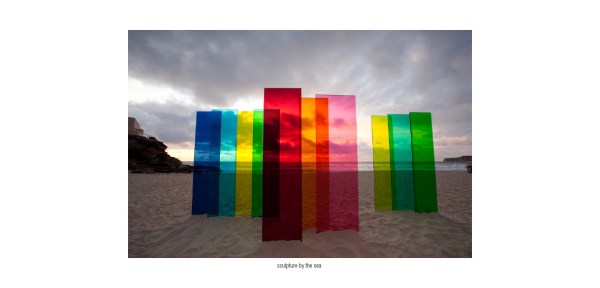
Nicolas Elias. The Geometry of Innocence, 2009. Acrylic sheets (Perspex). Sculpture by the Sea, Sydney.

Nicolas Elias. The Geometry of Innocence, 2009. Acrylic sheets (Perspex). Sculpture by the Sea, Sydney. Source: nicholaselias.com

Love the simplicity and scale of this work of public sculpture.

More photos of The Geometry of Innocence on the artist’s blog.

Part of Sculpture by the Sea, an exhibition series in Sydney.

Standard
Research

Holden Caufield, MFA

Adam—at once ideological and post-ideological, vaguely engaged and profoundly spectatorial, charming and loathsome—is a convincing representative of twenty-first century American Homo literatus. He is a creature of privilege and lassitude, living through a time of inflamed political certainty, yet certain only of his own uncertainty and thus always more easily defined by negation than by affirmation, clearly dedicated to poetry but unable to define or defined it (excet to intone that poetry isn’t about anything), and impicitly nostalgic for earlier, mythical eras of greater strength and surety. He has long suspected, for instance, that he is incapable of having “a profound experience of art and I had trouble believing that anyone had, at least anyone I knew.” Insofar as he is interested in the arts, he tells us, he is “interested in the disconnect between my experience of actual artworks and the claims made on their behalf; the closest I’d come to having a profound experience of art was probably the experience of this distance, a profound experience of the absence of profundity.”

James Wood, “Reality Testing,” (New Yorker Magazine, October 31, 2011) a review of Ben Lerner’s new novel, Leaving the Atocha Station (Coffee House). The book’s narrator is Adam Gordon, a poet.
Standard
Citizenship

oakland: my fair city

I have a lot of love for Oakland, California, where I lived from 1994 to 2010. Here are a few new reasons to love Oakland:

General Strike poster

Love this General Strike poster. The illustrations, typography, and colors are pitch-perfect. Hard to make out the artist's name: R. Black? Source: OccupyOakland.org.

John Robb, from Fairfax, California, managed almost singlehandedly to shut down a Chase bank branch.

"John Robb, from Fairfax, California, managed almost singlehandedly to shut down a Chase bank branch" reported Adam Gabbatt, blogger for the Guardian (UK). Photograph: Adam Gabbatt/guardian.co.uk

“I got here at 10.30am, one my own,” Robb told the Guardian from his position seated in front of the entrance.

“Security kept pushing me away, but I stayed by myself for another 30 minutes. Then someone else arrived, they still pushed us away. Then the big march came past and we called everyone over, they came and the bank locked the doors.”

…Some protesters voiced their desire to smash the bank’s windows; other protesters stood in front of the bank and prevented them from doing so.

(As told to Adam Gabbatt for the Guardian, Nov. 2, 2011)

Skeptics demanding OWS’ demands ought consider this:

Occupy Oakland shuts down a Chase bank during today's General Strike.

Occupy Oakland shuts down a Chase bank during today's General Strike. (Source: Facebook, photographer unconfirmed.)

I think the message is pretty clear. If this doesn’t do it, how about this: We’re fed up with Big Banks, Wall Street, and rising inequity that grossly rewards the top 1%.

Not in Oakland, but it's a solidarity movement. This Brooklyn Bridge occupier's irresistible optimism is positively winsome. Source: OccupyWallStreet.org

Not in Oakland, but it's a solidarity movement. This Brooklyn Bridge occupier's irresistible optimism is positively winsome. Source: OccupyWallStreet.org

This photo is from a movingly penned post which proclaims:

And in our own backyard, in thousands of backyards, from Augusta and Jackson, Springfield and Sioux Falls, Vegas and Santa Rosa* and Green Bay: Americans celebrated the occupation in its infancy. Jobs with dignity. Housing fit for families. Education. Health care. Pensions. The very air we breathe. What can those who want democracy demand from the king, except his crown? Regime change is in the air. America is looking at itself, it’s place in the world and who we are to be.

This is not a demonstration. It’s participation.

(—Jed Brandt and Michael Levitin, originally printed in the Occupied Wall Street Journal, and reposted on occupywallst.org.)

(*My first hometown!)

Plus…

OWS artwork by the illustrious JL. Source: @justinlimoges.

Hallow's Eve papercut by the illustrious JL. Source: @justinlimoges.

While 10,000+ occupiers were reported to peacefully protest all day yesterday, an unruly few have marred the nonviolence with acts of vandalism, early the following morning. Once again Adam Gabbatt from the Guardian reports:
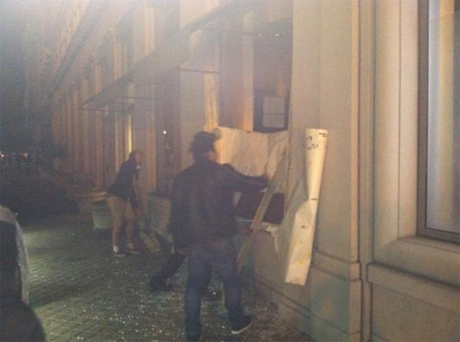
Adam Gabbat for the Guardian: "10.33am GMT: Some of the Occupy protesters have been repairing the damage done by a small group of people who did employ violence." Posted about 30 minutes after another posting about the "third use of tear gas," presumably the haze in the photo? (Photo: Adam Gabbatt; source: Guardian.co.uk.)

Adam Gabbat for the Guardian: "10.33am GMT: Some of the Occupy protesters have been repairing the damage done by a small group of people who did employ violence." Posted about 30 minutes after another posting about the "third use of tear gas," presumably the haze in the photo? (Photo: Adam Gabbatt; source: Guardian.co.uk.)

I suppose the saying about spilt milk could be updated in regards to broken glass. Still, the intention to make amends—however futile—for those who don’t understand the reasoning behind a nonviolent strike, is heartening. Cynics may lump all of Oakland and her protestors together, but they act independently, and many, as we see above, act with good intentions.
Standard
Research

When “artists” means 90% non-fine artists

Patricia Cohen reported that an NEA “Study Says Artists Have Higher Salaries” (NY Times, October 30)—in fact, claiming that the average artists’ earnings are higher than the average worker “by nearly $4,000.”

“Average” is not equivalent with “mean,” yet it would be very easy to misinterpret the headline that most artists are better paid than everyone else. Or to assume that the artists referred to are fine artists.

But the NEA’s “Artists and Arts Workers in the United States” report’s data sets (the US Census Bureau’s American Community Survey) are particular, and what it means—and what it doesn’t mean for visual artists—is quite revealing upon investigation.

First, the survey is based on those who identify primarily as artists:

To be counted as an artist, survey respondents must have identified a job within one of these 11 occupational categories as accounting for the most number of hours worked in a given week. In other words, being an artist is their “primary” job.

Many visual artists have day jobs; those who spend most of their time as teachers, curators, or art handlers would not be counted in the survey.

Second, the category “artist” is comprised of many who may not self-identify as artists.

There are 2.1 million artists in the United States.
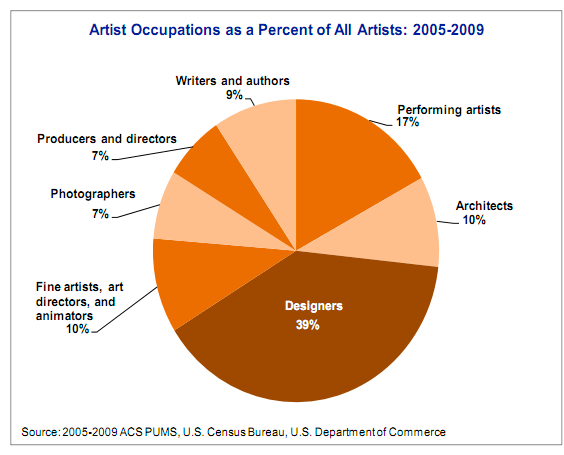
· More than a third of those artists (39 percent, or 828,747 workers) are designers—a category that includes commercial and industrial designers, fashion designers, floral designers, graphic designers, interior designers, merchandise displayers, and set and exhibit designers.*

The idiosyncratic boundaries of inclusion is illustrated here: curators and art installers (who are often artists) are not be included, yet exhibit designers are. Almost half (49%) of respondents are in design and architecture—typically salaried occupations that are quite technical. Would the announcement that “Designers and Architects have Higher Salaries” be surprising?

How many survey respondents are visual artists? Less than 10%.

· Fine artists, art directors, and animators make up 10 percent of all artists (212,236 workers).

Fine artists make up less than 10% of survey respondents.

Whether fine artists make up 1% or 9% of survey respondents is impossible to tell. It’s even possible that, in this case, “artists” means 99% non-fine artists.

Standard