Research

Identity Crisis

I don’t often cite Freud, but his concept, paraphrased by Margaret Talbot in a profile of Carrie Brownstein in the New Yorker (January 2, 2012), seems to explain the minutia and self-absorption of the banter of our modern age:

the narcissism of small differences: the need to distinguish oneself by minute shadings and to insist, with outsized militancy, on the importance of those shadings.

Standard
Art & Development

2012: grow your intelligence

Psychology professor Rodolfo Mendoza-Denton shares a nice thought about the optimism and pessimism of learning to carry into the new year. (Via Greater Good Science Center)

A key aspect of the “grow your intelligence message” is the implications it has for the experience of difficulty. If one believes that abilities and intelligence are fixed or wired in us, then experiencing difficulty on a task can only mean one thing: that one must not have the correct wiring, genetic makeup, or inherent ability to succeed at that task. It’s very easy to come to this conclusion in the face of failure: I received a message from a student of mine the other day who apologized for not doing well on an exam, and she remarked, “I must not be cut out for this.”

However, if one believes that intelligence is malleable and can grow with practice, then the very psychological meaning of difficulty changes: It now suggests you are activating your intelligence, that you are flexing and practicing your skills. Difficulty is to ability like water is to a growing plant; as such, you become resilient in the face of trouble.

[Note to self: Practice making art. Experiencing art. Having patience. Being kinder. Enacting principles. Reaching goals. Taking risks. Embracing adventure. Being grateful.]

Standard
Art & Development

2011 highlights

mirrorsblackportraittake charge of your happinesshopexpectationsleah v jessicajane v dantryn v marycwy v cwycreativity flowpositive signs 1symbolic ecologycreativity csikszentmihalyipossibilitygive thanks

mirrorsblackportrait, Rush Gallery, NYC. Thanks Hank, Natasha and Charlotte.
hopexpectation
, take charge of your happinessJenkins Johnson Gallery, NYC & San Francisco. Thanks Karen, Teresa, Alyssa and Courtney.
Dialgoues, photographed in residence atWoodstock Byrdcliffe. Thanks Leah, Jessica, Jane, Dan, Tryn and Mary.
Positive Sign #1, 6, 31, 57, SFMOMA Open Space & Steven Wolf Fine Arts, San Francisco. Thanks Suzanne, Steven and Andrew.
Creativity, Mihaly Csikszentmihalyi, Untitled Gallery, Manchester, UK. Thanks Mike and Katie.
Give Thanks, Untitled Gallery / Project Space Leeds, Leeds, UK. Thanks to Katie Rutherford and all the contributors who shared their gratitude lists with me.
Thanks also to Courtney at SoEx; Sally at Chinese Arts Centre; Christian at Invisible Venue; Hannah and Scott at DXDX Studio; Brandon; Fawn at Catskill Arts; Aaron and Jackie at MacArthur B Arthur; and Ruth, Whitney, Lauren and Jeanne at Seton Hall.

studiodovetail joint

360º view, studio and woodshop class. Residency at Woodstock Byrdcliffe Guild, Woodstock, NY. Thanks Katherine, Paul and fellow AIRs!

IPPA

Advancing my research into positive psychology at the IPPA World Congress, thanks to the generous support of a Jerome Foundation Travel and Study Grant.

art practical,should i stay or should i goart practical temporary art review art competition odds

Art Practical features: “Should I Stay or Should I Go?” and “Portrait of an Artist, Wily and Engaged.” Thanks Patricia, Vicky, Stephanie, Mike, Woff, Pablo, Emma, Torreya, Amanda, Tattfoo and Lee.
Art Practical reviews: “Residency Projects II, “Under Destruction I & II,” “From New York: Curtain Call.” Thanks Matthew and Tess.
“Art Competitions: A Selective Comparison of Applicant Pools, Awards, and Odds.” Temporary Art Review & Rejected. Thanks Sarrita, James, Tattfoo and fellow data-gatherers.
Notes on Object-Viewer Relations.” SetToSignal.com. Thanks Pablo, Brent and Alicia.

T H A N K   Y O U
~ for your support and interest in my work;
~ for reading;
~ for participating in the art community;
~ for sharing your enthusiasm!

Let me know what your 2011 was like, and what you’re looking forward to in 2012!

Standard
Research

Jim Hodges @ Gladstone, Andrea Bowers @ Kreps

I can’t bring myself to see the Carsten Höller show at the New Museum. It sounds like something I would love—
1. It’s called Experience.
2. There’s lots of mirrors.
3. There’s lots of playing with perception.

But, after Jerry Saltz’ rant, I’m afraid the New Museum will be overrun by crowds, and that it will be pervaded by playfulness and novelty that edges out reflexivity. In other words, my experience will be of a spectacle, and not of a phenomenological unravelling, of mystery unfolding into discovery, of the gradual maturity of an idea or sensibility.

While I work up my patience, I made it to see Jim Hodge’s excellent exhibitions at Gladstone Gallery (through December 23) today. At the 24th Street venue, there were three massive works, all masterfully accomplished. The first is a huge black glass mosaic tondo. During my visit it was a full circle; the website depicts the piece shown in segments. Indeed, during my visit I noticed unpainted patches on the wall, which I realize now were artifacts of this evolving display. It depicts flashes of light and sparkles, achieved only with the tile pattern. It’s spectacularly reflective and shimmering.

Adjacent to the tondo is an installation of a single, huge, slowly spinning, mirrored disco ball. Four programmed spotlights are pointed at it, so that the starry specs of light cast about the room move in multiple directions. If you’re moving at New York City speed, you’ll fail to notice that the disco ball is lowering very slowly. Indeed, if you stick around long enough, you will see it descend, unbelievably, into a circular hole jackhammered into the concrete floor, and filled with inky water. Indeed, the mirrored ball touches the surface, then becomes engulfed, achieving a slowly disappearing reflection of itself in the water, submerging completely until the room is still and dark. To transition from such a mesmerizing visual rhythm to stillness was markedly calming. Visiting galleries in Chelsea can seems like a Sisyphean task; this installation left me feeling grateful and centered.

At Hodges’ 20th Street show, I was utterly stumped by the technique behind the massive electroplated(?) boulders.

Andrea Bowers is a total beast with her graphite realism. She continues to be one of most unabashedly activist artists working today. Her show at Andrew Kreps (closing on Saturday) revisits second-wave feminist publications and posters, and combines them with devastatingly good pro-choice drawings and portraits of LGBTQ and worker’s rights demonstrators.

Ohad Meromi‘s inexplicably warm material manipulations—geometric, fundamental, recognizable, and yet fully conjectural—continue though Saturday at Harris Lieberman. A ballet bar lines the walls. Collages and their handmade plywood frames converge to become sculptural objects. A participatory “anti-performance workshop” is scheduled for Saturday 6pm.

Matthew Brannon at Casey Kaplan. Irresistible as usual letterpress/screenprints, plus 3-D translations in sculpture. The show is a crime thriller, staged in touches of fey powder pink, windowed office doors, and glossy hand-painted signs. It’s sort of literary and nostalgic and domestic. Between the pink, the letterpress, and the personally-scaled texts, I wonder if the work would be read or regarded differently if the artist was female. It shouldn’t matter, but it does. As Randy Cohen pointed out last night (at a great panel discussion at the intersection of ethics, psychology, and perception organized by No Longer Empty), a person might see clearly, but never objectively.

Standard
News

give thanks installation at untitled gallery / project space leeds

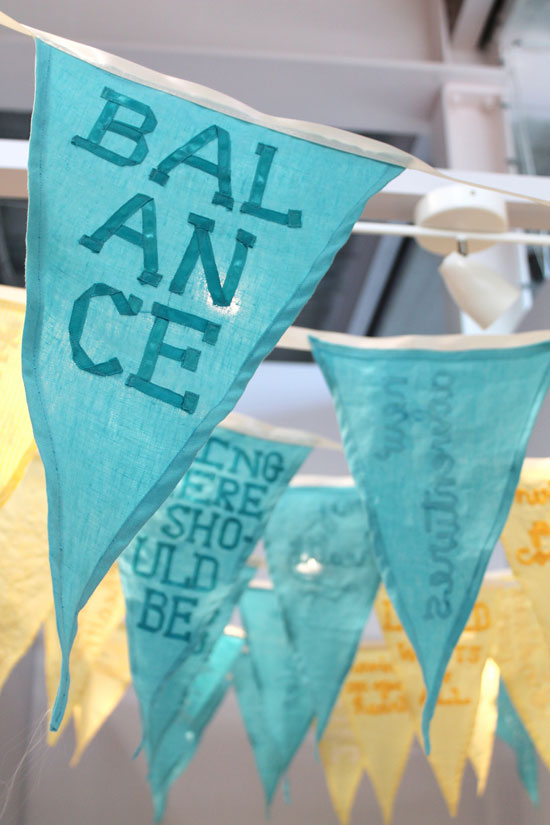
Give Thanks, 2011, site-specific installation of 39 pennant flags: satin ribbon, linen, gratitude statements, dimensions site-variable. Recently on view at Untitled Gallery @ Project Space Leeds, Leeds, UK.

Give Thanks, 2011, site-specific installation of 39 pennant flags: satin ribbon, linen, gratitude statements, dimensions site-variable. Recently on view at Untitled Gallery @ Project Space Leeds, Leeds, UK.

Photos of my latest installation, Give Thanks, now posted. Sincere thanks to Katie Rutherford and Untitled Gallery for the photographs.

Standard
Sights

see: hanna Sandin

Via Sculpture Center’s new Tumbler:

Hanna Sandin, No-good cell phone supply the coop, blocked broad well, 2010, steel, nylon coated steel cable, barrel swivels, chimney brush, squirrel barrier, birdfeeder grill, crab trap, rubber gasket, bird deterrent, steel shelving, 6’ x 12’ x 13’, installation view. Source: Sculpture Center's Tumblr.

Hanna Sandin, No-good cell phone supply the coop, blocked broad well, 2010, steel, nylon coated steel cable, barrel swivels, chimney brush, squirrel barrier, birdfeeder grill, crab trap, rubber gasket, bird deterrent, steel shelving, 6’ x 12’ x 13’, installation view. Source: Sculpture Center's Tumblr.

Hanna Sandin’s sculptures: So simple, so witty. Mobiles of mundane objects take on (typo)graphic elegance in photographed form.

More works at Sandin’s website. There’s one with a Moebius strip! And one that references plants!

Standard
Sights

XYZ: perceptions and spaces

December 7-22, 2011
XYZ:NYC 10 Downing
Leslie Eastman and Natasha Johns-Messenger
presented by No Longer Empty
10 Downing Street, West Village, NYC

A collaborative team since 2004, their work has historically focused on exploring real and perceived space through interventions in interior architecture. For XYZ: NYC 10 Downing, the pair will seek to challenge the perception of visitors through a three-part series of optical site installations designed to force visitors to experience and interpret alternate points of view.

This is a pretty great exhibition, complete with a camera obscura, perceptual mirrors-and-lights spaces, virtual reality goggles, and a Naumann-esque hallway. I heard about the exhibition via a program, wherein an NYU psychologist, the former NY Times Ethicist Randy Cohen, and the two artists shared lots of thoughts about optical and psychological perception, the ethical responsibilities of artists, and biases. It was a great talk. Eastman, in particular, had some prime nuggets:

[The exhibition] doesn’t have footnotes, but it does have references.

and

[On expanding perception through drawing:] It’s like learning to hear the bass and not just the treble.

Looking forward to more programs from No Longer Empty.

Standard