Research, Values

Cultivating Indifference to Toil

Jiro Dreams of Sushi* is a documentary film about Jiro Ono, a three-star Michelin chef who runs a small sushi restaurant in Tokyo. What emerges from the portrait is an unending search for perfection; Jiro is 85 years old and is not interested in retiring. Jiro’s philosophy of his success is pure rigor—get up and do the same thing every day, but try to make it better every day. It’s not OK to make it just as good as last time.

Westerners might call this level of commitment passion or obsession, yet Jiro seemed to transcend emotion. He didn’t seem crazy or myopic. He was just astoundingly hardworking and rigorous.

Jiro also talked about choosing a line of work and loving it, and never complaining about it. This really struck me. As an American, my conversational style is casual, emotional, and revealing. As a New Yorker, I’d love to be the New Yorker type that thinks that everything is fabulous; I’m not. And as an artist, I can feel challenged working with partners with differing time lines, communication styles, and priorities. But this is a good reminder to be grateful for all the opportunities to make art, work as an artist, and share my thoughts and projects. There is much more to think about beyond the constraints.

*Watch the trailer.

Standard
Impressions

An inspirational art collector

Via Michael Arcega:

Howard Vogel: postal worker by night (shift), art collector by day.
1922-2012

Just read about the amazing life of Howard Vogel (Matt Schudel, “Herbert Vogel, unlikely art collector and benefactor of National Gallery, dies at 89,” Washington Post, July 22, 2012). He and his wife, Dorothy, lived modestly in a NYC apartment and collected amazing works by Chuck Close, Richard Tuttle, Sol Lewitt, and many more.

The obituary characterizes couple as letting their passion for art shape their lives, despite the draw of the riches and luxuries that would have been theirs with a few choice sales from their collection. Instead, they chose to share their collection to the National Gallery of Art, where the couple viewed art decades ago, and where admission fees are never charged.

Standard
News

positive signs #34-60 on sfmoma open space

Contrary to what we usually believe, ... the best moments in our lives, are not the passive, receptive, relaxing times... The best moments usually occur when a person's body or mind is stretched to its limits ... to accomplish something difficult and worthwhile. Optimal experience is something we make happen.

Christine Wong Yap, Positive Sign #50 (Optimal experience is something we make happen), glitter pen on gridded vellum, 8.5×11 in.

Starting today, I’ll continue posting Positive Signs on SFMOMA’s Open Space blog ever other Wednesday. Look for #34-60 to take a deeper look at flow, hope, autonomy, and aesthetic experience.

See all Positive Signs to date.

Through September 26, 2012: every other Wednesday
SFMOMA Open Space

Standard
Sights

how’s this for irrational exuberance

I am working on projects relating to the themes in Irrational Exuberance (Asst. Colors), a shop-like installation of modest ambitions and accessible pleasure. This video of last night’s fireworks show in San Diego, in which all of the pyrotechnics were accidentally activated all at once, instead of a leisurely, choreographed set, sort of captures the mood: perhaps a bit daft, yet irrepressibly cheerful.

Standard
Impressions

Coney Island Museum Postcards

I finally visited Coney Island. Interested in the site’s history, we went to the Coney Island Museum (which also houses the Side Show, where tattooed punks and burlesque fire-eaters find gainful employment). It’s a very small museum, but worth the $5 admission fee if you’re a fan of:

outsized theatrical productions (a wall of photos documents the over-the-top performances that Coney Island was once known for, each one with hundreds of actors in Biblical disaster scenes),

graphic design (each ride featured their own beautifully printed, die cut tickets),

hand painted signs, which lined the rises of the stairwell,

tchotchkes (historical souvenirs included flip books and a pennant flag, a shape I’ve been working with a lot!),

funhouse mirrors (some things never get old), and last but not least,

artist-created museums. Like the Museum of Jurassic Technology in Culver City, CA, parts of the Coney Island Museum seems largely the work and invention of one Aaron Beebe, an artist who lovingly created a cosmorama (like a cyclorama, but not all the way round) of the great Dreamland fire.

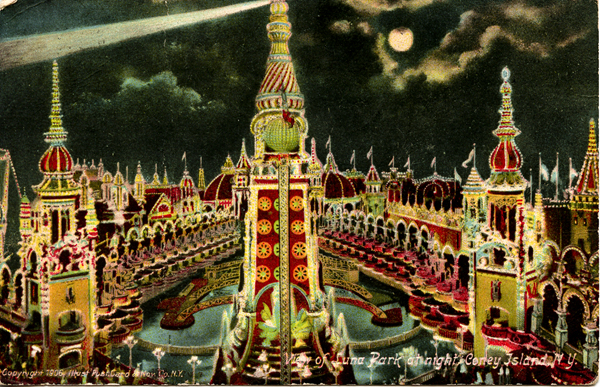
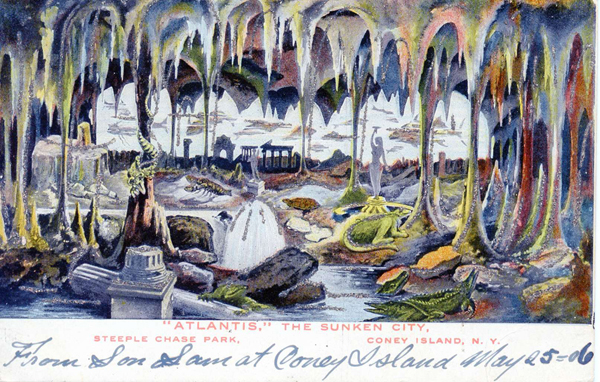
My favorite part was a series of vintage postcards in velvet-lined displays set into the wall. Flip a switch, and a light comes on, revealing the postcards’ delicate illustrations of historical Coney Island scenes. Flip the switch again, and the postcard becomes back-lit. This is the postcards’ ingenious second view: the same scene at night, illuminated by electric lamps and moonlight! Tiny die cuts form colored paper windows that glow when backlit. It’s brilliant, and preceded, unknowingly, my Lens Flare (Miniature Multiple) project.

I couldn’t find pictures of the backlit postcards, but enjoy these, via astropop.com:

View of Luna Park at Night, Coney Island. Credit: Postcard courtesy of The Coney Island Museum // Image source: astropop.com.

View of Luna Park at Night, Coney Island. Credit: Postcard courtesy of The Coney Island Museum // Image source: astropop.com.

"Atlantis," The Sunken City, Steeplechase Park, Coney Island. Credit: Postcard courtesy of The Coney Island Museum // Image source: astropop.com

“Atlantis,” The Sunken City, Steeplechase Park, Coney Island. Credit: Postcard courtesy of The Coney Island Museum // Image source: astropop.com

For more postcard images, visit astropop.com/coney/.

Standard
Sights

The Third Paradise presented by Cittadellarte – Fondazione Pistoletto

I love Italian Arte Povera artist Michelangelo Pistoletto’s screenprints on mirror-polish steel.

I also really enjoyed theorist Claire Bishop’s book, Installation Art: A Critical Survey (Routledge, 2005).

While Pistoletto is well-known for his mirror pieces, he has also been creating Cittadelarte, a non-profit with numerous working groups re-imagining art, life, work and more. I’m not quite sure I understand what it is, as much as glean a sense of revolutionary possibility from it. I thought I’d visit if I ever make my way to Italy, but it turns out I don’t have to go there to participate. See below for a worldwide Cittadelarte participatory program coming this December.

Bishop, on the other hand, is no fan of participatory art, and is in fact launching her latest book, Artificial Hells, at CUNY’s Martin E. Segal Theater tomorrow night.

Hold these opposing thoughts in your mind, if you can:

June 26, 2012, 6:30–7:30pm
Artificial Hells Book Launch
Martin E. Segal Theatre, 365 Fifth Avenue, New York, NY 10016

A searing critique of participatory art by an iconoclastic historian

Join art historian Claire Bishop and Carrie Lambert-Beatty in conversation at the Martin E. Segal Theatre to celebrate the launch of Bishop’s new book, Artificial Hells: Participatory Art and the Politics of Spectatorship.

Since the 1990s, critics and curators have broadly accepted the notion that participatory art is the ultimate political art: that by encouraging an audience to take part an artist can promote new emancipatory social relations. Around the world, the champions of this form of expression are numerous, ranging from art historians such as Grant Kester, curators such as Nicolas Bourriaud and Nato Thompson, to performance theorists such as Shannon Jackson.

Artificial Hells is the first historical and theoretical overview of socially engaged participatory art, known in the US as “social practice.” Claire Bishop follows the trajectory of twentieth-century art and examines key moments in the development of a participatory aesthetic. This itinerary takes in Futurism and Dada; the Situationist International; Happenings in Eastern Europe, Argentina and Paris; the 1970s Community Arts Movement; and the Artists Placement Group. It concludes with a discussion of long-term educational projects by contemporary artists such as Thomas Hirschhorn, Tania Bruguera, Paweł Althamer and Paul Chan.

Since her controversial essay in Artforum in 2006, Claire Bishop has been one of the few to challenge the political and aesthetic ambitions of participatory art. In Artificial Hells, she not only scrutinizes the emancipatory claims made for these projects, but also provides an alternative to the ethical (rather than artistic) criteria invited by such artworks. Artificial Hells calls for a less prescriptive approach to art and politics, and for more compelling, troubling and bolder forms of participatory art and criticism.

Via Art Agenda:

21 December 2012
Michelangelo Pistoletto

The Third Paradise
cittadellarte.it
rebirth-day.org

Rebirth-Day: the first worldwide day of rebirth
A great celebration throughout the world—a vital, living, breathing symbol of a new beginning.

December 21st, the winter solstice in the northern hemisphere and the summer soltice in the Southern, is a day celebrated by mankind since time immemorial.

A fateful “end of the world” connotation, as widespread as it is unfounded, has been attributed to this day in 2012, proposing a theme that is recurrent in mythologies and religions as well as in the literature of fantasy and science fiction.

All imaginative factors aside, this date can take on a symbolic meaning, as it effectively corresponds to a climactic phase of human history. We are progressing steadily toward an inevitable collapse—the science is there to prove it.

The whole of human society is now in the reckoning and so must face a historic transition, a complete change.

Humanity has gone through two paradises. The first, in which it integrated fully with nature; the second, in which it expanded into an artificial world of its own, which grew until it came into conflict with the natural world. It is time to begin the third stage, in which humanity will reconcile and unite nature and artifice, creating a new balance at every level and in every area of society: “an evolutionary step in which the human intelligence finds ways to live in harmony with the intelligence of nature” (Michelangelo Pistoletto).

A new perspective opens up that involves everyone, without exception, in the daily effort to implement the process of rebirth—each according to his or her abilities and possibilities.

On 21 December 2012, let us meet in streets and squares all over the world, and on the Web, to take part in the great inaugural celebration of the Third Paradise.

Participation in the Rebirth-day represents a personal commitment to the process of change….

Standard
Citizenship

Ai Wei Wei: Never Sorry

Courage is envisioning and articulating freedom that is yet to be actualized. Angela Davis talks about this—imagining change is the first step of making change. One year after his release following months of detainment without due process, Ai Weiwei wrote:

I often ask myself if I am afraid of being detained again. My inner voice says I am not. I love freedom, like anybody; maybe more than most people. But it is such a tragedy if you live your life in fear. That’s worse than actually losing your freedom.

…none of us have been dealt with through fair play, open trials and open discussion. China has not established the rule of law and if there is a power above the law there is no social justice. Everybody can be subjected to harm…

Stupidity can win for a moment, but it can never really succeed because the nature of humans is to seek freedom. They can delay that freedom but they can’t stop it.

(“Ai Weiwei: to live your life in fear is worse than losing your freedom,” Guardian, June 21, 2012):

Further, even as a known target of one of the world’s most secretive and repressive governments, Ai remains an optimist:

What I gained from the experience is a much stronger sense of responsibility, and an understanding of what the problems are and how one can understand what’s happening and remain a positive force. You have to see your own position from the other side. At the same time you have to maintain a passion for what you are doing. You have to have sensitivity and joy. If you don’t have that, you will be like a fish on the beach, drying up on the sand….

Standard