Click on the thumbnails below to see the full-sized images in a new window. Please be patient, the galleries are 300-500 kb.
FRED FESTIVAL

PLACES
Cumbria

Manchester

London

ART

SIGNS
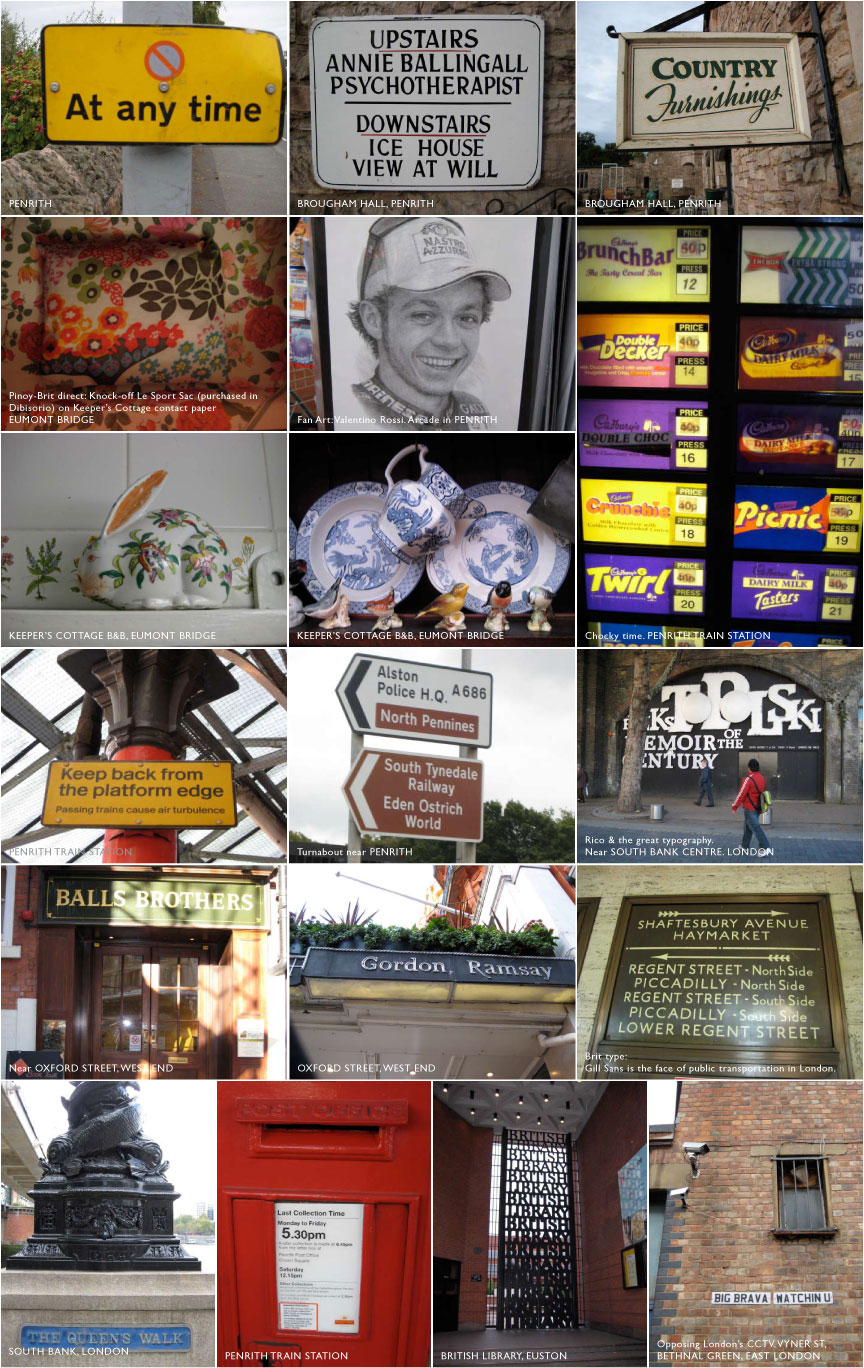
TASTES
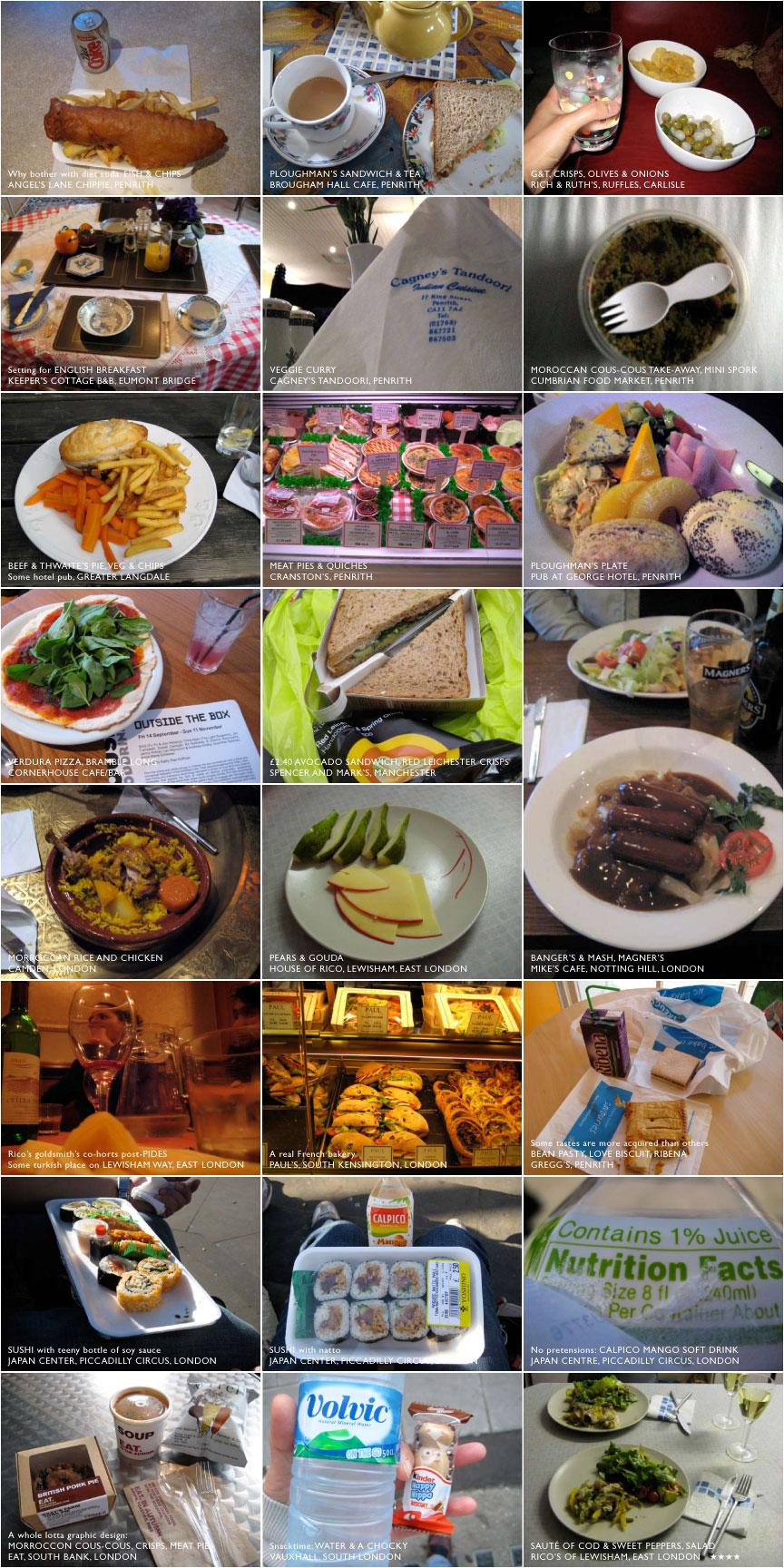
Click on the thumbnails below to see the full-sized images in a new window. Please be patient, the galleries are 300-500 kb.
FRED FESTIVAL
PLACES
Cumbria
Manchester
London
ART
SIGNS
TASTES
My last day of four in London. Too premature to sum up any concrete ideas. Immediate impressions follow:
-Manchester’s great. I was really impressed with the city’s investment in culture. Saw “Outside of the Box,” a knock-out show of media art at Cornerhouse, an contemporary art gallery and film hub, as well as a cool retrospective of work by SF-based Lynn Hershman Leeson at the Whitworth Gallery at the University of Manchester. I was so impressed with the city’s vibrance that I found the constant refrain that Manchester was trying to shake off its industrial reputation to seem outdated, but a Londoner’s slight scoff at Manchester proved me that other minds have yet to be opened.
-London has looked like this in my visit:
–Lewisham Road feels remarkably similar, at least on appearances to parts of Brooklyn: lots of immigrants from all over the world, internet cafes/call centers, low storefronts with lightboxes, fried chicken, mattress retailers. Of course on the other side of Lewisham Road is Goldsmith’s, where I’ve stumbled upon a small community of Filipino and Fil-Am expats. How funny it is to sit in a Morrocan cafe in punk-rock Camden-town and listen to Taglish.
–Quiet opulence everywhere. The city is not especially pretty, but the remarkable architecture always gives me an awareness of a sensibility of being in the seat of an Imperial power, however faded it may be in the shadow of the U.S. superpower. Even as I snap my tourist photos of Parliament and Big Ben, I’m thinking: what were the conditions that made all of this possible? The finest building materials: gold, marble. The huge consumption of tea from China, chocolate from Latin America, sugar from the West Indies? I like the idea that somehow I can subvert something by being here and sitting in Royal parks, walking through the free museums… but of course what’s more important is what I can bring home as a citizen, not just a consumer, of the United States.
I was startled and amazed and angered when, lost in the Victoria & Albert Museum in London’s swank South Kensington, I stumbled upon a view of two great halls. In one hall sat two monumental columns, which soared to the atrium several stories above. They were the two halves of Trajan’s Column, built in Rome in AD 131. On the other side sat a conservatory for antiquities, with a replica of Michalangelo’s David sitting among dozens of partially crated busts, statues and reliquaries. The view of these priceless antiquities was awe-inspiring. And I mean awe in the sense of terrific, and terrible. I am only surmising the conditions that made it possible for the Column to be cut in half and moved to South Kensington from Rome. And there are so many layers of meaning to explore: the collapse of the Roman empire, the past greatness of the British Empire, the vulnerability in the consolidation of wealth and power of that magnitude.

My DIY Burtynsky. Visited the Mall of America — mega-church of consumerism and diversions — on an unplanned overnight layover in Minneapolis (Tip: Flying to London? Fly direct and avoid Northwest Air).

The wealth of nations at the Victoria and Albert Museum.
–In addition to some art and history museums, I’ve been visiting as many contemporary art spaces as possible, seeing everything from Doris Salcedo’s unsettling exhibition at White Cube on Hoxton Square to Ed Ruscha’s stunning watercolors at Gagosian on Oxford street — about £1m in small photorealist watercolors were watched over by two suited and booted guards who found my photo-taking suspicious — to group shows at Alma Enterprises, which has all the atmosphere of a decaying public high school, in up-and-coming Bethnel Green. The standout space, however, is inIVA, the Institute for International Visual Arts, spearheaded by an international consortium of artists, thinkers and business leaders of color. It’s brand new, on a smelly alley in Hoxton, with a largish gallery, project space, and library that collects catalogs by artists of color only. I love it. It’s a beautiful building in a great location with top-notch art and huge potential to be a formidible force in London, and hopefully, the world. I find it hope-inspiring.
Rico Reyes (artist, curator, theorist and my generous host in London) and I had the good fortune of participating in Leticia Valverdes’ project, “Is London the Place for Me?” As I’ve been travelling and shooting photos of landscapes of sheeps and stone walls, neo-Gothic cathedrals and plates of bangers and mash, I’d been wondering how much I’m looking for experiences that fit my expectations of England, instead of seeing England as it is. But with Valverdes’ props and a digital studio, we were able to play with the cliches. We placed ourselves — Chinese American and Filipino American artists — into a tea room designed to display wealth and refinement. It’s a simple, ironic gesture, and I enjoyed it very much.
Visuals will be uploaded in mid-October, but here is an interim post.
-Participating in the FRED festival looks like:
–Hanging out in Brougham Hall, the fortified castle that dates back 1600 years ago to the Roman days. It’s currently undergoing private reconstruction under the leadership of Mr Christopher Terry, a delightful Englishman, world traveller and architect. Mr Terry took me to see the Lake District, past the beautiful lakes Ullswater and Brotherswater, and over the Hardknotts Pass, where we could see 20 miles to the Irish Sea.
–Meeting a few other artists involved with FRED, such as Sally Barker, who has made sculptures of poo and set them out along a beautiful creek and waterfall outside of Sticklebarn(?) Tavern in Great Langdale, Kate Gilman Brundrett, who developed the Ministry of Creative Parking for the parking-starved town of Penrith, and Tony Charles, who makes his own pigments out of steel rust and created a marvelous floor pattern in the art college, which is housed in a former steel mill. And I also enjoyed painting rocks to assist Kate Raggett with her piece, which involved hauling 5,000 stones up the side of a hill behind a mining museum into sheep grazing territory, and arranging it into a design that can be seen from miles away, such as at the Castlerigg Stone Circle.
–Staying at the Keeper’s Cottage B&B, which was actually the gamekeeper’s cottage during Lord Brougham’s time. Pam and James Wright maintain it now as a beautiful, homey cottage, and the little touches in the decor are adorable. The view outside my window is picture perfect: a farm with sheep and what looks to my city-slicker eyes as Shetland ponies, walls of slate cutting up the green fields. The breakfasts of Cumberland sausage and bacon (what we Yanks call ham) and eggs and toast with homemade marmelade are fantastic…
This year, I’m lucky enough to travel abroad twice. In a few days, I’ll be off to the UK. It’s my first time across “the” pond. I’m going to be an artist in FRED, the annual art invasion of Cumbria. Then I’m going to see as much art in Manchester and London as possible.
I feel lucky to be an artist who makes a living as a self-employed graphic designer. Still, having tasted the life of a full-time artist during my trip with Galleon Trade, I want more. And that’s another reason why being an Affiliate Artist at the Headlands is so great — sure, there’s the studio, the awesome environment, the community, but I’ve also been savoring the osmotic zone of artists-in-residence. The AIRs are there to have time and space to experiment and develop, and appear to be happily spending their days and nights thinking about, talking about and making art. I find myself wondering, What would it be like to wake up in a secluded place, and in the quiet of the morning, wander over to the studio and see where the day takes me?
I’m starting to think of these opportunities for international travel as Temporary Autonomous Zones (TAZs) as an artist. A while ago, I worked with Underground Railroad, a collective of cultural workers who theorized that, while we lived in a country that lacks physical TAZs (Not counting Burning Man — I mean those accessible to young urban POCs), cultural events could be transient TAZs. The vision was that a taste of being free would lead towards expansions in duration, until soon enough the TAZ would be round-the-clock and migrate beyond its four walls.
I love this idea’s elegance — its sense of natural momentum. It’s not about the fear of failure driving one to a necessary optimism. Rather, the potential is just too good to pass up.

Carlos Celdran’s Living Room in Manila.
Galleon Trade’s home base in Metro Manila was also an artist’s residency and alternative arts space. It’s a large, beautiful room with a view of Roxas Blvd (which is sort of like Venice Beach) and the South China Sea. When a spacious, well-appointed room with lots of light is the first ingredient in building an artistic community, it shores up the importance of ‘home.’

My shot of Poklong Anading’s installation at Finale Gallery in Megamall.
Stephanie Syjuco is on the outside looking in, a fitting symbol, I think, for the experience that many of the US-based artists engaged as visitors to the Filipino art community.

It ain’t a party without pancit. It’s plenty surreal to attend an art opening in a mall — let alone one accompanied with pancit, chicharron, queso-filled lumpia and fried broad beans. And red wine, touché.
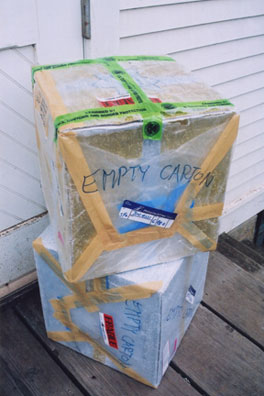
Balikbayanned. After a magical 10 days in Manila, re-entry to the US — the banalities, the rat race, the predictability — was rough. Similarly, the balikbayan boxes in the Regalos project went through their own ordeal as Galleon Trade mastermind, Jenifer Wofford, attempted to repatriate them via Air Cargo. As a transit-specific project (as described by scholar Eric Estuar Reyes), these new marks of transit bring the work to a different stage of the project. I’m looking forward to showing these works to a local audience at the Euphrat Museum in October.
The Regalos Project
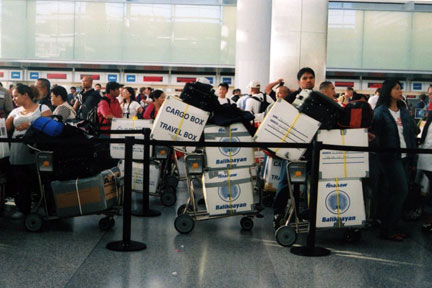
Context: Balikbayan* boxes and their owners at the Philippine Airlines counter at San Francisco International Airport. These boxes, and dozens more, were on my flight to Manila. In a testament to the impact of balikbayan boxes, their additional weight was enough to necessitate a re-fueling stop in Guam.
*Literally, “going home.” Can refer to (1) standardized cardboard boxes for shipping gifts to the Philippines or (2) overseas Filipinos returning to the islands.
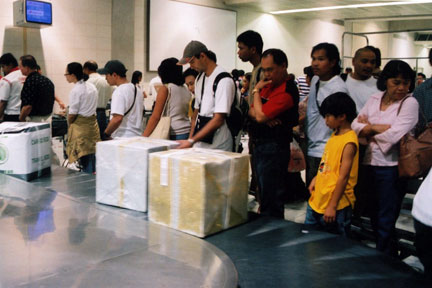
Process: My empty, glitter-covered balikbayan boxes for the Regalos project generated curiosity at the baggage carousel at Ninoy Aquino airport (MNL) in Manila.
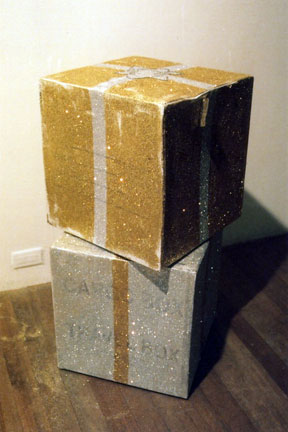
Product: The Regalos boxes on display at Green Papaya Art Projects in Quezon City. Some of the glitter was lost in transit, suggesting the entropy between giver and receiver or intention and material. I really liked how Eric Reyes, one of our academic counterparts in Galleon Trade, put it: “It’s not so much a site-specific project, as much as a transit-specific one.” He liked that the work showed marks of transit, and which I think reflects his interests in imperialism and migration.
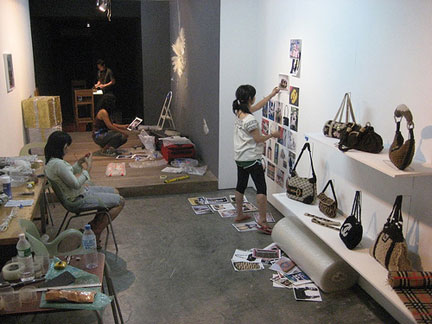
Installation at Green Papaya Art Projects, with Mike Arcega, Stephanie Syjuco and Reanne Estrada. Photo: PeeWee Roldan.
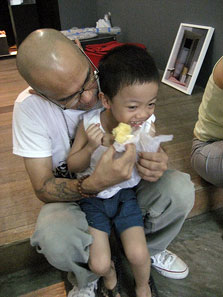
Family moments: Artist and Green Papaya Art Projects owner Norbert “PeeWee” Roldan and his son Joaquin share an ensaymada, a cheese-covered brioche. The ensaymadas were delivered by a relative of Galleon Trade artist Mike Arcega. Photo by Stephanie Syjuco.
In addition to interfacing with Filipino artists, I also took Galleon Trade as an opportunity to get to know and work with the other Galleon Trade artists, many of whom are busybusybusy back in the US. Being part of the Galleon Trade show at Green Papaya was awesome on all accounts: the exhibition was professional and it gelled curatorially (thanks to the planning of Jenifer, Mike, Stephanie, Eliza Barrios, Megan Wilson and PeeWee Roldan). And throughout the installation, when we gave each other honest feedback and discussed the works’ meanings and contexts, I thought to myself, “This is what it’s really about.”
Sights

Jenifer Wofford is right: A tabletop book on Filipino street graphics is long overdue. As an enthusiast of typography and scripts, I enjoyed all the hand-painted signs, plump cursives, and florid jeepney ornamentation. Jeepneys are a quintessential Filipino mode of transportation; leftover from the U.S. occupation, jeeps have been assimillated as a key form of cheap public transportation. Jeepneys are loud, noxious, and–as any resident of congested M. H. Pilar Street in Malate, Manila might think–overabundant. Yet somehow, it works perfectly: they’re fast, the open windows provide a natural breeze, and there’s an unspoken honor system for passing the fare from rider to rider until it reaches the driver. They’re also richly decorated with spirit and personality, featuring everything from names of overseas workers to airbrushed murals (motorcycle riders or space scenes, for example). The mix of colorful typography with reflective metal is especially irresistible.
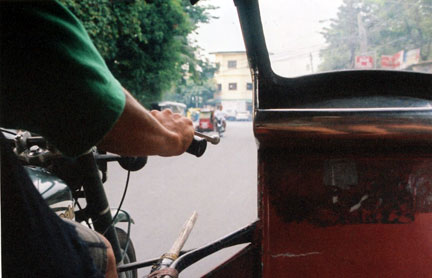
Though Manila’s traffic puts even the Bay Area’s congestion into perspective, there are lots of options for getting around, and some of them–like the tricycle–are lots of fun. The tricycle is actually a small motorcycle with a sidecar of welded steel for passengers. Riding through Teacher’s Village to have merienda (afternoon snack, including dinuguan and puto–pork blood soup and steamed rice muffins) at Mike Arcega’s tita’s house inspired a moment of sincere gratitude.
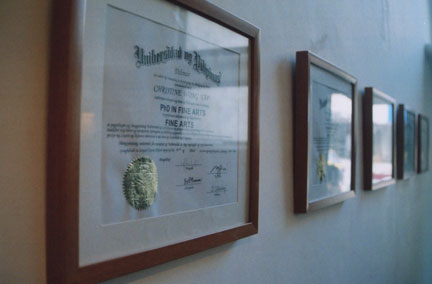
My honorary PhD in Fine Art from the University of Philippines, Diliman. The degree doesn’t actually exist; Mike Arcega had conterfeit diplomas made for the artists in the Green Papaya show to explore native economies.
Tastes

Classic homemade Filipino food (and drink) (clockwise from bottom): bangus (fried fish), some of the sweetest, tenderest chicken and pork adobo (vinegar and soy sauce stew) I’ve ever tasted, kare-kare (peanut-sauce stew), rolls of sweet rice, and San Miguel beer. On the first night I arrived, PeeWee Roldan, artist and owner of Green Papaya Art Projects, hosted a beautiful welcome dinner. Gaston Damag‘s sophisticated artwork lined the walls, and we enjoyed a low-key homecooked meal before the madness of daily openings and lectures.

Galleon Trade artist Jaime Cortez camoflages with the Aristocrat Restaurant, “The Philippines’ most popular restaurant,” which also happened to be next door to our home base. Jaime shares a plate of eggplant-tomato-onion salad, which, when stirred, surprisingly resembles salsa — except with baggong (shrimp paste).

In a country of round scoops of rice, square blocks stand out. mag:net High Street in ritzy Fort Benafacio keeps it cubic. Beef mechado (tomato-based stew), adobo quail eggs, and a light sangria. Lovely.
Tourist Trap

This small piece of paper cost me quite a bit of worry.
I saved 650 pesos for the airport exit fee, but the rate had just been raised from P 550 to P 750, and the booth was strictly cash-only. I was short 100 pesos, which translates roughly into US $2. The situation became worrisome when the airport’s two ATMs wouldn’t accept my card. Worse, I carried a traveller’s check that had been utterly useless in the Philippines. Ironically, the airline supervisor said that since this happens so often, PAL no longer keeps a petty cash box to help out their passengers. Instead, he suggested that I borrow money from other passengers and pay them back on US soil. (A bad idea — there wasn’t actually an ATM and retailer to make change at the arrival area at SFO.) Luckily, a sympathetic traveller freely contributed pesos to my (mortified) relief. Whew!
The funny thing is, so many taxes are tacked on to airfares, I probably wouldn’t have thought twice about a $17 fee on top of my ticket price. But the current system creates these mini-fiascos. For all the high technology involved in running an airport, is a credit card machine too much to ask?
Sounds
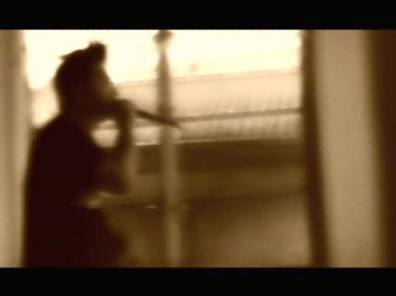
[Image from Romeo’s youtube video. Video by Eliza Barrios.]
Romeo Candido’s impromptu performance / goodbye gift to the Galleon Trade artists at The Living Room was really moving. With only two instruments — his voice and a loop pedal — Romeo created a full composition that crystallized a passing moment and brought everyone present with beauty. Romeo is a very talent filmmaker from Toronto working in Manila, and just by chance he happened to be in residence at The Living Room. I think almost all of the Galleon Traders were delighted by the affinity in our practices as North American artists trying to make a deeper connection to the contemporary arts in the Philippines.
The heart of the Galleon Trade exchange exhibition is face-to-face contact. I feel extremely lucky to be one of the nine California-based artists who were able to pull away from busy-ness in the States to interface directly with Manila’s artists.
A few memorable sites/situations:
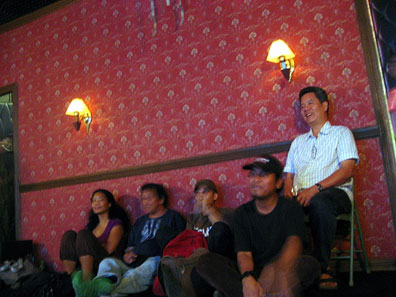
[Mogwai screening room: (l-r) Reanne Astrada, Romeo “the oldest punk rocker” Lee, two Filipino artists–one named Jet and another whose name I can’t remember–and the artist Gerry Tan. Photo by Stephanie Syjuco.]
Cubao X slide show. A self-organized presentation of work by contemporary Filipino artists at Mogwai, a brand-new, hip café with a sleek upstairs screening room. Cubao X is a locus of galleries, design shops, comic book stores and restaurants that once housed artists studios, and before that, the Marikina Shoe Expo. Though local artists are ambivalent about the displacement of artist’s studios for artsy commerce, I was still impressed that the owners of Mogwai made the glam screening room available for an artist slide show.
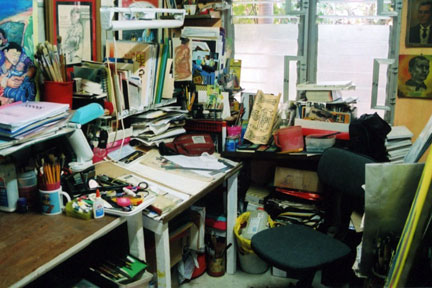
Cavite studio. Emil is a social realist painter and installation artist, and a longtime activist. The social change of the 1960s in the States seems so distant to me, but for Emil, the Philippine’s people power movements of the 1970s and 80s are part of his personal and artistic history. Emil is also my cousin.

[Poklong Anading, Untitled Gaze, 2007, Photographic Transparency, 90 x 192 inches. From Finale Gallery]
Megamall closing. I had the good fortune to attend the closing reception of Poklong Anading’s exhibition at Finale Gallery in Megamall in Manila. (Yes, there is a mall called Megamall, and yes, it’s common and unsurprising for Manila’s commercial galleries to be located there. The location is apt, since malls offer a clean, air-conditioned escape from the chaotic, humid streets outside.)
Poklong makes top-notch object- and photography-based relational art. On display at the closing was a back-lit, life-sized photograph of viewer’s backs as they packed the narrow storefront gallery during the opening. Inside, an oversized mousetrap made of neon and cement hummed with an audio track of chatter. I thought the work was elegant and smart. It expressed Poklong’s ambivalence on the social nature of art openings and the commercial context of the gallery (mall signage could be seen in the reflection of the windows in the photograph, and it was mimicked in the neon sculpture). On another level, to look at the photo resulted in a curious effect of being physically outside of the gallery as well as the a circle of opening attendees photographed.
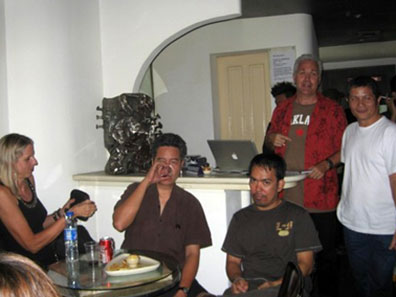
[Artists and audience at the ArtGrill: (l-r) Galleon Trade artist Johanna Poethig, Gerry Tan, yet another Filipino artist named Jet, sound artist Chris Brown, and artist and mag:net gallery owner Rock Drillon. Photo by Eliza Barrios.]
Q. C. Q&A. mag:net café Katipunan in Quezon City (Q. C.) held an ‘ArtGrill’ featuring in Galleon Trade artists. I’m glad I had the chance to contextualize my Regalos project, as it helped people like Gerardo Tan, a conceptual artist and Dean at the University of the East College of Fine Arts, to better appreciate my ideas. It was also really nice to hear my fellow artists talk about their work. For example, Stephanie Syjuco, who left the Philippines as a young child, discussed her work in relation to forging/counterfeiting her identity, which took on new meaning in the context of the Philippines.
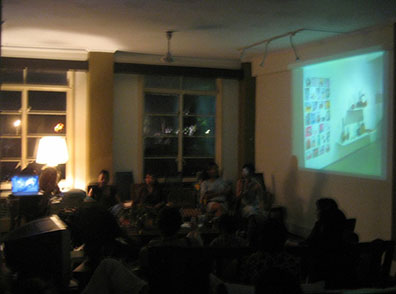
[Artists’ Salon at The Living Room, hosted by Carlos Celdran. Photo by Stephanie Syjuco.]
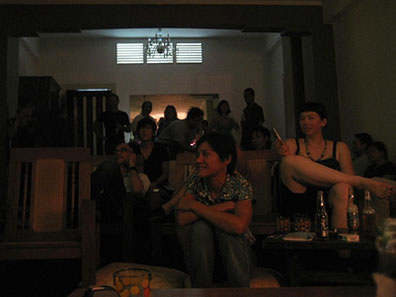
[Audience. Photo by Stephanie Syjuco.]

[Carlos Celdran checks the projection. Photo by Eliza Barrios.]
Malate Salon. Carlos Celdran did a fabulous job leading the discussion at The Living Room, an alternative space and art residency. With his familiarity with critique that seems more Western than Filipino, Celdran pressed the Galleon Trade artists with very thoughtful questions. He asked me about the cultural appropriation of using balikbayan (literally, “going home”) boxes. I took it as an opportunity to pursue a question that Carlos constant poses about art: “Is it Filipino?” People always asked how many Galleon Trade artists are Filipinos or Fil-Ams. I also found the constant discussions about who does or doesn’t look Filipino very curious—after all, Filipinos, more than Americans, have a broader understanding of Chinese and Spanish influences in Filipino blood. So I found it interesting that as a Chinese, I would be appropriating the balikbayan box, while my intention was to express my skepticism of my contribution as an American.
Afterwards, during a surprise birthday party for me (lucky me!) the Galleon Trade artists had the honor of having our photo taken by Juan Caguicla, an incredible photographer who happened to be renting us a room down the hall.
More words and pictures to be posted soon. In the meantime, see pictures and posts about the Galleon Trade expedition at:
Official Galleon Trade news blog
Jenifer Wofford’s blog, Wofflings
Claire Light’s blog, Atlas(t)
Four days into my 10-day sojourn in the Philippines as part of Galleon Trade, I’d like to take a break to consider generosity and joie de vivre.
I’m really impressed with the amazing people I’ve met, such as the artist-gallery owners presenting the Galleon Trade exhibitions: Norberto “PeeWee” Roldan, an artist and designer who runs Green Papaya Art Projects, and Rock Drillon, an artist who runs the mag:net cafe.
Filipinos are famous for their hospitality, and combined with the professionalism and generosity I’ve experienced from our collaborators, I can’t say enough how nice it has been here. The gallery owners have really extended themselves to help create the exhibitions we envision, ensure local publicity (photos and articles in the Philippines Daily Star and Inquirer), and arranging for rock and experimental sound bands to play at the openings. We’ve also had the honor of landing at The Living Room, an alternative space run by Carlos Celdran. I have heard nothing but amazing things about Carlos’ tours (from Lonely Planet as well as individuals), and my experience on the Intramuros tour with Carlos even exceeded my high expectations. He conveyed a very complex history with pride, pain, humor and characteristic style. He made the sense of loss of his beloved city (after Gen. MacArthur’s carpet-bombing of the jazz-age city known as the ‘Pearl of the Orient’) tangible, yet the talk encompassed Filipino spirit and spirituality.
While class divides allow only a fraction of Filipinos to afford the lifestyle we are enjoying as American visitors, I have to say that I have developed a fondness for Filipino joie de vivre and patience (though dozens of jeepney and taxi drivers might be honking at each other non-stop, none seem to be angry). I can’t remember the last time I sat down to coffee in little cups and saucers to have a quality conversation, but here it seems to happen at least once a day. Maybe it’s because we’re guests on a short visit, but the small moments of mutual exchange underscored by generosity are very sweet and inspiring, and hopefully I can pull away from multi-tasking back home long enough to re-create them.
 R+D
R+D 