Research, Travelogue

NYC Art

Some NYC highlights:

The kindness of friends and fellow travelers

The easy loquaciousness of a city of professional talkers

Brilliant people and their sincere enthusiasm to share industry insights

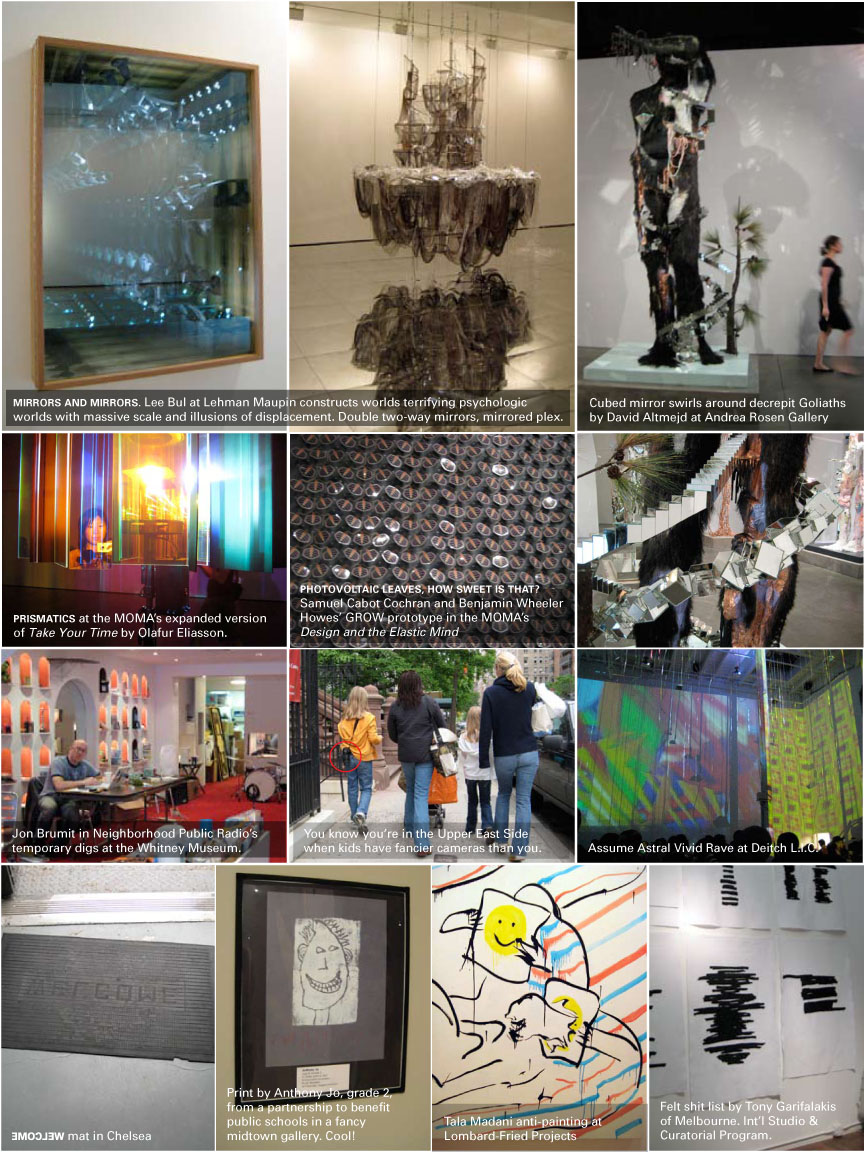
Surprising phosphorescent rubber sculptures by Jeanne Silverthorne at McKee Gallery.

The psychologically pregnant, tough and beautiful sculptures by Lee Bul at Lehmann Maupin Gallery

The strange giant figurative sculptures in unexpected media by David Altmejd at Andrea Rosen Gallery

More (yes, more!) Olafur Eliasson art at MOMA and PS1. Yes, the big rotating mirrored ceiling is impressive, but so are the kaleidoscope windows and color spectrum screenprint series.

Neighborhood Public Radio‘s quirky storefront broadcast studio and friendly faces at the Whitney Biennial

The videos at the Whitney Biennial:
Javier Tellez’ blind people and an elephant,
Omer Fast’s exploration of memory with a soldier’s narrative,
Mika Rottenberg’s chick/chicken coop installation/video, whose video/installation at the Tate Modern last fall was extremely enjoyable as well,
Spike Lee’s When the Levees Broke.
Also,
Ellen Harvey‘s Museum of Failure, which expresses her skepticism of art’s capacity in light and mirrors,
Heather Rowe’s Screen for the Rooms Behind,
photographs and shipped glass Fed Ex boxes by Walead Beshty

Vlatka Horvat’s temporary text-in-nature performances photographed and on display at Neuhoff Gallery

A delightful taste of sad-sack SF humor at Apex Art‘s Lots of Things Like This, a group show curated by Dave Eggers with Tucker Nichols and

Cao Guo-Qiang at the Guggenheim. Great use of the space. I loved the discreet installations in the wings, such as the shipwreck of china plates and cups, and the river constructed of yak skin with live snakes.

New York Magazine‘s fantastic graphic design

The International Studio and Curatorial Program‘s great new building in East Williamsburg, and esp. Satoshi Hashimoto for his futile video in which he buries himself in dirt.

Yoko Ono at Galerie Lelong
(A tangent: My mother loved the Beatles. She was introduced to their music by her Adult Education English instructor. She loved John Lennon’s voice, but she was also impressed that regardless of his wealth and fame, he married a Japanese woman. It was proof that anything is possible in America. Little did my mother know about Oko’s influence in Conceptual Art and Fluxus.)

Substraction, the surprising and humorous show of giant Ab Ex paintings at Deitch Projects.

Marco Breur & Arnold Helbling mail art with chromogenic paper at Von Lintel Gallery

Vintage Robert Colescott videos and mockumentary at Kravets Wheby

Some low-lights:

Overpriced food and coffee that tasted like coffee-flavored beverage.

Loads of corporate and secondary market galleries selling historic paintings by white men from the 20th century, as recent as the 1970s.

Standard
Research

Cotter on Eliasson

Holland Cotter’s review of Olafur Eliasson‘s show (nytimes.com, April 18, 2008 ) at the MOMA and PS1 includes elegant observations.

Eliasson’s art is highly perceptual, often involving optical illusions, so the viewer’s task is refreshingly straightforward. Cotter explains:

…like certain kinds of jazz, or ragas, or New Age ambient sound, this is an art of variation rather than destination. It lays out a visual theme, then asks you to wait, watch, wait some more and discover things happening.

Check this out. Poke your head in here. Slow down.

I think viewer-centered experiential art can be very generous to viewers, but Cotter susses out a nuanced indifference:

Like abstract painting, Mr. Eliasson’s art can be slow to reveal itself. In an installation called “Beauty” a rainbow emerges from a curtain of mist and vanishes. Maybe you see it; maybe you don’t.

I really enjoyed Eliasson’s show at the SFMOMA. First, I was proud that a the first retrospective of such an important contemporary artist was organized in our home city. Second, it was a surefire crowd-pleaser. The exhibition reminded me of San Francisco’s Exploratorium—light, color, play, wonder—but where the Exploratorium is dark, whirring, and a little musty and nostalgic, Eliasson’s show was bright, contemplative, straight as an arrow.

It’s a fun, pleasurable show, that appeals directly to audience members, regardless of what they think of or know about contemporary art. I can’t remember the last time I could whole-heartedly endorse a show for artists and non-artists alike.

Still, Cotter’s a professional, and he offers one more insight:

A fair amount of his work, in a witty way, is about disruption and disorientation. Rooms tilt; doors are not doors. At P.S. 1 a waterfall flows upward; a rotating metal fan, propelled by its own wind power, swings from a cable, just above head height, in MoMA’s atrium. This is art that teases and even, a little, humiliates, as we hesitate before the false doors, or are blinded by flashing lights, or duck the buzzing fan.

That hint of not-niceness is a crucial ingredient in Mr. Eliasson’s audience-pleasing art. It keeps it from being too sappy or flashy, all disco balls and special effects.

Maybe Cotter’s petting makes the following slap sting so much more:

And how radical is Mr. Eliasson’s art? How market-challenging or expectation-shifting? In the end — so far — not terribly. “Take Your Time” looks anomalous enough in an object-fetish moment…. At the same time the work is too intent on appealing to our appetite for passive sensation and too readily adapted to corporate design….

The writer goes on to contrast Eliasson’s enchanting work with directly political work associated with PS1’s “Wack! Art and the Feminist Revolution.”

I believe good art is good art, regardless of politics. So when Cotter says that

In others ways, though, [Eliasson’s show] reminds us how far in the current decade art has not come.

I am skeptical of the validity of this criteria for judging an exhibition. Certainly contemporary arts should consider the political implications of their positions, but the prospect that art exhibitions — particularly individual shows — are barometers of political progress is a little frightening. As an individual artist, my thinking may be self-centered or conventional here, but I think progress can be measured with more quantitative data in the galleries neighboring Eliasson’s shows — namely, displays from museums’ permanent collections.

Standard
News, Research

Points of reference: on mirrors

Most things which appear in a mirror duplicate what can be seen in its immediate vicinity…. But for each of us there is one item whose appearance is inescapably confined to the mirror, because there is no way of seeing it except in a mirror…. For all these reasons, the mirror, in art as in life, has assumed complex metaphorical significance, epitomising both the vice and vanity and the virtue of prudent self-knowledge.

—Jonathan Miller, “On Reflection,” London: National Gallery Publications Ltd [1998] p. 12-13

Dispersion experiment

I’ll be showing a new experiement in my studio during the Headlands Open House this Sunday, 4/20.

Or, stop by the artist’s talk at Frey Norris Gallery on Saturday, 4/19, or the talk at Kearny Street Workshop on Thursday, 4/24.

Standard
Research

Fear Not Contemporary Art, Part Two

In a 2001 interview on Fresh Air with Terri Gross, trumpeter and producer Quincy Jones discussed “Soul Bossa Nova” (1962).

This iconic tune (the theme for the Austin Powers movies) may seem kitschy today, but imagine its original context in the early 1960s: the Civil Rights movement, modernism’s internationalism, its embrace of the avant garde… Jazz was not the high-brow classy thing we think of now, but it was cutting edge, dangerous. It conjured nightclubs, interracial relationships (oh my!), critiques of segregation.

Jones described the song’s origins: on tour with Dizzy Gillespie in Brazil, the audience members included teenaged Antonio Carlos Joabim and Astrud and João Gilberto. History was made with this meeting: it inspired “Soul Bossa Nova” and, according to Jones, Joabim’s ground-breaking bossa nova tune, “Desafinado,” is “pure Dizzy Gillespie.”

I was surprised to learn that a major cross-cultural exchange by artistic legends was facilitated by the U.S. government: the tour was sponsored by the State Department.

Artists as cultural ambassadors? Seems so progressive! Today’s politicians view the arts with so much suspicion. Why can’t we have politicians as fervently vocal in their support of contemporary arts and culture as the Guilianis of the world are in their opposition to it?

Standard
Research

On pranks

I’m interested in how the work of art mediates a relationship between the artist and the viewer, akin to Lewis Hyde’s idea that a gift is not just a transference of possessions, but a method of forming a social bond. Naturally, I’d seek to clear this bond of obstructions, which unfortunately, can be viewers’ lack of receptivity.

When viewers haven’t accepted the legitimacy of contemporary art (or even modern art) their tone can be “smugly dismissive,” as art critic Kenneth Baker pointed out a few weeks ago, because as political beings they “dread the stigma of ‘elitism.'”

This dismissal is all too real. At last year’s SECA show at the SF MOMA, a visitor cruised by a contemporary sculpture made of cinderblocks whose broken faces were covered in a graphite-colored glitter (the artist arranged the use of a rooftop from which to throw blocks into a vacant lot).

Hardly pausing to look at the art, the visitor declared her dismissal: “My three-year-old could make that.” To further emphasize her point, she added, “Any three-year-old could make that.”

The viewer’s hostility, I think, reveals her fear of being “had.” While postmodern art can be jokey and upset expectations (about the boundaries of art), I think the viewer’s suspicion that the joke is on her, personally, is revealing.

In “April Fool! The Purpose of Pranks” (NYTimes.com, April 1, 2008), Benedict Carey writes:

“As humans, we develop this notion of fairness as a part of our self-concept, and of course it’s extremely important in exchange relationships,” said Kathleen D. Vohs, a consumer psychologist at the Carlson School of Management at the University of Minnesota. Dr. Vohs and her co-authors, Roy F. Baumeister of Florida State University and Jason Chin of the University of British Columbia, propose that the fear of being had is a trait that varies from near-obliviousness in some people to hypervigilance in others.

The museum visitor may suspect that artists are playing a joke on her, and that her hypervigilance (or cynicism) protects her from being “had” by fraudulent artworks. Common wisdom (“my three-year-old could do that”) is an anti-intellectual’s response. Even without knowledge of contemporary art history, a little bit of receptivity and curiosity might lead one to consider, Why would an artist would throw bricks off of a rooftop into a vacant lot? Why would she cover the broken faces in glitter? Doesn’t it resemble a man-made geode? What does it mean to take a common material and make it look like a semi-precious stone?).

In fact, many artists use humor or pranksterish tactics to make their work more accessible; to help audiences put aside their fear of contemporary art and engage more fully with the art experience. To paraphrase artist Jason Kaligiros, “Humor is the invitation, but it’s not the party.”

What most skeptical viewers don’t know is that much postmodern art acknowledges the role of the viewer. Without the viewer, I believe a work of art comprises an incomplete circuit.

Carey writes:

…practical jokes are far more commonly an effort to bring a person into a group, anthropologists have found — an integral part of rituals around the world intended to temper success with humility. And recent research suggests that the experience of being duped can stir self-reflection in a way few other experiences can, functioning as a check on arrogance or obliviousness.

Standard
Research

Good news in a time of financial tightening…

To be prosocial (which encapsulates philanthropy, activism and generosity) is to be optimistic that one’s contributions or behaviors matter. As Jim Giles wrote in the New Scientist (excerpts below) prosocial acts, not possessions, increase happiness. So acting towards material comforts might be asocial, reinforcing my idea that pessimism is tied to our meatspace reality and that our material reality is one of inadequacy and futility.

Money can buy happiness, but only if we spend it on others, say researchers behind a three-part psychology experiment.

The study is interesting because it suggests that the way money is spent may be more important than total income, which people often focus on as a source of happiness, says Sonja Lyubomirsky, a psychologist at the University of California, Riverside.

Lyubomirsky has recorded similar increases in happiness in students who were asked to perform acts of kindness, such as helping a friend with their homework.

She suggests that the reason may be due to the way we adapt to changes in our lives.

“Moving into a bigger house will give you a happiness boost, but you then get used to the house,” says Lyubomirsky. The same goes for other types of possessions.

Acts of kindness, by contrast, are more likely to produce unexpected positive outcomes, such as a favour performed in return. Prosocial acts also enhance our self-perception in a way that possessions do not, adds Lyubomirsky.

From Jim Giles’ “Give away your money and be happy,” NewScientist.com, March 20, 2008

Standard
Art & Development, Research

Looking at art vs. Looking at the world

Had a “gallery day” yesterday, cut short by achy feet (wrong shoes, my bad). But visual images in the world-at-large are giving Art a run for its money.

Christian Nguyen at Patricia Sweetow Gallery
Christian Nguyen draws oppressively orderly architecture in graphite and paint on unstretched, unprimed canvas. Nightmarish, like an Anselm Kiefer, only it’s tight graphite lines, not expressive found object and paint strokes, that makes the soaring view claustrophobic. Patricia Sweetow Gallery.

Art 1, world nil.

Squirrel
People idealize working from home, but you don’t know cabin fever the way I’ve known it. Little things help, like our newest visitors. For some reason these squirrels started coming by our balcony, on weekdays only, around 5 pm. If they could talk I bet they’d say, “Quitting time!”

Art, world 1.

institute for personal change
In preparing for the upcoming two-person exhibition with the talented Miss Jenifer K. Wofford at Frey Norris Gallery,* which opens April 3, I’ve been thinking about my text-based work, which was so often about humor and pathos. This postcard (wrong address, but it’s too perfect for me to pass up) is a great example of how real life is perfectly imperfect.

thanks for being a friend
Christine Wong Yap, Thanks for Being a Friend (before and after views), 2006, letterpress on paper bag.
*Get to Frey Norris early—the first 40 people will receive a bottled beverage wrapped in an editioned print/sculpture-to-be.

Art, world 2.

ian macdonald at branstein
Ian MacDonald’s curious objects are comprised of ceramic, stone, cement, enameled steel and acrylic. Grouped objects of identical shapes and ambiguous functions formed a sort of home-design-like display. Quiet yet impressively considered. MacDonald’s show is called Optimism (if you want it) and is on view at Rena Bransten Gallery, which is also showing flawless photos by Candida Höfer. And Höfer’s good, real good. I’m neither knowledgeable nor especially enthusiastic about the medium of photography, but I have come to admire the rigor in making such symmetrical, indicting prints of lavish interiors.

Art 4, world 2.

civil disobedience
Civil disobedience at Market and New Montgomery.
I think it’s pretty joyous and admirable when people exercise their right to civil disobedience for a good cause (and what better cause than stopping this ridiculous war?). Still, I couldn’t help but feel helpless among the gawking throngs—every other person was pointing a camera/camera-phone/video cam at the silent protesters creating a vigil-like spectacle. Now, I’m that person blogging about it.

Art 4, world 3.

flowers on bart
An outlandish hair clip on a miserable BART car. Flowers, fruit, female beauty—how fundamentally human it is to equivocate the fleeting with the joyous.

Art, world: Tie. Good game, good game.

Standard