Artists, Community, Research

College Art Association: artists, ideas, inspiration

[Apologies for the duration since the last post. I’ve been busy working towards an exhibition—Portraiture: Inside Out, opening at the Walsh Gallery at Seton Hall University in New Jersey on March 3rd. I’ve also been preparing for a stint as a contributor to SFMOMA’s Open Space blog from March through June.]

———

The College Art Association (CAA) 2011 Annual Conference is in New York this week, so I took some time out to attend. I first heard of the conference from classmates seeking academic jobs, but it turns out that the conference has a lot to offer non-job-seekers as well.

My personal highlights are:

During the “Data As Medium” panel, Brian Evans (University of Alabama) talked about cognitive linguistics (someone’s been reading Lakoff/Johnson!) and found similarities between Kandinsky’s point-line-plane schema with databases’ variable-array-table. He also drew parallels between the hierarchy of information (noise-data-info-knowledge) and the experiential spectrum (reality-sensation-perception-cognition). I was fascinated.

Penelope Umbrico, Img Collection #6: Universal Remotes, (for sale on the Internet)

Penelope Umbrico, Img Collection #6: Universal Remotes, (for sale on the Internet). Source: PenelopeUmbrico.net

Penelope Umbrico, For Sale/TVs From Craigslist

Penelope Umbrico, For Sale/TVs From Craigslist. Source: PenelopeUmbrico.net

I adored the artist’s lecture by Penelope Umbrico (Bard College and School of Visual Art). She uses mundane sources like Flickr and Craig’s List to find images of mundane things, like sunsets and armoires. What made her talk especially engaging and funny is the way she structured her narrative to follow her thought process. First came the sunsets, then armoires followed, then televisions. Then photos of people in front of her installations of photos of sunsets at museums, such as the nice installation at SFMOMA’s 75th Anniversary collection show. The worm eats itself.

Curiously, Umbrico cited numerous authors already on my list of to-reads:
Walker Percy, a 20th century fiction and non-fiction writer interested in cognitive science; Vilém Flusser, a Czech philosopher whose writings are oft cited by artists; and Milan Kundera, Czech author of books like The Unbearable Lightness of Being.

The discussion was especially provocative after reading “The Postmedia Perspective,” a recent article by Domenico Quaranta on Rhizome.org (brought to my attention by the astute and curious ET). Quaranta, summing up Peter Weibel, says:

postmedia art is the art that comes after the affirmation of the media; and given that the impact of the media is universal and computers can now simulate all other media, all contemporary art is postmedia.

Or in Weibel’s words:

This media experience has become the norm for all aesthetic experience. Hence in art there is no longer anything beyond the media. No-one can escape from the media. There is no longer any painting outside and beyond the media experience. There is no longer any sculpture outside and beyond the media experience. There is no longer any photography outside and beyond the media experience.

I also attended “Making a Living With or Without a Gallery,” in which the panelists could offer little beyond common sense career advice (dealers aren’t parents {or peyh-rints, in the New York idiom}; getting a gallery is not an end; artists should make their own scene). Thus my highlight was running into art critic Jerry Saltz. I think his writing is accessible, smart and unpretentious. Indeed, I’ve heard people say that the New York Magazine and Work of Art critic is–aided by social media–populist to a fault, but I think in the art world, where playing nice-nice for self-advancement seems like the rule, I find his willingness to say what he really thinks, to engage mass audiences, and to be uninhibitedly enthusiastic at times to be refreshing.

A panel on residencies hosted by the Alliance of Artists Communities exposed me to the Fine Arts Work Center in Provincetown, MA. It sounds like a great residency if you can commit to seven (winter) months in New England.

I did not manage to formulate my comment into a question during the Q&A session, but I wanted to say that after all the hours (and fees) I’ve spent applying to residencies (14 applications to residencies, fellowships and studio programs in the past 12 months), I have come to appreciate specificity. I am grateful to those organizations that state what kind of artists should apply, and frustrated by organizations who cast very wide nets, even if the artists they have awarded in the past fit a specific profile—perhaps they are international or established, or comfortably 2-D or 3-D work.

Even if application fees merely offset the costs of the program, and organizations want to attract the largest pool of entries in order to secure the best applications since you never know what the jurors will go for, it seems like being specific about which artists should apply would behoove the jurors and applicants. While I wouldn’t want any artist to lose out on opportunities, let’s be realistic about the odds of success and the wasted efforts of hundreds of applicants.

For example:

The A.I.R. Gallery’s 2011 Fellowship program received 250+ applications for six fellows.
//////////////////////////////////////////////////
//////////////////////////////////////////////////
//////////////////////////////////////////////////     or 1:41
//////////////////////////////////////////////////
//////////////////////////////////////////////////

Smack Mellon’s 2011 Artist Studio Program received 600+ applications for six studios.
//////////////////////////////////////////////////
//////////////////////////////////////////////////
//////////////////////////////////////////////////
//////////////////////////////////////////////////
//////////////////////////////////////////////////
//////////////////////////////////////////////////     or 1:100, or 1%
//////////////////////////////////////////////////
//////////////////////////////////////////////////
//////////////////////////////////////////////////
//////////////////////////////////////////////////
//////////////////////////////////////////////////
//////////////////////////////////////////////////

The Public Art Fund’s In the Public Realm new work commission program received 400+ applications for a 10-person shortlist, for up to three commissions.
//////////////////////////////////////////////////
//////////////////////////////////////////////////
//////////////////////////////////////////////////
//////////////////////////////////////////////////     or 1:133, or 0.7%
//////////////////////////////////////////////////
//////////////////////////////////////////////////
//////////////////////////////////////////////////
//////////////////////////////////////////////////

The Lower East Side Printshop Special Editions Residency Program received a whopping 600+ applications for four awardees.
//////////////////////////////////////////////////
//////////////////////////////////////////////////
//////////////////////////////////////////////////
//////////////////////////////////////////////////
//////////////////////////////////////////////////
//////////////////////////////////////////////////     or 1:150, or 0.6%
//////////////////////////////////////////////////
//////////////////////////////////////////////////
//////////////////////////////////////////////////
//////////////////////////////////////////////////
//////////////////////////////////////////////////
//////////////////////////////////////////////////

[See more art competition odds.]

I don’t intend to discourage artists from applying (quitters never win!), and I do not mean to imply that these programs don’t warrant their desirability and high level of competition. What I’m trying to say is: Don’t say your program supports emerging artists if rarely awards them in actuality. Save us the time, effort, and dashed hopes. There are certainly easier ways of generating income and finding great artists. The Jerome Foundation is very clear about who and what it funds, and I think it’s a great model.

Unsurprisingly, my favorite panel featured major artists talking about life as artists. Parallel Practices featured Petah Coyne, Philip Taafe, Vija Celmins, Robert Gober, and Janine Antoni. That’s a mind-blowing group of artists. Initially, they responded to the question of what they do when they’re not making art: gardening (Celmins), travelling or walking to observe (Coyne & Taafe), nothing (Taafe), purposively driving cross-country to stop in post-Katrina New Orleans and Laramie, WY (Gober), and seeking to release the unconscious through dance (Antoni; she demonstrated an amazing five-part sequence of movements inspired by Jungian unconscious. To boot, she also mentioned flow, the concept by Mihaly Csikzentmihalyi, one of my favorite authors at the moment. Of flow, Antoni said, “I live my life for it,” and I think many artists would agree.)

But the Q&A session made me realize that this discussion was not just good because these were great artists, but because the talk focused on two fundamentals of being an artist:
1. Creativity—where it comes from, and how to find it when it’s gone; and
2. Resolving life of an artist, which can feel like an anomaly in conflict with the status quo.

I think hearing these artists speak about such fundamental and personal matters provided a sense of wholeness; implied was the vision of the integrated self, in which being an artist did not conflict with being a committed partner, parent, worker, or invested citizen. While these artists are arguably among the most important living artists of our times (I’m in agreement with Gober, who said such of Celmins), and their realities are much different from the mass at CAA (few know the pain of a bad Venice Biennale show, but most can relate to bad reviews), there was a sense that common conditions to being an artist, like finding balance in art and love, can be resolved. It was hope-inspiring.

At the International Association of Art Critic’s panel, “Artist-Critic: The Critic-Artist,” my negative emotions narrowed in on one critic—I didn’t catch his name because I couldn’t see who was who—but he caught my attention with glib, disparaging statements like,

“I don’t find contemporary art that engrossing.”

“Forty years ago, poets and painters all went to the same events,” (as if there were ever only one scene, or one scene that mattered) “and that’s not so today, so I think that’s why there are no poet-critics.” (What about Kevin Killian and a lively, arty lit scene in San Francisco?)

With the rise of blogs, “there’s rampant amateurism” that the panelists stood against, and deservedly so, because “If you were going to get your car fixed, you wouldn’t take it to a repair shop that’s just been open six months. Likewise, we’ve been looking at art for thirty or forty years, and that experience sets us apart.” (What a bad analogy. I would totally trust a newly certified mechanic with basic repairs. The inexperienced would never become experienced otherwise. Plus, while excellence may be aided by experience, it is not exclusive to the experienced.)

Ironically, someone else on the panel told a joke about critic’s kingmaker complex, for which this self-important critic seemed to be a case study.

Mel Chin, Safehouse

A safe house in New Orleans that will store the hand-drawn “Fundred” dollar bills before they are brought by armored truck to Congress. Source: Fundred.org.

Mel Chin is my new favorite artist. His interview by Miranda Lash of the New Orleans Museum of Art revealed a thoughtful, intelligent, politically-engaged, humble and personable artist. Besides the utter charm of a Southern-accented Chinese American contemporary artist (seriously!), he talked with sensitivity and generosity about his projects, which could be considered social practice or political art, yet seems to come from such a place of intellectual clarity and moral certainty, it seems free of the politically-correct baggage. It is not aesthetic theory that lends these projects value. They are compelling because they act in the world with efficacy.

In Chin’s view, “Art is a catalytic structure that forms the possibility of options.”

Watch a PBS Art 21 video of Mel Chin discussing Revival Field, a scientific experiment to show how plants can remove toxins from soil. Chin’s animation explains the project in greater detail.

I am also a huge fan of the Fundred project, a participatory movement to lobby Congress to clean up the lead-contaminated soil in a New Orleans neighborhood. Get involved and draw a Fundred!

Fundred is an art project envisioned by Chin and executed by children, adults, teachers, and all of us.

Between sessions I attended the California College of the Arts alumni reception. It was really great to see former instructors, catch up with alumni, and connect with other artists new to New York. Being surrounded by bright, thoughtful artists and art workers is still one of my favorite activities.
Standard
Meta-Practice, Projects, Research

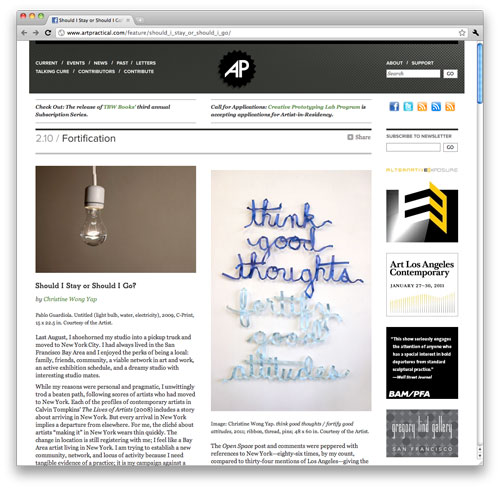
Should I Stay or Should I Go? on Art Practical

Art Practical, Should I Stay or Should I Go? Christine Wong Yap

My feature on artists staying or leaving the Bay Area is finally out in the current issue of Art Practical. Thanks to the interviewed artists—Michael Arcega, Pablo Guardiola, Stephanie Syjuco, Emma Spertus, and Jenifer Wofford—for their time and insight. And a deep bow to Editor-in-Chief Patricia Maloney, Copy Editor Victoria Gannon and the rest of the Art Practical team for their support and guidance!

“Should I Stay or Should I Go?”
Feature story published on
Art Practical, Issue 2.10

Standard
Research

Happiness, seriously

To be concerned with happiness is to risk the perception of frivolity. Happiness is not perceived as a subject worthy of serious attention, particularly in contemporary art, in my experience. But as positive psychologists argue, the search for happiness is neither common sense nor thoroughly understood; additional inquiry is warranted from this point of view.

For those who cherish their notion that art about pain is more weighty or more serious, have a look at Italo Calvino’s short story, “The Adventures of a Poet.” The author describes the struggle to write about pleasure, and the familiar ease of writing about ugliness. In this way, perhaps it could be said that making art about happiness is more challenging.

Emory University features an archive of Calvino’s writings on their website. Have a look around.

Standard
Community, Research

Stuff & Happiness: Like!!!

Alexandre Singh’s The School for Objects Criticized
New Museum
Thru January 23

Alexandre Singh, _The School for Objects Criticized_, 2010, Multimedia installation, installation view: New Museum of Contemporary Art. Source: New Museum of Contemporary Art

Alexandre Singh, _The School for Objects Criticized_, 2010, Multimedia installation, installation view: New Museum of Contemporary Art. Source: New Museum of Contemporary Art

Caught Free at the New Museum before it closes on January 23rd. By chance, I saved the best for last: Alexandre Singh’s multimedia installation, an installation as theatrical “play,” with inanimate objects as actors. Found objects were lent WASPy perspectives and political positions in surround sound audio tracks and theatrical lighting. It was entertaining, which made the fact of sitting in a room looking at common objects even more strangely compelling.Thankfully, Free is accompanied by an online catalog, with more info on the installation.

Haegue Yang’s Voice and Wind
New Museum
Thru January 23

This installation of colorful, rainbow-palette Venetian blinds and scents occupies the New Museum’s ground floor glass-walled installation space. It’s a fun installation that invites people to walk thru, dipping under portals and encountering semi-enclosed spaces to sniff different scents. I was most interested in the parallels I found with my own work; in the statement, Yang professes an interest in happiness, and colors “on the edge of taste.”

Walls & Bridges: Happiness
New York Public Library
Saturday, January 29, 2011

I’m looking forward to this dialogue about happiness and art, featuring Barbara Cassin, Daniel Handler, Maira Kalman, and Sophie Wahnich.

America considers the pursuit of happiness an inalienable right. But where is this pursuit taking us? How valuable is positive thinking? In arts, melancholia has long been a source of inspiration. Specialist of Ancient Greece Barbara Cassin will give a philosophical point of view on the topic, and historian of the French Revolution Sophie Wahnich will bring some insight on the conditions of happiness. They will be discussing with co-authors of 13 Words Lemony Snicket (Daniel Handler) and Maira Kalman, also New Yorker cover artist and author of the acclaimed And the Pursuit of Happiness.

Standard
Community, Research

Points of reference

For artists and/or fans of Borges and Calvino:
Cynthia Ozick reading “In the Reign of Harad IV,” a wonderful short story by Steven Millhauser, about making, visibility, and recognition. On the New Yorker‘s fiction podcast.

For fellow cognitive science and psychology dabblers:
“Social Animal: How the new sciences of human nature can help make sense of a life,” by David Brooks (yup, that David Brooks, the NYT columnist), a summation of loads of psychological and cognitive science research, including thoughts about flow and happiness.

For those who need an optimism booster shot:
Born to Be Good: The Science of a Meaningful Life, by Dasher Keltner (New York: W.W. Norton & Co., 2009).
The UC Berkeley psychology professor’s theories on how to live a balanced life of “completing the good in others.” Interesting discussion of the intellectual lineage from Darwin to Ekman (a facial expression researcher profiled by Malcolm Gladwell in the New Yorker). The author’s long hair + references to Eastern philosophy = high hippie dippy quotient, but Keltner is an informed and lively writer. Those seeking cynical, burdensome academic texts ought look elsewhere.

For those seeking art that touches on psychoanalysis:
Jonathan Solo: Shadow
Catherine Clark Gallery
January 8 – February 19, 2011
see also: Carl Jung, Shadow

For those obsessed with happiness and/or mapping:
Mappiness, an iPhone app that asks users to rate their level of happiness at random moments throughout the day. Developed by London School of Economics PhD candidates, it’s a fully realized, popular version of what I had hoped to do with Hedonimeter.net, a project I started in grad school and hadn’t yet returned to. My enthusiasm for visual and symbolic systems has not evolved into the motivation to learn more about statistics and programming… yet.

For art-seekers in San Francisco:
Works by friends and supporters:
Three solo exhibitions: Jaime Cortez, Kenneth Lo, and Ginger Wolfe-Suarez
Southern Exposure, 3030 20th St., San Francisco, CA
January 7, 2011 – February 19, 2011

For art-seekers in LA:
Collective Show
January 21-23 and January 27-30, 2011
995, 997 North Hill Street, Los Angeles, CA

For art-seekers in Liverpool:
Nam June Paik
Tate Liverpool
17 December 2010 – 13 March 2011

For typography nerds:
The flyer for the symposium at the Nam June Paik Art Center. Nothing wrong with type-based solutions, no.

For design-seekers in San Francisco:
A show curated by the super-talented, super-humble Jon Sueda
The Way Beyond Art: Wide White Space
January 20–February 5
CCA Wattis Institute for Contemporary Art

Standard
Impressions, Travelogue

New Haven: Art, architecture, clouds, and nativity scenes

New Haven, I learned, is very sleepy during Yale’s winter break. The special exhibitions at Yale University Art Gallery and the Yale Center for British Art are in changeover. Artspace was not open during their normal scheduled hours of the current show. Though the timing of my visit was not ideal, I enjoyed looking for and finding art in New Haven today.

Yale University Art Gallery
First—Louis Kahn’s building knocked my socks off. The exterior was cold and blocky, but the interior featured a beautiful lobby, interesting textures, and warm touches, like the uneven edges on the window scrims, and a cool-while-totally-sensible triangular stairwell. Big points for the handsome building signage in projected light.

Collections worthy of a prestigious Ivy League, like an Assyrian stone wall from the 5th c. BC. C’mon! (It’s the first image in this Flash-based “gallery tour.”)

Lots of gems in European and American art. I studied debossed gold-leaf patterns at length in some stunning pre-Renaissance icons. Duchamp’s Tu M’. A good Nam June Paik closed circuit television installation showing a live video of artificial flowers mounted to the top of the tube. Lucas Samaras’ Chicken Wire Box #4 (1972) and Untitled (1963), a panel covered in concentric circles of different colored yarn, then pinned with hundreds of straight pins (kind of like this). Happy and perception-stretching.

I also very much enjoyed mentions of local industry. The decorative art and design—early modernist nickel-silver tea set, pressed lead glass bowls—manufactured in little Massachusetts towns like Dedham and North Attleboro. They assert a history about designers and craftsmen that contrasts, in my mind, the must-have (in 19th c. wealthy homes and 21st c. general art museums) portraits of wealthy patrons.

joseph smith, tea caddy, 1767, source yale university art gallery

Joseph Smith, Tea caddy, 1767. Source: Yale University Art Gallery website

Joseph Smith’s Tea Caddy (1767) kills me. It looked totally out of place in the vitrine with mirror-polished silver vases. It manages to be endearing and craptastic. The construction of the clay seems unconcerned with formal considerations, but the calligraphic curliques suggest a desire to make it beautiful and refined. It’s surprisingly complex.

I also found the Asian and African art floor inspiring—Chinese watercolors and ceramics spurred me to think about patterns and line and the tropes of genre paintings; a ceremonial mask surrounded by oversized photographs of similar masks in use in Africa seemed like a sensitive approach to exhibiting these objects in contexts so different than their originally intended ones.

Yale Center for British Art
The architecture here is opposite what you’d think—instead of heavy, dark wood paneling with ornate wainscoting is warm, orange-toned wood interrupted with concrete. The galleries were lined with unbleached canvas-covered walls and filled with light. Except for an atrium (pictured on the museum home page), which I found suffocatingly prison-yard-esque, the museum was open and welcoming. This fresh approach seemed reflected in the collections curation. There were what seemed like hundreds of British paintings on view, and I never thought I’d hold up to make it all the way through, but surprising choices in the selections kept my morale up.

John Constable’s Cloud studies are a special treat that alone would make a visit worthwhile. Even for non-painters. (Otherwise you can get the book.)

I also liked the house portraits—they are more like oil-painted illustrated 3-D maps (remember these cheesy illustrated maps?) of English estates. The perspective is often forced and awkward. They’re interesting as cultural documents. (When you have a mansion and gardens upon gardens, do you really need a painting of it too? Do the servants carrying loaded baskets upon their heads evoke the same sense of satisfaction as the parasol-wielding leisure-seekers?) They are, essentially, heavily narrated architectural and informational graphics, and their quirks appeal.

Knights of Columbus Museum

The Knights of Columbus are a Catholic service organization, and they have a huge “museum” (though it seemed more like an office building with some gallery spaces) on the edge of downtown New Haven. I visited and found their exhibition on a recent mosaic project in DC to be informative. Photographs and texts guide viewers step-by-step through the old-world tradition completed with modern industrial tools. From drawing, making the mosaic in sections, scaffolding, to installation, it was great for nerding out on technical side of art making.

There’s also the State Room, full of memorabilia of different honorary gifts that were given to various Knights. The KoC-logo has been emblazoned on cowboy boots, judge’s gavels, and even a Filipino barong. It reminded me of promotional item showrooms, which are fun to visit as an artist.

The real reason I went to the KoC Museum, though, was for the Christmas in Asia exhibition of crèches, or nativity scenes. They were so brilliant that I am still disappointed that photography was not permitted; after all, I didn’t see any individual artists credited. While a few works were attributed to specific woodcarving workshops in China, the overwhelming majority was to “Unknown Artist”—presumably, some street vendor who sold the item in a brief transaction where Western currencies were advantageous and an exhibition loan form was absent. But whatever.

The crèches generally fell into two groups. In the first category, it seemed as if Asian craftsmen did a competent job of simulating Western realism, as well as tropes about the nativity scene and the participant’s appearances. This is interesting as an outcome of globalization. The objects were made for Western audiences, or for a local audience that prefers their nativity scenes traditional. The second category, however, spoke to my taste for the awkward and funny cross-cultural translations. In these cases, artists interpreted the nativity scene with local materials (bamboo, Korean paper mâche, Indonesian woodcarving, Filipino shells) and traditional forms. Sometimes the manger was substituted with a raised bamboo platform-hut with a thatched roof. The camels gave way to elephants (Pakistan) and a cat (Korea). This kind of willful naiveté was captured in an elaborately traditional Thai scene, featuring wrapped skirts on the women, farmer’s shirts on the men and a gilt fruit basket loaded with tropical fruit. The kicker was that the three wise men included a saffron-robed monk.

The crèches might indicate a darker truth—local craftsmen turning to non-native narratives to appeal to tourists’ tastes, not to mention colonialism. However, there are other possible explanations, and here’s one: For my mom, a Buddhist, Christ presents neither conflict nor contradiction. (In fact, I think the reason Christianity is not my cup of tea is because it’s incapable of this kind of religious tolerance.) It’s possible that some of these folk crafts emerge from the same feeling of nonchalant appropriation. Or maybe the craftspeople just love Christmas.

Standard
Research

Me and You, You and Me

For those “ball and chain” jokes and the idea that relationships always come before the self, here’s a ripost in favor of mutually-enriching relationships: “The Happy Marriage Is the ‘Me’ Marriage,” by Tara Parker-Pope (NY Times, December 31, 2010).

Research shows that the more self-expansion people experience from their partner, the more committed and satisfied they are in the relationship.

To measure this, Dr. Lewandowski developed a series of questions for couples: How much has being with your partner resulted in your learning new things? How much has knowing your partner made you a better person?

The article is accompanied by a great infographic.

Standard
Community, Sights

Three reasons to be excited about art

Please excuse my previous griping post and have a look at this:

1. Brendan Fernandes and Ohad Meromi at Art in General

I helped to install these two artists’ shows, and I’m very excited about the quality and experimentation in both of them. I feel very fortunate to work with wonderful staff and interns at Art in General in the production of shows by really kind, thoughtful artists.

Brendan Fernandes’ exhibition, From Hiz Hands, opens in the ground-floor Project Space tomorrow, Friday, December 10 at 6pm. In addition to a massive wall text and audio piece, there are three super neon signs you can see from the street.

Ohad Meromi contribues Rehearsal Sculpture, a likably obscure set of sculptures, props and setting for participatory action. Ohad’s prior work (see Harris Lieberman Gallery, of the sweetly ligature’d logo, for pics) are really fun combinations of formal and vernacular design with social overtones, so I’m really interested in this more explicitly performative and experiential work.

2. Mark Bradford, artist, MacArthur Genius, and artist-philanthropist-role model.

Bradford, who exuded articulateness, integrity and rigor in his talk at SFAI, is a role model. His most recent feat of fearlessness is committing to donate $100k to support other artists in the pursuit of their own projects that might not be otherwise funded. How awesome is that?

3. Via HWT, this image by Frances Twombly, found on ArtNet:

Frances Twombly, Balloons, 2004

Frances Twombly, Balloons, 2004

Standard