Research

see: graphic design now in production / don’t see: tavares strachan in NYC

Would love to see this show, on in Minneapolis now:
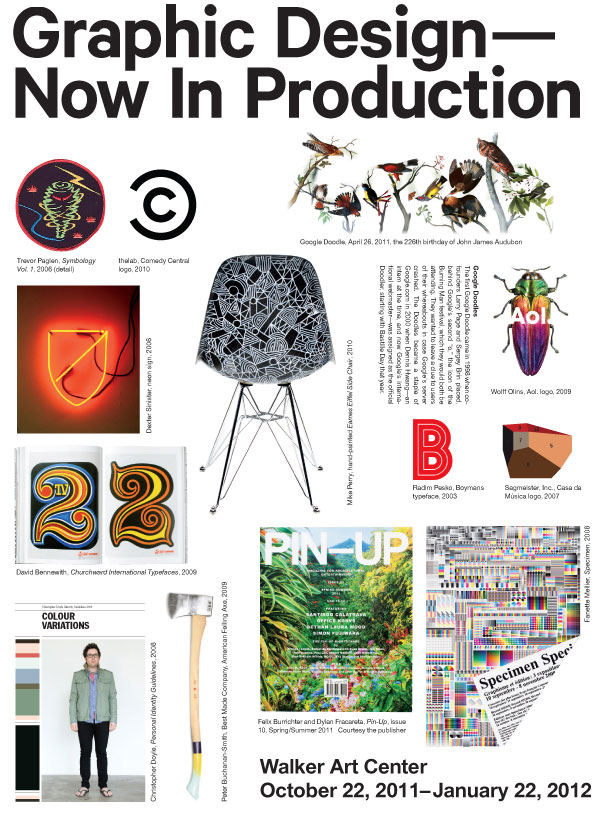
Graphic Design Now in Production, Walker

Graphic Design: Now in Production
Walker Art Center
Minneapolis 

This major international exhibition explores how graphic design has broadened its reach dramatically over the past decade, expanding from a specialized profession to a widely deployed tool. With the rise of user-generated content and new creative software, along with innovations in publishing and distribution systems, people outside the field are mobilizing the techniques and processes of design to create and publish visual media. At the same time, designers are becoming producers: authors, publishers, instigators, and entrepreneurs employing their creative skills as makers of content and shapers of experiences.

Featuring work produced since 2000 in the most vital sectors of communication design, Graphic Design: Now in Production explores design-driven magazines, newspapers, books, and posters as well as branding programs for corporations, subcultures, and nations. It also showcases a series of developments over the past decade, such as the entrepreneurial nature of designer-produced goods; the renaissance in digital typeface design; the storytelling potential of titling sequences for film and television; and the transformation of raw data into compelling information narratives.

Graphic Design: Now in Production is the largest museum exhibition on the subject since the Walker’s seminal 1989 exhibition Graphic Design in America: A Visual Language History, and the Cooper-Hewitt’s 1996 comprehensive survey, Mixing Messages: Graphic Design in Contemporary Culture. Appropriately, this exhibition is being developed jointly with the Cooper-Hewitt.

I’d also love to see this, and it’s in my city, but—it’s not open to the public. I get that there’s a tradition to conceptual stagings, and that this is fitting with Strachan’s art about displacement, but c’mon! Why publicize it if only a very select and well-connected few will be invited to see it? Since the press release is vague about how the public can gain access, while not ruling out the possibility of the show being viewed, nor stating the principle along with access will be granted, I’m assuming that a few people will see it, and that it’s largely a matter of social capital.*

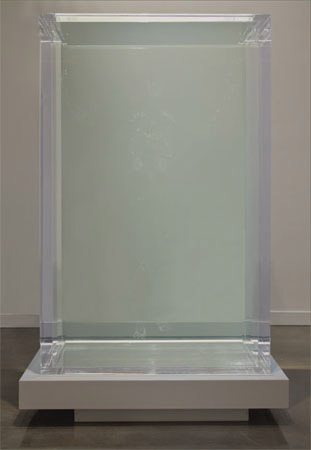
Tavares Strachan, What Will Be Remembered in the Face of All that Is Forgotten, 2010.  Hand-blown glass, 900 gallons of mineral oil, Plexiglass® tank, steel base, 75 x 62 x 62 inches.

Tavares Strachan, What Will Be Remembered in the Face of All that Is Forgotten, 2010. Hand-blown glass, 900 gallons of mineral oil, Plexiglass® tank, steel base, 75 x 62 x 62 inches.

Tavares Strachan: seen/unseen
A Large-scale Exhibition
Undisclosed New York City Location
New closing date: October 28
September 19–October 28, 2011

Curators: Jean Crutchfield & Robert Hobbs

In recognition of the theme that presence and absence assume in the work of Tavares Strachan, a Bahamian-born and Manhattan-based artist, this large-scale overview of his work from 2003 to the present is on view at an undisclosed location for the duration of the show. Focusing on the artist’s overall practice of positioning works so that some of their aspects are visible while others remain conceptual, this exhibition, subtitled seen/unseen, is intended to be a work of art in its own right.

Tavares Strachan: seen/unseen represents the latest contribution to the now legendary tradition of closed exhibitions, including Robert Barry’s now infamous 1969 Closed Gallery Piece and Yoko Ono’s 1971 advertisement for her nonexistent Museum of Modern Art exhibition.  However, unlike these empty or fictitious exhibitions, Tavares Strachan: seen/unseen will feature drawings, photographs, video works, sculpture, and installations as well as a series of new works in a massive 20,000-square-foot industrial space, converted just for this exhibition.

Strachan began emphasizing presence and absence in his art as early as 2003, when he installed a light meter outside his mother’s house on the outskirts of Nassau and connected it via satellite to a computer-activated light box in his RISD dorm room to create an interactive work, enabling him to enjoy in real time and around the clock simulated Bahamian light and darkness.

Tavares Strachan: seen/unseen includes a series of new works especially created for this exhibition, beginning with a new version of the artist’s internationally celebrated 2005 piece The Distance Between What We Have and What We Want, consisting of a 4.5-ton block of ice, harvested from a frozen river about 400 miles under the Arctic Circle.  New York Times critic Roberta Smith commended Strachan for his “pioneering courage” and characterized this piece as “spectacularly ambitious.”

While the exhibition Tavares Strachan: seen/unseen is not open to the public, the exhibition itself will be fully documented with a forthcoming website and publication.

For more information and additional images contact info@isolatedlabs.com

(*By the way, the same goes for some of the cliquey, invitation-only social events at art spaces in San Francisco that I’ve heard about lately; the exclusiveness is really high school. Get over yourselves.)

Standard
Sights

10/15-16: serpentine garden marathon

Three of my favorite things will be rolled into one this weekend: contemporary art, public space, and marathons! OK, there probably isn’t an actual 26.2 mile course to run, but still, this sounds really cool.

Garden Marathon [lots of pics at the link, including a nice bird’s eye view of the High Line]
15-16 October 2011
Serpentine Gallery
London

The Serpentine Gallery Garden Marathon is the sixth in the Gallery’s acclaimed Marathon series. This two-day event is an exploration of the concept of the garden. A product of the creative encounter between the man-made and the natural, between order and disorder, the garden can offer productive metaphors for the interactions between human life and time, care, thought or space.

The event is directly inspired by the Serpentine Gallery Pavilion 2011, designed by Peter Zumthor. The encounter of architecture and garden creates a contemplative space that is both set within – and meditatively separated from – the wider surroundings of Kensington Gardens.

Participations will range from the fields of horticulture, design and architecture to explore the creation of gardens and their spatial, urban and scientific importance, through to works by artists and readings by poets and writers exploring the significance of the garden in our experience of the world.

Participants include:
Etel Adnan, Brian Aldiss, Maria Thereza Alves, Rosie Atkins, Yto Barrada and Sean Gullette, Gianfranco Baruchello, Gerry Bibby, Stefano Boeri, Andrea Branzi, John Brockman, Pablo Bronstein, Lizzie Carey-Thomas, Hélène Cixous, Emer Coleman, Pascal Cribier, Adam Curtis, David Deutsch, Elizabeth Diller, Jimmie Durham, Marcus du Sautoy, Brian Eno, Patrick Eyres, Hans-Peter Feldmann, FIELDCLUB, Sophie Fiennes, Adriaan Geuze, Jef Geys, Dominique Gonzalez-Foerster, Dan Graham, Rodney Graham, Fritz Haeg with Denise Withers, Zarina Hashmi, Will Holder, Jennifer Jacquet, Charles Jencks, Koo Jeong-A, Alison Knowles and Meghan DellaCrosse, Pablo León de la Barra, Jonas Mekas and David Ellis, Catherine Mosbach, muf architecture/art, Christian Philipp Müller, Peter Murray-Rust, Silke Otto-Knapp, Mark Pagel, Philippe Parreno, Giuseppe Penone, Julia Peyton-Jones, Alice Rawsthorn, Carissa Rodriguez and Avena Gallagher, David Rowan, Peter Saville and Anna Blessmann, Rüdiger Schöttle, Richard Sennett, Bas Smets, Paul Smith, Something & Son, Susan Stenger, Corin Sworn, Wolfgang Tillmans, Mierle Laderman Ukeles, Günther Vogt, Sophie von Cundale, Alex Waterman, Cerith Wyn Evans, Andrea Zanzotto and Qiu Zhijie.

As well as: The observer’s guide to the Serpentine Gallery Garden Marathon – compiled in one voice, in the field, by a pool: Paul Becker, Ian Evans, Will Holder, John D. Millar, Francesco Pedraglio, Heather Phillipson, Natasha Soobramienen, Cally Spooner, Nick Thurston and Luke Williams.

Standard
Artists, Sights

10/18: The Nelson Manobar: lecture at SVA

I’ve chatted with these guys. They’re really funny and unpretentious. This should be a great talk.

oct11_sva.jpg
The Nelson Manobar
Tuesday, October 18, 7pmSVA Theatre
333 West 23 Street, NYC
visualandcriticalstudies.wordpress.com

Jimbo Blachly and Lytle Shaw, editors of The Chadwick Family Papers, discuss the Nelson Manobar, an occupiable scale model of Admiral Nelson’s HMS Victory that was long a fixture at Chadwick Manor. At once a theatrical stage set for recitations of Nelson’s death speech and a nautically-themed pub, the Manobar was thought lost until its recent rediscovery in a remote storage unit belonging to the Victoria and Albert Museum in Mumbai. The discussion includes the circumstances of the Manobar’s rediscovery, the saga of its passage back to the United States, and its singular place within the Chadwicks’ larger nautical collections. Gloria Kury, whose Periscope Publishing issued The Chadwick Family Papers: A Brief Public Glimpse, moderates the lecture; artist Steve Dibenedetto is a respondent. Presented by the BFA Visual & Critical Studies Department.The BFA Visual and Critical Studies Department at SVA is a multidisciplinary studio program designed to engage and challenge ambitious students in areas beyond a single medium of expression and creation. This dynamic course of study reflects our rapidly expanding visual culture and the increasing urgency to educate students about all aspects of visual experience. Visual & Critical Studies allows students an extraordinary opportunity to shape their own multi-dimensional art education through a guided combination of studio courses and academic offerings focusing on myriad forms and venues of contemporary visual life.

Standard
Sights

See: Swiss Institute’s Under Destruction III

I enjoyed the first two parts of the Swiss Institute’s exhibition, Under Destruction I and II (read my review on Art Practical). Under Destruction III is just as great. It closes on Sunday. If you won’t get to see it, have a look at these images at the Swiss Institute’s site.

I loved Jonathan Schipper‘s To Dust (2009–2010). It’s two cement statues hung upside down from chains attached to a motor. The motor activates subtle oppositional movement, so that the statues slowly pulverize each other.

Alexander Gutke‘s The White Light of the Void is a 16 mm looped film, brilliantly displays a nearly-blank film routed on pulleys attached to adjacent wall in place of a looping device. (Check out his other work too.)

Ariel Schlessinger‘s exploding Bubble Machine was not in operation during my visit, but you can watch YouTube documentation of this crazy device.

In the side gallery, Eric Anderson’s Reading Room exhibition is well worth a visit too. Prints produced in collaboration with Cabaret Voltaire are lovely, messy original objects that would appeal to graphic designers and printmakers alike. Using a variety of media, such as some kind of large-LPI photo media like polymer plate, letterpress, tricksy things like inked up letterpress furniture, overinking, under-inking, and transparent inks, there is a lot to look at and respond to, in optical, material, and conceptual dimensions.

I also stumbled across Matthew Brandt’s lovely decayed photographs at Hendershot Gallery. (In process, they seem not unlike Julie Perini’s Collaboration with The Earth film project). Click around Brandt’s site—lots of interesting uses of various media and photography (and I don’t mean printing on canvas). I especially like these Ed Ruscha-like Taste Tests.


Standard
Research

Highlights from the Positive Psychology conference

Last weekend I attended the International Positive Psychology Association’s Second World Congress on Positive Psychology in Philadelphia, PA, with the support of a Travel and Study Grant from the Jerome Foundation. It was an invigorating experience. I gained new concepts, an inspired list of books to read, and a clearer understanding of this growing field.

Positive psychology is a new realm; I’ve encountered skepticism of it based on its name only. But the conference (which I’ll call ‘IPPA,’ pronounced “IH-pah”) featured rigorous empirical researchers and practitioners across clinical psychology, education, business, and the humanities. With 1,200 whip-smart attendees from 62 countries, I felt as though I was part of an emergent domain that will revolutionize psychology as well as culture. I’ve been reading books about positive psychology since 2009; IPPA made me excited to learn more and help advance the field as it intersects with the arts and humanities.

What is positive psychology? Perhaps this is best explained via the words of its founding psychologists, Martin Seligman and Mihaly Csikszentmihalyi (2000), as quoted by Robert Vallerand:

“Psychology should document how people’s lives can be most worth living.”

To paraphrase James Pawelski, IPPA President as well as the Director of Education and Senior Scholar at the Masters of Applied Positive Psychology program at UPenn, one of the leading centers of research and scholarship:

Positive psychology is not merely a psychology for sunny days. It is also a psychology for rainy days…. [As a young person witnessing the aftermath of the recent terrorist acts in Norway said,] ‘If one man can create so much hate and death, how much good can we create together?’

I think it was also Pawelski, in discussing the positive turn in humanities, who expressed that

We see positive psychology as balancing (negative) psychology

which for the 20th century has been fixated on trauma, illness, and pathology. As in physical medicine, it is high time to expand beyond treatment towards wellbeing. As Chris Peterson put it:

“Health is more than the absence of illness”

and so too, psychological wellbeing is more than the absence of pathology. The positive psychology view according to Martin Seligman is that

People are not driven by the past, but can be drawn to the future.

Again, Pawelski:

Rather than seeing the positive as simplistic, positive psychology makes the positive more complex.

What I looked forward to. Many of my drawings in the Positive Signs series, as well as some concepts in my essays on Art Practical, were inspired by Martin Seligman’s Learned Optimism and Mihaly Csikszentmihalyi’s Creativity. During my residency at Woodstock Byrdcliffe Guild immediately preceding IPPA, I read Csikszentmihalyi’s Flow: The Psychology of Optimal Experience. So I was very excited to hear Seligman and Csikszentmihalyi speak.

Seligman (left) and Csikszentmihalyi (right) are named IPPA Fellows.

Seligman (left) and Csikszentmihalyi (right) are named IPPA Fellows.

I was also excited to meet potential partners, especially those whose work intersects with the arts. I suspect that principles of positive psychology can be useful for contemporary artists by informing:

processes, by becoming aware of flow activities;

artwork, via increased understanding of relationships created in the art viewing experience and new theories of phenomenology; and

attitudes, especially in regards to experiencing career setbacks and successes.

Highlights. I was very excited about:

Clearer definitions. University of Illinois researcher Ed Diener identified

preconditions of happiness as optimism, positive experiences, and lack of negative affect.

Gallup Scientist in Residence Shane Lopez pinpoints hope.

“Hope is goal-directed thinking (goals thinking) in which people perceive that they can produce routes to desired goals (pathways thinking) and the requisite motivation to use those routes (agency thinking).

Hope — The ideas and energy we have for the future.

High hope people believe that the future will be better than the present and that they have the power to make it so.”

Matt Gallagher, a clinical psychology researcher at the University of Kansas, distinguishes between hope and optimism:

Hope (Snyder) — Agency and pathways towards goals

Optimism (Scheier & Carver) — Globalized positive/negative expectancies

Emphasis on personal agency [is the] crucial difference
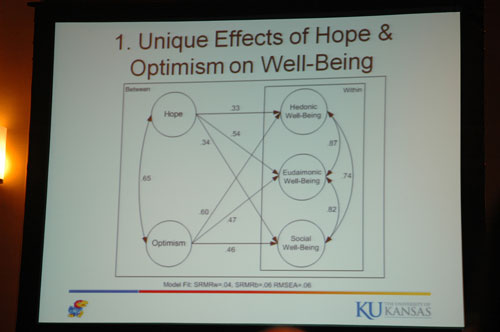
Matthew Gallagher's research on the unique effects of hope and optimism on wellbeing.

Matthew Gallagher's research on the unique effects of hope and optimism on wellbeing.

He also explained the difference thusly:

When you mash optimism and self-efficacy together, you get hope.

Erica Chadwick, PhD candidate from the Victoria University of Wellington, shared this definition of savoring from Fred B. Byrant and Joseph Veroff (2007):

If a savoring process is elicited when a positive emotion is experienced, then savoring could well be the mediating mechanism through which a person’s cognitive repertoire is expanded when a positive emotion is experienced. Furthermore, when people savor, they often broaden the range of feelings they can have and contexts in which these feelings can occur.

Happiness is not frivolous. Hope can’t wait.

Lopez’s Gallup studies revealed that

Hope, engagement, and wellbeing do not correlate to income.

Clearly this is not an argument against equity, but a call to foster hope without delay. That’s because, as Lopez pointed out,

“When we link ourselves to the future, we behave better today.”

Abraham Maslow’s hierarchy of needs (1943) is a fundamental psychology concept visually represented as a pyramid. The idea is that basic needs must be met first, and in order of importance, with self-actualization as the pinnacle—and endmost—need.

Maslow's hierarchy of needs

Maslow's hierarchy of needs (Source: Wikipedia)

At IPPA, Diener argued that

Abraham Maslow’s hierarchy of needs can be addressed at all levels, not necessarily in the order Maslow suggested.

Ed Diener's revision of Maslow's hierarchy of needs, with the needs congruent and concurrent.

Ed Diener's revision of Maslow's hierarchy of needs, with basic needs side-by-side with psychological needs.

Edward Deci, who studies self-determination theory, focused on

three basic human needs: the need to express competence, autonomy, and relatedness, which can be intrinsic, extrinsic, or emotionally motivated. Extrinsic motivations can actually undermine intrinsic motivations for engaging activities.

Edward Deci's Self-Determination Theory describes three basic psychological needs. Competence is the sense of effectance and confidence in ones's context. Autonomy is to behave in accord with abiding vaules and interests, and engage actions that would be relatively self-endorsed. Relatedness is feeling cared for, connected to, and having a sense of belonging with others.

Edward Deci's Self-Determination Theory describes three basic psychological needs. Competence is the sense of effectance and confidence in ones's context. Autonomy is to behave in accord with abiding vaules and interests, and engage actions that would be relatively self-endorsed. Relatedness is feeling cared for, connected to, and having a sense of belonging with others.

I especially appreciated Deci’s point that

Autonomy does not mean complete independence; you can be autonomously dependent

because that points to how artists can be autonomous and forge their own paths with the support and encouragement of their peers.

This sentiment was echoed by Karen Skerrett, who studies qualities of resilience in couple relationships:

Resilience is not self-sufficiency.

Deci added that

To foster greater internalization, create social contexts that allow people to feel competent, autonomous, and related. But it must fit with who people are

Which seems like a worthwhile consideration for artists developing participatory and relational projects.

Diener also identified,

“The number one predictor of enjoyment: ‘I learned new things, and I got to use my new skills today.’

In advance of a positive criticality. Since even my wholly optimistic work can inspire projections of skepticism, I was especially keen to hear Pawelski share Csikszentmihalyi’s opinion that

Positive psychology is a metaphysical orientation towards the positive. In other words, the positive is just as real as the negative.

Dan Moores illustrated this with a humorous talk called Ecstatic Poetry and the Limits of Suspicion. In it, he conveyed

we have a hermeneutics [study of interpretation] of suspicion (Marx, Nietzsche, and Freud), while lacking a hermeneutics of affirmation.  

Such a hermeneutics disserves

“The ecstatic poetic tradition [which] connects many cultures and reaches across vast stretches of time. It represents a positive affirmation of the values of happiness, human connections, festivities, and relatedness to transcendent sources of meaning. The tradition contains countless poems depicting peak states of being and positive, life-affirming emotions, such as serenity, awe, wonder, rapture, joy, gratitude, and love. Such poetry is written in praise of the goodness of life, the abundance of nature, and the intimate interrelation of the whole cosmos.”

Unsurprisingly, Moores shared a Romantic poem. This spurred a sense that contemporary art trends that revisit Romanticism and Transcendentalism (the “New Sincerity”) may find inspiration in this intersection of positive psychology and humanities, if the scientific approach isn’t too much at odds with the intuitive nature of such artmaking.

Elevation and awe. Jonathan Haidt, who studies moral political psychology, presented research

on emotion and elevation, correlating ‘up’ with altruism and admiration
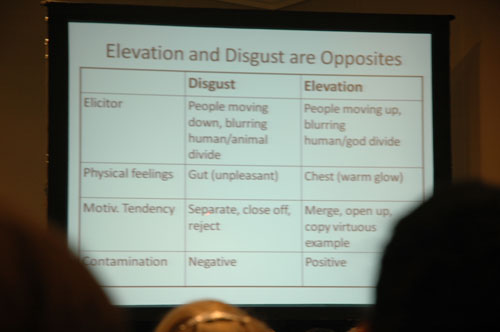
Jonathan Haidt's chart showing how Elevation and Disgust are Opposites. People moving up blurs the human/animal divide, stirs unpleasant physical feelings in the gut, and motivates people to separate, close off, and reject, so is negative. People moving up blurs the human/god divide, providing a warm glow in the chest, and motivates toward merging, opening up, and copying virtuous example, and so is positive.

Jonathan Haidt's chart showing how Elevation and Disgust are Opposites. People moving up blurs the human/animal divide, stirs unpleasant physical feelings in the gut, and motivates people to separate, close off, and reject, so is negative. People moving up blurs the human/god divide, providing a warm glow in the chest, and motivates toward merging, opening up, and copying virtuous example, and so is positive.

It’s similar to the up-down cognitive metaphors in Lakoff/Johnson’s linguistics, which I diagrammed in Positive Sign #24.

Christine Wong Yap, Positive Sign #24 (Conceptual Metaphors), 2011; glitter and neon pen on gridded vellum; 8.5 × 11 in./21.5 × 28 cm

Christine Wong Yap, Positive Sign #24 (Conceptual Metaphors), 2011; glitter and neon pen on gridded vellum; 8.5 × 11 in./21.5 × 28 cm. Source: blog.sfmoma.org.

Veronika Huta, who studies awe, inspiration, and transcendence at the University of Ottowa, independently confirmed that

Elevation is correlated with, and is an indicator of, virtuous, pro-social behavior.

Connecting neo-Romantic art and studies of awe was UPenn graduate student Ann Marie Roepke’s diagram relating horror and awe, similar to the 19th century view of the sublime.
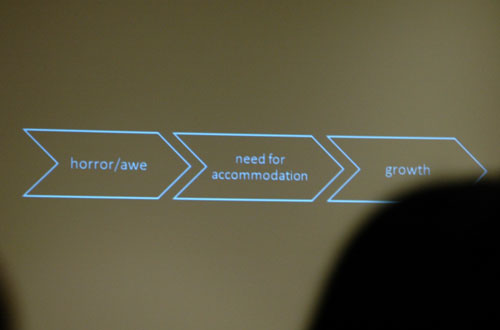
horrow/awe to need for accommodation to growth.

Slide by Anne Marie Roepke showing horrow/awe to need for accommodation to growth.

Passion. Robert Vallerand, from the University of Montreal, studies obsessive and harmonious passion.
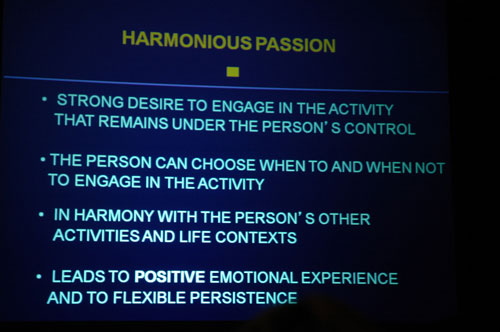
Harmonious passion manifests as a strong desire to engage in the activity that remains under the person's control. The person can choose when to and when not to engage in the activity. It is in harmony with the person's other activities and life contexts, and it leads to positive emotional experience and to flexible persistence.
Robert Vallerand describes harmonious passion as a strong desire to engage in the activity that remains under the person's control. The person can choose when to and when not to engage in the activity. It is in harmony with the person's other activities and life contexts, and it leads to positive emotional experience and to flexible persistence.

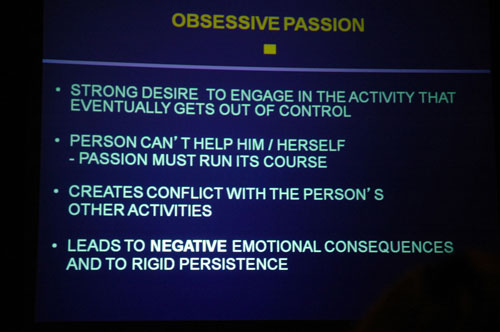
Robert Vallerand describes obsessive passion as a strong desire to engage in the activity that eventually gets out of control. The person can't help him or herself; the passion must run its course. It creates conflict with the person's other activities, and leads to negative emotional consequences and to rigid persistence.

Vallerand describes obsessive passion as a strong desire to engage in the activity that eventually gets out of control. The person can't help him or herself; the passion must run its course. It creates conflict with the person's other activities, and leads to negative emotional consequences and to rigid persistence.

There’s a clear analogy to the arts here, where artists may develop a detrimental obsessive passion driven by extrinsic motivators, rather than a harmonious passion fueled by intrinsic motivation that leads towards increased subjective wellbeing.
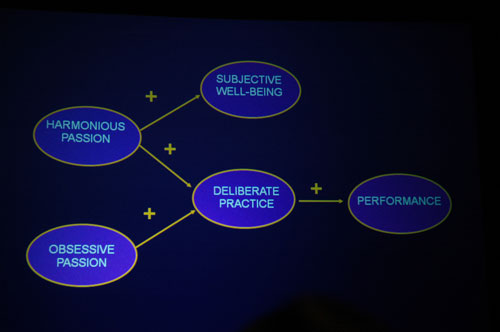
Robert Vallerand shows that obsessive passion and harmonious passion can both lead to performance, but only harmonious passion will include enhanced subjective wellbeing.

Vallerand found that obsessive passion and harmonious passion can both lead to deliberate practice and performance, but only harmonious passion will include enhanced subjective wellbeing.

Since I think emerging artists can put pressure themselves to see extrinsic rewards to their progress, Vallerand’s final message seems especially relevant.

Vallerand's take home messages: Try to cultivate harmonious passion for one activity. Take the activity seriously without taking yourself seriously. Include other fun activities in your life. Understand the functionality of obsessive passion. Learn from setbacks, improve and grow within the activity.

Vallerand's take home messages: Try to cultivate harmonious passion for one activity. Take the activity seriously without taking yourself seriously. Include other fun activities in your life. Understand the functionality of obsessive passion. Learn from setbacks, improve and grow within the activity.

Information graphics. What follows is a sampling of visuals which appealed to me.
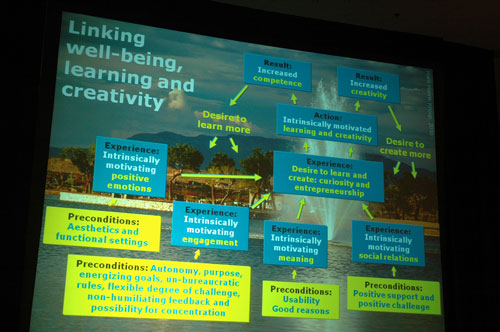
Hans Henrik Knoop's flow chart linking wellbeing, learning, and creativity, delightfully overlaid on a fountain.

Hans Henrik Knoop's flow chart linking wellbeing, learning, and creativity, delightfully overlaid on a fountain.

Neural synchrony imaged by Stephens, Silbert and Hasson, displayed in a talk by Barbara Friedrickson.

Neural synchrony imaged by Stephens, Silbert and Hasson, displayed in a talk by Barbara Friedrickson.

Sara L. Trescott presented a poster entitled Pain and Happiness: A Shifting Mathematical and Psychological Paradigm.

Sara L. Trescott presented a poster entitled Pain and Happiness: A Shifting Mathematical and Psychological Paradigm.

The most frequently presented graphic seemed to be a flow chart whose correlations are represented in nominal tenths or hundredths, rather than the visual hierarchies I would have preferred. It might well be a data-minded scientific idiom. Perhaps visual representation would be misconstrued as non-empirical shorthand.
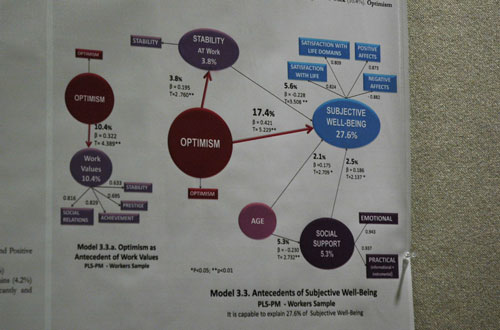
I believe this is Lucia Helena Walendy De Freitas' poster on The Influence of Optimism on Subjective Wellbeing: A Study Based on College Students and Workers Samples.

I believe this is Lucia Helena Walendy De Freitas' poster on The Influence of Optimism on Subjective Wellbeing: A Study Based on College Students and Workers Samples.

Bee Teng Lim's Powerpoint flow chart showing the impact of amplifying savoring.

Bee Teng Lim's Powerpoint flow chart showing the impact of amplifying savoring.

These graphics, indeed, the positive psychology endeavor as a whole—recall a passage from Alain de Botton’s The Pleasures and Sorrows of Work, in which the author responds to an engineer’s algebraic formula:

“I was struck by how impoverished ordinary language can be by contrast, requiring its user to arrange inordinate numbers of words in tottering and unstable piles in order to communicate meanings more infinitely more basic than anything related to an electrical network. I found myself wishing that the rest of mankind would follow the engineers’ example and agree on a series of symbols which could point incontrovertibly to certain elusive, vaporous and often painful psychological states—a code which might help us feel less tongue-tied and less lonely, and enable us to resolve arguments with swift and silent exchanges of equations.”

Two projects deserve special recognition for employing terrific graphic design. Both were large-scale public initiatives promoting wellbeing, thus the success of the endeavors was dependent on accessible design and copywriting.

Nic Marks discussed a project with new economics foundation promoting wellbeing in London.
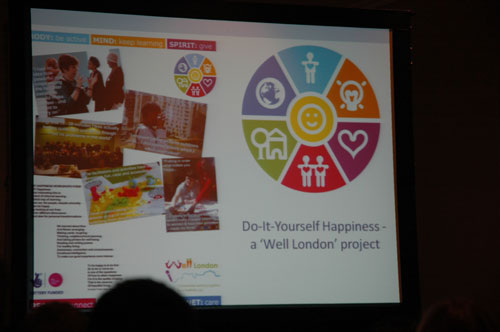
Nic Marks presented Do-It-Yourself Happiness, a Well London project.

Nic Marks presented Do-It-Yourself Happiness, a Well London project.

Plus, Marks conducted a drawing exercise in which workshop attendees drew each other without looking at their papers, which enacted the five steps the public initiative promoted. I loved the exercise, as participants’ responses were immediate, hilarious, and relational.

Participant's blind portrait of another participant.

Participant's blind portrait of another participant.

Chris Peterson and Nansook Park, both from the University of Michigan, shared their ___ Makes Life Worth Living campaign, a university-wide year theme. Students wore t-shirts with the blanks filled in.

___ Makes Life Worth Living.

Conference photos. And inspired by Richard Baker’s quiet and stirring photographs in Alain de Botton’s The Pleasures and Sorrows of Work, I clicked a few images documenting the visual vocabulary of the conference.
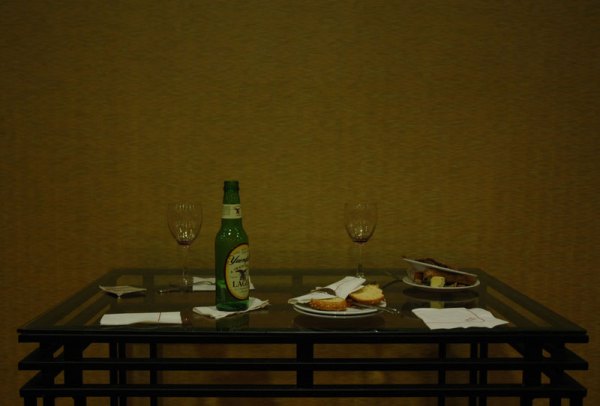
Post Reception Still Life

Applied Positive Psychology symposium.

Poster Session 1

Stripes

Poster Session.

Gina Haines' poster on positive psychology and phenomenology featured a foil mirror.
Gina Haines' poster on positive psychology and phenomenology featured a foil mirror.
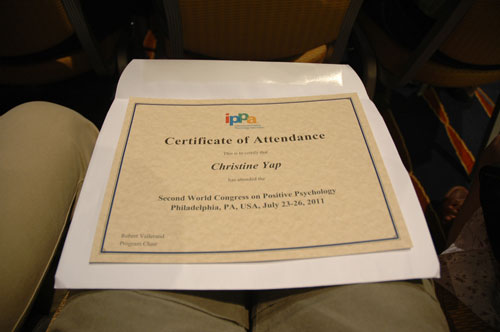
Certificate of Attendence

Standard
Research

Thomas Wilfred, kinetic light composer: Catnip for Neo-Transcendentalists

Via the New Yorker on The Tree of Life:

Thomas Wilfred made art objects that mechanically produced light and color. Some initial research results:

A trailer of Lumia, a 2006 documentary by 13bits, a NYC production company. In the middle of the trailer, there’s a shot of a hard-edged kinetic light display that should appeal to graphic designers and motion graphic designers.

Documentation of Opus 147 on Youtube. Artwork produced in 1957, video shot in 2006 for the documentary above.

The Eugene and Carol Epstein collection maintain some pages with a bio of Wilfredphoto documentation of light displaysa cool cross-section diagram, and other resources. (Hooray for dedicated collectors!)

Standard
Research

read: fine sentences

If I were a purveyor of fine sentences I would stock gems such as these.

In his post comparing jury duty to conceptual art, art critic Glen Helfand wrote on SFMOMA’s Open Space (“Justice Redux,” June 22, 2011):

Here’s my account of the case to which I was assigned: Ms. E drank something troubling, a crystal clear bottle of water with its Harrah’s label intact. It may have been standard transparent plastic, but was corrosive all the way down. She described burning up inside, but not as dramatically as her lawyer, who also relished, in words and sometimes pictures, the horrors of esophageal surgery….

What might be the real costs of a Drano cocktail, in PTSD dollars? It was as if there was a short circuit in my thinking patterns—all of a sudden, this was capital R real. Unlike forming a critical position on the Gertrude Stein exhibitions, our decision would have some measurable impact on someone’s life.

Lots of pleasing word-smithing here. The double duty of “capital”—both financial and figurative—is nice. Plus it’s nice to take the enterprise of criticism down a notch sometimes.

Though critics do articulate fine ideas too:

the seemingly infinite archive of world events produced by photography conflates surface appearance with psychological depth, iconicity with memory, publicity with history….

Eva Díaz paraphrasing critic Siegfried Kracauer in a review of Drawn from Photography at the Drawing Center, NYC (Artforum, Summer 2011). Díaz goes on:

Artists… hand-copy photographs and photo-based media, thereby lengthening the duration of the image’s production and, for the viewer, transforming perception by fastidiously rendering what once presented itself with glossy immediacy.

Also in Artforum, Catherine Wood previewed the Manchester International Festival and this summer’s iteration sounds equally high-brow and low-brow—and totally fun. Adding the MIF to my bucket list.

One more Artforum goodie*: Graham Bader considers Roy Lichtenstein’s Brushstrokes paintings. In doing so, he quotes David Joselit, who characterizes painting’s “reification trap” thusly:

maximum prestige with maximum convenience of display

which means, as Bader writes,

[painting] is inevitably and intimately linked to the commodity.

The Brushstroke paintings are Ben-Day dot paintings depicting painterly strokes. Very cheeky. They are funny and interesting because they’re quotations, and I can’t help but think about Jerry Saltz’ recent rant against tired postmodernism:

The beautiful, cerebral, ultimately content-free creations of art’s well-schooled young lions…

…many times over—too many times for comfort—I saw the same thing, a highly recognizable generic ­institutional style whose manifestations are by now extremely familiar. Neo-Structuralist film with overlapping geometric colors, photographs about photographs, projectors screening loops of grainy black-and-white archival footage, abstraction that’s supposed to be referencing other abstraction—it was all there, all straight out of the seventies, all dead in the ­water. It’s work stuck in a cul-de-sac of aesthetic regress, where everyone is deconstructing the same elements.

in his reaction to the Venice Biennale on Artnet. (Though he did like some things, including an installation by Argentinian Adrián Villar Rojas, who made a massive beached whale for Moby Dick at the Wattis in 2009. Congrats to AVR, and to his collaborator Alán Legal!)

The June 27th issue of the New Yorker is a good reminder of why I’m a subscriber. Rebecca Mead’s profile of Alice Walton, the Walmart heir opening a major museum in Arkansas, is quintessentially New Yorker. It’s about an individual of influence, yes, but the story is far from the stuffy Upper East Side. That I’ve yet to hear about this museum via typical art channels makes it even more intriguing. I’m also looking forward to reading Adam Gopnik’s essay on drawing. But in the meantime, Ian Frazier’s Talk of the Town contribution counterposes events in Harlem: a mostly-POC poetry reading and a mostly-white Socialist film screening. The description of the latter setting will ring a bell among radical buddies in Berkeley:

At a counter by the entry, racks of densely printed leaflets, the left’s traditional accessories, sat near new paperback editions of books by Leon Trotsky….

“O.K., everybody, can we all sit down…?” The last words were pronounced in the hopeful, rising tone that might be called the Leftist Exhortative….

The watchers in Freedom Hall roused themselves for a lusty booing and hissing of Dick Cheney when he came briefly into the frame….

…even the familiar pleasure of hating horrible things didn’t seem to buoy the Freedom Hall crowd. In the flickering dark, a palpable gloom.

Having been to a few gatherings like this myself, I found Gopnik’s humor winsome. The activists’ pessimism in the final couplet is too close for comfort. I suppose whatever inspired me to make the Activist Complaints drawings in 2007 still resonates with me.

*This issue of Artforum is called “Acting Out: The Ab-Ex Effect.” Talk about tired of Ab-Ex.

Standard