Category Archives: Research
Chelsea Gallery Jaunt
It started late and ended early—Chelsea’s lack of eateries and bathrooms, why dost thou forsake me?—so here are only a few picks and reports:
Dan McCarthy’s text paintings
Shoot the Lobster inside Martos Gallery on 28th Street
Absurd texts like “DEPECH MODE” (sic) are painted with a round brush in large, cartoonish scripts. However, the paintings are smooth, matte, and flat. Like weather-worn signage, the image seems ground down to the gesso underneath—they are mostly white, with the color appearing as artifacts of brushstrokes. Perhaps the artist achieved the effect with the use of resist, sanding or both. Yet the work feels fresh, and not overworked or precious. The way the text is off just a bit, and the surprise that such a flat surface can be tactile and appealing, made for an interesting experience for me.
—
Song Dong’s Doing Nothing Book pages
Pace Gallery, 25th Street
Dong wrote a text about doing nothing, yet having to do it, then sent it to translation services. He then presented their translations (and mis-translations), often on their company letterhead, in the exhibition. The results where sometimes practical, sometimes attempting philosophical tones, and mostly far-off.
Odd iceberg-like sculptures out of drywall (with electrical outlets) or tiled walls (with showerheads) and window frames nearby were interestingly strange forms.
—
Dieter Roth. Björn Roth
Hauser & Wirth, 18th Street
Hauser & Wirth’s much hyped, new space was massive and spectacular, but the work was almost* all not my taste. The disparate materials and forms seem like so much to pull together, then there’s all the smears, dust, blotches, pours, I guess you could say the ooziness, seems repellant on a visceral level, and then it actually became repellant via the aroma of chocolate. At first, it was heavenly, and I wondered why the workers casting chocolate and sugar sculptures looked so angry. After I re-entered the gallery and the waft hit me anew to the effect of nausea, I understood.
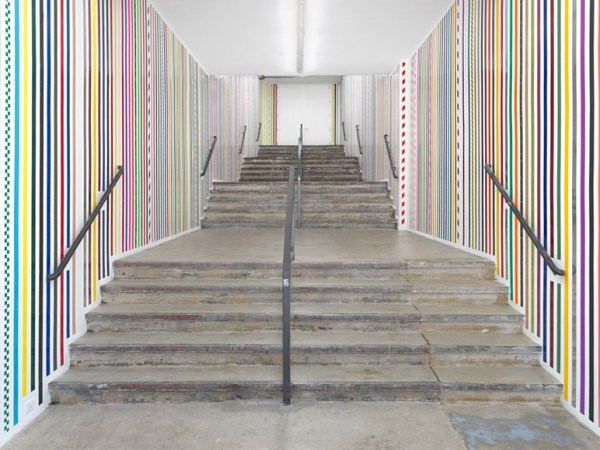
Martin Creed, Work No. 1461, 2013, 2-inch wide adhesive tapes, Overall dimensions variable. Permanent installation on view from 24.01.2013, Hauser & Wirth, 511 West 18th Street, New York NY 10011 // martincreed.com
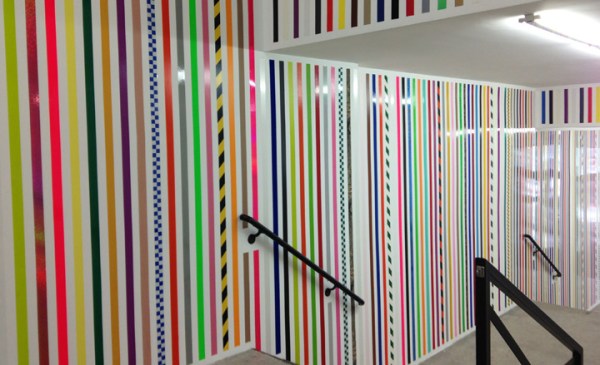
Martin Creed, Work No. 1461, 2013, 2-inch wide adhesive tapes, Overall dimensions variable. Photography: Bjarni Grímsson; © Dieter Roth Estate; courtesy Hauser & Wirth // wallpaper.com
Martin Creed’s entrance installation at Hauser & Wirth
This makes sense now!
*I did love one work: the hallway installation made of vertical stripes of hundreds of different kinds of two-inch tapes, films and fabrics. There was Painter’s tape, duct tape, holographic films, calendared vinyls, retro-reflective materials, caution tapes, hook-and-loop tapes, adhesive foam, novelty tapes like camouflage. The overall effect was colorful, like visual candy. But the materials were quotidian and recognizable. I love that such common materials, used in such a simple gesture, can create such an uncommon, delightful experience. That leap seems like magic to me, and I hope to achieve and explore that in my own work. There was so much to look at and appreciate. For example, the mylar tapes took up the pebbly texture of the wall, resulting in distorted reflections. There was fleecy flannel that I was dying to touch. The inclusion of adhesive foam—a utilitarian and not visual tape—was humorous. And many of the calendared vinyls, retro-reflectives, and holographic films are not typically available in two-inch rolls—they were probably cut painstakingly by hand, or (probably) at much expense on a vinyl plotter. I spent a lot of time looking at the individual stripes as well as the overall whole.
Points of Reference: Choice Cuts, Wintry Mix

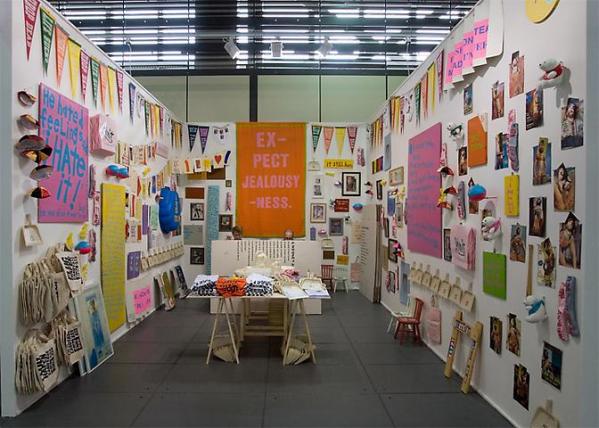
Cary Liebowitz, Art Forum Berlin, booth installation // Alexander Grey Associates, alexandergrey.com.
Some words and meanings of import to me this week:
—
I love it when an exhibition looks pitch-perfect. It brings me great satisfaction as a preparator to execute a changeover with immaculate results. Galleries have an unspoken ambition to sustain a highly artificial state of perfection; it works best when you feel that no other visitors have been there, with their grubby hands or floor-scuffing feet. Coming from this mindset, I was startled by this:
great art, though, is rarely perfect.
(The fragment has lodged itself in my brain, orphaned from its source. I think it’s from the New Yorker, but having been out of town for much of the past four months, I’m working my way haphazardly through the backstock, and finding the source seems an impossible task.)
I’ve been mulling this over—what allows art to be imperfect, what things/activities ought to result in perfection (crafts? services?), and why I’d forgotten that art has this privilege of imperfection (perhaps seeing too much art in sales-oriented commercial spaces, internalizing the feeling that art should look expensive)?
—
I stumbled onto the website of Trapped in Suburbia, a fun design firm in the Netherlands, that had an exhibition about happiness.
You’d think that an exhibition about happiness would capture my attention. But their motto, pulled from a Chinese proverb (go figure) was what ultimately spoke to me:
Tell me and I’ll forget; show me and I may remember, involve me and I’ll understand.
Fine, it’s an aphorism, and thus designed to impart wisdom with concision and rhythm that makes it seem profound. (For similar reasons, I find writing tweets unsatisfying.) It works for me in the context of a recent discussion I had about whether the relationship between what artists make and what artists make happen are equal or not. I think what artists make happen gains meaning through the shared experiences that artists make happen. The aphorism sort of mirrors what I mean to explain about the creative and aesthetic process: ideas without manifestation are intangible or intransient; objects can hold those ideas but remain inert without active attention; but by producing spaces/situations, possibilities and engagement, the ideas and objects take root in people’s minds and lives and experiences and memories. They live on in a larger way than personal experiences with objects.
—
From 2003 to 2011, Haim Steinbach led a seminar at the University of California San Diego called The Object Lesson. He instructed his students to chose an object—any object—and bring it to class every week. Over the course of the semester, they would consider these objects from every possible vantage point….
For ten weeks, three hours a week, they looked at the same fifteen objects. Again and again and again….
…students took turns responding to things they desired and despised on the table. Steinbach pressed them week after week: Is it a real object? An ideal object? A love object? A conceptual object? An object of desire? An actual object? A virtual object? An art object? While discussing the aggression of a piece of wood or the phallic quality of vampire teeth, students came to see how much the analysis hinged on their own projections and desires.
The Artist’s Institute, a Hunter College project, recently selected the work of Haim Steinbach for consideration. In doing so, they published a PDF with the above text and organized a show-and-tell. I love Steinbach’s class exercise, and am inspired to try it with like-minded artist-friends. I know what I would bring: a printed celebration ribbon from a party store.
This dovetails nicely with the proverb above—the meanings of objects take root in us when our own “projections and desires” fit with them. It’s like what differentiates a space from a place—the personal meanings that accrue (Yi-Fu Tuan).
—
Very short, very sweet stories and pics on imbuing objects with meanings/personal experiences. Reader’s photos of souvenirs at “What I Brought Home,” (NYT).
—
I’ve been trying to convey the complexity of happiness. Here is Zadie Smith distinguishing between joy and pleasure (thanks JKW):
Occasionally the child, too, is a pleasure, though mostly she is a joy, which means in fact she gives us not much pleasure at all, but rather that strange admixture of terror, pain, and delight that I have come to recognize as joy, and now must find some way to live with daily.
—Zadie Smith, “Joy,” New York Review of Books, January 10, 2013
get excited: turrell, deller

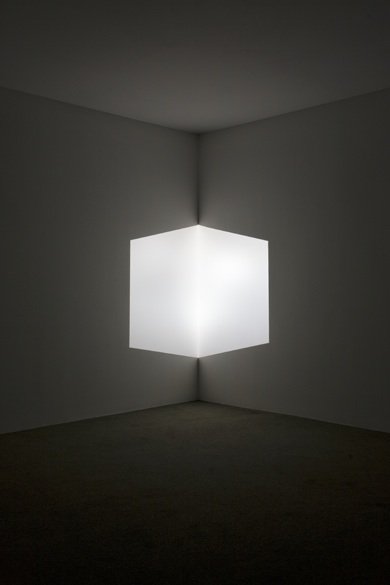
Image: James Turrell, Afrum (White), 1966, Projected light, Dimensions variable, Los Angeles County Museum of Art, partial gift of Marc and Andrea Glimcher in honor of the appointment of Michael Govan as Chief Executive Officer and Wallis Annenberg Director and purchased with funds provided by David Bohnett and Tom Gregory through the 2008 Collectors Committee (M.2008.60) © James Turrell. Photo © 2012 Museum Associates/LACMA. // lacma.org
James Turrell: A Retrospective is coming this summer, to be exhibited concurrently at three museums! This is super exciting. I love Turrell’s phenomenological light installations. They are very difficult to install and exhibit. Not to be missed!
May 26, 2013–April 6, 2014
Los Angeles County Museum of Art (LACMA)
June 9–September 22, 2013
Museum of Fine Arts, Houston
June 21–September 25, 2013
Guggenheim, NYC
—

Jeremy Deller, Joy in People banner (made by Ed Hall). Photographed in London, November 9, 2011, by Linda Nylind. // icaphila.org
Jeremy Deller’s retrospective at the Hayward Gallery in London was a brilliant, daring move by curator Ralph Rugoff. I missed this show at the Philly ICA last fall (and it seems like NYC museums missed this opportunity). The show has continued on, however.
February 1–April 28, 2013
Jeremy Deller: Joy in People
Contemporary Art Museum, Saint Louis, MO.
More Deller: The Guardian picked Joy in People for the sixth Best Art Exhibitions of 2012. Deller will represent the UK at this year’s Venice Biennale.
get excited: mail order brides
My good friend Jenifer K Wofford and her collaborators Eliza and Reanne are up to their high art hijinks again.

Mail Order Brides (M.O.B.)
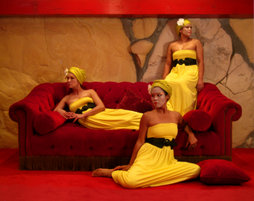
Still from Fiebre Amarilla V, 2011
Courtesy the artists // San Jose Museum of Art, sjmusart.org
New Stories from the Edge of Asia: This/That
San Jose Museum of Art, San Jose, CA
These artists take on identity issues (and Asian identity in particular) by creating narratives that often are born from loosely autobiographical, conflicting situations. In video, film, multimedia works, photographs, and performance art, they conjure temporary identities that reflect the constant struggle, negotiation, and precarious balance between different worlds. The exhibition includes works by Erica Cho, Mike Lai, Candice Lin, the artists’ collective Mail Order Brides (M.O.B.) (Eliza Barrios, Reanne Estrada, and Jenifer Wofford), and T. Kim-Trang. “New Stories from the Edge of Asia” is an ongoing exhibition series that presents work by artists from Pacific Rim countries and cultures who explore new narrative territory using animation, digital techniques, video, and film.
Have a look at M.O.B’s Always a Bridesmaid, Never a Bride services to get a sneak peek at what you might see.
—
If you’re in SF and Oakland and planning on making the trek down to the South Bay, I’d like to offer this gentle reminder: Happiness Is… is on through April 14 at Montalvo Arts Center Project Space Gallery in Saratoga.
see: light show at the hayward gallery
The Hayward strikes again. Wish I could visit this exhibition of light-based sculpture in London:
The Light Show
Hayward Gallery at Southbank Centre
London, UK
January 30–April 28, 2013
Though my Bay Area friends are very excited about Leo Villareal’s installation on the Bay Bridge, I would be excited to see installations by Anthony MacCall, Carlos Cruz-Diez, Ceal Floyer, and Nancy Holt, whose works tend to be less tech-y and more sublime.
See this really nice website with previews of artists’ works.
see: Nam June Paik and Ai Wei Wei retrospectives at the Smithsonian
Looks like the Smithsonian’s art programming is going to force my hand to act on my daydream of visiting DC. Both of these retrospectives sound too good to miss:
Nam June-Paik: Global Visionary
American Art Museum
Through August 11, 2013
Ai Wei Wei: According to What?
Hirschhorn Museum & Sculpture Garden
Through February 23, 2012