Community, Values

Finishing the Game: a movie, but not just a movie

Finishing the Game (2007, dir. Justin Lin, dist. IFC Films) is an indie mock-umentary of the re-casting of Bruce Lee’s unfinished film after his death in the 1970s. The auditions bring out Asians of all stripes — suave professionals, dreamers and actors of integrity — throwing kicks and emitting feline howls. It’s a light-hearted movie with lots of big hair, but in the subtexts are plentiful jabs at the movie industry’s racism and money-grubbing values.

Go see it!

I really liked the film. It’s funny and irreverent, and inherently Asian without being limited to Asian-ness, yet it touches on serious issues of race and representation. Plus there’s a token white guy! Come on! That’s hilarious! I hear the subtext, and it sounds like: You know where you can stick those quirky sidekick / comedic relief roles?!!

Finishing the Game just opened in the Bay Area. Haven’t heard of it? That’s because they don’t have a marketing budget.

But the upswing is that since the cast is involved in grassroots promotions, I caught a really eye-opening Q&A with some of the actors and producers. The discussion (which provided a classic example of who feels entitled to speak) kept coming back to the clash between representation and the movie industry, or art and business. I knew that Justin Lin’s first big feature film, Better Luck Tomorrow, was a “credit card film.” Talk about self-subsidizing (think six figures!) Its success was a miracle story. But actor Roger Fan (who stars in both films) explained that the popularity of BLT provided Hollywood studios with the hard evidence to take on movies with APA leads, and the result was that MTV became BLT’s distributor, and Harold and Kumar was green-lighted.

But here’s the sad news. Actor Sung Kang shared a maxim: people make indie films because they have to. The irony is that Lin originally wanted a Hollywood studio behind BLT at the start — and he had his chance — he was offered $2m to make BLT as long as the cast was not APA. So three cheers to Lin and BLT producers Julie Asato and Curtis Choy (yeah, the Curtis Choy who made The Fall of the I-Hotel. Uh huh!) for sticking to their guns. You can cite their integrity for the recent improvements in APA representation in American cinema. Cheers!

But Kang also pointed out that he’s just an actor: all he can do is be the best actor he can. What talks to studio execs is dollars, so, as cheesy as it sounds, support your independantly-produced APA film! Your ticket really means something.
http://www.youoffendmeyouoffendmyfamily.com/

Standard
Community, Values

Exceptional Art Economics

Art doesn’t play by conventional economic rules, argues Dutch economist and artist Hans Abbing in “Why Are Artists Poor?: The Exceptional Economy of the Arts.”

Art isn’t valued like typical commodities.
Art workers aren’t treated like other workers. Being an artist is similar, though, to being a small business owner — except that most small business owners have business plans, and know when to cut their losses.
Artists usually self-subsidize their practices, yet what most often makes artists stand out is their commitment to developing new work over the years. Like a Jenifer Wofford recently blogged, being an artist sometimes feels like a game of attrition — whoever sticks around long enough, whoever can still develop while forfeiting a salary and stability, wins.

But art is valued exceptionally, which inspires rare generosity. For example…

FRED went out on a limb to support my work for this year’s festival. They hadn’t heard of me and didn’t know anyone who could vouch for me (the “vouch” is important, not for cronyism, well, only, but because the terms “art” and “artist” are so unsanction-able; i.e., “artist” can refer to hobbyists and professionals alike), but they believed in my project. For the opportunity to realize my soft sculpture for FRED, I’m thankful.

When we made contact in England, Rico, my host in London, was a friend of the aforementioned Wofford. Without hesitation, Rico opened his home for a fellow artist. These days I would count him as a friend, and I’m grateful for his openness and hospitality.

I am also grateful to photographers who contribute art documentation to artists. Tony West shot brilliant photographs of my work for the FRED Festival. His excellent photos are vast improvements in my art documentation. I am so thankful to Tony West for sharing his photographs with me. Please check out Tony’s site. I am especially amazed with his landscapes. He’s a truly agile photographer, and you wouldn’t believe how quickly he works.

Standard
Community, Research

Tastes in art: what I learned from two videos

My generous host in London, curator and artist Rico Reyes, posed a thought-provoking question. We were visiting galleries, and I had something like an allergic reaction to psychedelic self-portrait videos at a gallery in London’s chi-chi West End (think: garish tie-dye animation superimposed on a bodysuit, with an Enya-like house music soundtrack, and hideous picture quality). I couldn’t hang, so I waited for Rico outside.

He asked: Do you look at art that is similiar to yours, or dissimilar?

Clearly my estimation of art is influenced by my tastes, and of course any artist would be happy to discover art that resonates with one’s own. So I admitted I usually look longest at art that is similar to mine. For example, I tend to spend less time with photographs and videos.

But I don’t feel that this is too limiting, because Jordan Kantor, a professor of mine in grad school, pointed out that art can look or think like one’s own. So while I headed out to the V&A just to see Simon Perriton’s installation just because its medium is papercuts, I’ll also happily perform actions with built-in futility in Jon Brumit‘s Vendetta Clinic, which was on view in Yerba Buena Center for the Arts earlier this year.

Which is not to mean that I don’t appreciate art that’s dissimilar to my own. I was recently surprised and impressed with a short video by Michelle Blade. Her work is on display in “I’m OK, You’re OK” (a group show I’m also in) at Playspace, the graduate gallery at CCA. (While our work can be tied together curatorially, I find her work different than mine because it seems uniformly optimistic.)

Michelle’s video consisted of a single shot of a gathering at Golden Gate Park. In the video, dozens of people, organized as a color spectrum of brightly hued shirts, hold hands and run in a winding spiral until they form a tightly knit column. And then they disperse. If you view the work as an abstraction, the colors advance in an orderly, quick pace, slow to a graceful endpoint, and then re-animate in disorderly joy. Colors overlap, the action reveals itself, and the activity disperses. It’s utopic — like the previously mentioned video — but Michelle’s is simple, short, endearing, unpretentious and pleasingly self-contained. While the video employs simple parameters, the social sculpture depicted in it is a fertile catalyst for ideas about art, painting, abstraction and social actions.

Though I tend to look for work that is similar to my own, I’m most interested in the elegant conveyance of complex ideas.

Standard
Art & Development, Community

Headlands Open House

Join me at the Headlands’ Open House.

It’s a privilege for me to be an Affiliate Artist at the Headlands, a vibrant community of national and international artists, writers, composers, musicians and dancers in residence.

I value being a member of a community where colleagues live, work, and breathe their creative practices.

The Headlands Open House happens three times a year, and it’s a great opportunity to visit studios and meet artists. I find open studios to be nice, informal settings for conversations about art. The current bunch is a varied and interesting, and includes tech-savvy object-makers like Chris Bell and David Gurman (who will present a large installation of photographs in Building 961) and conceptually-driven photo and video artist Hank Willis Thomas. I’m also really looking forward to seeing the finessed video work of UK-transplant Richard T. Walker (Affiliate Building, 960).

It’s a long haul out to the Marin Headlands, but the setting is gorgeous: fresh air, ocean salt. Just the other night I saw more stars that I have in all my years living in Oakland.

My studio is in the basement of the Affiliate Building (960, around the bend and up the hill, behind the Nike missle. Seriously.). Coats imperative, scarves recommended. See you there.

Standard
Community

Fall Arts Previews

I love summer, but I’m excited about this fall. Here’s why:

Duration TBA
Artists InSight: The Big Ideas Project—Three Views: Jenifer K. Wofford, Derrick Ion, Ali Dadgar

Opening reception: Thursday, September 6, 6:30 pm
“Through a proposal process, local artists were invited to create original interpretations of the 07-08 Big Ideas using the concept of Tibetan Buddhist Thangka paintings as inspiration. We are proud to present three interactive contemplative installations by artists Ali Dadgar, Derick Ion and Jenifer K. Wofford.”
Yerba Buena Center for the Arts‘s Room for Big Ideas
FREE

August 20 to October 19, 2007
To Hedonopolis, From Melancolony: Current Topography of Filipino Visual arts
Curated by Rico Reyes
Terry Acebo Davis, Yason Banal, Genara Banzon, Leo Bersamina, Emily Caisip, Crisanta de Guzman, Cirilo Domine, Reanne Estrada, John Yoyogi Fortes, Vince Golveo, Maryrose Cobarrubias Mendoza, Johanna Poethig, Charles Valoroso, Carlos Villa, and Jenifer Wofford
Artist Talk: Thursday, September 6, 3 pm to 4 pm in the Maraschi Room, Fromm Hall
Opening Reception: Thursday, September 6, 4 pm to 6 pm, Thacher Gallery
University of San Francisco
Work by Galleon Traders and friends Jenifer Wofford, Reanne Estrada and Johanna Poethig are included, as well as work by Yason Banal, an artist the Traders met in the Philippines!

October 6, 2007–January 20, 2008
Michael Arcega: Homing Pidgin
De Young press room page: “Contemporary artist Michael Arcega reinterprets the Oceanic collections at the de Young Museum for this exhibition. Arcega is known for sculpture and installations that revolve around language, a subject he dealt with early in his life when his family emigrated from the Philippines to California. At the de Young, he will show common Oceanic objects that have become altered after frequent interactions with Western culture. He compares this phenomenon to the pidgin languages (dialects that blend Western and Oceanic words) spoken throughout Oceania. He calls the works pidgin objects. “In the same way pidgin languages get ideas across, these cultural residues of pidgin objects act as bridges toward understanding the artifacts within the glass cases,” Arcega says.”
De Young Museum

September 19, 2007 – December 23, 2007
One Way or Another: Asian American Art Now

Michael Arcega, Xavier Cha, Patty Chang, Binh Danh, Mari Eastman, Ala Ebtekar, Chitra Ganesh, Glenn Kaino, Geraldine Lau, Jiha Moon, Laurel Nakadate, Kaz Oshiro, Anna Sew Hoy, Jean Shin, Indigo Som, Mika Tajima, Saira Wasim
Berkeley Art Museum
I was delighted when I found out this NY-based Asia Society show was coming to the Bay Area. It’s a museum-quality survey of mostly young, contemporary Asian American artists. What’s not to love? Keep an eye out for work by Galleon Trader Michael Arcega Berkeley-based Indigo Som. The Bay Area also represents with Binh Danh and Ala Ebtekar. And I always look forward to seeing Kaz Oshiro‘s work in person. And, here’s the NYTimes.com review.

September 17 – October 13, 2007
Don’t Try This At Home: A Group Exhibition Obsessively Reshaping The Ordinary
Tamara Albaitis, Lauren Davies, Krishna Khalsa, Stephani Martinez & Zachary Royer Scholz
Gallery Hours: Tues by appt, Wed – Sat, 12 to 5pm
Opening Reception: Monday September 17, 6 to 9pm
Artists’ Talk: Saturday October 13, 2pm
Intersection for the Arts
With CCA alum Lauren Davies and Zachary Royer Scholz, whose work can be pretty amazing.

September 13 – 29, 2007
A World Premiere Dance Theatre Work
51802
by Resident Company The Erika Shuch Performance Project
Thursdays – Saturdays at 8pm
Intersection for the Arts
With Jen Chien, a talented friend, and Danny Wolohan, a distinctive addition to many Bay Area theater pieces I’ve seen.

TBA
Gina Osterloh
Solo show at Margaret Tedesco’s 2nd Floor Projects.
A treat to see work by a really rigorous former-SF-, now LA-based Galleon Trader.

September 08, 2007 – February 24, 2008
Take your time: Olafur Eliasson
SFMOMA
I’m so excited that our local museum of modern art initiated and is premeiring a well-deserved retrsospective by Eliasson, an exciting contemporary sculptor/installation artist.

Through September 6, 2008
Capp Street Project: Mario Ybarra Jr.
Mario Ybarra Jr.’s large-scale mural examines the history, anecdotes, and mythology that surround mural making in the Bay Area.
Wattis Institute for Contemporary Art
I helped out with this mural earlier in the summer, and had a great time working with and learning from the illustrious, LA-based Mr. Ybarra.

Standard
Art & Development, Community, Travelogue

Exchange: Talking, drinking, laughing, eating, looking

The heart of the Galleon Trade exchange exhibition is face-to-face contact. I feel extremely lucky to be one of the nine California-based artists who were able to pull away from busy-ness in the States to interface directly with Manila’s artists.

A few memorable sites/situations:

mogwai screening room
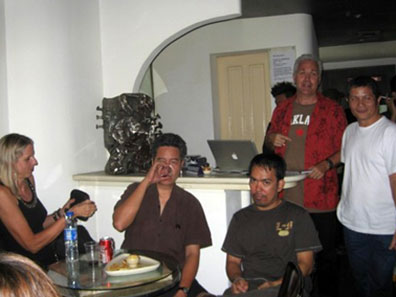
[Mogwai screening room: (l-r) Reanne Astrada, Romeo “the oldest punk rocker” Lee, two Filipino artists–one named Jet and another whose name I can’t remember–and the artist Gerry Tan. Photo by Stephanie Syjuco.]
Cubao X slide show. A self-organized presentation of work by contemporary Filipino artists at Mogwai, a brand-new, hip café with a sleek upstairs screening room. Cubao X is a locus of galleries, design shops, comic book stores and restaurants that once housed artists studios, and before that, the Marikina Shoe Expo. Though local artists are ambivalent about the displacement of artist’s studios for artsy commerce, I was still impressed that the owners of Mogwai made the glam screening room available for an artist slide show.

emil yap studio
Cavite studio. Emil is a social realist painter and installation artist, and a longtime activist. The social change of the 1960s in the States seems so distant to me, but for Emil, the Philippine’s people power movements of the 1970s and 80s are part of his personal and artistic history. Emil is also my cousin.

poklong anading Untitled Gaze  2007, Photographic Transparency   90 x 192 inches
[Poklong Anading, Untitled Gaze, 2007, Photographic Transparency, 90 x 192 inches. From Finale Gallery]
Megamall closing. I had the good fortune to attend the closing reception of Poklong Anading’s exhibition at Finale Gallery in Megamall in Manila. (Yes, there is a mall called Megamall, and yes, it’s common and unsurprising for Manila’s commercial galleries to be located there. The location is apt, since malls offer a clean, air-conditioned escape from the chaotic, humid streets outside.)
Poklong makes top-notch object- and photography-based relational art. On display at the closing was a back-lit, life-sized photograph of viewer’s backs as they packed the narrow storefront gallery during the opening. Inside, an oversized mousetrap made of neon and cement hummed with an audio track of chatter. I thought the work was elegant and smart. It expressed Poklong’s ambivalence on the social nature of art openings and the commercial context of the gallery (mall signage could be seen in the reflection of the windows in the photograph, and it was mimicked in the neon sculpture). On another level, to look at the photo resulted in a curious effect of being physically outside of the gallery as well as the a circle of opening attendees photographed.

Art Grill audience
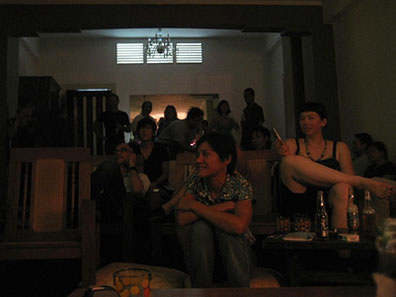
[Artists and audience at the ArtGrill: (l-r) Galleon Trade artist Johanna Poethig, Gerry Tan, yet another Filipino artist named Jet, sound artist Chris Brown, and artist and mag:net gallery owner Rock Drillon. Photo by Eliza Barrios.]
Q. C. Q&A. mag:net café Katipunan in Quezon City (Q. C.) held an ‘ArtGrill’ featuring in Galleon Trade artists. I’m glad I had the chance to contextualize my Regalos project, as it helped people like Gerardo Tan, a conceptual artist and Dean at the University of the East College of Fine Arts, to better appreciate my ideas. It was also really nice to hear my fellow artists talk about their work. For example, Stephanie Syjuco, who left the Philippines as a young child, discussed her work in relation to forging/counterfeiting her identity, which took on new meaning in the context of the Philippines.

Artist's Salon at the Living Room
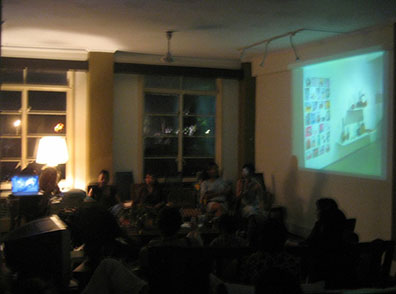
[Artists’ Salon at The Living Room, hosted by Carlos Celdran. Photo by Stephanie Syjuco.]
Crowd at Living Room
[Audience. Photo by Stephanie Syjuco.]
carlos celdran
[Carlos Celdran checks the projection. Photo by Eliza Barrios.]
Malate Salon. Carlos Celdran did a fabulous job leading the discussion at The Living Room, an alternative space and art residency. With his familiarity with critique that seems more Western than Filipino, Celdran pressed the Galleon Trade artists with very thoughtful questions. He asked me about the cultural appropriation of using balikbayan (literally, “going home”) boxes. I took it as an opportunity to pursue a question that Carlos constant poses about art: “Is it Filipino?” People always asked how many Galleon Trade artists are Filipinos or Fil-Ams. I also found the constant discussions about who does or doesn’t look Filipino very curious—after all, Filipinos, more than Americans, have a broader understanding of Chinese and Spanish influences in Filipino blood. So I found it interesting that as a Chinese, I would be appropriating the balikbayan box, while my intention was to express my skepticism of my contribution as an American.
Afterwards, during a surprise birthday party for me (lucky me!) the Galleon Trade artists had the honor of having our photo taken by Juan Caguicla, an incredible photographer who happened to be renting us a room down the hall.

More words and pictures to be posted soon. In the meantime, see pictures and posts about the Galleon Trade expedition at:
Official Galleon Trade news blog
Jenifer Wofford’s blog, Wofflings
Claire Light’s blog, Atlas(t)

Standard
Art & Development, Community

Post-Ship Launch Report

Last Saturday’s Galleon Trade: Ship Launch was my first time helping to organize an art auction.

(I don’t know how to say this without sounding hokey, but: I try to savor when I have a first experience with anything; it’s a way to watch myself grow and to acknowledge the adventures within my daily life. It’s a lesson I learned while traveling abroad, and have tried to bring home.)

I’ve donated work to many auctions before, and I always admired how professional and enjoyable Intersection for the Arts’ auctions are. Their attention to detail—white gloves on the art handlers, very clear roles and responsibilities, a detached wrapping area—provided an example I sought to emulate.

I also learned a lot from the dedication and professionalism of certain individuals. Jenifer Wofford, an artist, educator and friend who initiated Galleon Trade and was the mastermind behind Ship Launch, worked night and day for weeks to tie up a gazillion loose ends, from the location, to handling media inquiries, to collecting the art, to serving as point-person for internal communications, to asking for help and delegating tasks. She even made the mango salsa. Her family was like a battalion of support, unloading tables and chairs on the front lines and unleashing wave after wave of delicacies like adobo skewers throughout the evening; her beau Rick was like a rock that I think all of the Galleon Traders leaned on for his professionalism, competence and manpower. The one thing I forgot to do was to toast Wofford’s dedication and leadership.

I also got to work with Mike Arcega, an artist whose fabrication and installation skills inspire me to raise the bar for myself. He and I worked on many aspects of the auction implementation together. First, with the help of Rick, we swept the 20×50’ gallery room. It wasn’t that the floor was bumpy – there was no floor. It was just unfinished concrete. Hence the Kleen Sweep. Sweeping felt more like digging a hole with a broom; the more we swept, the more dust filled the air and made us look like we were going gray in our hair.

By mid-day, we filled a garbage bag with at least 50 pounds of dust. This is one more of those idiosyncratic behind-the-scenes moments of being an artist. It’s not the stereotypical schmoozing-at-an-opening scene or the musing painterly looking-and-thinking pose. I could feel my lungs feel grody, but I appreciated the fact of knowing what needed to be done and making it happen. It’s really a blessing to be surrounded by energetic, capable people.

Despite starting at 10 am, we couldn’t have finished installation without Stephanie Syjuco’s help. And there would be no auction without the generosity of 40 artists who donated work, among them, my favorites Renee Gertler (who’s in an upcoming group show at Swarm), Stephanie Russell, Erik Scollon, and Mario Ybarra, Jr., a Los Angeles-based artist who I’ve had the pleasure of assisting for the past few weeks during his Capp Street residency at the Wattis Institute. (Keep an eye out for postings about the mural unveiling in September.) I also feel really lucky to be a beneficiary of Amanda Curreri’s and Emily Sevier’s generous spirits; they helped wrap up the artwork in the tight turnaround time (not to mention a very tight corner of the hallway).

Of course, the event would not have been a success without the numerous contributors, too many to list here. Their financial support was really incredible. I’m especially moved, though, by the sense of community that crystallized; people were genuinely interested in Galleon Trade take off, artists bought other artists’ work (because collecting art is a way to support your fellow artists; it’s not just for capital-C collectors), and it was really sweet to see moms and Tias in action in support of a contemporary art project.

Considering that this was a first time for us organizing an auction, I thought the event went really smoothly. The rest of my life has taken a back burner. I’d like to include one more behind-the-scenes look—laundry all over the floor, no time for grocery shopping—and include one more acknowledgement—to the partners and spouses who, despite the financial instability and constant project-driven obsessions, still find a way to love artists: Thank you.

Standard