Citizenship, Meta-Practice

Art World Misogyny

Sexism in the art world: the art world needs to radically re-think its ethics.

Today’s profile of Simon Evans and Sarah Lannan (WSJ) was framed as an ongoing quandary between husband-and-wife collaborators: How will Evans and Lannan share credit for artwork branded as Evans’, which Lannan has increasingly co-authored over the past eight years?

The title, “An Art-World Love Story: As Simon Evans’s star rises in the art world, his wife wants more credit” is frankly pre-Women’s Lib. Besides the fact that Evans is identified by name, and Lannan only as “his wife,” the angle is sexist—it implies that a gold-digging Lannan wants credit because Evans’ capital is increasing, not due to her contributions:

While Ms. Lannan, 29, was deeply involved in the creations, the works continued to carry his name…. Ms. Lannan had been growing increasingly uncomfortable with their practice of showing work that they had jointly produced under Mr. Evans’s name. They went to a couple’s therapist in 2012 to talk about it, but found they spent much of the sessions educating the counselor on how the art world worked….

The commercial art world is no model for ethical behavior. To me, explaining the art world’s misogyny to a therapist sets up conditional ethics. What ought to be done—giving credit where credit is due, and honoring one’s life partner—is obvious. Yet the couple seems to waffle in deference to money and power:

…given Mr. Evans’s reputation, Ms. Lannan was wary of upsetting the status quo. “We thought it was up to ‘The Man,’ or whoever was in control of the art world,” she said. “There is no way I was going to destroy this thing that Simon has. And neither one of us wants to lose our jobs.”

This illustrates the pervasiveness of artists’ precarity: with so many artists desperate for modest recognition, those who’ve garnered success can become fearfully beholden, lacking personal agency. From my reading, Evans holds the cards—and he is reluctant to sacrifice his male privilege to risk marginalization by association.

To cynics (or so-called realists) who call this strategy is a fair response to an unjust market, I’d offer this: The market is not fixed. It’s not truth, and we shouldn’t let its distortions form the organizing principles in our lives, relationships, and creative collaborations.

The commercial art world of collectors and dealers reflects the values of a privileged and prejudiced few. By doing nothing, and allowing Lannan to carry the burden of agitating for recognition, Evans allows the the myth of male genius to work to his benefit at his wife’s detriment. Similarly, if artists feel that we’re never in any position to assert our principles within the shape and structure of our interactions, then we are likewise complicit.

When George Baselitz recently said that women “don’t paint well,” as backed up by  “the market test,” at least his shock-schtick publicized the art world’s sexism overtly. Internalized misogyny and self-preservationist complacency, on the other hand, are less public, more prevalent, and no less abhorrent.

Standard
Citizenship, Sights

Artists Answer Institutions’ Unasked Question

A Brooklyn artist self-organizes an exhibition in her own studio to make a brilliant, affirmative counter-statement to the problem of women’s under-representation in museum exhibitions and biennials.

The 2014 Whitney Houston Biennial: I’m Every Woman
Sunday, March 9, 4-8pm (one night only)
20 Jay Street, Suite 207, Dumbo, Brooklyn

“The biennial comes as a response to the continuing minimal representation of women artists in major museums and galleries. To bring some balance to the art institutions in New York this season, curator and artist Christine Finley will host more than fifty female artists from a varied range of geographic and cultural backgrounds, disciplines, methodologies, and generations. The artists studio will be transformed into an inviting, living space, a salon filled with work from artists including Mickalene Thomas, Guerilla Girls, Swoon, Sienna Shields, and Annie Sprinkle & Beth Stephens. The aim of bringing together so many creative voices is to sing a collective song that celebrates the contributions of pioneer female artists and marks a moment in our communal trajectory.”

Standard
Citizenship

Tania Bruguera on Reciprocity, Generosity, and Earned Respect

Tom Finkelpearl:

“I’ve been thinking a lot about reciprocity lately…. When you say you have created a community, that could mean this exchange, the notion that I’ll help you with your sound editing if you do the camera work for me, which seems like reciprocity.”

Tania Bruguera [emphasis added]:

“The mistake is in the use of if. It is not, ‘I do this for you if you do this for me,’ it’s just, ‘I do this for you.’ The point is that each person should say the same. It is not a quid pro quo. Maybe person A is helped by person B, and later person B gets help from person C and D, and person A is helping person C. It’s not a two-way street; it’s a place in the middle, where people meet. It is knowing that you will have support, and things are not seen as debts or gains but as joy.

I always say that I wanted to provide a safe environment [at Cáthedra Arte de Conducta], safe but tough, safe because we were based in trust and honesty, not because it was easy. It is a system based on professional admiration, which each person has to work hard to get from the rest of the group.”

—From Tom Finklepearl, What We Made: Conversations on Art and Social Collaboration(2013)

This community understanding described by Bruguera is the opposite of the nakedly ambitious—where other people are sources of economic or social capital to be exploited, or lacking such capital, disregarded. Since artists’ opportunities for external validation are so competitive, it’s easy to be lazy and let ambitions guide behaviors.

I’d love to strive for this model of positive contributions:

To stop currying favors and stockpiling IOUs.

To quit politicking with hidden agendas.

To admire the admirable, and to question devotion to the merely influential.

To speak up or be discreet because it’s the right thing to do, not from fear of how it will affect reputations or limit future opportunities.

To pay it forward.

To give freely, and to continually earn each others’ respect.

To create spaces that are safe but tough.

Standard

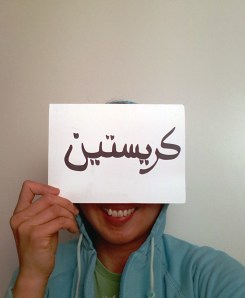
By giving people postcards with their names written in Arabic, Jamila Mohamad Hooker collects selfies that recognize the beauty and universality of the Arabic language.

I’m shy, but I think this project is super awesome, so here’s mine:

Foreign Postcard project by Jamila Mohamad Hooker.

Foreign Postcard project by Jamila Mohamad Hooker.

Learn more about Foreign Postcards.

Citizenship

Foreign Postcards by Jamila Mohamad Hooker

Image
Citizenship

In response to President Obama’s recent, not-so-cool counterexample of art history majors, SFMOMA solicited responses along the theme of #ArtDegreesWork:

Did your degree in art history help you start a company? Get a museum job? Teach in a classroom? Share your story!

A lovely affirmation of what we artists and art history majors already know. Check it out here.

#ArtDegreesWork

Aside
Citizenship, Meta-Practice, Values

Just say no

Stop asking artists to work for free.

And artists, just say no to working for free.

That’s what Tim Kreider called for in “Slaves of the Internet, Unite!,” a funny, bitterly-laughing-because-it’s-true, op-ed on NYT (Oct. 26, 2013). (Recent grads and emerging artists are the most guilty.) Krieder included a form letter:

Here, for public use, is my very own template for a response to people who offer to let me write something for them for nothing:

Thanks very much for your compliments on my [writing/illustration/whatever thing you do]. I’m flattered by your invitation to [do whatever it is they want you to do for nothing]. But [thing you do] is work, it takes time, it’s how I make my living, and in this economy I can’t afford to do it for free. I’m sorry to decline, but thanks again, sincerely, for your kind words about my work.

“In this economy” implies the recession, and that working for free might be OK in abundant times. But in this capitalist economy, where artists have no protections, I don’t think we can’t really afford it, recession or none.

The Graphic Arts Guild has been preaching to freelance illustrators and graphic designers to ask for decent compensation for the good of their fields, and it’s about time for fine artists and freelance writers to take up the mantle.

W.A.G.E. has been agitating for artists to get paid for our labor—such as exhibiting our work. I’ve added my name to the list of supporters, and you can too.

Their latest project is W.A.G.E. Certification, in which non-profits in NYC can sign up to be certified as organizations that equitably pay artists’ fees. I love the idea; nationwide requirements like CARCC would be ideal, but short of that, this model, sort of like a Better Business Bureau of art nonprofits, is a huge step forward.

I hope it spreads like wildfire around the country.

I hope foundations take it up as a grant requirement to nonprofits.

Basically, W.A.G.E. Certification requirements stop organizations from asking artists to work for free:

1. Artist Fees must be paid.

2. The Artist Fee is separate from, and must not be used to cover travel, lodging, installation, shipping or any other expenses associated with production.

Though W.A.G.E. Certification is currently in progress, it’s already helped me think through certain artist’s opportunities.

For example, a Brooklyn art nonprofit has a current call for a fellowship program. Successful applicants will receive a solo exhibition along with the requirement to stage a public program. No funds are promised.

In fact, not only will artists not receive an artist’s fee, nor any production expense reimbursements, applicants are required to submit a budget and a plan for external funding for the public program. So in addition to unpaid exhibition labor, Fellows will undertake fundraising and project management labor, too.

The organization’s only monetary outlay, according to the application, is the printing of postcards. That’s like, what, $75 to $300, a pittance compared to artist’s expenses incurred in a solo show. I could easily spend $1-3k on materials alone, whereas the greatest financial burden is incurred by the time it takes to conceptualize, prototype, procure, produce, pack/crate, transport, install, and de-install a show.

(Think about this: I work as an art installer at a nonprofit gallery. They pay me to handle artworks. This other nonprofit gallery would have me take time off from a paid job to do the same exact labor, but will not pay because the artwork is by a different artist: me.)

This nonprofit receives support from state, city, and borough funding agencies, as well as corporations and foundations. Yet not one of those dollars will go directly to individual artist Fellows who will take on the lion’s share of creating a gallery exhibition and public event. In exchange for a venue and access to the organization’s audience, Fellows arguably take responsibility for a fraction of the gallery’s annual programming, not for a fraction of its annual budget, but zero compensation.

Sometimes interactions that should be little to no work still amount to working for free.

I recently contributed images to a nonprofit organization’s printed curriculum, which, despite their good intentions and my attempts at self-protection, still ended up backfiring.

They didn’t have money for reproduction rights (always suspect to me, as publication budgets usually account for design and printing). 

I did it as a favor to friend, though I asked for a contract. (Again, artists, get the GAG handbook if you haven’t already!) The organization’s lawyer drafted one that specified artworks, and I submitted images with full caption information.

The publication included images that I didn’t permit them to use, as well as incomplete and incorrect captions (which would have duly credited the art organizations that did support me with actual money). I sent the organization a list of ways they overstepped their own agreement. They were sincerely apologetic and pulled the curriculum to revise it, which I appreciate.

Zero compensation is bad enough; further time and frustration expended is worse.

Kreider should be paid well for his skill. I admire his ability to write about this topic humorously. To me, arguing such an obvious point makes me smack my forehead in exasperation.

Organizations can be very ironic in how they characterize their own labor. An artist’s residency program posted this recently on re-title.com:

We are tired of artists not getting the support and time they need to move forward with their artistic careers. So, we want to offer artists a space to rest, experiment, and create – and to do so with ease.

The note of frustration is pretty hilarious, because what this organization does—charge about $850 USD after tax for a one month rental of a bedroom and semi-private studio—doesn’t qualify as artists “getting the support and time they need” to me.

For that amount, you could rent a small studio in Brooklyn, the second most expensive urban area to live in the US, after Manhattan.

What I am really after is the normalcy of transactions. Artists provide a service and undertake labor. Nonprofits who purport to support artists should then funnel their funds to artists. It’s pretty simple.

I was once hired by a nonprofit to design an appeal letter for their direct mail campaign soliciting cash donations. I finished the job and sent an invoice for my services, extending a nonprofit discount to them.

A week later, I receive an envelope in the mail. Expecting a check, I opened it, only to find the very appeal letter I designed.

“Oh!” I thought. “You’ve got it turned around. I don’t pay you. YOU pay ME.”

I need to bring that clarity and certainty as a designer to my approach towards opportunities as an artist.

Despite this rant, I am glad that nonprofits exist. They’re part of a legacy of social change and transformation in this country that I’m very proud of. Lots of amazing and ethical arts nonprofits exist and support countless artists. Nonprofits are spaces in which alternative futures can be played out in the present… until the time when better alternatives will become more viable.
Standard
Citizenship, Meta-Practice, Values

Points of reference: Income inequality, empathy, artists, and capital

There’s something in the air…. Articles have been popping up about the intersection of the tech sector and extreme wealth, and status and the empathy gap, just as my artist friends in the Bay Area are reeling about news of galleries closing and venerable artists being evicted. To consider income inequality, class, and how artists got into the position we’re in in relation to the high-powered wealth-corrupted “art world,” I’ve been thinking specifically about capitalism.

Here are some points of reference, of which I’m still trying to make sense:

INCOME INEQUALITY:

In New York, Bill de Blasio‘s NYC mayoral campaign.

This past weekend’s Creative Time Summit. I didn’t go, but will watch some of the videos, esp Rebecca Solnit’s keynote on gentrification in SF, and My Brooklyn’s mapping- and data-driven anti-gentrification efforts.

“Will Work for Inspiration,” David Byrne’s op-ed for Creative Time Reports, includes this bit on preserving NYC for all:

I don’t believe that crime, danger and poverty make for good art. That’s bullshit. But I also don’t believe that the drop in crime means the city has to be more exclusively for those who have money. Increases in the quality of life should be for all, not just a few.

THE EMPATHY GAP:

The title says it all: “Rich People Just Care Less” is an op-ed by psychologist Daniel Goleman posted in NY Times (October 6, 2013):

A growing body of recent research shows that people with the most social power pay scant attention to those with little such power. …

Income inequality is at its highest level in a century. This widening gulf between the haves and have-less troubles me, but not for the obvious reasons. Apart from the financial inequities, I fear the expansion of an entirely different gap, caused by the inability to see oneself in a less advantaged person’s shoes. Reducing the economic gap may be impossible without also addressing the gap in empathy.

Over at the Greater Good Science Center, Jason Marsh posted “Why Inequality Is Bad for the One Percent” last year (September 25, 2012), and though it opens with then-presidential candidate Mitt Romney, it’s furnishes more background to Goleman’s op-ed…

…in a 2010 study published in Psychological Science, researchers found that people of higher socioeconomic status (SES) were worse at reading other people’s emotions—a skill known as “empathic accuracy,” a basic part of empathy.

… inequality may be self-perpetuating: The lack of compassion the rich feel might make them less likely to out look for the less fortunate, thereby increasing the gap between rich and poor—and the worse this gap gets, the research suggests, the less inclined the rich may be to do anything about it.

… insularity is an enemy of empathy.

CREATIVITY:

In trying to get a foothold in NYC as an artist, it’s nice to hear David Byrne acknowledge the difficulty:

As one gets a little older, those hardships [of surviving in NY in the 1970s] aren’t so romantic – they’re just hard. The trade-off begins to look like a real pain in the ass if one has been here for years and years and is barely eking out a living. The idea of making an ongoing creative life – whether as a writer, an artist, a filmmaker or a musician – is difficult unless one gets a foothold on the ladder, as I was lucky enough to do. I say “lucky” because I have no illusions that talent is enough; there are plenty of talented folks out there who never get the break they deserve.

ART META-PRACTICE:

Maria Popova recently posted “Happy Birthday, Brain Pickings: 7 Things I Learned in 7 Years of Reading, Writing, and Living” on Brain Pickings:

Do nothing for prestige or status or money or approval alone. As Paul Graham observed, “prestige is like a powerful magnet that warps even your beliefs about what you enjoy. It causes you to work not on what you like, but what you’d like to like.” Those extrinsic motivators are fine and can feel life-affirming in the moment, but they ultimately don’t make it thrilling to get up in the morning and gratifying to go to sleep at night — and, in fact, they can often distract and detract from the things that do offer those deeper rewards.

Jerry Saltz, who seems perpetually in a pickle about being an art world insider while trying to critique the art world’s narrow halls of power, did have this worthwhile critique to share, in “Saltz on the Trouble With Mega-Galleries” in NY Mag:

The artist is a brand, and the brand supersedes the art. The scale and pace of these places often turn artists into happy little factories with herds of busy assistants turning out reams of weak work. It’s the new Capitalist Realism.

Andrea Fraser’s “1% Art” came out last year in Adbusters, but only recently crossed my path. It’s really good, so I’ve quoted it at length:

A broad-based shift in art discourse may help precipitate a long overdue splitting off of the market-dominated subfield of galleries, auction houses, and art fairs. If a turn away from the art market means that public museums contract and ultra-wealthy collectors create their own privately controlled institutions, so be it. … It is time we began evaluating whether artworks fulfill, or fail to fulfill, political or critical claims at the level of their social and economic conditions. We must insist that what art works are economically determines what they mean socially and also artistically.

If we, as curators, critics, art historians and artists, withdraw our cultural capital from these markets, we have the potential to create a new art field where radical forms of autonomy can develop: not as secessionist “alternatives’ that exist only in the grandiose enactments and magical thinking of artists and theorists, but as fully institutionalized structures, which, with the “properly social magic of institutions,’ will be able to produce, reproduce and reward noncommercial values.”

Fraser’s post made me ask myself, “What am I doing?” If I resent how much Saltz bags on others for writing too much about the 1% art world and mega-galleries, when they and he should write about the 99%, shouldn’t I focus my efforts in the 99% as well? What does that mean for me as an artist, in relation to other artists and institutions? What does that mean for me as an art worker—an installer and assistant?

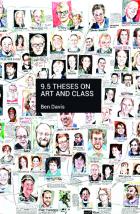
Ben Davis, 9.5 Theses on Art and Class (Haymarket Books).

Ben Davis, 9.5 Theses on Art and Class (Haymarket Books).

Finally, I read Ben Davis’ 9.5 Theses on Art and Class (Haymarket Books) in an informal book club. The book was provocative, but I’ve really enjoyed exchanging ideas with bright artists, curators and art historians in our little self-organized book club. (You can participate in a virtual book club hosted on Temporary Art Review, thus far here and here.)

Our final meeting yesterday, ended with a fascinating discussion about how our future selves might look back on this contemporary moment in art history from a post-capitalist perspective. How will we historicize this Capitalist art? What will it be like to be distanced from such narrow conditions of production?

What if artists are at the center, not the power players that Davis spends so many chapters discussing? What if I went on a 1% Art World diet, ignoring the art stars, yacht parties, the market, celebrity gossip, and auction records, how much time would I have for thinking about materials and processes?

What might a post-capitalist art world look like? What kinds of structures and institutions will artists work within? How do I turn my attention towards those alternative futures now?

Standard