Art & Development, Travelogue

Travelogue Entry No. 1: Cumbria, England

Visuals will be uploaded in mid-October, but here is an interim post. 

-Participating in the FRED festival looks like:

–Hanging out in Brougham Hall, the fortified castle that dates back 1600 years ago to the Roman days. It’s currently undergoing private reconstruction under the leadership of Mr Christopher Terry, a delightful Englishman, world traveller and architect. Mr Terry took me to see the Lake District, past the beautiful lakes Ullswater and Brotherswater, and over the Hardknotts Pass, where we could see 20 miles to the Irish Sea.

–Meeting a few other artists involved with FRED, such as Sally Barker, who has made sculptures of poo and set them out along a beautiful creek and waterfall outside of Sticklebarn(?) Tavern in Great Langdale, Kate Gilman Brundrett, who developed the Ministry of Creative Parking for the parking-starved town of Penrith, and Tony Charles, who makes his own pigments out of steel rust and created a marvelous floor pattern in the art college, which is housed in a former steel mill. And I also enjoyed painting rocks to assist Kate Raggett with her piece, which involved hauling 5,000 stones up the side of a hill behind a mining museum into sheep grazing territory, and arranging it into a design that can be seen from miles away, such as at the Castlerigg Stone Circle.

–Staying at the Keeper’s Cottage B&B, which was actually the gamekeeper’s cottage during Lord Brougham’s time. Pam and James Wright maintain it now as a beautiful, homey cottage, and the little touches in the decor are adorable. The view outside my window is picture perfect: a farm with sheep and what looks to my city-slicker eyes as Shetland ponies, walls of slate cutting up the green fields. The breakfasts of Cumberland sausage and bacon (what we Yanks call ham) and eggs and toast with homemade marmelade are fantastic…

Standard
Art & Development, Travelogue

Autonomy

This year, I’m lucky enough to travel abroad twice. In a few days, I’ll be off to the UK. It’s my first time across “the” pond. I’m going to be an artist in FRED, the annual art invasion of Cumbria. Then I’m going to see as much art in Manchester and London as possible.

I feel lucky to be an artist who makes a living as a self-employed graphic designer. Still, having tasted the life of a full-time artist during my trip with Galleon Trade, I want more. And that’s another reason why being an Affiliate Artist at the Headlands is so great — sure, there’s the studio, the awesome environment, the community, but I’ve also been savoring the osmotic zone of artists-in-residence. The AIRs are there to have time and space to experiment and develop, and appear to be happily spending their days and nights thinking about, talking about and making art. I find myself wondering, What would it be like to wake up in a secluded place, and in the quiet of the morning, wander over to the studio and see where the day takes me?

I’m starting to think of these opportunities for international travel as Temporary Autonomous Zones (TAZs) as an artist. A while ago, I worked with Underground Railroad, a collective of cultural workers who theorized that, while we lived in a country that lacks physical TAZs (Not counting Burning Man — I mean those accessible to young urban POCs), cultural events could be transient TAZs. The vision was that a taste of being free would lead towards expansions in duration, until soon enough the TAZ would be round-the-clock and migrate beyond its four walls.

I love this idea’s elegance — its sense of natural momentum. It’s not about the fear of failure driving one to a necessary optimism. Rather, the potential is just too good to pass up.

Standard
Art & Development, Travelogue

Postcards from Manila, Part II

the living room
Carlos Celdran’s Living Room in Manila.
Galleon Trade’s home base in Metro Manila was also an artist’s residency and alternative arts space. It’s a large, beautiful room with a view of Roxas Blvd (which is sort of like Venice Beach) and the South China Sea. When a spacious, well-appointed room with lots of light is the first ingredient in building an artistic community, it shores up the importance of ‘home.’

stephanie syjuco looks at poklong's anading's photographic installation at finale gallery
My shot of Poklong Anading’s installation at Finale Gallery in Megamall.
Stephanie Syjuco is on the outside looking in, a fitting symbol, I think, for the experience that many of the US-based artists engaged as visitors to the Filipino art community.

reception food
It ain’t a party without pancit. It’s plenty surreal to attend an art opening in a mall — let alone one accompanied with pancit, chicharron, queso-filled lumpia and fried broad beans. And red wine, touché.

balikbayan
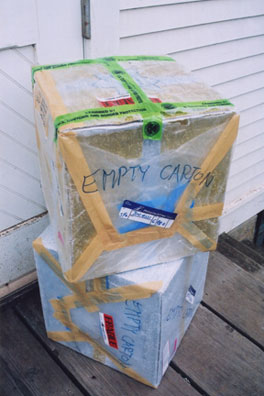
Balikbayanned. After a magical 10 days in Manila, re-entry to the US — the banalities, the rat race, the predictability — was rough. Similarly, the balikbayan boxes in the Regalos project went through their own ordeal as Galleon Trade mastermind, Jenifer Wofford, attempted to repatriate them via Air Cargo. As a transit-specific project (as described by scholar Eric Estuar Reyes), these new marks of transit bring the work to a different stage of the project. I’m looking forward to showing these works to a local audience at the Euphrat Museum in October.

Standard
Art & Development, Travelogue

Wish You Were Here: ‘Postcards’ from the Philippines

The Regalos Project

balikbayan boxes at SFO

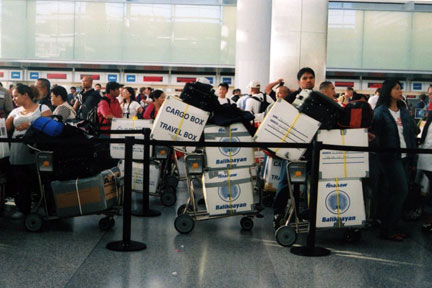
Context: Balikbayan* boxes and their owners at the Philippine Airlines counter at San Francisco International Airport. These boxes, and dozens more, were on my flight to Manila. In a testament to the impact of balikbayan boxes, their additional weight was enough to necessitate a re-fueling stop in Guam.
*Literally, “going home.” Can refer to (1) standardized cardboard boxes for shipping gifts to the Philippines or (2) overseas Filipinos returning to the islands.
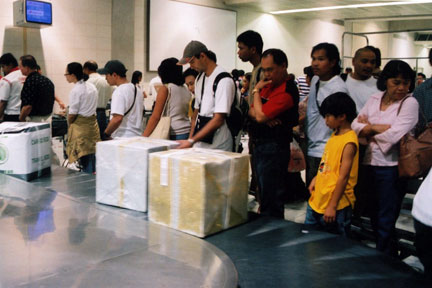
regalos at MNL baggage claim

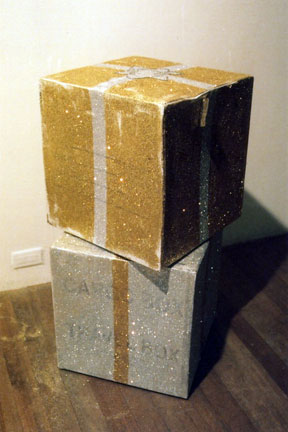
Process: My empty, glitter-covered balikbayan boxes for the Regalos project generated curiosity at the baggage carousel at Ninoy Aquino airport (MNL) in Manila.
regalos project at Green Papaya Art Projects

Product: The Regalos boxes on display at Green Papaya Art Projects in Quezon City. Some of the glitter was lost in transit, suggesting the entropy between giver and receiver or intention and material. I really liked how Eric Reyes, one of our academic counterparts in Galleon Trade, put it: “It’s not so much a site-specific project, as much as a transit-specific one.” He liked that the work showed marks of transit, and which I think reflects his interests in imperialism and migration.
installation at green papaya
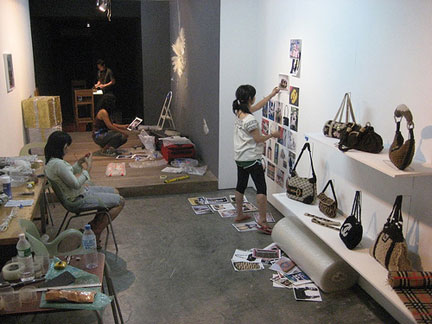
Installation at Green Papaya Art Projects, with Mike Arcega, Stephanie Syjuco and Reanne Estrada. Photo: PeeWee Roldan.
peewee and joaquin at green papaya
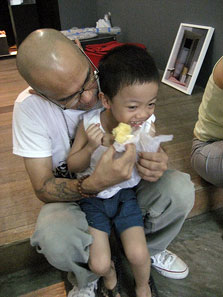
Family moments: Artist and Green Papaya Art Projects owner Norbert “PeeWee” Roldan and his son Joaquin share an ensaymada, a cheese-covered brioche. The ensaymadas were delivered by a relative of Galleon Trade artist Mike Arcega. Photo by Stephanie Syjuco.

In addition to interfacing with Filipino artists, I also took Galleon Trade as an opportunity to get to know and work with the other Galleon Trade artists, many of whom are busybusybusy back in the US. Being part of the Galleon Trade show at Green Papaya was awesome on all accounts: the exhibition was professional and it gelled curatorially (thanks to the planning of Jenifer, Mike, Stephanie, Eliza Barrios, Megan Wilson and PeeWee Roldan). And throughout the installation, when we gave each other honest feedback and discussed the works’ meanings and contexts, I thought to myself, “This is what it’s really about.”

Sights

Jeepney on M.H. Pilar Street

Jenifer Wofford is right: A tabletop book on Filipino street graphics is long overdue. As an enthusiast of typography and scripts, I enjoyed all the hand-painted signs, plump cursives, and florid jeepney ornamentation. Jeepneys are a quintessential Filipino mode of transportation; leftover from the U.S. occupation, jeeps have been assimillated as a key form of cheap public transportation. Jeepneys are loud, noxious, and–as any resident of congested M. H. Pilar Street in Malate, Manila might think–overabundant. Yet somehow, it works perfectly: they’re fast, the open windows provide a natural breeze, and there’s an unspoken honor system for passing the fare from rider to rider until it reaches the driver. They’re also richly decorated with spirit and personality, featuring everything from names of overseas workers to airbrushed murals (motorcycle riders or space scenes, for example). The mix of colorful typography with reflective metal is especially irresistible.
tricycle

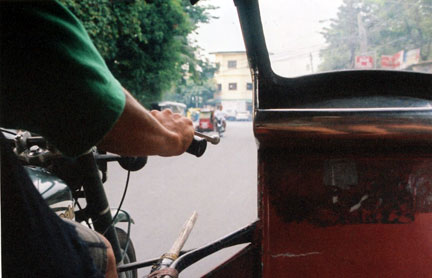
Though Manila’s traffic puts even the Bay Area’s congestion into perspective, there are lots of options for getting around, and some of them–like the tricycle–are lots of fun. The tricycle is actually a small motorcycle with a sidecar of welded steel for passengers. Riding through Teacher’s Village to have merienda (afternoon snack, including dinuguan and puto–pork blood soup and steamed rice muffins) at Mike Arcega’s tita’s house inspired a moment of sincere gratitude.
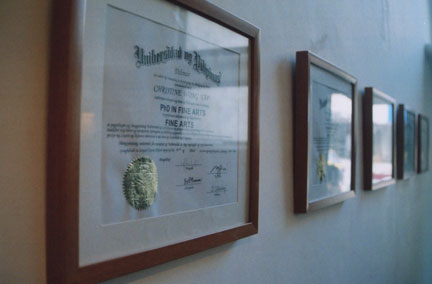
diplomas at green papaya

My honorary PhD in Fine Art from the University of Philippines, Diliman. The degree doesn’t actually exist; Mike Arcega had conterfeit diplomas made for the artists in the Green Papaya show to explore native economies.

Tastes

dinner at green papaya

Classic homemade Filipino food (and drink) (clockwise from bottom): bangus (fried fish), some of the sweetest, tenderest chicken and pork adobo (vinegar and soy sauce stew) I’ve ever tasted, kare-kare (peanut-sauce stew), rolls of sweet rice, and San Miguel beer. On the first night I arrived, PeeWee Roldan, artist and owner of Green Papaya Art Projects, hosted a beautiful welcome dinner. Gaston Damag‘s sophisticated artwork lined the walls, and we enjoyed a low-key homecooked meal before the madness of daily openings and lectures.

jaime at aristocrat

Galleon Trade artist Jaime Cortez camoflages with the Aristocrat Restaurant, “The Philippines’ most popular restaurant,” which also happened to be next door to our home base. Jaime shares a plate of eggplant-tomato-onion salad, which, when stirred, surprisingly resembles salsa — except with baggong (shrimp paste).

net High Street

In a country of round scoops of rice, square blocks stand out. mag:net High Street in ritzy Fort Benafacio keeps it cubic. Beef mechado (tomato-based stew), adobo quail eggs, and a light sangria. Lovely.

Tourist Trap

airport receipt

This small piece of paper cost me quite a bit of worry.
I saved 650 pesos for the airport exit fee, but the rate had just been raised from P 550 to P 750, and the booth was strictly cash-only. I was short 100 pesos, which translates roughly into US $2. The situation became worrisome when the airport’s two ATMs wouldn’t accept my card. Worse, I carried a traveller’s check that had been utterly useless in the Philippines. Ironically, the airline supervisor said that since this happens so often, PAL no longer keeps a petty cash box to help out their passengers. Instead, he suggested that I borrow money from other passengers and pay them back on US soil. (A bad idea — there wasn’t actually an ATM and retailer to make change at the arrival area at SFO.) Luckily, a sympathetic traveller freely contributed pesos to my (mortified) relief. Whew!
The funny thing is, so many taxes are tacked on to airfares, I probably wouldn’t have thought twice about a $17 fee on top of my ticket price. But the current system creates these mini-fiascos. For all the high technology involved in running an airport, is a credit card machine too much to ask?

Sounds
Romeo performing Spark
[Image from Romeo’s youtube video. Video by Eliza Barrios.]
Romeo Candido’s impromptu performance / goodbye gift to the Galleon Trade artists at The Living Room was really moving. With only two instruments — his voice and a loop pedal — Romeo created a full composition that crystallized a passing moment and brought everyone present with beauty. Romeo is a very talent filmmaker from Toronto working in Manila, and just by chance he happened to be in residence at The Living Room. I think almost all of the Galleon Traders were delighted by the affinity in our practices as North American artists trying to make a deeper connection to the contemporary arts in the Philippines.

Standard
Art & Development, Community, Travelogue

Exchange: Talking, drinking, laughing, eating, looking

The heart of the Galleon Trade exchange exhibition is face-to-face contact. I feel extremely lucky to be one of the nine California-based artists who were able to pull away from busy-ness in the States to interface directly with Manila’s artists.

A few memorable sites/situations:

mogwai screening room
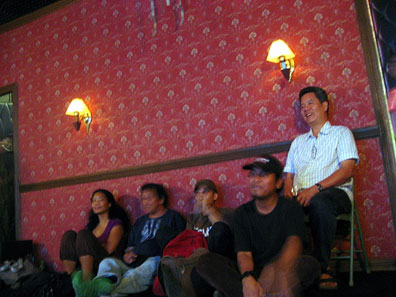
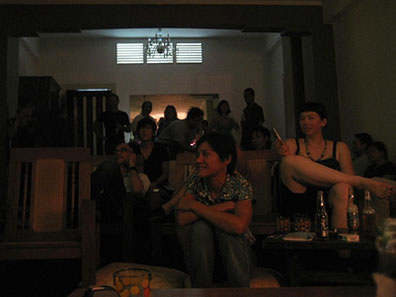
[Mogwai screening room: (l-r) Reanne Astrada, Romeo “the oldest punk rocker” Lee, two Filipino artists–one named Jet and another whose name I can’t remember–and the artist Gerry Tan. Photo by Stephanie Syjuco.]
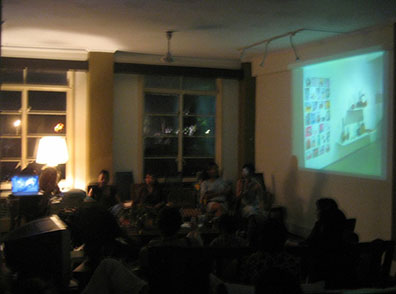
Cubao X slide show. A self-organized presentation of work by contemporary Filipino artists at Mogwai, a brand-new, hip café with a sleek upstairs screening room. Cubao X is a locus of galleries, design shops, comic book stores and restaurants that once housed artists studios, and before that, the Marikina Shoe Expo. Though local artists are ambivalent about the displacement of artist’s studios for artsy commerce, I was still impressed that the owners of Mogwai made the glam screening room available for an artist slide show.

emil yap studio
Cavite studio. Emil is a social realist painter and installation artist, and a longtime activist. The social change of the 1960s in the States seems so distant to me, but for Emil, the Philippine’s people power movements of the 1970s and 80s are part of his personal and artistic history. Emil is also my cousin.

poklong anading Untitled Gaze  2007, Photographic Transparency   90 x 192 inches
[Poklong Anading, Untitled Gaze, 2007, Photographic Transparency, 90 x 192 inches. From Finale Gallery]
Megamall closing. I had the good fortune to attend the closing reception of Poklong Anading’s exhibition at Finale Gallery in Megamall in Manila. (Yes, there is a mall called Megamall, and yes, it’s common and unsurprising for Manila’s commercial galleries to be located there. The location is apt, since malls offer a clean, air-conditioned escape from the chaotic, humid streets outside.)
Poklong makes top-notch object- and photography-based relational art. On display at the closing was a back-lit, life-sized photograph of viewer’s backs as they packed the narrow storefront gallery during the opening. Inside, an oversized mousetrap made of neon and cement hummed with an audio track of chatter. I thought the work was elegant and smart. It expressed Poklong’s ambivalence on the social nature of art openings and the commercial context of the gallery (mall signage could be seen in the reflection of the windows in the photograph, and it was mimicked in the neon sculpture). On another level, to look at the photo resulted in a curious effect of being physically outside of the gallery as well as the a circle of opening attendees photographed.

Art Grill audience
[Artists and audience at the ArtGrill: (l-r) Galleon Trade artist Johanna Poethig, Gerry Tan, yet another Filipino artist named Jet, sound artist Chris Brown, and artist and mag:net gallery owner Rock Drillon. Photo by Eliza Barrios.]
Q. C. Q&A. mag:net café Katipunan in Quezon City (Q. C.) held an ‘ArtGrill’ featuring in Galleon Trade artists. I’m glad I had the chance to contextualize my Regalos project, as it helped people like Gerardo Tan, a conceptual artist and Dean at the University of the East College of Fine Arts, to better appreciate my ideas. It was also really nice to hear my fellow artists talk about their work. For example, Stephanie Syjuco, who left the Philippines as a young child, discussed her work in relation to forging/counterfeiting her identity, which took on new meaning in the context of the Philippines.

Artist's Salon at the Living Room
[Artists’ Salon at The Living Room, hosted by Carlos Celdran. Photo by Stephanie Syjuco.]
Crowd at Living Room
[Audience. Photo by Stephanie Syjuco.]
carlos celdran
[Carlos Celdran checks the projection. Photo by Eliza Barrios.]
Malate Salon. Carlos Celdran did a fabulous job leading the discussion at The Living Room, an alternative space and art residency. With his familiarity with critique that seems more Western than Filipino, Celdran pressed the Galleon Trade artists with very thoughtful questions. He asked me about the cultural appropriation of using balikbayan (literally, “going home”) boxes. I took it as an opportunity to pursue a question that Carlos constant poses about art: “Is it Filipino?” People always asked how many Galleon Trade artists are Filipinos or Fil-Ams. I also found the constant discussions about who does or doesn’t look Filipino very curious—after all, Filipinos, more than Americans, have a broader understanding of Chinese and Spanish influences in Filipino blood. So I found it interesting that as a Chinese, I would be appropriating the balikbayan box, while my intention was to express my skepticism of my contribution as an American.
Afterwards, during a surprise birthday party for me (lucky me!) the Galleon Trade artists had the honor of having our photo taken by Juan Caguicla, an incredible photographer who happened to be renting us a room down the hall.

More words and pictures to be posted soon. In the meantime, see pictures and posts about the Galleon Trade expedition at:
Official Galleon Trade news blog
Jenifer Wofford’s blog, Wofflings
Claire Light’s blog, Atlas(t)

Standard
Art & Development, Travelogue, Values

Manila, Manila

Four days into my 10-day sojourn in the Philippines as part of Galleon Trade, I’d like to take a break to consider generosity and joie de vivre.

I’m really impressed with the amazing people I’ve met, such as the artist-gallery owners presenting the Galleon Trade exhibitions: Norberto “PeeWee” Roldan, an artist and designer who runs Green Papaya Art Projects, and Rock Drillon, an artist who runs the mag:net cafe.

Filipinos are famous for their hospitality, and combined with the professionalism and generosity I’ve experienced from our collaborators, I can’t say enough how nice it has been here. The gallery owners have really extended themselves to help create the exhibitions we envision, ensure local publicity (photos and articles in the Philippines Daily Star and Inquirer), and arranging for rock and experimental sound bands to play at the openings. We’ve also had the honor of landing at The Living Room, an alternative space run by Carlos Celdran. I have heard nothing but amazing things about Carlos’ tours (from Lonely Planet as well as individuals), and my experience on the Intramuros tour with Carlos even exceeded my high expectations. He conveyed a very complex history with pride, pain, humor and characteristic style. He made the sense of loss of his beloved city (after Gen. MacArthur’s carpet-bombing of the jazz-age city known as the ‘Pearl of the Orient’) tangible, yet the talk encompassed Filipino spirit and spirituality.

While class divides allow only a fraction of Filipinos to afford the lifestyle we are enjoying as American visitors, I have to say that I have developed a fondness for Filipino joie de vivre and patience (though dozens of jeepney and taxi drivers might be honking at each other non-stop, none seem to be angry). I can’t remember the last time I sat down to coffee in little cups and saucers to have a quality conversation, but here it seems to happen at least once a day. Maybe it’s because we’re guests on a short visit, but the small moments of mutual exchange underscored by generosity are very sweet and inspiring, and hopefully I can pull away from multi-tasking back home long enough to re-create them.

Standard
Art & Development, Values

Assisting an Artist

A while back, I realized that I wanted to gain perspective on the life of an established, full-time artist. I started looking for an artist’s assistant position. But since San Francisco’s art market is so small, it can support only a limited number of working contemporary artists. My chances looked slim.

Luckily, I had the good fortune to assist Mario Ybarra Jr. in June. A Los Angeles based artist, Ybarra was a Capp Street Artist in Residence at the CCA Wattis Institute for Contemporary Arts. I was at the right place at the right time, but it was serendipitous in other ways.

First, I felt that my interest in contemporary art and background in community art were at odds. Ybarra’s project for the Wattis was—can you believe it—a mural. I jumped at the opportunity to work with an artist weighing the conceptual considerations of mural painting. Second, my sensitivity to CCA’s poor racial diversity had become more acute, and Ybarra freely supplied his perspectives on being a contemporary artist of color. I appreciated our frank discussions, which raised questions of access (described in terms of squeezing through a hole in a chain-link fence, and now holding the fence for others to enter), identity politics and being pigeon-holed or tokenized. Third, I was interested in shaping the art world into one that I would want to participate in. Ybarra is a great case study for changing the terms of engagement. In addition to his inventive artistic practice (his studio is the street), he’s also a youth educator and gallery owner—an entrepreneur who proudly employs neighborhood locals, a curator who seeks artists that might not have a venue otherwise. His generosity is clear; his gratitude for his teachers lives on as a practice of mentoring emerging artists (and, by the way, donating work to support Galleon Trade).

Of course, I picked up on many practical, technical and conceptual skills (like rag-throwing, spray-bottle painting, and balancing the urge to upset cliches with a commitment to humanizing his subjects) as well, and actually, I had a great time working with him and his other assistants from Wilmington.

Ybarra’s two-story mural is in the stairwell at the entrance of the Wattis Institute, on the San Francisco campus of the California College of the Arts. The mural will be unveiled in September, along with a new monograph.

Standard
Art & Development, Community

Post-Ship Launch Report

Last Saturday’s Galleon Trade: Ship Launch was my first time helping to organize an art auction.

(I don’t know how to say this without sounding hokey, but: I try to savor when I have a first experience with anything; it’s a way to watch myself grow and to acknowledge the adventures within my daily life. It’s a lesson I learned while traveling abroad, and have tried to bring home.)

I’ve donated work to many auctions before, and I always admired how professional and enjoyable Intersection for the Arts’ auctions are. Their attention to detail—white gloves on the art handlers, very clear roles and responsibilities, a detached wrapping area—provided an example I sought to emulate.

I also learned a lot from the dedication and professionalism of certain individuals. Jenifer Wofford, an artist, educator and friend who initiated Galleon Trade and was the mastermind behind Ship Launch, worked night and day for weeks to tie up a gazillion loose ends, from the location, to handling media inquiries, to collecting the art, to serving as point-person for internal communications, to asking for help and delegating tasks. She even made the mango salsa. Her family was like a battalion of support, unloading tables and chairs on the front lines and unleashing wave after wave of delicacies like adobo skewers throughout the evening; her beau Rick was like a rock that I think all of the Galleon Traders leaned on for his professionalism, competence and manpower. The one thing I forgot to do was to toast Wofford’s dedication and leadership.

I also got to work with Mike Arcega, an artist whose fabrication and installation skills inspire me to raise the bar for myself. He and I worked on many aspects of the auction implementation together. First, with the help of Rick, we swept the 20×50’ gallery room. It wasn’t that the floor was bumpy – there was no floor. It was just unfinished concrete. Hence the Kleen Sweep. Sweeping felt more like digging a hole with a broom; the more we swept, the more dust filled the air and made us look like we were going gray in our hair.

By mid-day, we filled a garbage bag with at least 50 pounds of dust. This is one more of those idiosyncratic behind-the-scenes moments of being an artist. It’s not the stereotypical schmoozing-at-an-opening scene or the musing painterly looking-and-thinking pose. I could feel my lungs feel grody, but I appreciated the fact of knowing what needed to be done and making it happen. It’s really a blessing to be surrounded by energetic, capable people.

Despite starting at 10 am, we couldn’t have finished installation without Stephanie Syjuco’s help. And there would be no auction without the generosity of 40 artists who donated work, among them, my favorites Renee Gertler (who’s in an upcoming group show at Swarm), Stephanie Russell, Erik Scollon, and Mario Ybarra, Jr., a Los Angeles-based artist who I’ve had the pleasure of assisting for the past few weeks during his Capp Street residency at the Wattis Institute. (Keep an eye out for postings about the mural unveiling in September.) I also feel really lucky to be a beneficiary of Amanda Curreri’s and Emily Sevier’s generous spirits; they helped wrap up the artwork in the tight turnaround time (not to mention a very tight corner of the hallway).

Of course, the event would not have been a success without the numerous contributors, too many to list here. Their financial support was really incredible. I’m especially moved, though, by the sense of community that crystallized; people were genuinely interested in Galleon Trade take off, artists bought other artists’ work (because collecting art is a way to support your fellow artists; it’s not just for capital-C collectors), and it was really sweet to see moms and Tias in action in support of a contemporary art project.

Considering that this was a first time for us organizing an auction, I thought the event went really smoothly. The rest of my life has taken a back burner. I’d like to include one more behind-the-scenes look—laundry all over the floor, no time for grocery shopping—and include one more acknowledgement—to the partners and spouses who, despite the financial instability and constant project-driven obsessions, still find a way to love artists: Thank you.

Standard