Art & Development

This is all just rehearsal for the big gig in the sky…

In case you were wondering, even art world types can object to baseless arty jargon. New York Times critic Roberta Smith lodges her complaints with “What We Talk About When We Talk About Art” (December 23, 2007). She calls out the oft-loftified terms “reference” (in place of “refer”) and “privilege” (over “favor”).

I sympathize with Smith’s overall point — I have always felt a little fake using the terms “moment” (as in, “Longo’s drawings reflected the anxiety of the historical moment”). And my ears prick up with irritation whenever I hear the word “rubric.”

[While I’m on this point, let me clarify: not all art jargon, as much as some common-sense belly-achers like to say, is B.S. For example, you could say, “how the painting is laid out,” but why would you, when “composition” is concise, coherent and unambiguous? More often than not, jargon is purposeful.]

Still, I disagree with Smith when she argues that “practice” is a destructive, misleading characterization of what an artist does. Smith associates an artist’s “practice” to a doctor’s or lawyer’s practice, with the implications that (1) artists must be sanctioned, (2) art making is “depersonalized” and controlled, and (3) practice “sanitizes a very messy process.”

But Smith doesn’t acknowledge the other use of “practice” — the one I embrace — suggesting a rehearsal or exercise. For example, I maintain an art practice. That’s not to say I’m open for business like a doctor or lawyer. It means I’m committed to keeping up this activity against the odds; with or without external validation, without predetermined outcomes. It also suggests that I’m not out to make my magnum opus today or tomorrow, but am confident that achievements are arrived at through repeated engagement.

Furthermore, Smith suggested alternatives to some phrases, but not for “practice.” Despite its divergent interpretations, I think “practice” is the best we’ve got for now. It serves an important function: to distinguish between “the Work” (as in outcome or product) and an artist’s “work” (as in labor or process).

Standard
Art & Development

Website & Blog Overhaul

Welcome back! I’ve redesigned my site, christinewongyap.com, as well as this blog! I’ve made the interface cleaner and the navigation simpler. Hope you enjoy it.

While I love the new site, I’ve also re-configured the site architecture. So if you’ve linked to a page within my old site, you might have a broken link! Sorry about the inconvenience. I did not mean to break links with you! And I would appreciate your updating efforts.

If you come across broken or incorrect links on christinewongyap.com, I’d love to hear about it. Email me at info [at] christinewongyap.com. (Don’t forget to mention the page, or just copy and past the URL from your browser’s location window.)

Enjoy!

Standard
Art & Development

Floating my boat

Makita jig saw
Fast, clean cuts, smooth operation. I’ve joined the club of owners of iconic blue-green hard cases.

Discount Builder’s Supply
For letting me return the bad jigsaw without hassling me. Also for staff who asks if you need help finding anything, and don’t look disappointed if you say yes.

Ashby Lumber
Despite the small store, they actually have a ton of stuff if you just ask. Plus they’re cool about special orders.

American Science and Surplus
The website’s design, writing and ink drawings oozes personality. (Talk about a content-rich website. It makes me hope to work with a humor writer on a design or art project one day.) Their stock is like the East Bay Depot of Creative Re-use, but brainier.

Validation
I was skeptical about the reception of the Regalos Project in Moving Cultures, an exhibition at the Euphrat Museum (Cupertino, CA) that ended yesterday. Maybe people didn’t ‘get’ it, I thought. Maybe it’s too conceptual. Or maybe people didn’t engage with it because it looks disposable and crappy. But Diana Agrabrite, Director of the Arts and Schools Program, told me that the Regalos Project was a great way to start conversations about the nature of art and to introduce conceptualism to students. With delight in her voice, Diana mentioned how one teacher started a 30-minute discussion with his students by pointing at my work and declaring “This is not art!” Clearly Diana enjoyed having the work in the show. And whether or not people think it’s art or not, I’m thrilled the questions it raises were explored by so many school groups. Cool!

A photo of the Regalos project on the Headlands stoop:
regalos project

Standard
Activist Imagination, Art & Development

Sports Metaphors + the Burden of Representation

In his profile of Kara Walker (New Yorker Magazine, October 8, 2007), Hilton Als describes a contingent of African American artists and their attempt to ostracize Kara Walker because her art didn’t ennoble African Americans. Elder stateswoman Betye Saar called Walker’s work “revolting” and asked if African Americans were being “betrayed.”

Walker, who was then pregnant, dug deep: “I felt, Well, I have to re-double my efforts if I’m going to keep all this going, and I’ve got to take this child and go charging through, like in football.”

I don’t think she set out to antagonize her predecessors, but I really admire her resolve, even as a young artist, to stay committed to her artistic practice, despite the costs.

I Am Not Making Activist Art for Activist Imagination. I’ll keep in mind the vision of Walker juking a field full of opponents.

Standard
Art & Development

Dark into Light: Multiple Pre-sale

dark into light cover
mock up of Dark into Light multiple, glow in the dark screen printed cover, 4 x 4 inches

In conjunction with the Dark into Light exhibition opening at Swarm Gallery on February 8th, I’m pleased to release a new multiple. The multiple is a limited-edition artist’s book featuring a phosphorescent cover screen printed by the artist. The book also includes color reproductions of the installation, a diagram and an interactive element.

Order it now for $10. The pre-sale price lasts until February 7th.* Includes S&H within the U.S. Please allow 6–8 weeks for delivery.

*After February 8, the multiple will be available for $12 retail.

Standard
Art & Development, Community

Grounded?

Fighting off a sore throat, I ran through the Grounded and Grounded? exhibitions at Southern Exposure and Intersection for the Arts a few weeks ago. Though I would have liked to have seen more of the interactive works, which painted the town pink as well as other things, here’s what “took.”

Jessica Miller at Grounded?
Jessica Miller‘s time-lapse videos / stop motion animations. I liked this lego-glacial-pattern piece, and a mesmerizing video of pink tape filling up the negative shapes in the shadow of an iron gate. As the sun went down the florescent tape filled the frame. I liked Jessica’s earlier baroque-pop photo-installations, too — those were funny and pretty — but these new videos are rough around the edges, and it’s exciting to see what she’ll do next.

scholz.jpg
Zachary Royer Scholz‘ b/w print of a site-specific/found sculpture. I remember seeing this piece in 2006, and was happy to see it again. I think I like Zach’s work because it seems to involve so much chance and discovery, like Daniel Spoerri filtered through a more formal language.

grounded_photo.jpg
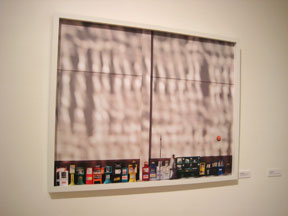
This photo by Moshe Quinn (Thanks Kevin Chen!) of light rippling on a mundane stuccoed building with street-level newspaper boxes and a passerby = Genius.

nold.jpg
While there were other interesting works, Christain Nold‘s Emotional Mapping poster, which was the result of a previous project at Southern Exposure, really caught my attention. First, the poster’s beautiful, in a micro-macro, Tufte/information-graphics-fan way. The content, consisting of mapping daily minutia, is personal, revealing and engaging. The map is a successful poster and also works as a book with multiple readings. But the project is interesting because the map is just a sliver — albeit a beautiful one — of a larger work that resides in the outside world.

Work about minutia is not new. I’ve made some, I’ve seen a lot. But Nold’s seems exceptional because it acts like a book, but you don’t have have to be bookish to find yourself immersed in the details.

If you’re like me, and are impressed by scary-smart programmer-artist-designers who make technology elegant for art applications, you’ll want to check out Nold’s site.

Standard
Art & Development

Work vs. The Work, and Working

I must have been an optimist. Only an optimist would expect that I could maintain a super-high level of art production, and ignore the realities of work, money and logistics (the Good, the Bad, and the Ugly?).

I love being an Affiliate Artist at the Headlands, but with the winter chills and funding shortages, I’ve had to psych myself up for the one-hour drive to the cold, damp studio… Of course there’s nothing better than the feeling of putting in a long day at the studio. I just have to remind myself that, in the end there’s the work, but day to day, it’s all about working.

See also Martin Creed’s If You’re Lonely, Work No. 470, 2005.

Standard
Art & Development

Game Time: Sports Adages for Art

Artists, supposedly, are not good at sports. But since art can be extremely competitive, I propose that artists embrace a competitive spirit and the values of sportsmanship (or is it sports-person-ship?).

To help get the ball rolling (ahem!), below are some sporty expressions. They’re the sand, you’re the oyster, and one day, you’ll have pearls — of wisdom! — at just the right art moments…

Preparing for a critique or meeting with a gallerist? Try slapping both your cheeks simultaneously and shouting, “Game time, baby!” If that doesn’t work, try throwing lots of uppercuts into the air and repeating, “Who’s the boss?”

Bummed about how hard it is to be an artist? Bemoaning scarcity? Try saying, “Suck it up!” Then go “walk it off.”

Can’t decide if your photo is worth the $400 back-mounting you envisioned? Even though it’s Nike’s slogan, I like “Leave nothing.” It’s about sacrifice, performance, action over words — in essence, “Give it your all” so you won’t have any regrets.

When the art ideas are facile, remember: “Don’t be a three page book.” (Paris Alexander)

There are almost always more deserving artists than available rewards. Remember: “Winning isn’t everything.”

Let’s commend artists with lots of “heart.” Not everyone can be the champ, but you can put on a good show with extraordinary persistence and courage. Lots of people root for the underdog.

Graceful concessions: I wish more artists could say “Good game.” Be happy for others’ successes, instead of comparing others’ accomplishments with their own.

Got the drill? Try to come up with art scenarios for these:

“Go big or go home.”

“It’s not the size of the dog in the fight, but the size of the fight in the dog.” (I’m not Michael Vicking it — the metaphor’s for boxing, OK?)

“Lesson No. 1: How to take a fall!”

“He’s just doin’ moves.” (This newfangled adage, from mixed martial arts, is a criticism of a fighter who is not trying hard enough to damage his opponent. “Doin’ moves” is similar to “going through the motions,” but with the intent to appear active.)

“He’s not made of wood.” Bunkerd Faphimi, a Muay Thai fighter, explains why he approaches fights without fear this way: Any opponent “will only have two arms and two legs, like me. He’s not made of wood.”

Standard