Art & Development

Crunch time!

M. sometimes jokes about “getting your game face on.” These days, I’m trying to keep my game face on. I’m about halfway through a marathon of Prep Life, Art Life, and Curator Life. I’ll do the touchdown dance on Friday, August 7 at 7pm — that’s the opening of This & That Int’l Mail Art Swap, a show within a show at Triple Base Gallery. Here’s a “Previously, in Christine’s Life” re-cap (a la Wofford, and Lost):

On Friday, Wallworks opened at YBCA — my day was a high-energy preparator push, and my night, a sentimental “see you later” with the kick-ass crew that I’d worked alongside for the past three intense weeks.

logo_thisandthat_400x60
logo_intlmailartswap_400x40
On Saturday, I dived into a mountain of mail art on my desk, and updated mailartswap.christinewongyap.com with photographs, profiles of the participating artists and a revised curatorial statement. It’s still a work in progress, but it’s really starting to come together. I’m very excited about the show and so proud to exhibit some really outstanding new projects.

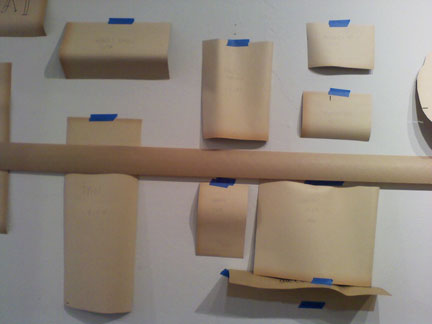
Exhibition mock-up

Exhibition mock-up


On Sunday, I donned my painter’s pants again for more prep work, this time for This & That. The mail swap features 32 projects — many are small drawings and photos, but there are also some projects that require more crafty exhibition strategies. I spent the day laying out the wall arrangement in Triple Base’s ‘cozy’ back room, then spackling, painting and chatting with Joshua Churchill about his project, which is gonna be awesome.

Yesterday, M and I moved me out of my studio at the Headlands into my new studio in West Oakland. Being a sculptor/installation artist, I’ve managed to acquire enough stuff to fill a 10′ moving van. I’ve graduated to a proper upright storage rack/crate for my framed works; I think my next studio project may be building a workbench for my new miter saw. Pegboard stocked, ready to go. My new studio’s going to be part art studio and part tinkerer’s garage.

Next up: making shelves, cutting some acrylic sheets, and resolving they vinyl signage. Then installing my own work.

Involved Socially — and This & That — opens this Friday, August 7, 7-10 pm at Triple Base Gallery.

Standard
Art & Development

art vs design

I got an Honorable Mention in this funny competition called Art Vs Design, organized by Artists Wanted, “a collaborative project between several New York City artists and creative organizations.” The judges included Mark Mothersbaugh — yeah, that Mark Mothersbaugh, who’s also an artist, did you know?

Congratulations to Mikal J. Hameed, who won the People’s Choice Award, and exhibited his work at a party at the New Museum! (Some random Oakland history: Mikal showed my woodcuts at his storefront gallery on the Oakland/Berkeley border like 10 years ago…)

There’s 50 Honorable Mentions; the ones that appeal to me are:
Matthew Hilshorst (whose tablecloth paintings are pretty great, Chicago, IL)
Abby Donovan (sculptural interventions, Eugene, OR)
Jan Huling‘s obsessive beadings, which seem to appeal and revolt a little, like the book cover for A Thousand Little Pieces (beadings, Hoboken, NJ)
Chandler O’Leary/Anagram Press’ Feminist letterpress broadsides printed by Jessica Spring (Tacoma, WA)

Standard
Art & Development

Arts Initiatives, NYC to MCR to OAK

Check out Jerry Saltz’s “Glimpse Art’s Near Future at No Soul for Sale” (New York Magazine, June 24, 2009) to read about the X-Initiative,

a makeshift four-day art fair… an exercise in “radical hospitality,” inviting more than 30 respected not-for-profit centers, alternative institutions, artist collectives, and independent enterprises from New York, the U.S., and around the world to exhibit whatever they want…. The spaces are free.

I love this idea because (1) it’s an art fair with noncommercial intentions, and (2) it’s perfect timing for collaborations among artist-led arts groups. I imagine the X-Initiative to be experimental, grassroots and also (hopefully) challengingly conceptual.

Coincidentally, I just learned about Contemporary Art Manchester,

a new, not-for-profit consortium of visual arts organisations, comprising of established, high-profile partners, independent galleries, young artist-run projects and curatorial agencies … generating new forms of exchange…

Contemporary Arts Manchester Trade City postcard

Contemporary Arts Manchester Trade City postcard

CAM’s inaugural project will coincide with the Manchester International Festival:

Trade City [is] a dynamic international exhibition … Introducing a number of Manchester and UK premieres and stimulating new commissions from regional and international contemporary artists…. Each participating organisation has selected … the work of twenty-six emergent to established artists….

It’s a brilliant move to extend the International Festival’s commissioning of new work to local artist-run organizations and artists.

I appreciate these initiatives in grassroots exchange, collaboration and reciprocity. Just because the art market has crashed doesn’t mean that artists should retreat to the margins of society. Instead, these artists and art promoters are GOING FOR IT — inventing new platforms for dialogue and creating spaces and networks for mutual support.


And what of the Bay Area? Like Manchester, our region is rich in alternative art spaces, great schools and bright artists, and we’re overshadowed in commerce by larger markets elsewhere. What the Bay Area lacks in glamour, though, we make up for with collaborative, grassroots activity. I’d love to see something the scope — and edginess — of an X-Initiative or CAM here in Oakland.

I think it’s a matter of vision — not just what the community here aspires to, but how we see ourselves within an international context. Like the Paul Arden book goes, “It’s not how good you are, but how good you want to be.”

Artists cultivate our local and international communities. In contrast, though, our public agencies seem tightly restrictive.

For example, in 2005, a few dedicated individuals created the Bayennale, a Bay Area biennial. It was grassroots, inclusive and site-specific (using shipping containers as exhibit spaces). That the “biennial” was under-attended and hasn’t yet recurred seems besides the point. What sticks for me was that it was a chance for an emergent scene to see itself and its collaborative capacity, and that in addition to local art there was a strong international presence, including a mixed media kinetic installation by a Berliner, I think, the likes of I haven’t seen since.

One of the problems is at the civic level. I think the city agencies haven’t been able to reconcile their strong commitment to cultural programming (read: diversity and community engagement) with a commitment to contemporary art and excellence.

The art scene in Oakland has grown a lot in the past few years; credit is due to the scrappy artists-gallerists, and to the city which has figured out how to support these groups and artists. But I can see Oakland being more than a network of modest galleries showing mostly local artists. It has the potential to be known for outstanding contemporary art and culture (and design, BTW), if it can sort out its convictions.

Standard
Art & Development, Research

Camp

Just re-read Susan Sontag’s “Notes on ‘Camp'” (1964), which you can find here. Though the essay is showing its 40+ year wrinkles, if you can look past some of the anthropological blanket statements, it’s a great read.

I especially enjoyed:

Making connections with Paul Martin’s Sex, Drugs and Chocolate: The Science of Pleasure (Harper Collins, 2007).

Sontag considered Camp to be “modern-day dandyism,” and described how dandies were driven by a fear of boredom. Martin examines this fear at great lengths, citing the reckless hedonism of Nero and Lord Rochester. Interestingly, Martin points out that boredom often reveals more about the bored person than it does about the world around him or her.

Further, Sontag sees Camp as a means of accessing pleasure. She seems to align with Martin’s thoughts on the importance of modest pleasures in daily life.

Sontag:

The discovery of the good taste of bad taste can be very liberating. The man who insists on high and serious pleasures is depriving himself of pleasure; he continually restricts what he can enjoy. … Here Camp taste supervenes upon good taste as a daring and witty hedonism. It makes the man of good taste cheerful, where before he ran the risk of being chronically frustrated.

Martin advocates becoming a “wily hedonist,” who pursues “more of the Modest Pleasures of everyday life that many of us tend to take for granted. … They should also be cheap or free; pleasure should not be the preserve of the wealthy.”

Q. Why is it that old things look so cool?

A. Sontag:

This is why so many of the objects prized by Camp taste are old-fashioned, out-of-date, démodé. It’s not a love of the old as such. It’s simply that the process of aging or deterioration provides the necessary detachment—or arouses a necessary sympathy.

Sympathy!?

[Camp and the attraction of everyday materials]

Just last week, I noted in a previous post that British sculptor Eric Bainbridge appreciates cheap materials because they “elicit a kind of sympathy, an identification with the viewer that this is what we are.”

Sontag:

Another effect: time contracts the sphere of banality. (Banality is, strictly speaking, always a category of the contemporary.) What was banal can, with the passage of time, become fantastic. …

Sontag’s talking about Campy aged materials; Bainbridge is concerned with cheap readily-available consumer-grade items. I think they’re one and the same now, because of levels of mass production. Bainbridge’s fake fur is immediately obsolete, destined for the landfill even before it reaches the retailer. To give you another example, cheap toothbrushes packaged for an Arabic-reading market and sold in a discount shop in post-industrial northern England are simultaneously new and old.

Sontag:

Camp taste transcends the nausea of the replica.

Christine Wong Yap, Pounds of Happiness (installation), 2009, mixed media, pound shop items, 8 x 8 x 5 feet / 2.4 x 2.4 x 1.5 m. Produced in the Breathe Residency at Chinese Arts Centre.

Christine Wong Yap, Pounds of Happiness (installation), 2009, mixed media, pound shop items, 8 x 8 x 5 feet / 2.4 x 2.4 x 1.5 m. Produced in the Breathe Residency at Chinese Arts Centre.

This hyper-compression of time seems to allow objects to be ultra-mundane in ways that are variously witty, arrogant, simultaneously dull as a doorknob and smart as a whip. I’m thinking about Pounds of Happiness, and also of Chu Yun’s Constellation. I really like Constellation because it’s so matter-of-fact: it consists of a dark room loaded with electronic appliances, so you see a field of standby lights. Interestingly, NG, whose tastes in art usually diverge from my own, liked the work as well. She imagines it to be quite spooky and poetic. I appreciate the nerve of calling incessantly humming electronic detritus art.

Chu Yun, Constellation No.1, Installation, 2006. Source: Vitamin Creative Space web site.

Chu Yun, Constellation No.1, Installation, 2006. Source: Vitamin Creative Space web site.

Failure.
For the past few years I’ve been obsessed with failure in art. I wondered, How can art convey the ineffable, yet still have to be materialized (and thereby be subjected to the constraints of semiotic systems, formal considerations, material limitations, etc.)? It seemed art was doomed to fail, or would be vaguely metaphoric and inadequate at best. I responded by embracing failure in projects like Soft Sculpture for Brougham Hall—a constantly-deflating inflatable sculpture.

Sontag describes Camp as an unintended avenue through which failure is viable, and even pleasurable:

When the theme is important, and contemporary, the failure of a work of art may make us indignant. Time can change that. Time liberates the work of art from moral relevance, delivering it over to the Camp sensibility….

Thus, things are campy … when we become less involved in them, and can enjoy, instead of be frustrated by, the failure of the attempt.

Currently, I’m following up the Cheap and Cheerful and Pounds of Happiness series with further investigations of modest ambitions, lightly-recombined cheap objects, and the decorative impulse. Here’s a sneak peek of a recent project:

Christine Wong Yap, detail, not yet titled, 2009, hankerchief, placemat, thread, 18 x 18 x 2 inches.

Christine Wong Yap, detail, not yet titled, 2009, hankerchief, placemat, thread, 18 x 18 x 2 inches.

I’m working, for the first time in a long time, very visually and reflexively. But I suspect that my conceptual inclinations are still at work. Perhaps, by way of embracing modest pleasures, I’m embracing exuberance, a step towards the extravagance of Camp:

Camp is a vision of the world in terms of style — but a particular kind of style. It is the love of the exaggerated, the “off,” of things-being-what-they-are-not.


Standard
Art & Development, Values

Criticism v. opinions

I really wish I was in NYC right now to see Charles Ray’s show at Matthew Marks. It sounds amazing.

I also appreciate Jerry Saltz’s write-up of Ray’s installations:

all brilliant examples of post-minimalist/conceptual sculpture, each created in the late eighties and new to New York, rattled my perceptions, jangled my faculties, and made me go “Wow!” … Ray’s sculptures, part of a long tradition of minimal installations, are also forerunners to much of the theatrical Festivalism of recent times (e.g., Maurizio Cattelan and Olafur Eliasson). Each piece is nearly invisible and formally economical. Yet each is outrageously labor-intensive….

–Jerry Saltz, “Dude, You’ve Gotta See This”, New York Magazine, June 7, 2009

Brilliant! I’m impressed with how concisely Saltz formally and historically situates the art, and conveys his viewing experience, enthusiasm and rationales.

And, I love that Saltz seems to be taking a stand. The public (including artists!) can harbor so much skepticism (if not outright antipathy) towards postmodern/minimalist/post-minimalist art, it’s nice to see a critic try to bridge the gap, and say, Yes, this is art, even if it looks like nearly nothing. And it’s hard work to make this kind of art.

He goes on to tell the viewer You have to look closely and think before you get your rewards.

All three of Ray’s pieces … are more than Merry Prankster sight gags. Each makes you ultra-aware of spaces outside the one you’re in, of rooms above and below you, the things that make these rooms and effects possible, and how your own body relates to all of this. They put you back in the realm of the unknown, of double vision and oddity.


Unfortunately, my enthusiasm for great art and arts coverage is sometimes marred by readers’ comment boards.

It takes a lot of time, work, consideration and nerve to make art and to write art criticism. So when it’s met with knee-jerk reactions from people who are convinced they could do the job better, I’m reminded of drunken ringside smack-talkers. The reality is that few people have the heart to wake up for 6am runs, much less step into the ring–not just once for their fantasy Rocky moment, but again and again, in spite of the anxiety, exhaustion, injuries and the constant availability of easier paths in life.

Likewise, in art, anyone can make an expressive gesture, but few have the nerve to dedicate themselves to a lifelong creative pursuit.

And in art criticism, any yahoo can have an opinion, but few have the patience and skill to form thoughts into well-reasoned, timely essays.

Recently, I’ve heard from artists who believed that MFA programs are scams, grad students are mindless sheep, and if they leave with anything, it’s how to regurgitate trends. Attacking participants in order to critique a system is lazy and immature. I attribute this attitude to learned helplessness and inadequate self-actualization. When you see the art world as a separate entity from yourself–rather than a group of people that includes yourself, in which you participate and shape with your words and actions–you cease to be accountable for it. You’re free to bash it, thereby legitimizing your own disappointments.

As one of my esteemed professors liked to ask,

What’s at stake?

When it comes to offering knee-jerk reactions, I’d like to see more armchair critics toe the line. You think you can make better art? Write better criticism?

Game on.

Standard
Art & Development, Community

art art art weekend part two

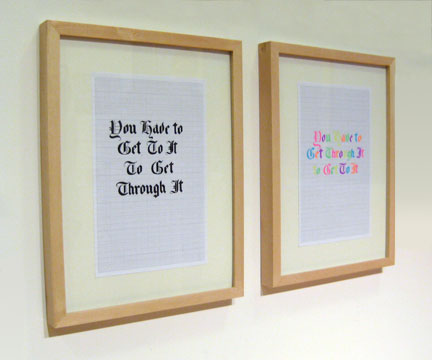
Christine Wong Yap, You Have to Get Through it to Get To It / You Have to Get To it to Get Through it, 2009, ink on paper 7.625 x 11.5 inches each. Produced in the Breathe Residency at Chinese Arts Centre.

Christine Wong Yap, You Have to Get Through it to Get To It / You Have to Get To it to Get Through it, 2009, ink on paper 7.625 x 11.5 inches each. Produced in the Breathe Residency at Chinese Arts Centre.

This installment of my art weekend update starts off with a few happy observations concerning last Saturday’s Southern Exposure’s Pop Noir auction at Electric Works:

First, it seemed like a successful fundraiser. The bidding was active and collectors seemed to enjoy getting worthy works and good deals while supporting SoEx. It was really great to see people buying art. Non-profits are struggling more than usual, so it’s great to see arts supporters persist.

Second, SoEx puts on a great auction. They got really great donations of local food and booze; the auction was run really smoothly, and the installation seemed to fit an incredible amount of work on rather limited wall space really well.

Third, my donation (pictured above) went at above the retail price; not bad when the minimum bid starts low. It’s nice to see your work appreciated so measurably. I’m not opposed to partnering with the right gallery, but lately, I’ve enjoyed the freedom to just make whatever I feel like, and get on with collaborations with artists and friends.

In the end, my attitude is the same as Leonard Cohen’s, who was recently quoted in “Careless Whisper” by Jennifer Allen in Frieze Magazine (April 2009):

I didn’t want to work for pay, but I wanted to be paid for my work.

In that spirit, I’ve made some works available.

Christine Wong Yap, Dime Store Advice, 2009, China marker on foil-laminated cardstock, 11.75 x 16.5 inches. Produced in the Breathe Residency at Chinese Arts Centre.

Christine Wong Yap, Dime Store Advice, 2009, China marker on foil-laminated cardstock, 11.75 x 16.5 inches. Produced in the Breathe Residency at Chinese Arts Centre.

Christine Wong Yap, Untitled (Lens Flare, Small Mirror), 2007, Etched mirror, colored pencil, frame, 13 x 16 x 2 inches

Christine Wong Yap, Untitled (Lens Flare, Small Mirror), 2007, Etched mirror, colored pencil, frame, 13 x 16 x 2 inches

Christine Wong Yap, Cheap and Cheerful #3, 2009, neon and glitter pen, 11.625 x 7.75 inches. Produced in the Breathe Residency at Chinese Arts Centre.

Christine Wong Yap, Cheap and Cheerful #3, 2009, neon and glitter pen, 11.625 x 7.75 inches. Produced in the Breathe Residency at Chinese Arts Centre.

Christine Wong Yap, Cheap and Cheerful #10, 2009, neon and glitter pen, 11.625 x 7.75 inches. Produced in the Breathe Residency at Chinese Arts Centre.

Christine Wong Yap, Cheap and Cheerful #10, 2009, neon and glitter pen, 11.625 x 7.75 inches. Produced in the Breathe Residency at Chinese Arts Centre.

If you’re interested in providing a good home for any of these works, please email me at cwy (at) christinewongyap.com, and I’ll send over a link where you can get prices (ranging from under $100 to a few hundred and up) and more info about these and other available works. Cheers.

If original art is out of your price range, consider multiples and books, available at my Store.

Standard
Art & Development

The Quest for the Perfect Sketchbook Continues

Having once engaged in the activity of drawing fervently, and now doing conceptually-oriented work in different media, I tend to disappoint past colleagues who are fond of my old drawings, and surprise new acquaintances when my skills are revealed.

Sometimes These are nice drawings! also means Oh! You can draw!

I’m sure most people would wonder why I’ve de-emphasized my expressive “hand” in favor of simpler, diagrammatic drawings. Maybe persistent stereotypes — like the myth that individuals either “can” or “can’t” draw, or that conceptual artists are too lazy or un-skilled to make objects — influence their views.

But the reasons are: I’m not out to “wow” anyone with my drawing skills, most of the time. My drawings are usually proposals for objects, information graphics or investigations of time and labor. So, using an expressive hand (revealing an authorial ego) could undermine the work. I try to execute my ideas in a straightforward way, with conceptual rigor and economy—to make simple acts go far.

While I’ve stepped away from intensive journal-keeping in recent years, I’ve come back to it during the Breathe Residency in Manchester. In those three months, I filled up almost 400 5×8″ pages. And those pages couldn’t look more different than my past sketchbooks.

Here’s a page from about 10 years ago.

Christine Wong Yap, untitled page from Sketchbook #7, 1998, acrylic, pen, collage and photo on textbook.

Christine Wong Yap, untitled page from Sketchbook #7, 1998, acrylic, pen, collage and photo on textbook.

I was inspired by illustrator/teacher Barron Storey and friends like John Copeland to capture my daily life and draw my immediate environments. I was blurring the line between finished works and works in sketchbooks.

Now, though, I’m consumed with research spanning pop psychology, installation and conceptual art, and any source that offers insights on optimism and pessimism. Here’s a page from my current sketchbook:

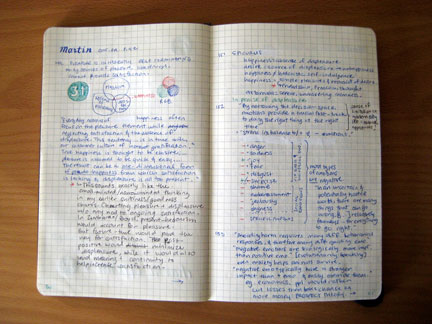
Christine Wong Yap, untitled page from book 24, ink on paper

Christine Wong Yap, untitled page from book 24, ink on paper

OK, I’ve embraced my inner nerd. Many of the pages are reading notes, lecture notes or diagrams of concepts. But I sketch ideas for projects too.

Christine Wong Yap, untitled page from book 24, ink on paper

Christine Wong Yap, untitled page from book 24, ink on paper

These aren’t works or drawings, really, but these books form the research backbone of my work. As Stephanie Syjuco recently advised UC Berkeley’s MFA graduates, it’s good to

Honor your intangible labor in the studio, even when you or others don’t see apparent results.

And that’s what the residency afforded — time and space to embark on intangible labor — experiments, research, reading. I’m confident that absolutely none of the work that resulted in the residency would have happened without all the research I conducted. So these notebooks may not be “works,” but that doesn’t diminish the importance of this work.

I’ve had every sort of possible sketchbook available on the market, and some handmade ones too. For research and diagrams, I’ve been happy with Moleskin’s gridded books. Yes, Moleskins are sort of hoity-toity, like I should be wearing a velvet blazer and Mary Jane Clarks, but they’re sooo worth it, even if the grid is in metric. Recently, I found a Moleskin knock-off (complete with creamy pages and soft grey grid) in a composition book form. This one’s nice because you have more space for your hand to rest.

5x8" hardbound Moleskin (left) and composition book-sized soft cover journal (right)

5x8 hardbound Moleskin (left) and composition book-sized soft cover journal (right)

Still, this one has a hideous plastic cover, molded to mimic pebbled leather — a tactile feature I’ll try to overlook.

cwongyap_sketchbook_24-4

Alas, the quest continues.

Standard