Art & Development

a follow-up to “the original”

I recently got a note from the artist Mircea Cantor, whose work I mentioned in a blog post written about a year ago.

Cantor and I share an interest in creating empty present forms (see his and mine).

As Cantor pointed out, my post could misconstrued as a snarky lob at a fellow artist, or a claim to precedence. I’d like to clarify that while I wrote that

what matters is not who comes up with an idea first, but who does it best (a cousin to the cynical saying, If you can’t do it better, make it bigger)

I didn’t intend to claim that my work was better, or that Cantor’s work was bigger b/c he couldn’t make it better. I am not that cynical. That’s why I distinguished our works, and discussed how the scale differentiates his work. Examining our conceptual intentions might help a larger audience understand how similarities and contradictions can co-exist in contemporary art. As I ended that previous post with this thought, I’ll do so again:

A lot of artists fear being unoriginal, so they usually wince when they encounter similar work by other artists. Whatever. Here’s a new saying: Similarities happen. It’s not the worst thing in the world. In fact, it can work out for everyone.

No hard feelings.

Standard
Meta-Practice, Research, Values

Enthusiasms Unbounded, Mentality, Reviews

My Art Practice as Enthusiasms Unbounded

“Enthusiams unbounded” is neither grammatically correct nor concise, but it’s the best linguistic capsule for my sentiment: that many aspects of being an artist can be seen as exercises in honoring curiosity.

I love my life in art because I’m constantly learning new things; I made a decision to cultivate areas of knowledge and skill, and they’re accumulating more or less every day. When I look at it this way, art practice is even more satisfying.

I’m starting to think that being an artist means studio work, as well as enacting one’s enthusiasms at will, anytime and anywhere. To borrow examples from my own recent past, this manifests via browsing exhibition catalogs about shopping, learning how to use a nail gun (powered with air: brilliant!), getting over my fear of hand-held circular saws, and savoring donut shop typefaces. My enthusiasms fuel my art practice, so as an artist, it’s my job to follow them.

An Observation on Mentality

My friend Stephanie pointed out that longevity in art can often be attributed to sheer determination. In other words, success in art is partially a war of attrition (especially for women, as my friend Jenifer would add). Stephanie vowed to make art, no matter what. I want art in my life, but I need happiness too. And I think there’s a way to cultivate both:

I suspect that another secret to longevity in the arts is good morale, which requires (at least) two skills:

1. The ability to welcome and accept all forms of validation. I think it’s along the lines of being a connoisseur, not an addict, of the tangible evidence of success. That means blocking out mithering resentments or bitterness in light of any successes, and not letting hang-ups limit the extent of one’s satisfaction.

2. A high tolerance, or the quick ability to recover. May the stings of rejection fade quickly. May the forgettable exhibitions be soon forgotten. May petty resentments pass, along with all the reasons to be jaded about the art world.

The goal, it seems, is to make optimism and happiness “sticky,” and to let all the rest roll off your shoulder. Duckin’ and weavin’. Stick and move.

Enthusiasms, specifically

A cursory look-see of downtown galleries less than stunning, with two major exceptions:

Kim Anno at Patricia Sweetow Gallery

Kim Anno’s paintings on metal are pretty and formal — two things I’m not usually that wowed by. But I felt that feeling of worship that I think overcomes many art lovers when I looked at her paintings — my God, the light! The works are pure abstraction, with large expanses of white paint nestled by wisps of translucent color; they “read” quite simple and gestural and yet there are passages upon passages of textures, patterns, marks and contrasting surfaces. The whites revealed themselves to be rich in color as well. They’re works that continue to reward the act of looking. Expertly executed.

Bruce Connor at Gallery Paule Anglim

I first saw one of Bruce Connor’s miraculous black-and-white inkblot pattern drawings in Lawrence Rinder’s Galaxy at Berkeley Art Museum a few weeks ago, so it’s a treat to see more of them so soon. I absolutely adore them. There are several tiny ones on view, as well as a generous series of leaf-shaped inkblots and a few fuddy-duddy assemblages. The inkblots, though, are sublime. Completely abstract, moments of recognition appear and fade away, with a variety of textures, media and mark-making devices that result in an surprising magnitude of visual experiences — some lent the sensation of solarized photographic prints, others are clearly tactile acrylic, still others suggested small infinities. They strike a balance between meticulous compulsion and the fine art of knowing when to stop.

Standard
Art & Development

thoughts on curating: Galaxy at BAM

Usually, when I visit museums, I head straight to the contemporary shows. Sometimes I skip the “famous paintings” shows altogether, because the selections from the collections rarely change or surprise. You know the formula: in general museums you’ll find chunky oils of landscapes and uptight portraits of nearly translucent members of the bourgeousie; in museums of modern art you’ll find a Cezanne, a Warhol, a huge, prominently-placed Still, a huge Rothko (always with a bench) and voila! — Western art history through 1960.

So when my friend Erik — whose critical eye I’d trust with, I dunno, my life, if my life depended on aesthetics — spoke highly of a selections-from-the-collections exhibit at the Berkeley Art Museum and Pacific Film Archive by Lawrence Rinder, who’s the new Director, I made a point to go see it before it closes August 30th.

Galaxy: A Hundred or So Stars Visible to the Naked Eye, occupies three of BAM’s roomy bays. Upon entering the first one, I looked around and saw a bunch of etchings spanning the Renaissance through Romantic eras. Really, Erik? I thought. This is the show? But Galaxy doesn’t disappoint. Or put another way, the BAM collections run deep and Mr. Rinder’s curatorial approach delights. The works in the show are all really good, and the selection and placement of the works exhibit whimsy, unexpected turns, humor, sex and formal elegance. The exhibition guide is written with a high degree of subjectivity, bringing fun and surrealism into the viewing experience. For example, a rather vanilla classical painting based on Greco-Roman mythology is annotated with the oddball note that The Princess Bride is based on the same myth. And in a surprise pairing, a painting that is depicted in a portrait of a lapdog (if that isn’t weird enough), appears next to the lapdog painting.

Mr. Rinder wrote in the exhibition statement that the works in Galaxy are not his favorites from the collections, but they are works that spoke to him during an intensive, personal investigation. This seems true of the exhibition, and it’s refreshing. While lots of museums are doing “blockbuster” exhibitions, it seems anathema to keep the “best” or “most famous” works in storage, but it’s a welcome change to be allowed to peek into a curator’s process this way. His sensibilities emerge through the selections, but don’t overpower the work, or burden it with thematic content. Galaxy is still a mish-mash group show, but the awkward over-reaching attempt at chronology is absent, and a lot of funny formal or thematic similarities can be teased out across the centuries (such as a shockingly grotesque pair of prints by Goya and James Ensor grouped with a text-based drawing by Ajit Chauhan, or a wall of black-and-white works, including a stunning photo by Paul Shiek). Yes, there is the Still, the huge Rothko, and some oldies-but-goodies. For example, I’d seen the kinetic sculptures by Harry Kramer and Jean Tinguely at BAM before, but in this pairing, it inspired me to consider kinetic art in terms of their incidental audio qualities.

I also noticed a love of paint and line. I was really surprised how much I responded to certain works by Bruce Connor, whose inkblot drawing from 1991 gave me nothing short of a total “Wow!” moment.

The biggest surprise of them all, however, was my reaction to a section of landscape pictures. Usually I can’t be bothered with images of nature or the pastoral, which either pale in comparison to the real thing or are mere exercises in the craft, but in Galaxy, it occurred to me that landscapes are ultimately about the human condition, because they are the sites in which man’s plight occurs, and the substrate upon which we project our egos. Landscapes reflect the development of our thinking, for better or worse — they are subject to our awareness of ecology or the follies of our hubris. Thus, landscape pictures are artifacts of human development, and they seem to appear in Galaxy as reminders of distant stories. Rousseau’s painting of a forest after sunset is really a work about light; it’s about paint to an extent, moreover, the paint seems to be in service of light and the majestic intensity of that the visual experience that nature can afford us.

I’ve been thinking a lot about the provisional — how the finished state of art is highly fictional and manufactured, and that entropy, the conditional, the complicit, are more natural and sensible, and this all speaks to our contemporary conditions, and about life in junkspace (Rem Koolhaas articulates the idea of junkspace in an essay on architecture — speculative writing that would be of interest to artists, thinkers and designers of all types). So it was with great interest that I noticed this quote in the Galaxy exhibition guide, which I think beautifully sums up some of the curatorial thinking behind the show:

Aberrations, too, should be represented in the chorale of the artwork. Why not aberrations? Aren’t they human? As such, don’t they participate, more or less copiously, in the psychological mechanisms of every human being? Might they not lead to the most valuable discoveries? Doesn’t art begin with aberrations? Just what is an aberration? Isn’t living an aberration?
–Jean DeBuffet, 1945

Mr. Rinder may have simply wished to contextualize DeBuffet’s highly-stylized, “naïve” work on paper, but I take the liberty of extrapolating the thought across the show; that the works in the collections are aberrations in sidestepping the dustbin of history, and whatever quality of the works that snagged curatorial interest were due to aberrations—whether by quirk, excellence or elegance.

Standard
Art & Development, Community

A place you should be: Stephen Wirtz Gallery

A quick jaunt around commercial galleries in downtown San Francisco left me feeling a bit “meh.” Maybe because it’s August and galleries aren’t too bothered about mounting statement-making shows, maybe because my nerves were frazzled by high-tourist-season traffic, or maybe my critical eye has become a cynical eye, informed too much by thinking about art as artifactual production, parallel to other forms of industrial and cultural production. My taste for commercial art is nearly nil; like commercial radio, its near-ubiquity ensures that the odds aren’t in my favor — I’ll have to tolerate it far more often than I will be happily drawn towards it.

castneda reiman
Image Source: Stephen Wirtz Gallery Website, Castaneda/Reiman’s Places We Have Never Been Exhibition page.
Image Caption: left: Three Tree Lake (drawing #2), 2009, laser etched paper, pigment print. middle: Rocky Seascape (paper 2 x 4), 2009. pigment print, found 2 x 4, oak veneer, 28 1/2 x 96 x 3 1/2 inches. right: Painting Stack with Rocks, 2009, pigment prints, oak, sheetrock, paint, cast porcelain rocks, 53 x 79 x 70 inches

One show, though, stood head-and-shoulders above the rest. It was Castaneda/Reiman’s “Places We Have Never Been” at Stephen Wirtz Gallery. The Bay Area duo has installed reproductions of landscape paintings — complete with frames and odd slices of textured drywall — a tad too close to adjacent shelves, so the prints sag or drape abjectly. The gallery walls are painted with mismatched roll-outs, and areas of sanded joint compound are visible. Cross-sections of stacked gypsum boards are housed in beautiful stained oak; the effect is a framed geometric minimalist abstraction, contrasting sharply with the unframed reproductions. Impossibly uniform opaque white rocks cluster near the gypsum board, missing any glints of quartz, or the rough scale of granite. You can tell the rocks were man-made, but you can’t tell from what. A small landscape print or hand-drawn transfer sits in a corner, heavy rag paper with deckled edge unnervingly out in the open, unframed. An expressionistic landscape — really, not unlike the kind of commercial schlock you find in rural membership galleries — uses some slate blues and greens that appear almost municipal, echoing the industrial hues of manufactured building materials.

The whole effect creates a tense contradiction: provisionality, finely tuned to point one’s attention to multiple illusions.

To ask “Where is the art?” begets affirmative answers without clear resolution. Yes, the framed painting in the reproduction is art. Yes, the print of the painting is art. Yes, the white rocks are art. And yes, the mismatched latex paint is art.

Casteneda/Reiman successfully disperses the location of the art throughout the site — the artists’ installation is theatrical, staged — while simultaneously saying that the gallery is always a staged installation. In this way, Casteneda/Reimen highlight the artifice inherent in all art. I have no qualms with using the word “artifice,” which does not in itself posses negative connotations (though you may be of the Romantic/Modernist persuasion and your value system only allows for art that is expressive/authentic/autonomous/evidence of genius or some kind of moralistic humanism).

I realize that my description of the work — abject, quoting, dispersed — makes it sound like an exercise in endgames, and the artists like over-theorized malcontents. And I can’t say that all viewers will appreciate the work in the show; in fact, many will do a walk-by, feeling put off (rather than attracted, like me) to the exhibition’s absence of grand gestures, obvious attempts at spectacle and feats of craftsmanship. But I really enjoyed the work, and found the illusions and forms to be quite humorous. There was wit, and yes, ironic distance, and yet, there were so many ideas and connotations that unfolded in my viewing experience.

Places We Have Never Been closes August 22. Concurrently on view at Wirtz, Kathryn Spence’s Cloudless White, another assembly of abject parts, slightly more expressive and endearing but also with moments of humor.

Standard
Art & Development

New Workbench

workbench

Just installed my new workbench / pegboard / shop light in my new studio.

Like my calendar? (Not a Mac Tools girlie one, but an awkwardly funny Pet Lovers one.)

I never had the space or need for a workbench, but I’m getting there now. I didn’t go too overboard, I think; it set me back about $125 in lumber and hardware (and a set of countersinking bits). The pegboard came pre-painted, which sped things up.

If you’re thinking, What kind of workbench is so clean?, the answer is One that’s got a fresh coat of varnish on it.

Don’t worry, lots of projects to come.

Standard
Art & Development

another entry in the “art takes you to some funny places” diary

Maybe it’s too soon to say, but based on my initial experience, being a curator seems like one part Director, one part Gopher. I expected to fetch odds and ends for the exhibition, but I was bit surprised how much artists entrusted me with creative decisions regarding their art. Guess I’ll just have to get used to it.

Two items I found myself chasing down recently:

78-rpm records. N. Sean Glover’s cardboard record player works better with fatter grooves. A Jackson Five 33 had to do for the opening. (It seemed fitting because “I Want You Back” was on heavy rotation in the shops while I was in Manchester.) But today, at the East Bay Depot for Creative Re-Use, I scored two 78s — Sarah Vaughn and the Benny Goodman Sextet.

Butane. David Moises’ Egoshooter is a modified barbecue lighter. Lighters can go in the mail completely emptied of fuel, so it was my job to re-fuel it for the exhibition. The gallery (understandably) didn’t want visitors to get hurt, but I just couldn’t show the Egoshooter disarmed — I was plagued with memories of grad school critiques of art “with no teeth.” Not having ever owned a refillable lighter, I wandered the aisles of CVS before I realized that, of course, butane is probably kept behind a counter, next to cartons of cigarettes. The CVS in North Oakland, formerly Long’s, was sort of an ideal place to find such a slightly obscure, anachronistic item. (It was also the source for my new white painter’s pants. Maybe I’m projecting, but I get a lot more respect at Home Depot when I’m wearing proper Dickies.)

Standard
Art & Development, News, This & That Mail Art Swap

Involved, Socially and This & That opens

Thanks to Dina and Joyce at Triple Base, Michelle Blade for having me in the show and compelling me to go one step beyond only exhibiting a work, M for love and support despite my week-long installation myopia, and the countless friends, supporters and mentors who attended, the opening reception for Involved, Socially seemed like a success.

It was well-attended, with a constant flow of people, and lots of time spent looking at art, reading texts and having good conversations.

I feel like both projects that I contributed, This & That International Mail Art Swap (a curatorial project in the back room featuring 32 artists) and Unlimited Promise (an installation in the basement) were strong, so I’m content.

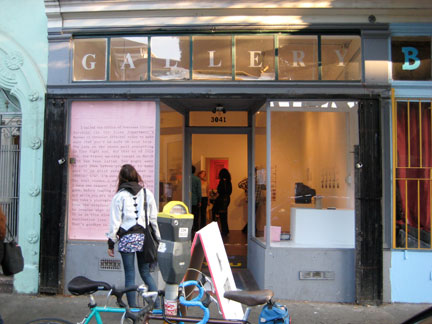
Sandwich board typography by Mylinh Nguyen, via Michelle Blade. Window: project by David Horvitz. You know it's San Francisco's Mission District by the taqueria and bicycle.

Sandwich board typography by Mylinh Nguyen, via Michelle Blade. Window: project by David Horvitz. You know it's San Francisco's Mission District by the taqueria and bicycle.

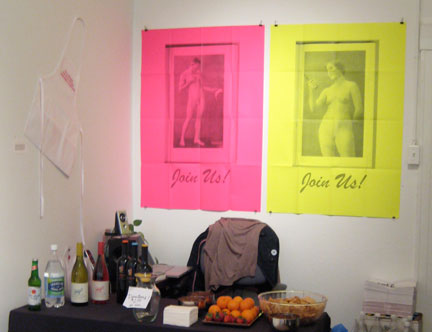
The main (front) part of the storefront held several artist's projects; This & That was in the back room. Yuen Fong Ling's fluourescent posters, commanding JOIN US, are visible from the street.

The main (front) part of the storefront held several artist's projects; This & That was in the back room. Yuen Fong Ling's fluourescent posters, commanding JOIN US, are visible from the street.

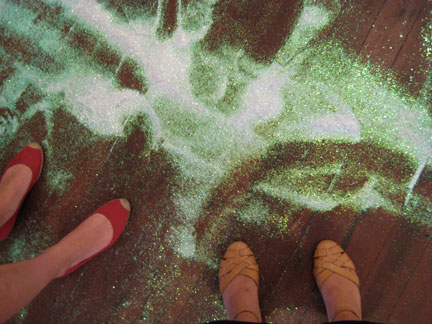
Amanda Curreri's and Sally Elesby's project - a line of iridescent glitter is drawn across the gallery. amandacurreri.com

Amanda Curreri's and Sally Elesby's project - a line of iridescent glitter is drawn across the gallery.

Left, works by Mark McKnight. Right, t-shirts by Amanda Curreri.

Left, works by Mark McKnight. Right, t-shirts by Amanda Curreri.

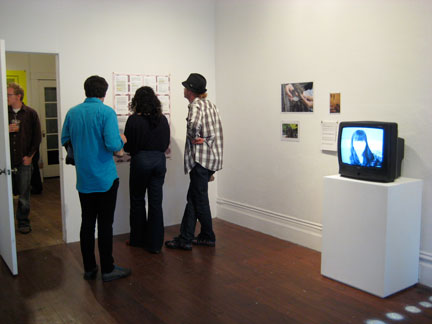
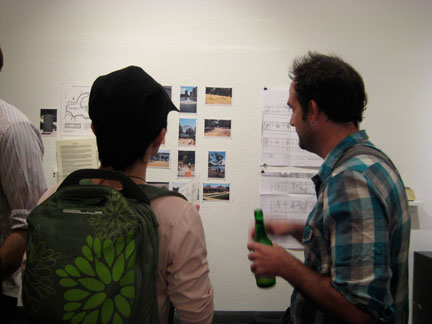
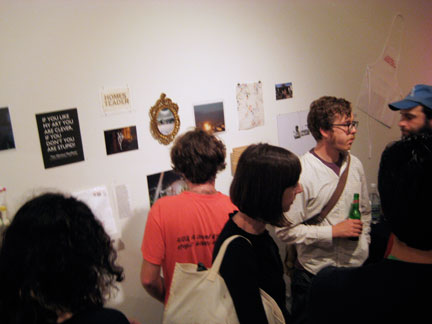
Photographer Seth Lower (far left, sethlower.com) inspects This and That; Jeronimo Roldan and Marcella Faustini and friend inspect Amanda Curreri's/Sally Elesby's correspondence (center). Jessica William's art (right). Not pictured: David Horvitz' letters about the Indian Ocean.

Photographer Seth Lower (far left, sethlower.com) inspects This & That; Jeronimo Roldan and Marcella Faustini and friend inspect Amanda Curreri's/Sally Elesby's correspondence (center). Jessica William's art (right).

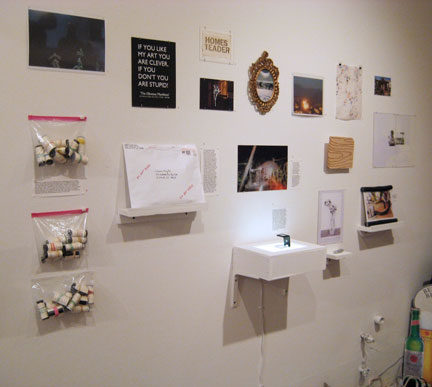
This and That, with works by Crowe and Rawlinson, Tan, Chavez-Dawson, Churchill, Hongisto, Blackmore, Chen, Staincliffe and Hall.

This & That, with works by Nick Crowe and Ian Rawlinson, Tattfoo Tan, Mike Chavez-Dawson, Joshua Churchill, Eric Hongisto, Simon Blackmore, Susan Chen, Daniel Staincliffe and Antony Hall.

This and That, works by same artists as previous photo, plus Anading, Bell, Payot, Brumit and Wagner, the Bloors, and Carollo. Lower corner, a moment for our sponsor.

This & That, works by same artists as previous photo, plus Poklong Anading, Chris Bell, Laurence Payot, Jon Brumit and Sarah Wagner, Simon & Tom Bloor and Michelle Carollo. Lower corner, a moment for our sponsor.

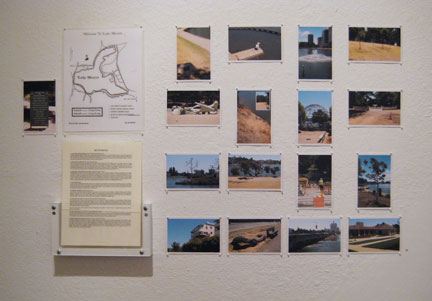
Scott Oliver's Lake Merritt walking tour.

Scott Oliver's Lake Merritt Walking Tour.

Verity-Jane Keefe's project on a housing estate in Barking, East London.

Verity-Jane Keefe's project on the estate in Barking, East London.

Works by Oliver, Keefe, Hattori, Glover, Pest.

Works by Oliver, Keefe, Taro Hattori, N. Sean Glover, Pest.

Works by Ryan, Woff, Sherry, Griffiths, Ma, Kabot, Kaplan, Yu.

Works by Anthony Ryan, Jenifer K Wofford, David Sherry, Mary Griffiths, Ivy Ma, Sarah Kabot, Scot Kaplan, MM Yu.

Works by O'Malley and Ling. Below, the spread.

Works by Susan O'Malley and Yuen Fong Ling. Below, the spread.

This & That artist Anthony Ryan takes home court advantage to inspect potential swap selections.

This & That artist Anthony Ryan takes home court advantage to inspect potential swap selections.

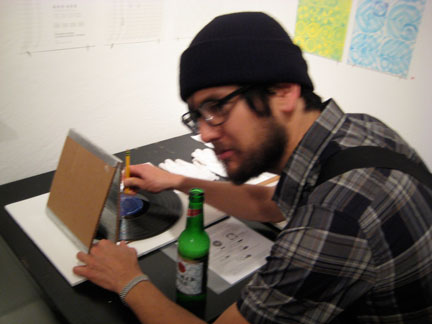
Joshua Churchill, looking uncharacteristically dodgy, powers N. Sean Glover's cardboard record player.

This & That artist Joshua Churchill, looking uncharacteristically dodgy, powers N. Sean Glover's cardboard record player.

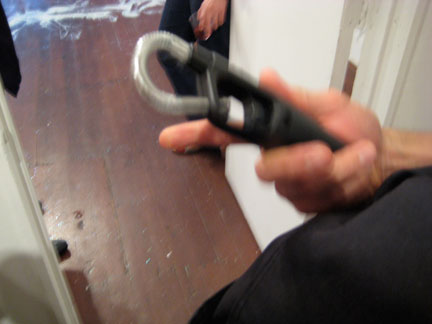
Churchill also tries out David Moises' Ego Shooter, but he's too fast for the camera.

Churchill also tries out David Moises' Ego Shooter, but he's too fast for the camera.

Mik Gaspay -- mikgaspay.com -- sports a This and That-like cardigan.

Painter/photographer Mik Gaspay -- mikgaspay.com -- rocks a This & That-like cardigan.

Taro Hattori and Scott Oliver discuss amongst themselves.

This & That artists Taro Hattori and Scott Oliver discuss amongst themselves.

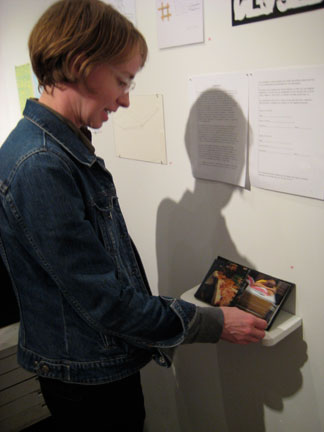
Naomi Vanderkindren -- vanderkindren.com -- browses MM Yu's Book of Sleep.

Naomi Vanderkindren browses MM Yu's Book of Sleep. (Naomi's photographs can be viewed at vanderkindren.com.)

A visitor inspects Antony Hall's Hele shaw cell experiment.

A visitor inspects Antony Hall's Hele shaw cell experiment.

Yuen Fong Ling's posters in background.

Yuen Fong Ling's posters in background.

MJ-jacket sporting Vice leans in to hear Joshua Churchill's sound project.

MJ-jacket sporting Vice leans in to hear Joshua Churchill's sound project.

A viewer reads N. Sean Glover's instructions for the cardboard record player.

A viewer reads N. Sean Glover's instructions for the cardboard record player.

Back room. Painter Marci Washington and mixed media artist Justin Hurty, and others. marciwashington.com. justin.hurty.com

Back room. Painter Marci Washington and mixed media artist Justin Hurty, and others. marciwashington.com. justin.hurty.com

Main gallery.

Main gallery. This & That artist Chris Bell talks shop with Naomi.

Amanda Curreri's glitter line, a few hours later...

Amanda Curreri's glitter line, a few hours later...

My installation, Unlimited Promise, in the basement.

My installation, Unlimited Promise, in the basement. Produced during the Breathe Residency at Chinese Arts Centre, Manchester, UK.

Spillage.

Spillage.

Thanks to all the artists in This & That for being such interesting artists and exhibiting professionalism, generosity and flexibility. Big thanks to Chris Bell, Joshua Churchill, Taro Hattori, Ali Naschke-Messing, Anthony Ryan, and Scott Oliver (who helped tremendously by installing his multi-part work) for coming to the opening. Thanks also to Susan Chen, who dispatched patience and editorial advice.

Involved, Socially runs through September 6th. Gallery hours are Thurs-Sun 12-5pm. For more info visit basebasebase.com. To learn more about This & That International Mail Art Swap, visit mailartswap.christinewongyap.com.

Standard
Art & Development, This & That Mail Art Swap

This & That and you

It’s complicated, but actually very simple:

Involved, Socially =
*curated by Michelle Blade
*features 5 artists
*the upcoming exhibition at Triple Base Gallery

This & That International Mail Art Swap =
*curated by Christine Wong Yap
*features 32 artists/artists groups
*a show in the back room at Triple Base Gallery, part of Involved, Socially.

You might think of This & That as a:
*curatorial project
*sub-show
*Little Big Show

Factoids:

The acronym for This & That could be “TnT.” (Thanks Churchill.) Hence the AC/DC theme song suggests itself.

Standard