Art & Development

Invisible Venue Intervention + Paper for CAA Chicago

Christian L. Frock presents
INVISIBLE VENUE

“Hello! My Name is…” a site-specific intervention with contributions from Chris Basmajian, Michael Damm, Anthony Discenza, Charles Gute, Jamie Hilder, Scott Oliver, Susan O’Malley, Zachary Royer Scholz, Zefrey Throwell, Christine Wong Yap

College Art Association 98th Annual Conference
February 10 – 13, 2010
Hyatt Regency Chicago
151 East Wacker Drive
Chicago, Illinois 60601

Public Art Dialogue Session:
Site Variations: The Shifting Grounds of Public Art
Featuring “Invisible Venue(s): Alternatives to the Institution” an overview of Invisible Venue by Christian L. Frock
Friday, February 12, 9:30am – Noon
Regency D, Gold Level, West Tower, Hyatt Regency Chicago
Chaired by Dr Harriet F. Senie and Dr Cher Krause Knight

“Hello! My Name is…” is a site-specific intervention of artist-created conference badges designed for anonymous distribution during the College Art Association 98th Annual conference in Chicago. Drawing on the required reading of the ubiquitous name badge in conference settings, contributing artists have created messages in response to the context of this academic and social networking event for art professionals. Badges will be anonymously distributed within the conference and arranged on tables in the standard grid fashion typical of a reception area. Each badge will be printed on the back with “This is public art. www.invisiblevenue.com” to direct attention to complete project details, documentation and a full suite of contributions online.

“Invisible Venue(s): Alternatives to the Institution” is a paper presented by Christian L. Frock in the conference session “Site Variations: The Shifting Grounds of Public Art.” The paper will be published in digital format by the College Art Association and will be republished in Issue 9 of Art Practical on February 25. A full length version of the paper, with images, will be accessible on www.invisiblevenue.com and available for distribution upon request.

The College Art Association Conference is the world’s largest international forum for professionals in the visual arts, with an anticipated attendance of more than 4,000 artists, art historians, curators, critics, and arts professionals. This is a ticketed event.

For more information, please visit christian

* * * * * * * * *

Invisible Venue collaborates with artists to present art in unexpected settings. www.invisiblevenue.com

Standard
Art & Development

Bright light

There’s so much to like about Bright Light, Vancouver’s Public Art Festival:

A light in winter.

Its economy.

The simplicity of black white and yellow. The design is elegant, understated, progressive, with charming touches.

The map is functional and cute. It’s not overburdened with text.

The programming: great art, community engagement, conceptualism, sophistication, accessibility, site-specificity, public interaction….

Standard
Art & Development

Eliasson on spectatorship and perceptual experiences in galleries

One of the predominant tropes of the artists in Il Tempo del Postino is their assertion of the socialising and empowering agency of art, which has long been an aim of theatre of the left, from Brecht to Invisible Theatre, developed by Augusto Boal in the 1970s, when social-issue plays were staged in public places, such as shopping centres, often drawing nonperformers, or ‘spect-actors’, into the debate….

The efforts of a number of these artists to orchestrate socialising contexts have been criticised in recent years for being patronising or for actually stultifying exchange.

[Stultifying? See Ranciere.]

A distinguishing factor of Eliasson’s work, though, is that he doesn’t consider language the primary socialising agent. His installations and events operate on the audience’s sensory perception, prompting not a conversational exchange but a subjective psychophysical experience. Although, as Eliasson points out, there is no unmediated neutral state of perception in a gallery, as by definition any aesthetic proposition demands sensory manipulation, he tends to expand effect beyond optical or linguistic cognition. Utopian claims for art creating solidarity through authentic communal discourse become redundant when the subjectivity of perception becomes the means as well as the subject of an artwork. Collectivity, suggests Eliasson, is more about the production of difference, and yet there remains a misperception that representation in the form of language creates a productive space, when in fact it simply describes a space that remains uninhabited. As it was for eighteenth-century romantic ironists, such as August Wilhelm and Friedrich Schlegel, for Eliasson it is the employment of the gap between representation and the actual world, between the sun and the evocation of a sun or an audience and their reconstruction, that generates poetic effect.

Sally O’Reilly, “Olafur Eliasson: Time is on his side,” Art Review, September 14, 2007

Standard
Art & Development

Artist Tauba Auerbach on the natural bases of grids

A COMMON CRITICAL READING of the grid casts it as the essential symbol of technology and human contrivance—the signal structure of modernism—cold, impersonal, and famously called “anti-natural” by Rosalind Krauss in her 1978 essay “Grids.” In my view, however, the grid could not be closer to nature; it is the direct and rebellious offspring of gravity. The first relationship between the grid and gravity is one of accordance. By pulling perpendicular to the surface of the earth, gravity installs the right angle as a cardinal feature of our physical world. Perpendicular relationships are naturally recurrent and omnipresent. A basic grid is an accretion of these relationships, intersections of horizontal and vertical lines—like those formed by a liquid’s surface drawn level by gravity and the path of a falling object, respectively: Materials succumbing to the force create x- and y-axes.

The second relationship is one that weds rebellion and submission, a fleeting union, as the rebellions are only ever temporarily successful. A tree most efficiently resists the force of gravity by growing straight upward—at a ninety-degree angle to the horizon. The vertical charge of life is in fact the act of fleeing an inevitable state of horizontality, death. The leveling force of gravity literally ages us, drawing us down until we cannot go down any farther. Here gravity and its opposition trace the axes.

The third relationship is one in which the grid itself is the opposition to gravity. In this broader case, the definition of grid should be expanded, as it is in Grid Index, to include tilings—coverings of the plane in which there is no excess of space or overlap between constituent shapes. The entropic event of ice melting, for instance, sets geometric tiling against gravity’s pull toward decay and disorder, taking the gridded (albeit inconsistent) crystalline structure and rendering it an amorphous molecular soup. Similarly, but in the reverse order, crystal structures grow more consistently and easily in zero gravity—even forming in unlikely substances like plasmas—without their entropic enemy. If gravity is a protagonist in the plot of entropy, then the order of the grid is its natural and valiant, although doomed, antagonist.

—Tauba Auerbach, “Out of Order” Book review of Grid Index by Cartsen Nicolai (Berlin: Gestalten, 2009), Artforum, 2010
[To see the article, visit Artforum.com, register or log-in, and search for Auerbach.]

Standard
Art & Development

The Art of Participation, one year later

A year ago, I wrote a review of The Art of Participation: 1950 to Now at the SFMOMA. Publishing can be capricious; my review was never published… until now.

—–

There is a lot to see, touch, hear, speak into, wear and click in The Art of Participation: 1950 to Now, a large-scale overview of participatory art. The museum is pervaded with a friendly, relaxed tone. Instead of compelling visitors to be on their best behavior, the audience is encouraged (and instructed on nearly every wall label) to participate as much as possible. The show is contingent upon visitors’ participation, which paradoxically, may be hampered by years of the museum’s Do Not Touch conditioning.

DOCUMENTING PARTICIPATORY ART

A historical section — mostly artifacts and documentation — make up about a third of the exhibition. It’s here where visitors encounter John Cage’s 4’33” (1952), the infamous note-less composition of ambient sounds, and the curatorial cornerstone of the exhibition. Cage’s concept of indeterminacy, or openness to chance or change, can be seen throughout, to varying results.

The historical section is a good introduction to participation-based art, starting with a display case of Fluxus books and ephemera. Videos by Abramović/Ulay, Yoko Ono and VALLIE EXPORT form a crash course in in-your-face Feminist performance art. Also included is the seminal media work, Kit Galloway’s and Sherrie Rabinowitz’ Hole in Space (1980); the delight of participants who encountered the unannounced bicoastal videoconference is quite infectious.

Hands-on pieces by Lygia Clark facilitate sensory interactions. The tender yet terrifyingly surgical Dialogo Oculos (1968/2008), for example, is a pair of modified goggles set face-to-face, mediated by a pair of small mirrors. It’s a goofy invention that piques an irrepressible curiosity.

Not all objects can inspire wonder and interaction so readily, as Clark’s Rede de elástico (Elastic Net) demonstrates. First, viewers are instructed to tie an oversized rubber band to expand a large net-in-progress. How and why one should participate is self-evident: small contributions create a tangible result. Second, viewers are invited to interact with other people using the net. This is a more demanding request and the payoff is uncertain.

SPECTRUM OF PARTICIPATION

Rede de elástico suggests two forms of participation. The lower level of participation—specific instructions for fleeting interactions—is often more comfortable, and draws a wider pool of participants. But prolonged, indeterminate engagement—such as those requiring interactions with strangers—requires investment and risk, so participants self-select. In return, these artworks are more generous with shared authorship and the potential for surprise and transformative experiences.

In a wall text, curator Rudolf Frieling cites the democratic potential of “the internet mindset.” Yet the problems of online communities—anonymity, unaccountability, unleashed base impulses—undermine many works, on- and offline, in The Art of Participation. Indeterminacy allows for connection, at the risk of vulnerability to abuse or disregard.

PARTICIPATORY ART AS SOLICITATION AND AGGREGATION

Many projects in The Art of Participation fall into the easy, popular category: artists creating interfaces for soliciting and aggregating single contributions (a sound, image or action). For example, c a l c and Johannes Gees’ communimage (1999–present) is a web-based mosaic made of user-uploaded images. The contributions are predictably low-brow: sexy profile pics, porn and opportunistic URLs. The almost decade-long mosaic-in-progress may be a historic Web 2.0 experiment, but there’s little at stake and the aggregation seems inconsequential. As does Jonah Brucker-Cohen and Mike Bennett’s Bumplist (2003), an email list with a finite amount of subscribers, so new subscribers “bump” old subscribers off of the list. In a medium rife with trivial time-sucks, what’s one more exercise in futility?

Beauty, unfortunately, does not inoculate a project from vulgarity. For example, Rafael Lozano-Hemmer’s Microphones (2008) consists of 20 vintage microphones arranged in a circle at the center of a large, darkened room, while hidden equipment records and plays back participants’ vocal input at random. Theatrical lighting lends a magical aura, but it’s not enough to deter viewers from contributing comments like “Yo, I like pussy” and “Mark’s not going to make it because he said the parking’s too hard.” Lozano-Hemmer shared the authorship of the content with viewers, but generosity does not always beget gratitude.

In essence, these high-tech installations function like community bulletin boards detached from their civic use-values. When participants have little to gain and nothing to lose, is it any surprise that their off-the-cuff contributions may be less considered, and more reflective of their social or anti-social tendencies or attitudes about contemporary art?

In some cases, participation with these bulletin boards seems too depersonalized, as in the case of HUQQUH (2008) by Ant Farm. The venerable new media and architecture innovators created a media time capsule. Visitors can download media from their digital devices to a customized van. But I raised my expectations after viewing Elizabeth Federici and Laura Harrison’s Ant Farm: Early Underground Adventures with Space, Land and Time (2008), which shows Ant Farm touring counter-culture landmarks and conducting live video feeds in the 1970s. I’m usually immune to the hippie brand of romantic transcendentalism, but I was moved by the urgency and on-the-ground exchange of their earlier media van. In comparison, HUQQUH seems like an inert repository for documenting media consumption. I can’t imagine that, after driving an art-car through a pyramid of burning TVs (in Media Burn, 1975), Ant Farm had Family Guy vodpods in mind. To be fair, this opinion may be premature—HUQQUH is a time capsule, so the work may not be ‘complete’ for another three decades.

EXCHANGE: GIFTS & TRANSACTIONS

On the other end of the participation spectrum are works that demand prolonged, indeterminate engagement among self-selected participants. These works can be generous while they also complicate questions of authorship and responsibility.

1st Public White Cube (2001/2008), by Blank & Jeron and Gerrit Gohlke, is a gallery-within-the-museum. The artists commissioned other artists (the Los Angeles-based collective 10lb Ape) to create an installation (what looks like yet another spectacular found junk installation/shed by psychedelic youth). The right to alter 10lb Ape’s installation was sold to the highest bidder on EBay—this week, local artist Tim Roseborough, who simply pinned unremarkable photographs of the installation to the wall. Blank & Jeron and Gohlke are probably making a point about commodification, but like the installation, the conceptual meta-project seems in need of editing.

If that project is an experiment in value, Jochen Gerz’ The Gift (2000/2008) is an expression of generosity, and a more elegant and resolved artwork. Gerz’ project involves arranging young photographers to shoot thousands of black and white portraits of museum visitors. Selected portraits will be installed in the highly trafficked second floor landing, and printed in the S.F. Examiner. At the close of the exhibition, the artist will re-distribute the portraits as original works on permanent loan from SFMOMA. Gerz turns museum visitors into subjects (who form a diverse counterpoint to Harrell Fletcher’s and Jon Rubin’s Pictures Collected from Museum Visitors’ Wallets, 1998, humorously disarming studio portraits of American archetypes: the stern father, the guileless graduate) as well as collecting recipients. By the looks of the long line, visitors were quite enthusiastic about sacrificing privacy for a little fame and free stuff. What they might not know (spoiler alert!) is that there’s no guarantee that participants will receive their own portraits. Recipients will have to exchange their photos on their own—the photographs facilitate new social interactions. Gerz’ project enacts author Lewis Hyde’s idea: the work of art is like a gift, which accrues value with circulation.

While there are numerous internet-based projects in the show, the one with the broadest potential is Dan Phiffer and Muson Zer Aviv’s ShiftSpace.org, “a browser plug-in for annotating, editing, and shifting the web.” The plug-in allows users to post notes, reconfigure text, swap images and edit code on any existing web page—personal, institutional, or corporate. It’s liberating and exciting—like leaving secret messages in public—with a lot of Web 3.0 potential because it adds a new layer, not just a new site, to the entire Web. ShiftSpace exemplifies how the best participatory art helps users re-think paradigms.

PARADIGMATIC SHIFTS

Erwin Wurm illustrates his challenge to the static-gallery paradigm by turning the gallery into a public theater where viewers can become actors. On the stage-like plinth, anyone can enact One Minute Sculptures by following the casually handwritten instructions and sketches and using the props. The One Minute Sculptures are essentially childlike ways of exploring the laws of the physical world, constituting a form of art-as-play. Two elements seem to shape participation: youth and critical mass. On a slow weekday, the plinth seemed like an intimidating stage—visitors shied away. On a busy weekend, the threshold’s visibility was in inverse proportion to visitors’ ages. Children readily became actors as parents became audience members. Young adults also took up the sculptures—demonstrating either youthful bravado or genuine comfort with hands-on art.

Least visible in the galleries and most radical in form, Janet Cardiff’s handheld camera-guided walking tour, The Telephone Call (2001), offers individuals a poetic one-on-one experience. Participants borrow a consumer-grade video camera and headset loaded with a pre-recorded video, in which Cardiff directs participants on tour of SFMOMA. Footage of the galleries and hidden spaces are spliced with narratives, memories, and other scenes, lending a peculiar sense of spacial and temporal dislocation. Cardiff manages to touch upon themes of subjectivity, eavesdropping and surveillance, while also making participants feel secure, as viewers are hidden in plain site in the guise of tourist. The result is a pleasurable, private experience that leaves a lingering sense of heightened perception.


In 1969, Allan Kaprow orchestrated a live, closed circuit broadcast at four sites in Boston, in a happening called Hello. Each location was equipped with cameras and monitors. Participants excitedly called out to one another:
“Hello! I see you! Can you see me?”
“Hello, Jim.”
“Pike — where are you? I can’t see you!”

The participants delighted in identifying others in the monitors. Seeing, however, was accompanied by a secondary concern—being seen, acknowledged, broadcast: I see you! Can you see me? By making participatory art, artists are seeing and acknowledging the viewers by providing a broadcast platform—a TV, a stage, a microphone, a gallery, the Web itself. But a broadcast platform only amplifies a voice. The output is only as meaningful as the input.

The Art of Participation includes work by: Abramović/Ulay; Vito Acconci; Francis Alÿs; Chip Lord, Curtis Schreier and Bruce Tomb (former members of Ant Farm); John Baldessari; Joseph Beuys; Blank & Jeron and Gerrit Gohlke; George Brecht; Jonah Brucker-Cohen and Mike Bennett; John Cage; c a l c and Johannes Gees; Janet Cardiff; Lygia Clark; Minerva Cuevas; Maria Eichhorn; VALIE EXPORT; Harrell Fletcher and Jon Rubin; Fluxus Collective; Jochen Gerz; Kit Galloway and Sherrie Rabinowitz; Matthias Gommel; Felix Gonzalez-Torres; Dan Graham; Hans Haacke; Lynn Hershman Leeson; Nam June Paik; Allan Kaprow; Henning Lohner and Van Carlson; Rafael Lozano-Hemmer; Tom Marioni; MTAA (M.River and T.Whid Art Associates); Antoni Muntadas; Yoko Ono; Dan Phiffer and Mushon Zer-Aviv; Raqs Media Collective; Robert Rauschenberg; Warren Sack; Mieko Shiomi; Torolab; Wolf Vostell; Andy Warhol; Stephen Willats; and Erwin Wurm.
Standard
Art & Development

interpreting the emancipated spectator

In his speech on The Emancipated Spectator, the contemporary French philosopher Jacques Ranciére examines the ideas of the spectator and the theater (which can easily be extrapolated to visual art). He aligns Artaud‘s, Brecht‘s and Debord‘s criticisms of the theater and spectacle with Plato’s fulminations against mimesis (no to representation and art, yes to reality; no to conflations of spectatorship with passivity). He explains that the actor-spectator relationship is too much like traditional pedagogy: hierarchical, active v. passive, stultifying.

I was surprised how much Ranciére’s ideas relate to popular education, an area I studied ages ago as an idealistic activist/youth worker. Those experiences will shape how I understand institutional power and privilege for the rest of my life. So when I arrived at graduate school, I was surprised that some co-horts could name-drop Hegel or Adorno, but understood race and class on Oprah’s terms — on interpersonal levels rather than systemic ones.

It’s interesting to see contemporary art critical theory (Ranciére’s writings and interview has appeared in Artforum) overlap with radical pedagogy. Raciére’s description of the conventional schoolmaster sounds like Paolo Freire’s “bank” model, in which students are empty piggy banks that must be filled with knowledge by teachers. In Pedagogy of the Oppressed, Friere describes an alternative “each one, teach one” model where everyone’s knowledge and capacities are respected and valued. In Ranciere’s words,

Emancipation is the process of verification of the equality of intelligence…. the “ignorant master” … does not teach his knowledge to the students. He commands them to venture forth in the forest, to tell what they see, what they think of what they have seen, to check it and so on.

Ranciére goes on to point out that even if works of propaganda have fallen from favor, dramaturges or performers still put

pressure on the spectator: maybe he will know what has to be done, if the performance changes him, if it sets him apart from his passive attitude and makes him an active participant in the common world. This is the first point that the reformers of the theatre share with the stultifying pedagogues: the idea of the gap between two positions. Even when the dramaturge or the performer does not know what he wants the spectator to do, he knows at least that he has to do something: switching from passivity to activity.

This is a fundamental flaw in art that aims to mobilize the viewer, and this is what I was alluding to when I wrote the post, Why I Am Not Making Activist Art for Activist Imagination:

The assumption that the viewer needs to be educated or inspired by the artist can imply an unequal relationship. This seems aligned with outmoded Modern and pre-Modern notions of the artist as genius – where an artist’s talent qualifies him to grant a gift of beauty or rare vision to the viewer. But instead of bestowing something upon recipients, I like Lewis Hyde’s idea of a gift: a symbol that forms a social bond.

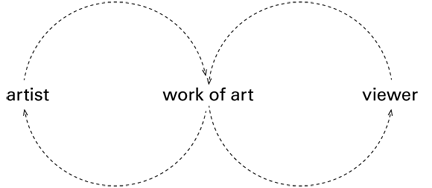
What social bond? I think the work of art mediates a relationship between the artist and viewer.

artist, work of art, viewer

As does Ranciere in regards to theater:

…the performance itself… stands as a “spectacle” between the idea of the artist and the feeling and interpretation of the spectator. This spectacle is a third thing, to which both parts can refer but which prevents any kind of “equal” or “undistorted” transmission. It is a mediation between them. That mediation of a third term is crucial in the process of intellectual emancipation. To prevent stultification there must be something between the master and the student. The same thing which links them must separate them….

So what does Ranciere propose?

We have not to turn spectators into actors. We have to acknowledge that any spectator already is an actor of his own story and that the actor also is the spectator of the same kind of story. We have not to turn the ignorant into learned persons, or, according to a mere scheme of overturn, make the student or the ignorant the master of his masters.

This, I think, is a central question in participatory art — when artists challenge their sole authorship, who is to say that viewers have anything invested?

Ranciére goes on:

Spectatorship is not the passivity has to be turned into activity. It is our normal situation. We learn and teach, we act and know as spectators who link what they see with what they have seen and told, done and dreamt. There is no privileged medium as there is no privileged starting point….

This is what emancipation means: the blurring of the opposition between they who look and they who act, they who are individuals and they who are members of a collective body….

An emancipated community is in fact a community of storytellers and translators….

This resonates with a lot of ideas in contemporary art: the end of the division between art and life, the skepticism that many contemporary artists feel about their privileged position of authorship, and the desire to create artworks that enact generosity, reciprocity and exchange.

Standard
Art & Development

on boredom and pleasure

In “Sex, Drugs and Chocolate: The Science of Happiness,” Paul Martin posits that the most notorious of historical hedonists were driven not by pain, but by an acute fear of boredom. This passage on boredom as a welcome antithesis for immense pleasure, then, is interesting:

Boredom isn’t just good for your brain. It’s good for your soul. “Bliss — a second-by-­second joy and gratitude at the gift of being alive, conscious — lies on the other side of crushing, crushing boredom,” Wallace wrote in a note left with the manuscript. “Pay close attention to the most tedious thing you can find (Tax Returns, Televised Golf) and, in waves, a boredom like you’ve never known will wash over you and just about kill you. Ride these out, and it’s like stepping from black and white into color. Like water after days in the desert. Instant bliss in every atom.”

Jennifer Schessler, “Our Boredom, Ourselves,” New York Times, January 21, 2010
Quotations in regard to David Foster Wallace’s “The Pale King,” (Little, Brown & Company, due out April 2011).

Standard