Artists

Mathieu Mercier

Stumbled upon the witty conceptual sculpture of Mathieu Mercier (B. 1970, France). I love the look and feel of it. To boot, he uses some of my favorite things: houseplants, lights, chandeliers, diamonds — yes!

Mathieu Mercier. Source: Spencer Brownstowne Gallery blog.

Mathieu Mercier. Source: Spencer Brownstowne Gallery blog.

Mathieu Mercier. acrylic on canvas, 60 inches diameter. Source: Spencer Brownstone Gallery.

Mathieu Mercier. acrylic on canvas, 60 inches diameter. Source: Spencer Brownstone Gallery.

Mathieu Mercier, Lampe double douille, 1999 | Hopf & Wortmann, Dna, 2006. Source: ioNoi.

Mathieu Mercier, Lampe double douille, 1999 | Hopf & Wortmann, Dna, 2006. Source: ioNoi.

Mathieu Mercier. Structure de mélaminé blanc pour plante, Loraine Bodewes Fotografie. Source: Observantonline.nl.

Mathieu Mercier. Structure de mélaminé blanc pour plante, Loraine Bodewes Fotografie. Source: Observantonline.nl.

Shelves to support leaves. Yes, that plinth looks like pegboard to me too. Brilliant!
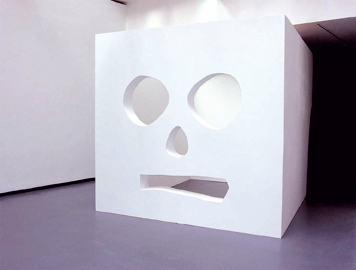
Mathieu Mercier. Des spectres et des automates, 2008. Source: le-dojo.org.
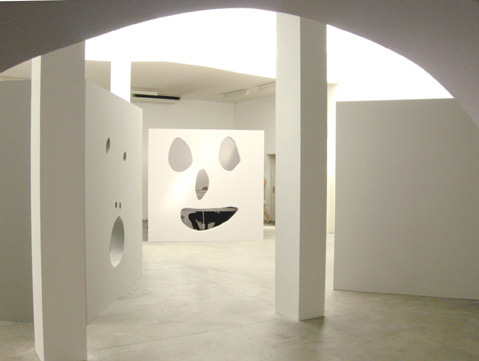
Mathieu Mercier. Des spectres et des automates, 2008. Source: le-dojo.org.

Matheiu Mercier. Le-Dojo.org.

Matheiu Mercier. Le-Dojo.org.


Also, here’s some very interesting work that challenges the identity of objects by Francisco da Mata (B. 1968, Portugal). View his website.
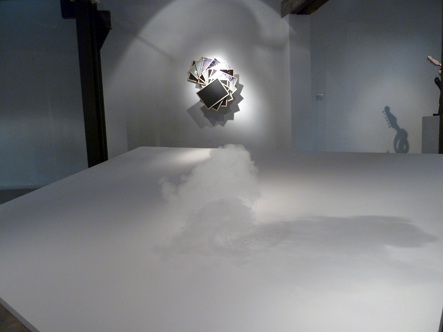
Francisco da Mata. installation view of the "First try to spell my name" show | 2010 | The Foundry, Shanghai. Source: Francisco-da-Mata.com

Francisco da Mata. installation view of the "First try to spell my name" show | 2010 | The Foundry, Shanghai. Source: Francisco-da-Mata.com
Standard

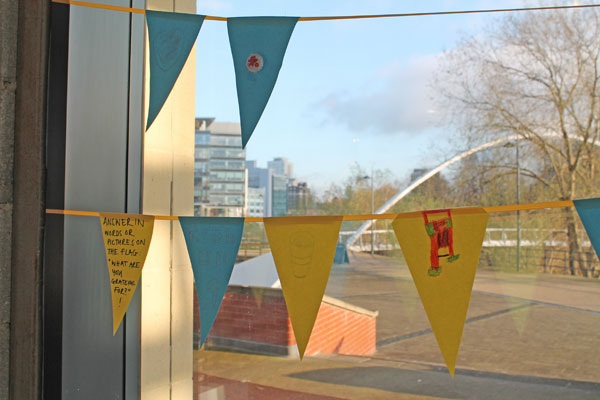
Thanks to Katie Rutherford, director of Untitled Gallery in Manchester, UK, I’ve got some photos of the participatory component of Give Thanks to share with you. The public was invited to make drawings on paper pennant flags in response to the question, “What are you grateful for?” I love the mix of children’s scribbles and grown-ups’ renderings.

Participatory component of the Give Thanks installation at Untitled Gallery at Project Space Leeds, Leeds, UK last month.

Participatory component of the Give Thanks installation at Untitled Gallery at Project Space Leeds, Leeds, UK last month.

Participants' gratitude pennants on display.

Detail with a subtle rendition of a cup (bottom row, center) and a drawing of the word, "ribbons."

Art & Development

Participants Give Thanks

Participatory component of the Give Thanks installation at Untitled Gallery at Project Space Leeds, Leeds, UK last month.

Participatory component of the Give Thanks installation at Untitled Gallery at Project Space Leeds, Leeds, UK last month.

Image
Art & Development

Further developments in professional development for artists

Very cool that there is yet one more resource for artists to tackle professional development. Presented by the eminently professional Creative Capital organization too!

PDP Launches Online Learning Program

Starting this month, the Professional Development Program (PDP) at Creative Capital will begin offering an ongoing series of seven new webinars for artists working in all disciplines nationwide.

To participate, all you need is access to a computer with speakers and an Internet connection (hard-wired preferred). There is no special software needed.

There are two great webinars taking place this month. Be sure to register soon because “seating” is limited!

Visual Arts Round Table: Critics, with Stephen Maine & Matthew Deleget
Monday, January 16, 7:00-8:30 EST
> Register

Real Life Budgeting, with Andrew Simonet
Monday, January 30, 7:00-8:30 EST
> Register

Participation Fee:
$25 per webinar

For a complete list of upcoming webinars and dates, visit PDP’s online Calendar.

Questions?
Please email Matthew Deleget, Online Learning Consultant, at matthew.

www.creative-capital.org.

Standard
Art & Development

2012: grow your intelligence

Psychology professor Rodolfo Mendoza-Denton shares a nice thought about the optimism and pessimism of learning to carry into the new year. (Via Greater Good Science Center)

A key aspect of the “grow your intelligence message” is the implications it has for the experience of difficulty. If one believes that abilities and intelligence are fixed or wired in us, then experiencing difficulty on a task can only mean one thing: that one must not have the correct wiring, genetic makeup, or inherent ability to succeed at that task. It’s very easy to come to this conclusion in the face of failure: I received a message from a student of mine the other day who apologized for not doing well on an exam, and she remarked, “I must not be cut out for this.”

However, if one believes that intelligence is malleable and can grow with practice, then the very psychological meaning of difficulty changes: It now suggests you are activating your intelligence, that you are flexing and practicing your skills. Difficulty is to ability like water is to a growing plant; as such, you become resilient in the face of trouble.

[Note to self: Practice making art. Experiencing art. Having patience. Being kinder. Enacting principles. Reaching goals. Taking risks. Embracing adventure. Being grateful.]

Standard
Art & Development

2011 highlights

mirrorsblackportraittake charge of your happinesshopexpectationsleah v jessicajane v dantryn v marycwy v cwycreativity flowpositive signs 1symbolic ecologycreativity csikszentmihalyipossibilitygive thanks

mirrorsblackportrait, Rush Gallery, NYC. Thanks Hank, Natasha and Charlotte.
hopexpectation
, take charge of your happinessJenkins Johnson Gallery, NYC & San Francisco. Thanks Karen, Teresa, Alyssa and Courtney.
Dialgoues, photographed in residence atWoodstock Byrdcliffe. Thanks Leah, Jessica, Jane, Dan, Tryn and Mary.
Positive Sign #1, 6, 31, 57, SFMOMA Open Space & Steven Wolf Fine Arts, San Francisco. Thanks Suzanne, Steven and Andrew.
Creativity, Mihaly Csikszentmihalyi, Untitled Gallery, Manchester, UK. Thanks Mike and Katie.
Give Thanks, Untitled Gallery / Project Space Leeds, Leeds, UK. Thanks to Katie Rutherford and all the contributors who shared their gratitude lists with me.
Thanks also to Courtney at SoEx; Sally at Chinese Arts Centre; Christian at Invisible Venue; Hannah and Scott at DXDX Studio; Brandon; Fawn at Catskill Arts; Aaron and Jackie at MacArthur B Arthur; and Ruth, Whitney, Lauren and Jeanne at Seton Hall.

studiodovetail joint

360º view, studio and woodshop class. Residency at Woodstock Byrdcliffe Guild, Woodstock, NY. Thanks Katherine, Paul and fellow AIRs!

IPPA

Advancing my research into positive psychology at the IPPA World Congress, thanks to the generous support of a Jerome Foundation Travel and Study Grant.

art practical,should i stay or should i goart practical temporary art review art competition odds

Art Practical features: “Should I Stay or Should I Go?” and “Portrait of an Artist, Wily and Engaged.” Thanks Patricia, Vicky, Stephanie, Mike, Woff, Pablo, Emma, Torreya, Amanda, Tattfoo and Lee.
Art Practical reviews: “Residency Projects II, “Under Destruction I & II,” “From New York: Curtain Call.” Thanks Matthew and Tess.
“Art Competitions: A Selective Comparison of Applicant Pools, Awards, and Odds.” Temporary Art Review & Rejected. Thanks Sarrita, James, Tattfoo and fellow data-gatherers.
Notes on Object-Viewer Relations.” SetToSignal.com. Thanks Pablo, Brent and Alicia.

T H A N K   Y O U
~ for your support and interest in my work;
~ for reading;
~ for participating in the art community;
~ for sharing your enthusiasm!

Let me know what your 2011 was like, and what you’re looking forward to in 2012!

Standard
Art & Development

Jonathan Haidt on the uses of adversity

In The Happiness Hypothesis (New York: Basic Books, 2006), psychology professor Jonathan Haidt explores the uses of adversity. His points seem to validate my issues with pundits’ declarations that the recession would be beneficial for artists (elaborated in “Portrait of an Artist, Wily and Engaged” on Art Practical). Haidt explains:

People need adversity, setbacks, and perhaps even trauma to reach the highest level of strength, fulfillment, and personal development

However, we oughtn’t

celebrate suffering, prescribe it for everyone, or minimize the moral imperative to reduce it where we can.

Based on numerous studies, Haidt concludes that some conditions for the uses of adversity can be inferred:

For adversity to be maximally beneficial, it should happen at the right time (young adulthood), to the right people (those with the social and psychological resources to rise to the challenges and find benefits) and to the right degree (not so severe as to cause PTSD).

To refine my position by way of paraphrasing Haidt, it’s inappropriate to celebrate the adversities that artists endure during recessions, especially considering the artists who lack the social and psychological resources, or find the adversities too severe, to continue practicing art.

Standard